Forgotten stories of queer Black Britain … Avanti West Coast Pride … Pope Francis

News

This Black History Month, Jason Okundaye is uncovering the forgotten stories of queer Black Britain

by Jason Okundaye (a London-based writer, and columnist at Tribune Magazine)

We know about the laws and riots. What about the spaces and intimate relationships communities carved out to survive?

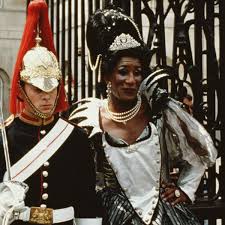
‘My vision of Black British queer history isn’t one that follows the template of how Black history is currently taught.’ A drag queen with a member of the Household Cavalry at Buckingham Palace in 1995.Photograph: Steve Eason / Getty Images

I’ve long respected the principle that, as a Black gay man in Britain, I owe the relative security and increasingly more tolerable environment that I enjoy to those who came before me. It’s just over 20 years ago that the footballer Justin Fashanu – who endured media storms and intrusions into his private life – killed himself. Now, the kind of explicitly homophobic and racist media vilification that Justin faced is unthinkable – even if, of course, homophobic and racist media still persist.

The idea of the past as host to revolutionary struggles that mapped out a better world for Black Britons is at the core of Black History Month, as well as major cultural events such as Notting Hill carnival. An American import, Black History Month was first celebrated in the UK in October 1987 thanks to the work of Akyaaba Addai-Sebo, who had been a special projects officer at the Greater London Council. In more recent years, Black Britons have accelerated our criticism of the outsized role the US plays in Britain’s Black History Month, with author Yomi Adegoke writing in 2017 that “calls for a British focus during October’s celebration are not new, but they are now louder than ever”.

But as a writer and researcher who focuses on Black British gay men, it sometimes feels as if this re-centring of Black Britishness doesn’t extend to my queer British forefathers. Instead, people and institutions tend to focus most on African American queer figures such as Marsha P Johnson, Stormé DeLarverie, or Bayard Rustin. There are multiple reasons for this. Particularly among white queer people, and usually in Pride month, conjuring received wisdom from African American queer figures, such as the often repeated but false statement “Don’t forget, Marsha P Johnson threw the first brick at Stonewall,” is a method for superficially engaging with Black queerness. The focus on singular and mythical brick-throwing moments allows Black queer figures to be presented as sacrificial lambs fighting in service of a broader queer movement, rather than people operating with the primary goals of self-organisation and self-preservation. Of course, the organising of Black queer and trans people such as Marsha should be honoured and taught, but it doesn’t hold much relevance to Black British queer history.

Another reason why these histories don’t tend to receive much coverage or specific engagement is because the story of Black Britain is often framed by legislation and policy changes, such as the first Race Relations Act in 1965, or moments of high drama, such as the 1981 Brixton riots. But what about the spaces, networks and intimate relationships that Black queer communities carved out for survival? As I set out to learn about the histories of Black British gay men, I discovered there’s been no legislation to reference and little by way of publicly recorded events to retrace. So, the best way forward has been to engage with a history from below, drawing on the knowledge of intimate networks.

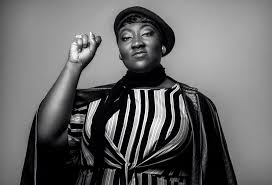
Lady Phyll

In Brixton, queer and trans Black British people found refuge in the late 1970s in a shebeen, an illegal bar, on Railton Road, which provided a space for socialising and cruising. Today, Railton Road and neighbouring Mayall Road are home to some of the most formidable Black British gay activists – whose organising around the Aids crisis, media homophobia and Section 28, among other issues, is too little known.

I only became aware of this rich community when I met one of my queer elders, Marc Thompson, whom I will call Uncle Marc because that is, of course, the respect he deserves. Uncle Marc, co-founder of PrEPster, an HIV prevention service, helped me with my undergraduate research on disparate HIV rates among Black British men who have sex with men. Since speaking with him and learning of his organising from the early days of the Aids crisis up until now, I’ve become aware of a wealth of Black British queer history that is under-studied and under-explored. There is much left to uncover – I want to learn, for example, about the short life of the Black Lesbian and Gay Centre in south London – how it came into being, and what Section 28 meant for its dependence on local government funding.

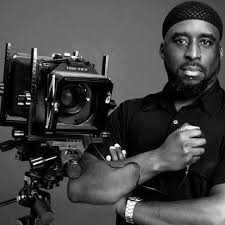
And what of the Black Pervert’s Network, a community safe space for experimental sex and play, run by Black queer artist Ajamu X? How did community safe spaces allow friendships and romances to flourish in an environment that was often hostile to Black queer life? As for Justin Fashanu, what’s often omitted from his story is the long, intensive campaigning and organising that Black queer activists engaged in to oppose the homophobic coverage of his coming out, while challenging the homophobia that plagued Black British media.

Uncovering the social histories of Black queer people requires going out and speaking with the community of elders who have lived, fought and loved through it. This is something I would task all Black people with – because understanding the intimate histories of our communities often relies on old-fashioned conversation and social knowledge, rather than on big policy changes or even what may be considered key moments in the history of race relations. After all, I wouldn’t define my own short personal history as a Black gay man by the passing of the 2010 Equality Act; I would define it through my networks, organising, friendships, romances and community. My vision of Black British queer history isn’t one that follows the template of how Black history is currently taught; it’s one I’m learning through coffees and Zoom calls with the giants whose shoulders I stand on.

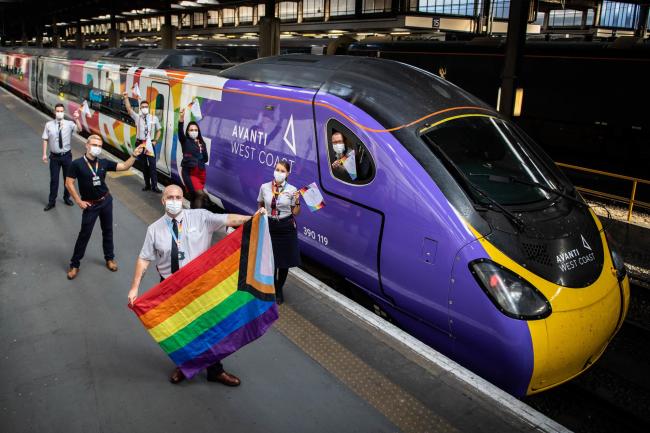
Recently, Avanti West Coast gave the world a glimpse of how they’re planning to Live Proud, including a train dressed head to toe in Pride colours. But, alas! It needed a name.

That’s why they asked us to find us a fitting title that would capture the heart and soul of Pride – what’s been achieved so far and how it can continue to make a difference long into the future. After receiving over 1500 amazing names and supporting stories, they’re delighted to have discovered a worthy winner.

The new name for this very special train is Progress.


Pope Francis

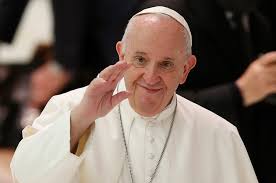
Pope Francis endorsed same-sex civil unions for the first time as pope while being interviewed for the feature-length documentary “Francesco,” which had its premiere at the Rome Film Festival last Wednesday.

“Homosexual people have the right to be in a family. They are children of God,” Francis said in one of his sit-down interviews for the film. “What we have to have is a civil union law; that way they are legally covered.”

UK’s first LGBTQ+ extra-care housing scheme … ALL FM Project … “Old Frame, New Picture” … Manchester Pride Listening Group for LGBT+ 55+

News

‘A game changer’. The UK’s first LGBTQ+ extra-care housing scheme gets go ahead

Accommodation in Manchester will support older LGBT+ people, whose loneliness has been exacerbated by the pandemic.

Bill Moss is the only gay person in his sheltered flats in Salford: ‘I do feel isolated. I could do with having LGBT+ neighbours to have a chat with.’ Photograph: Christopher Thomond / The Guardian

Bill Moss, a retired prison officer, felt isolated before Covid. As the only gay person in his block of sheltered flats in Salford, corona virus has heightened his sense of loneliness. Single, without any close family and cut off from an active social life in Manchester’s gay village, he spends most of the day with only the TV for company.

Bill, 57, has been through a pandemic before. Aids robbed him of the love of his life, Henry, and at least 50 friends. So he appreciates how serious this one is, but he cannot get that message across to his fellow residents congregating unmasked at the entrance of the flats and wandering corridors and lifts unprotected. Their lack of understanding underlines his feeling of being alone.

“It’s as if they do not think Covid affects them, but nobody is above this,” says Bill. “I do feel isolated. I could just do with having LGBT+ neighbours to have a chat with. It would allow me to be myself. There are things you don’t have to explain and things you can talk about that are impossible with straight listeners.”

After years of having to hide his sexual identity at work, Bill says now as a “proud, gay man”, it would just be easier to live in his old age supported by LGBT+ people and services.

He is not alone. A report and housing survey by the Manchester-based LGBT Foundation, reveals that 74% of responders want a home for their old age aimed at them and delivered by a LGBT-specific provider, but 43% had no idea where they would get care and support in the future.

For Bill and some of the other older members of Manchester’s 7,000-plus LGBT+ community, it could soon be a reality, with the imminent construction of the UK’s first extra-care housing scheme for LGBT+ people.

Manchester City Council has put out to tender a scheme to build an LGBT-affirmative extra-care scheme in Whalley Range, south Manchester. An 18-member LGBT+ steering group will help to develop the scheme. Just over half (51%) of the 150 places are to be allocated to LGBT+ people aged over 55, who need extra physical or mental support.

With two-thirds of care home staff surveyed by Manchester and Nottingham universities in 2014 saying they did not have a gay, lesbian, bisexual or trans resident, the scheme could not come soon enough.

“We know this cannot be true”, says Bev Craig, Manchester City Council’s member for adult health and wellbeing. “LGBT people have long been drawn to Manchester in the knowledge that the community here is strong and supported. However, we know that there is an issue with loneliness among older LGBT people in this city and a core reason for this is access to safe, affordable and secure housing.

As the number of older people in the city continues to grow, having a real understanding of what the community needs and wants from their extra-care housing will be vital.”

Mindy Meleyal, 69, from Wythenshawe, is a lesbian and has lived with her partner for 30 years. She sees the LGBT housing scheme as a “game changer” in a care system reluctant to acknowledge sexuality of any kind in older age.

“I’ve always thought I would rather die than go into a care home, but as you get older you need to feel secure. If I knew that the manager was LGBT affirmative, I would feel very differently,” she says.

An earlier survey by the LGBT Foundation on the impact of Covid on members of its community, revealed that many were alone, or with families who did not accept their identity. Almost two-thirds (64%) lacked support from an LGBT+ specific organisation, 42% wanted mental health support and 8% felt unsafe.

Stuart, 55, a gay trans man, who came out less than three years ago and recently moved to the city, lives alone and has fibromyalgia, which limits his activity. He says: “Because I never made friends in Manchester and all the contacts I have are from the LGBT Foundation, I have been very, very isolated during Covid. I know I will need care in the future so a place targeted at LGBT+ people would mean I would not feel the need to hide what I am”.

Manchester blazed an international trail for gay rights with the building of Europe’s first gay centre in 1986 and a thriving gay village. It is also the UK’s first age-friendly city region. The extra-care scheme has been in discussion since 2014. Cuts of more than £500m to the local authority’s budget over the last decade, threats to the government funding model for extra-care schemes and now the pandemic means it may be another three years before its doors open.

Similar schemes exist in Germany, Sweden and Spain. Bob Green, an LGBT Foundation consultant for the project, visited three projects in the US to learn from their experiences. In Minneapolis, he found that the complex was taken over by “straight people”. He believes that this was because of the inadequacy of the application and allocation system.

In Philadelphia, he was inspired by LGBT+ residents regarding the care facility as their first real “home”. The scheme he saw in Los Angeles was not exclusive to LGBT+ residents but welcomed other groups as the Manchester care home will too. “We do not want to cut ourselves off as a community,” Green says.

He is clear that any targeted care home needs to be part of a wider package of measures to benefit Greater Manchester’s growing elderly LGBT+ population. For this reason, the LGBT Foundation is piloting the UK’s first accreditation scheme for housing providers in the city. They will receive training and support to be able to prove they are aware and considerate of LGBT+ residents’ needs.

Lawrie Roberts, the manager of the Pride in Practice scheme, says: “We are building on our accreditation for primary care, which started off in Greater Manchester before expanding nationwide. Adapting it to adult social care and housing has huge potential.

It demonstrates to residents that these services are willing to do more to improve care for LGBT people and that staff have gained confidence and knowledge from undertaking the training we provide. We know from LGBT communities that they want something meaningful like this award to signify which are the trusted and most welcoming schemes locally to them.”

Bev Craig believes the new Manchester care home will also help to drive up standards across the country. “Only 150 people get the chance to live in this scheme. But it should lead to an improvement in provision across the UK,” she says.

As for the Whalley Range local community, April Manderson thinks the care home will be welcome. “I’m all for it,” enthuses the 56 year old, who is black. “I’d even be happy to live there myself in an environment that is multicultural, diverse and age-friendly.”


The project: ALL FM would like to broadcast 100 older Manchester people
ALL FM is a local community radio station serving south, central and east Manchester and based in the South Manchester suburb of Levenshulme.

Do you fancy being recorded and broadcast either as part of Out In The City or as an individual (over 50) project?

It could be anything from plugging something you’re doing – a project or voluntary work, sharing expertise or episodes of your life or work history, showcasing creative work, group discussions or interviewing someone.

Whatever it is, ALL FM want your voices on the radio.

The idea is to meet up with people in small groups, pairs or individually  – social distancing, or on zoom, to start a chat about what people might want to broadcast. This could be in a safe community venue or outside in a park, or in a café … all as flexible as possible to make sure everyone feels safe.

Then we’d plan it together, record it and in the next few months broadcast it along with up to a 100 other people’s voices, with their music choices added. Our ultimate aim, once we can all move more freely, all those 100 will be invited to join ALL FM, do radio training and have their own live show.

Recording and broadcasting Manchester’s older people is top of the agenda for ALL FM.

We would love it if the airwaves were full of our voices.

If you want to be involved please contact us.


Old Frame New Picture: how older people are represented in the media and what we can do about it

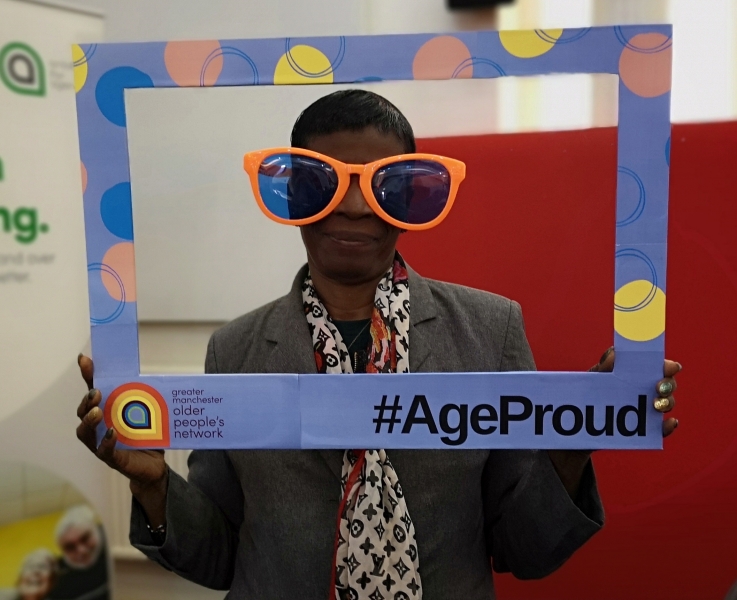
The Greater Manchester Older People’s Network have recently launched the “Old Frame, New Picture” photography competition to gather positive and diverse images of older people.

You are invited to attend an event designed to examine the issue of negative and stereotypical representations of older people in the media.

Wednesday, 28 October 2020, 10.00am – 12.00pm

To register, please use the link to Eventbrite below:

https://www.eventbrite.co.uk/e/old-frame-new-picture-how-older-people-are-represented-in-the-media-tickets-125453353357

Have you seen one too many photos of wrinkly hands or other dehumanising pictures of people over 50 in adverts and news articles?

This online event is an opportunity to examine and challenge how older people are portrayed in the media with negative and stereotypical images of vulnerability and fragility. How can we challenge this narrative with one that celebrates the diversity of older people’s lives and their contributions to society?

This event will include presentations and provocations from a range of speakers who will draw on professional and personal insights to explore why we represent older people in this way and how this has been compounded by Covid-19. This will be followed by a broader discussion on ageing, media and representation where attendees will have the chance to also share views, ideas and ways in which we can change the picture in the frame.

The speakers include:

Alex Rotas, leading photographer who specialises in challenging ageing stereotypes through photography

Thomas Scharf, Professor of Social Gerontology in the Population Health Services Institute at Newcastle University

Pauline Smith from the Greater Manchester Older People’s Network

Sabrina Fuller, 2020 bOlder artist

Heather Bell, emerging photographer

More info via https://manchestercommunitycentral.org/old-frame-new-picture


Manchester Pride: LGBTQ+ 55+ Listening Group

Wednesday, 4 November 2020, 2.00pm – 4.00pm

The Listening Group will be a structured, but informal, conversation about the ways in which Manchester Pride can better support you and your community in the future.

The session is a chance for you to have your say and help to shape Manchester Pride’s activities in the future.

The session will be held via zoom and you will be able to attend using full video and audio, either video or audio or just using the chat function if you would prefer.

Any questions? Contact engagement@manchesterpride.com or 0161 831 7700.

Quinn: Canada’s transgender footballer … National Coming Out Day: People from sport share stories

News

Quinn: Canada’s transgender footballer on being ‘visible’ and playing at the Olympics

Throughout this article Quinn is referred to as they / their to respect their wishes around use of pronouns. Quinn has also dispensed with what they call their “dead” former first name.

“When I was figuring out who I was, it was really scary and I didn’t really understand if I had a future in football, if I had a future in life.”
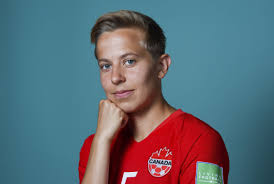
Quinn doesn’t like living in the spotlight. Yet as a professional athlete, it often comes with the territory.

But little provides a greater platform than sport, and despite being a self-proclaimed introvert, Quinn recognised the power of using that platform and of “being visible”.

And so, in September 2020, Quinn, a defender for Canada’s women’s football team, publicly came out as transgender.

“It’s really difficult when you don’t see people like yourself in the media or even around you or in your profession. I was operating in the space of being a professional footballer and I wasn’t seeing people like me,” Quinn said.

Quinn, who has five goals and 59 caps for Canada, won Olympic bronze at Rio 2016 and played at the 2019 World Cup.

The 25-year-old remains eligible to compete in women’s sport despite identifying as transgender because gender identity differs from a person’s sex – their physical biology.

Most people, unless they’re non-binary, have a gender identity of male or female.

Quinn was assigned female at birth but after many years of questioning themselves, realised their own gender identity did not match their sex.

In an interview with BBC Sport, Quinn tells how there are still “spaces of ignorance” in women’s football, their Olympic ambitions, and their concern as sporting governing bodies start to weigh up transgender policies.

‘More learning to be done’ in women’s football

On coming out as transgender in an Instagram post in September 2020, it marked the end of Quinn living “essentially two different lives”.
“I really didn’t like feeling like I had a disconnect between different parts of my life, being a public figure, and so I wanted to live authentically,” they say.

“I think being visible is huge and it’s something that helped me when I was trying to figure out my identity.

I wanted to pass that along and then hopefully other people will come out as well if they feel safe to do so and I can create a safer space for them.”

Quinn had their first interactions with transgender people at college and it was at that point, they say, that they “really understood that was who I was”.

“I couldn’t verbalise what I was feeling before and I didn’t have the right language to articulate how I was feeling before that.

We live in a world that is so binary and I have been receiving messages ever since I was a young child about how I should act, how I should portray myself and how I should be and anything that deviated from that was essentially wrong.

I wanted to live my authentic self, dress the way I wanted to, present the way I wanted to, and that wasn’t always seen as positive, so that was really hard to digest.”

Those in Quinn’s personal circle have known their identity for some time, and the reaction from Canada team-mates, who they told in an email, was “overwhelmingly positive”.

For “the most part”, women’s football is a supportive space, adds Quinn – who is currently on loan at Swedish club Vittsjo GIK from the American National Women’s Soccer League (NWSL) side OL Reign – but there are still “spaces of ignorance”.

“It’s been a really long ride with [Canada team-mates] and they are people who I consider some of my best friends,” Quinn says. “A lot of those players have been my concrete supports going through this process.

I think when looking at the larger realm of women’s football there still are spaces of ignorance and there is a little bit of push back, so those are definitely opinions that I want to see change over a period of time and to create a completely safe space for me, because quite honestly I don’t think sport is there yet and women’s football is there yet.”
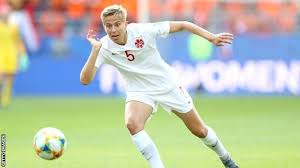
Despite their team-mates’ acceptance and support, Quinn admits there is “still a lot of learning to be done”.

“I’m really open for my team-mates wanting to talk to me,” Quinn says. “I wasn’t taught throughout the course of my life what it meant to be trans, all the language around it. I think that’s something that’s new for a lot of people.

Once I started living more authentically in my life, whether that’s just how I present myself or coming out to them as trans, I think they’ve all said to me it’s really incredible to see me just live my authentic self and how I’ve exuded a different level of confidence, and how it just fits with who I am as a person.”

Being ‘openly trans’ at an Olympics

Quinn hopes to take their visibility as a transgender athlete to sport’s greatest level by playing at next year’s rearranged Olympics in Tokyo, something which would make them “incredibly proud”.
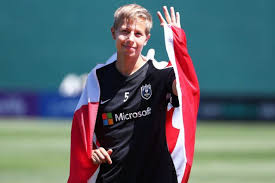
“That was one of the reasons why I came out publicly, it’s because I want to be visible and I think the Olympics is a massive platform to have that visibility,” Quinn adds.

“It’s my hope that I might be the first and that’s really exciting, but it’s also my hope that there are other people following in my footsteps and so I hope that it opens the door to other trans athletes being represented at the Olympics.”

Since 2004, transgender athletes have been allowed to compete at the Olympics.

Those who have transitioned from female to male are allowed to do so without restriction. However, current International Olympic Committee guidelines, issued in November 2015, state that transgender women (those who have transitioned from male to female) must suppress testosterone levels for at least 12 months before competition.

And specifically in athletics, the Court of Arbitration for Sport’s most recent ruling permitted the restriction of testosterone levels in female runners to protect “the integrity of female athletics” – but raised concerns about how those rules would be applied.

Explicit IOC guidelines do not exist for non-binary athletes – those whose gender identity falls outside the categories of man or woman.

The IOC says it is trying to strike the right balance of fair and equal competition, while not excluding trans athletes from the opportunity to participate.

These rules will be in place for Tokyo 2020 but a consultation process is ongoing.

Critics of the IOC’s current position argue people born biologically male who transition after puberty retain a physical advantage over their competitors, with former Olympic swimmer Sharron Davies saying women’s sport should not be used as a “live experiment” on the issue of transgender athletes.

Quinn’s announcement also comes at a time when various governing bodies are weighing up their own policies towards transgender athlete participation, with World Rugby proposing to ban trans women from contact rugby.

“I think it is really concerning,” Quinn says.

“I think that we need to focus on why we’re in sports in the first place and the celebration of the excellence of our bodies.”

I’m just another person doing the thing that I love to do and I get the privilege do that every day on the pitch.”


National Coming Out Day: People from sport share stories
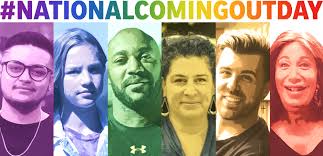
In sport, as in life, the decision of when to come out is a deeply personal one.

People may choose to be out to some, but not to others – or, for any number of reasons, not come out at all.

It’s a decision that takes courage and strength, which causes reactions you can’t always predict, and there’s nothing wrong in deciding you’re not ready or able to do it.

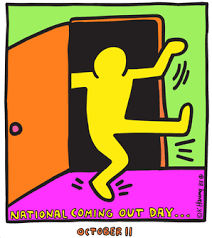
As part of National Coming Out Day (11 October), people from across the world of sport have shared their stories, and there’s no doubt that they feel happier, stronger and more confident as a result of being open and honest about who they are.

‘I wasn’t going to hide who I am any more’

Liz Carmouche made UFC history in 2013 when she took on Ronda Rousey in the first women’s fight.

She was also the first out lesbian to compete for the organisation, and wore a rainbow mouthpiece to the octagon for her bout with Rousey at UFC 157.

But reaching a point where she felt comfortable doing that was a journey in itself.

Before her mixed martial arts career, Liz served in the US Marine Corps at a time LGBT people would be discharged for talking openly about their sexuality, under a policy known as “don’t ask, don’t tell”.

“I was 22 when I came out, and by ‘came out’ I mean come to the realisation of what my sexuality was,” says Liz.

“That was while I was in the Marine Corps, so I had to hide it for four years. I was worried that I was going to be outed and kicked out, so I was constantly looking over my back. I wasn’t going to hide who I am any more.”

Liz admits concealing her sexuality took a toll on her mental health, and she was scared she might face violence from some of the people she served with if they found out she was gay.

“That was such a difficult, trying and depressing time – and that wasn’t going to be something that I was going to go through again when I left the Marine Corps,” she says.

“I certainly don’t want to throw it anyone’s face, but I’m not going to hide away in the dark and deny who I am. Wearing my rainbow mouthpiece was a reminder of what I’d overcome to be where I was at, and a reminder that I could do anything.”

‘He was sorry I’d had to go through it on my own’

Like Liz Carmouche, rugby league player Keegan Hirst took a long time to accept his sexuality.

“With the benefit of hindsight, I probably realised I was gay when I was 14 or 15,” he says.

“But the only gay people I knew were George Michael and Elton John, and I wasn’t like them so I figured I couldn’t be gay – or that’s what I told myself.”
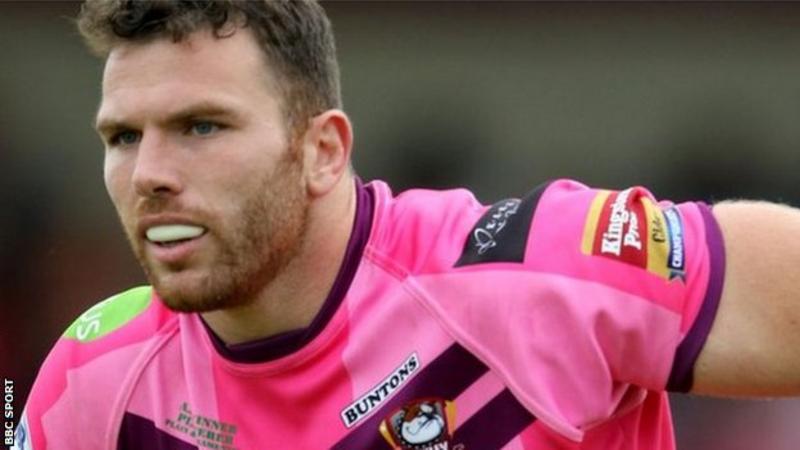
Keegan, by his own admission, became very good at hiding it.

He got married and had children and it was only when the stress of maintaining his double life became too much that he decided to open up to his then wife about his sexuality.

“I think it became unbearable for her to live with me,” says Keegan.

After telling her and the rest of his family, Keegan had to come out to his team-mates at Batley Bulldogs.

“I was dreading telling the lads, but after telling my family, that was the easiest bit,” he says.

“A couple of my closest team-mates had come round to my house after one game and we’d had a couple of beers.

“I’d been venturing into Leeds and gone to a couple of gay bars, so there must have been some rumours flying round.

“And one of the lads said: ‘What about these rumours? Are you gay? Is it true?'”

Keegan says he can still remember that moment, and the split-second calculation he made as he tried to decide whether this was the right time to tell them.

“It seemed to last for ages in my head, and I said: ‘Yeah, it’s true.’ And when I said that, one of the lads said that he’d always known – and, to be fair, he’d always made jokes about it, so maybe he had. One of the lads cried and he was a big tough guy. He was crying because he was sorry I’d had to go through it on my own and he couldn’t be there to help me.

And they asked me what they should do if any of the lads asked them? And I said it wasn’t a secret any more, so tell them.”

‘I told him I felt like I needed a hug’

One of the reasons Keegan Hirst struggled with his sexuality in the way he did was the fact that, for a long time, LGBTQ+ people seemed to be either unwelcome or largely invisible in the sporting world.

Initiatives such as Stonewall’s Rainbow Laces campaign have helped bring about change and ice hockey’s first Pride weekend in the UK this year inspired one player to tell his story.

“I’d known for nine or 10 years, but I wasn’t willing to accept it to myself,” says Zach Sullivan of Manchester Storm.

“But in November, I’d had a really bad game and I messaged my best friend in Glasgow and said: ‘I need to tell you something. I like men and women.’

“And he was like: ‘Yeah, I know.’ And I was like: ‘Oh, OK!'”

Zach admits he was scared that opening up about his sexuality could cost him some of the relationships he had built over the years.

But the positive reaction from his friends and family persuaded him to share his story more widely, through a social media post timed to coincide with the start of the Pride weekend.

“I just remember coming to my room-mate after I put the message out,” Zach recalls.

“He asked me how I felt, and I told him I felt like I needed a hug. I don’t like the spotlight and I didn’t know the reaction would be as positive as it has been. It’s the first time in my life that I’m carrying a message (about inclusion) that I’m passionate about – so if I have to come out of my comfort zone to do that, I’m happy to.”

‘Eddie Howe asked what he could do to make things easier for me’

Coming out stories tend to focus on the lesbian, gay and bisexual community – but if you’re coming out as transgender, there’s an added layer of complexity.

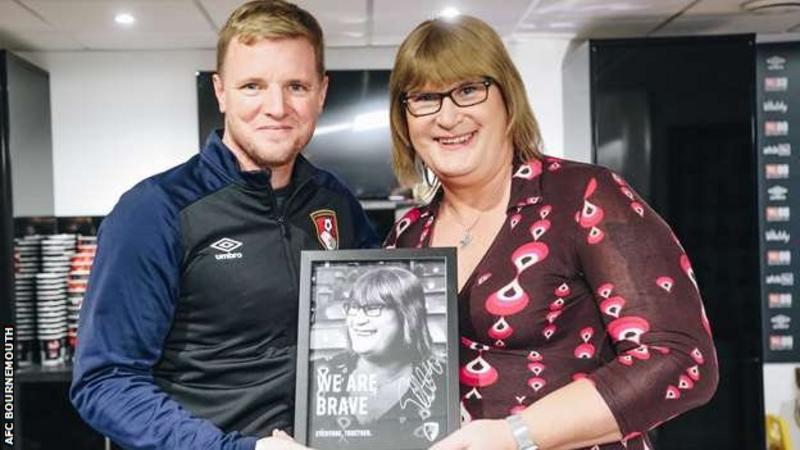
“When you’re lesbian, gay or bisexual, you’re basically just telling people who you’re attracted to,” says Sophie Cook, the former club photographer at AFC Bournemouth.

“But when you’re trans, you feel that you’ve finally got to the place where you need to be, and you tell people who can then end up struggling with it and almost mourning for the person they knew and loved before.”

It’s never a simple process – but in Cook’s case, coming out was made easier by the reaction of the people around her.

“My last game as Steve was the match where we got promoted as champions,” she remembers.

“That summer I knew that I was trans, so I told the commercial manager and we all ended up meeting in the owner’s box overlooking the pitch. It’s me, the chairman and then manager Eddie Howe – who asks me what he could do to make things easier for me. And when you come out, not everyone understands right away, so if your boss can say something like that, it’s really all you can hope for.”

Once she’d come out to the management team, Sophie had to tell the players.

“I needed to meet them before a match day, because the first time I met them as Sophie couldn’t be as they were running down the tunnel,” she recalls.

“So they called the players together and the assistant manager said: ‘I suppose you’ve noticed our photographer has changed a bit since last season. I’d like you to meet Sophie.’ Our captain, Tommy Elphick, started clapping and the rest of the players joined in. And then Tommy said: ‘Right, let’s go and train.’ I was like: ‘Is that it?!'”

‘It just makes being LGBT feel everyday’

Perhaps no-one sums up the importance of coming out better than BBC Sport presenter Clare Balding.

“I realise the value of just being really comfortable and proud and happy,” she says.

“You don’t have to make grandiose statements; you don’t have to kiss in public. You just get on with it and that’s massively helpful to people because it just makes being LGBT feel everyday.”
New Covid-19 Restrictions for Manchester … Kissing Cowboys & Cowgirls … Hate Crime Awareness Week

News

New Covid-19 restrictions for Manchester operate from Wednesday, 14 October, and will be reviewed every 14 days.

Gathering indoors with someone you don’t live with is not allowed except in special circumstances (eg a support bubble).

So until we move into the Medium alert level (Tier 1) Out In The City is not able to meet.

You can view full details about the changes for high risk areas here


Kissing cowboys & cowgirls: the queer rodeo stars bucking a macho American tradition

‘I had no idea this existed’ … a portrait from National Anthem. Photograph: Luke Gilford

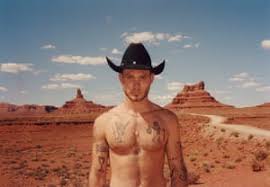
Photographer Luke Gilford couldn’t believe his eyes when he first stumbled across a gay rodeo. He set out to capture the joyous, tender, authentic world he saw there.

Luke Gilford was at a Pride event in northern California in 2016 when he was drawn to a stand by the sound of Dolly Parton singing 9 to 5. What he found there would change his life. Members of the local chapter of the Golden State Gay Rodeo Association were promoting what they do, and how they live. Gilford looked on in astonishment. “I grew up around this world,” he says. “I had no idea this existed. I really didn’t think it was real.”

A sought-after film-maker and photographer, Gilford cuts a striking figure. A New York Times profile that same year recounted how you could often catch a glimpse of him downtown, in a hand-me-down cowboy hat, football-style shoulder pads over his bare torso.

The headwear belonged to his father, a rodeo champion and subsequent judge in the Professional Rodeo Cowboys Association. Gilford was born in Colorado, and grew up watching his dad ride in snakeskin boots, a giant silver buckle gleaming at his waist. He gradually realised that he didn’t fit into this world, though. “The mainstream rodeo world is, you know, obviously, very homophobic and conservative. There’s so much machismo. It’s racist.”

‘We all know what a rodeo is and we all know what queer is. We don’t think of them as going together. Photograph: Luke Gilford

So this chance encounter with a bunch of people who’d managed to do what seemed impossible to him was as exciting as it was discombobulating. “We all know what a rodeo is,” he says, “and we all know what queer is. We don’t think of them going together”. He set about exploring how they might.

The result is National Anthem, Gilford’s first photographic monograph – and, to his mind, a timely musing on the state of America. “We’re taught in school to recite the national anthem every morning. It has this aura of promise. But as we grow older, we realise this promise is kind of a myth. What I think is really beautiful, and so inspiring, about the queer rodeo community is that it brings back that aura of promise. It embraces both ends of the American cultural spectrum: people living on the land, but who are also queer.

“To begin with, it was very personal, a way to reconnect with a side of myself I had suppressed. But I started the project around the time Trump was elected. So it has felt really urgent to work on a wider scale beyond that personal level, to focus on what we all should be talking about and working towards.”

‘We’re all from places that are still hostile to queerness.’ Photograph: Luke Gilford

The first gay rodeo happened in the mid-1970s, as one of the more creative fundraisers by the Imperial Court System. This pioneering LGBT non-profit, now the second-largest in the US, uses charitable fundraising to build ties with communities. It is still run entirely by volunteers, on whom fanciful titles are bestowed. In 1975, Phil Ragsdale, then Emperor I of Reno, threw a benefit for a senior citizens Thanksgiving dinner. More than 100 people took part in this gay rodeo, as well as five cows, 10 calves, one pig and a Shetland pony. A King, a Queen and a Miss Dusty Spurs (the drag queen category) were crowned, and history was made.

Today, the International Gay Rodeo Association (IGRA) has 15 member groups across the US, with one more in the Canadian Rockies. After meeting the Californian chapter, Gilford began saving up, planning to hit the circuit. “I was living in New York at the time. So I would fly to the south-west, rent a truck then travel around – to New Mexico, Utah, Colorado.”

The project is mostly portraiture, often close-up, with some shots against the backdrop of those fabled big skies and endless expanses. And Gilford was no outsider looking in: he clearly saw himself in the people he met. “We’re all from places that are still hostile to queerness.”

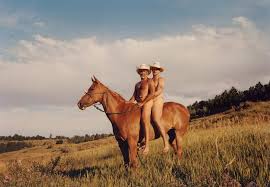
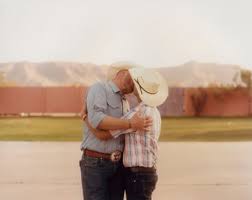
There is a lot of skin: shirtless torsos, a man shot from behind wearing little more than tasselled green chaps, a naked couple on a horse. But it isn’t erotica. In one particularly tender shot, a man in jeans and blue plaid rests his hand on his partner’s back, underneath the latter’s pale checkered shirt. “How often do you see something like that?” says Gilford. “Gay cowboys have long been fetishised in pornography, as in art, but this was completely authentic. It’s a real community. These are real lovers.”

Creating the pictures was a way for him to listen to people’s stories, to see their scars, to discover their beauty and contentment. “Usually when we hear about rural queerness it’s in a negative way,” he says. “It’s like something bad has happened – it’s the Matthew Shepard story. We don’t have examples, really, in pop culture of people who are queer and living real lives and living their best life.”

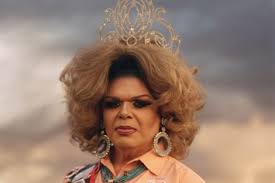
Queer rodeo royalty … Priscilla Toya Bouvier. Photograph: Luke Gilford

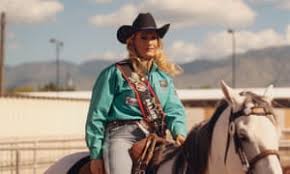
This certainly seems to apply to Priscilla Toya Bouvier – AKA Paul Vigil, AKA Miss IGRA 2019, AKA queer rodeo royalty – who frowns at the camera with thick, black lashes in a peach button down and turquoise beads, diamante crown catching the light of a low sun, sash festooned with as many buttons and badges as a piece of fabric can be.

Lee is one of several portraits of people of colour, whose presence defies the commonly held misconception that rodeo – and by extension rural America – is exclusively white. It brings to mind the Compton Cowboys and other Black horsemen and women who rode through Houston and Oakland in a recent Black Lives Matter protest. Gilford points out that the queer rodeo is welcoming to anyone on the LGBTQIA+ spectrum and beyond. “If you are black or brown or Asian and you do not feel safe in the mainstream rodeo spaces, you’re welcome at the queer rodeo, even if you’re not queer.”

He prizes this openness and doesn’t find it particularly common. “I’ve never totally identified with urban queer culture, which is about celebrating this escape, perhaps, from rural places. It’s about partying, consumerism, capitalism.” The queer rodeo world struck a different chord. “It is so much more about a connection to the land, to animals, to community.”

Gilford is best known for music videos and fashion spreads featuring glitzy showbiz high fliers: Lizzo, David Lynch, Christina Aguilera, as well as Fonda and Anderson. He doesn’t see this new work as a departure, though, given how full of spectacle and heightened emotion rodeo is. But he does think queer rodeo has a different energy to its straight counterpart. “Mainstream rodeo is so much more about danger and violence,” he says. “Here, it’s still a celebration, but one of love and care. Because these are people who have survived a certain kind of trauma and are now here to re-enact this traditional western performance, which is also a form of drag.”

‘Mainstream rodeo is so much more about danger and violence.’ Photograph: Luke Gilford

The book opens with a quote by Black writer and trans rights activist Janet Mock about family as community, “a space where you don’t have to shrink yourself”. A couple of pages later, Gilford riffs on this notion, saying that “one of the great powers of the queer rodeo is its ability to disrupt America’s tribal dichotomies that cannot contain who we really are – liberal versus conservative, urban versus rural, ‘coastal elite’ versus ‘middle America’”.

National Anthem has also helped him to accept who he really is, a queer child of rural south-west America, a fact that lends his project greater poignancy. It’s a homecoming of sorts, a return to the land, a metaphor, a dream. “It’s the future,” he says, “the America we all dream of, being able to be whatever we want to be.”
  • National Anthem was published on 1 October

‘The rodeo is a spectacle oozing with displays of power and vulnerability’ Photograph: Luke Gilford

Luke discovered the International Gay Rodeo Association (IGRA), and began to see himself as part of a rodeo family. “It was a revelation,” says Gilford. “I had no idea that this kind of thing existed. It was like, ‘Oh, wow, you can accept this part of yourself’.”

National Hate Crime Awareness Week

Background

National Hate Crime Awareness Week runs from 10 to 17 October 2020. The awareness week is an opportunity to bring people together, highlight Greater Manchester’s zero tolerance to hate crime and encourage both victims and witnesses to take a stand and report hate crime.

No one should face hate, violence or abuse because of who they are, who they love, where they’re from, what they look like or what they believe.

Hate crime takes many forms, from violence because of your sexuality to verbal abuse online because of your ethnicity. No form of hate is acceptable.

If you’ve been a victim or a witness, report it to @gmpolice or visit http://www.letsendhatecrime.com

Greater Manchester stands together for Hate Crime Awareness Week. Hate crime will not be tolerated here. Last year, 488 people were prosecuted for hate crime.

Everyone has the right to feel safe and we all have a responsibility to stand against hatred and discrimination.

Manchester Community Safety Partnership has ten £1,000 grants available to voluntary, community, social enterprise and public sector groups. These aim to raise awareness of what hate crime is and to increase the reporting of hate crime incidents.

Projects must be delivered during Manchester’s Hate Crime Awareness Week (1 – 7 February 2021).

If you have any suggestions what Out In The City could do, please let me know here.

Polari Book Prize … Never before published images of men in love (1850 – 1950) … Mind Yer ‘Ed … Understanding The Fight Over Trans Rights

News

Polari Book Award

The UK’s only award to celebrate LGBTQ+ literature, Polari, marks its 10th birthday in 2020.

In this special anniversary year, the founder – author Paul Burston – praised the exceptional writing talent, diverse styles and subject matter on show in this year’s shortlists.

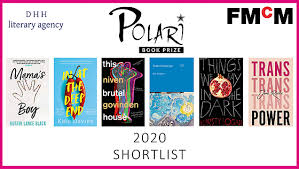
A visionary exploration of trans identity, a re-interpretation of the gothic novel and a graphic guide to LGBTQ+ cultural history all feature on the shortlists for this year’s Polari Prize and Polari First Book Prize.

The winning books from both shortlists will be announced at 5.00pm on Thursday, 15 October on YouTube. Tune in to The Polari Prize 2020.

​The Polari First Book Prize 2020 shortlist are:

Queer Intentions: A Personal Journey through LGBTQ+ Culture by Amelia Abraham (Picador)

Life As A Unicorn – A Journey From Shame to Pride and Everything In Between by Amrou Al-Kadhi (Fourth Estate)

Tell Me I’m Forgiven: The Story of Forgotten Stars Gwen Farrar and Norah Blaney by
Alison Child (Tollington)

The Confessions of Frannie Langton by Sara Collins (Penguin)

Sensible Footwear: A Girl’s Guide – a graphic guide to lesbian and queer history 1950 – 2020 by Kate Charlesworth (Myriad Editions)

The Private Joys of Nnenna Maloney by Okechukwu Nzelu (Dialogue Books)

The Polari Prize 2020 shortlisted books are:

Mama’s Boy: A Story from Our Americas by Dustin Lance Black (John Murray)

In At The Deep End by Kate Davies (The Borough Press)

This Brutal House by Niven Govinden (Dialogue Books)

Blue Wallpaper by Robert Hamberger (Waterloo Press)

Things We Say in the Dark by Kirsty Logan (Harvill Secker)

Trans Power: Own Your Gender by Juno Roche (Jessica Kingsley Publishers)

The official website of the award-winning LGBTQ+ literary salon is: https://www.polarisalon.com/


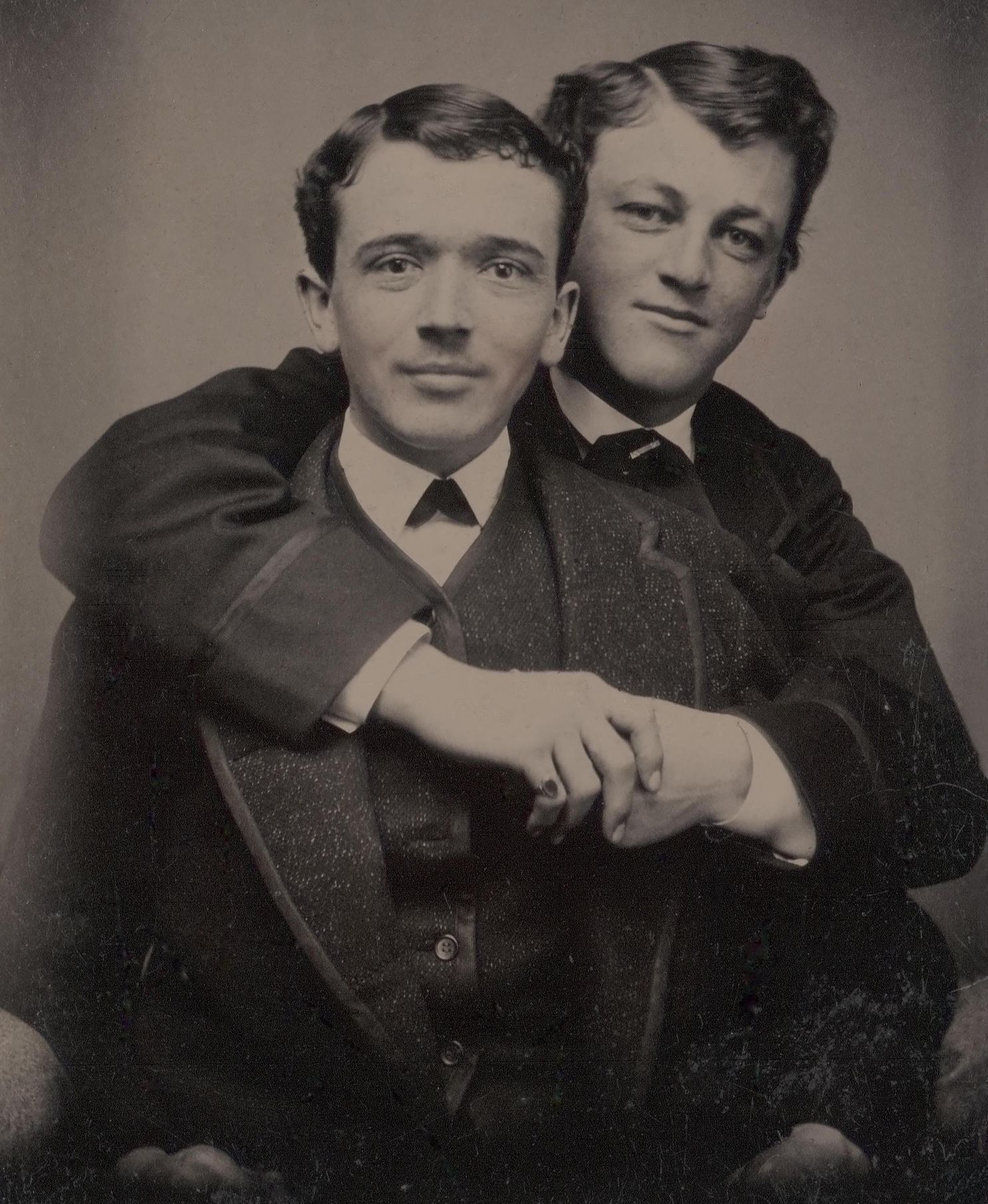
Never before published images of men in love between 1850 and 1950

Hugh Nini and Neal Treadwell’s journey began in an antiques shop in Dallas when they discovered a photograph of two men, unmistakably in love.

Nini and Treadwell saw themselves in the two men in the photograph and were filled with so many questions about who they were. Neither of them expected that this photograph would become the first of a 2,800-image collection and that they would publish their own book, “LOVING — A Photographic History of Men in Love 1850s-1950s.”

Nini and Treadwell would come to refer to this book as their “accidental collection.” Each year, as they travelled Europe, Canada and the United States, they combed through boxes of photos at flea markets and in antiques shops to find more photos of men in love. In the beginning, the collection was composed only of found photographs that they felt spoke to them. Eventually, they began to pursue them actively online, in estate sales and in family archives.

Nini and Treadwell wrote this about finding their first photo:

“Our collection began twenty years ago when we came across an old photo that we thought was one of a kind. The subjects in this vintage photo were two young men, embracing and gazing at one another — clearly in love. We looked at that photo, and it seemed to look back at us. And in that singular moment, it reflected us back to ourselves. These two young men, in front of a house, were embracing and looking at one another in a way that only two people in love would do. Dating sometime around 1920, the young men were dressed unremarkably; the setting was suburban and out in the open. The open expression of the love that they shared also revealed a moment of determination.

Taking such a photo, during a time when they would have been less understood than they would be today, was not without risk. We were intrigued that a photo like this could have survived into the twenty-first century. Who were they? And how did their snapshot end up at an antique shop in Dallas, Texas, bundled together with a stash of otherwise ordinary vintage photos?”

The two found their second photo through an online auction. It was tiny, the size of a thumbnail, and portrayed two young soldiers circa 1940. The gaze between the men was just like the one they saw in the first photograph they found. The words “Yours always” were etched in the small glass art deco frame around the photograph.

The earliest image in their collection dates to 1850, and the collection spans 100 years, including images from the Civil War and World War II. They come from all over the world and aren’t all traditional photographs — some are daguerreotypes, glass negatives, tintypes, cabinet cards, photo postcards and even photo strips.

Determining whether the men in the photographs were in love was not always easy, especially when acceptable displays of affection between men have changed so much through the years. Nini and Treadwell share in the book how they made the determination:

“When deciding whether or not to acquire a photo or snapshot, we have a rule that we follow. We call it the 50/50 rule: we have to believe that it’s at least 50% likely that we’re looking at two men who are romantically involved. There are few 50/50 images in our collection and none in our book. What determines whether or not we’ll acquire a photo can sometimes be an embrace that leaves no doubt that the relationship exceeds friendship or fondness. When possible, though, there is one sure way to determine if a photo is “loving.” We look into their eyes. There is an unmistakable look that two people have when they are in love. You can’t manufacture it. And if you’re experiencing it, you can’t hide it.

Finding these photographs is a rescue mission for Nini and Treadwell, and they see themselves as stewards of the once lost images. They haven’t shared their collection with anyone until now, mostly because they didn’t think anyone would want to see it. To their surprise, the response has been overwhelmingly positive and often emotional.

The images have resonated with all ages, genders, and orientations, political or otherwise. Nini and Treadwell continue to collect images and hope to see their collection in a travelling exhibit or museum. They are considering a second volume that would include the hundreds of the military images they have acquired.

Reflecting on their collection in the book, Nini and Treadwell wrote, “Until this collection, we thought that the notion of us as a loving couple was ‘new.’ What we have learned from our collection is that we’re not new. We, and other couples like us, both male and female, are a continuation of a long line of loving couples who have probably existed since the beginning of time.”

“One of our earliest photos is a male couple making marital vows to one another. We have others that were taken later in the twentieth century. There is a playful, perhaps theatrical, spirit in this photo. Had it been discovered during the lives of its subjects they could have plausibly claimed to have been joking around. For us, however, there are too many points of sincerity: the deliberate placing of a ring on the other’s wedding finger, the ‘I declare’ posture of the officiate, the expressions of the two grooms, and finally, and most telling, posing under an umbrella. Our collection tells us that beginning sometime in the mid 1800s, and continuing into the 1920s, two men posing under an umbrella together was an outward declaration of love between the two men.”

Photos: Courtesy of the Nini-Treadwell Collection copyright “Loving” by 5 Continents Editions)


Age UK’s Content Team are working with the NHS on a project to help older people talk openly about their mental health – with loved ones and their GP. The Team would love to hear from older people from minority backgrounds (especially people of colour) about how lockdown has affected their mental health, how they’ve been feeling through lockdown and what they’ve found more difficult. The film will be used across Age UK’s social media channels and website to help strike up conversations about mental health.

What would they need to do?

We’re asking those who want to get involved to produce a short video (no longer than a minute) answering the question: “How has lockdown affected your mental health?”

They can just film it on their phone or ask someone to film it with them. We’re looking for a variety of honest experiences. It might be that they’ve struggled to get out of bed, felt isolated, left the washing up a few days longer than usual or they might have had thoughts of worthlessness or that their life has lost meaning. Sharing these experiences can help others talk about their feelings.

Please send any videos you can to: christina.bradley@ageuk.org.uk by Friday 16 October – thank you!

In a separate project we are looking for  a few more participants for Mind Yer ‘Ed. You may recall previously that Jean, Pauline and Tony were interviewed about experiences during lockdown. For more info see here

If you are interested in being interviewed over the telephone for this project, please contact us.


Understanding the fight over trans rights – Part 1

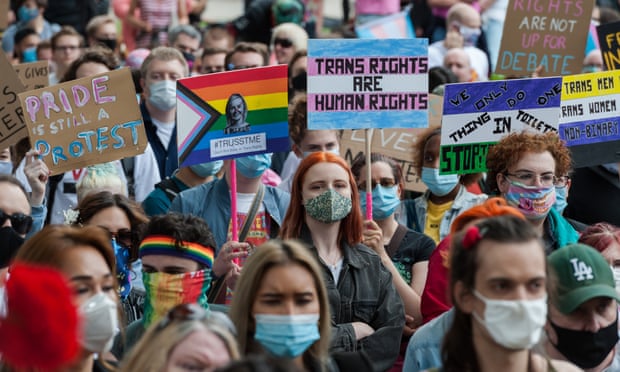
Stephen Whittle has been at the heart of trans activism for half a century. He discusses the legal and political progress that has been made over the last few decades while the Guardian’s Scotland correspondent Libby Brooks examines why there was a backlash over the 2015 Gender Recognition Act, which proposed a further expansion of trans rights.

Listen here

Understanding the fight over trans rights – Part 2

In September 2020 the equalities minister, Liz Truss, announced that some reforms to the Gender Recognition Act would go ahead, but one key aspect – allowing trans people to self-identify without a medical diagnosis – would not be adopted.The issue has divided ‘gender-critical’ feminists from those who are more trans inclusive. Is there a route to reconciliation?

Listen here