Museum of Science & Industry

News

Trips & Adventures –  7 February 2019

Yesterday we held a successful Hate Crime Awareness event with 25 attendees where we learnt all about hate crimes and hate incidents focussing on sexual orientation and transgender issues. Thanks to the folk from Church House who are always supportive, the volunteers – Leroy and Jim – and Nat and Ben (Police Community Safety Officers) who spoke to us about these vital issues and encouraged a free and wide-ranging discussion.

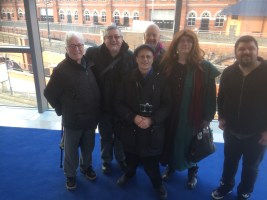
However, today we visited the White Lion, an old fashioned and traditional pub offering Chinese and Caribbean cuisine as well as traditional English dishes, before our visit to the Museum of Science & Industry.

The main purpose of our visit was to see Stephenson’s Rocket, the historic locomotive which was last in Manchester 180 years ago! The guide was very knowledgeable and enthusiastically explained how a steam train works, how the first inter-city railway made history right here in Manchester and how Rocket changed our world and the way we travel forever!

The museum houses the world’s oldest surviving passenger railway station and we also found time to take part in a weaving workshop.


Bridgewater Hall

News

Trips & Adventures – 30 January 2019

A few of us gathered at the Briton’s Protection pub for a quiet pie and a pint before meeting others in the Bridgewater Hall foyer. There we also met our guide, Glynn, who had worked at the concert hall for over 20 years.

The Bridgewater Hall is the iconic international concert venue in Manchester city centre, (which replaced the previous venue – the Free Trade Hall, which had poor acoustics). It cost around £42 million to build and currently hosts over 250 performances a year.

The hall is home to The Hallé orchestra, and is the primary concert venue for the BBC Philharmonic Orchestra. The building sits on a bed of 280 springs, which help reduce external noise and vibration from the road and passing trams.

The Bridgewater Hall held its first concert on 11 September 1996 and was officially opened on 4 December by Queen Elizabeth II, alongside the Duke of Edinburgh. The Bridgewater Hall was one of a number of structures built in the 1990s that symbolised the transition to a new and modern Manchester following de-industrialisation and the 1996 bombing.

We visited areas which are not normally open to the public including the undercroft where you can see the springs, and the performer’s changing rooms. It was great to see behind the scenes. Apparently Jessye Norman (an American opera singer associated in particular with the Wagnerian repertoire) refused to use the changing room, staying at the near-by Midland Hotel and getting a limousine to ferry her to the Bridgewater Hall!

On the plaza outside is the “Ishinki Touchstone”, a sculpture by Kan Yasuda made of polished Italian Carrara marble which is white streaked with bluish-grey. The stone weighs 18 tonnes and was installed in August 1996. It cost £200,000 and the rumour is that it is lucky to touch the stone. We all enjoyed another great day out.

Trips & Adventures – 1 February 2019 

Norman and Stuart went to a concert by the St Petersburg Philharmonic Orchestra at the Bridgewater Hall on Friday 1st February and it was free, donated by Manchester airport. Before the concert we had a drink in The Briton’s Protection, a nearby pub.
The programme was changed, as was the conductor who was to be Yuri Temirkanov but was replaced by Vassily Sinaisky. The music began with Symphony No 1 in D flat major The Classical, Op 25.  This was followed by The Second Piano Concerto by Rachmaninoff with soloist Freddy Kempf. After the interval the concert ended with a rousing performance of Tchaikovsky’s Symphony No 5 in E minor, Op 64.
We retired to the pub for another drink. Concert going is a thirsty business.

Strictly Come Dancing

News

Trips & Adventures – 26 January 2019

Six of us from Out in the City went to the Manchester Evening News Arena (courtesy of Unique X) for a VIP experience to see “Strictly Come Dancing” on tour. I have to admit I was a bit sceptical – I’m not a regular viewer of the show – OK, I’ve never seen a programme in full. But it was spectacular, sensational and stunning … and other words beginning with “s” (like superb).

Ore Oduba, a British television and radio presenter, best known for winning the fourteenth series of BBC One’s “Strictly Come Dancing”, hosted the show. Supported by a live band and some amazing singers, seven couples made up of a celebrity and a professional dancer did two dances each, from the classic waltz to the sultry rumba, and were marked out of 10 by four judges. These were Craig Revel Horwood, Dame Darcey Bussell, Shirley Ballas and Bruno Tonioli. When Dr Ranj and his partner danced a sexy salsa, Craig Revel Horwood said that it reminded him of the NHS – No Hip Swivel! We boo-ed playfully. Although one dance scored only 22 out of 40, the standard was generally so high that one dance scored 39 out of 40 and four dances scored full marks. However, the audience decided who won the ultimate prize; with fans having the power to vote for their favourites and choose who lifted the famous Glitterball Trophy.

The singers covered such gay classics as “I’m Coming Out” and “Dancing Queen(s)” when Craig and Bruno danced. When they sang “We are Family” it reminded me of the time I went to see Sister Sledge at the Hacienda Night Club. Only one sister turned up, but she still appeared on stage looking from left to right when she sang the lyrics: “We are family, I’ve got all my sisters with me”.

There were also professional dancers and a highlight for me was the dance performance at the end. The group led by two men dancing together filled me with pride and warm emotion. I shed a tear (don’t tell anyone!)

We had the chance to stand up and dance in our seats to the “Strictly Come Dancing” theme tune. There were costume changes, crowds and cha-cha-cha! Darlings, the whole event was fun, camper than a row of tents and totally Fab-U-Lous.

Shrewsbury

News

Trips & Adventures – 24 January 2019

Shrewsbury is the county town of Shropshire on the River Severn. It is easy to get to, as it only took one hour and six minutes on the train from Manchester Piccadilly, and there is so much to see.

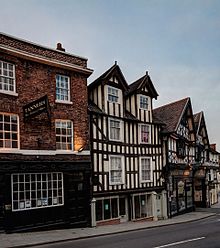
Shrewsbury is a market town whose centre has a largely unspoilt medieval street plan and over 660 listed buildings, including several examples of timber framing from the 15th and 16th centuries. Shrewsbury Castle, a red sandstone fortification, and Shrewsbury Abbey, a former Benedictine monastery, were founded in 1074 and 1083 respectively by the Norman Earl of Shrewsbury, Roger de Montgomery. The town is the birthplace of Charles Darwin and is where he spent 27 years of his life.

Typical Tudor and Georgian architecture on Wyle Cop

We visited the Castle (which unfortunately was closed until mid-February) and climbed the tower which provided a panoramic view over the town. Of course, it was time for lunch and we found a very nice pub “The Bull”. Shrewsbury is one of the few places in the UK where independent shops outnumber the big chains.

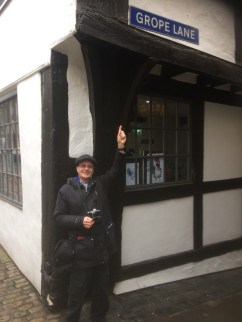
You can easily explore the town centre on foot and we went to the Abbey, St Chad’s church and the Museum and Art Gallery. There were many old streets, passages and alleys and we spotted “Grope Lane” on our travels.

Next to Shrewsbury Cathedral was a lovely cafe called the “Orchard Cafe”. Age UK meet there once a month for a meal out, and we sampled delicious cakes with our coffee. The locals confirmed that the town is not pronounced “Shrohz-ber-ee” but should be pronounced “Shrews-ber-ee”.

We ended up tired and museumed-out, but wanting to come back to explore more.


John Rylands Library

News

Trips & Adventures – 17 January 2019

After dining at the Moon Under Water, we took the short walk along Deansgate to the John Rylands Library.

Although the Library was named after a man, it was founded by a woman. Enriqueta Rylands opened her Library in 1900 as a gift to the people of Manchester 18 years before some women achieved the freedom to vote. Its collections contain previously unheard stories of women from around the world.

The current exhibition is “The Women Who Shaped Manchester”. The gallery showcases a variety of items from poems, letters and books to handwritten manuscripts. Together they tell remarkable stories of how women have been perceived and sought to challenge the status quo.

Too little ink has been spilled telling the stories of exceptional women from Manchester’s past – from the mill workers to the protesters who galvanised the streets. We delved into the sepia-tinted days of 19th and 20th century Manchester seeing the city through the words and actions of extraordinary women. We were amazed by their feats as they paved new paths with their dedication and determination.

Unfortunately, we were not allowed to photograph the exhibits as some were sensitive to light. One extraordinary letter was from Winston Churchill where he was clearly worried that women would disrupt a meeting at the Free Trade Hall. He wanted the women to sign an agreement confirming best behaviour or be excluded from the building!

We read Emmeline Pankhurst’s stirring letter that speaks for those prepared to make the ultimate sacrifice in the name of equality. The exhibition captures the passion and strength of these pioneers, and we were inspired by the Women Who Shaped Manchester.

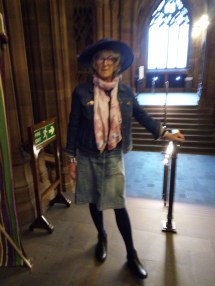
We had another opportunity to dress up. I’m thinking of changing the name of the group from “Out In The City” to “Hat In The City”.

We also looked at the reading room and historic toilets in the basement before retiring to the café for refreshments and cakes.