
Lesbian Aunts’ Day
Lesbian Aunts’ Day is celebrated annually on 13 July.
It is a special day to honour and celebrate the presence of lesbian aunts, their impact on their nieces and nephews, and their vital role within the LGBT+ and broader family community.
The occasion first gained traction organically through social media and online LGBT+ spaces. It often overlaps with broader family and community celebrations, similar to its sibling holiday, National Gay Uncles (Guncles) Day, which is celebrated on the second Sunday of August.

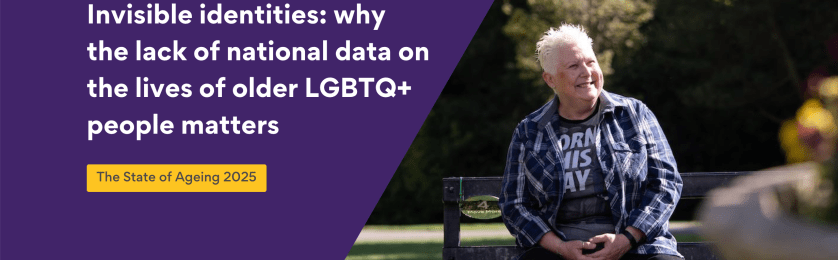
Invisible Identities

By Sarah Wilkinson (Research and Analysis Manager at Centre for Ageing Better)
The older LGBTQ+ population has seen much change in their lifetime but it is a group that continues to be overlooked. Our Research and Analysis Manager Sarah Wilkinson explains why their absence from official datasets matters, beyond just counting their numbers.
Between 2019 and 2024 the number of lesbian gay and bisexual people aged 50 and over in the UK is estimated to have increased by a third from 343,000 to 457,000. The older LGBTQ+ population is set to grow at an even faster rate than the overall older population, as relatively larger cohorts of LGBTQ+ people in their 30s and 40s age.
Yet national datasets rarely report measures by sexual orientation or gender identity. Even when this data is collected, it may not be reported due to small sample sizes – especially for older age groups in which numbers of LGBTQ+ people are smaller. Increasing recruitment of older LGBTQ+ participants by those responsible for national surveys would help address this.
It is important to also recognise that there are differences within the older LGBTQ+ community as lesbians, gay men, bisexual people and trans people face some different issues as they age.
Data is especially lacking on older trans people’s lives. Furthermore, while data is sometimes reported by gender, sexual orientation and gender identity intersect with other characteristics (such as ethnicity and disability) resulting in different prospects for later life. This adds to the need for sufficient sample sizes to allow for intersectional analysis.
This long-standing lack of quantitative data on LGBTQ+ lives has contributed to the invisibility of older LGBTQ+ people in policymaking and service design. Older LGBTQ+ people have lived through, and been instrumental in progressing, extraordinary social and legal changes. Now in their later lives, they face the overlapping challenges of ageism and the ongoing effects of a lifetime of homophobia and transphobia.
Stronger evidence is needed on how these issues affect the wellbeing and quality of life of older LGBTQ+ people so policies and services can better meet their needs. While qualitative insights and lived experience are valuable, more robust national quantitative data is essential to show how lifelong discrimination affects LGBT+ people as they age – and to support policy action to reduce these inequalities.
The inclusion of voluntary sexual orientation and gender identity questions in the 2021 England and Wales Census was a positive step. Its full population coverage avoids sample size issues and has been invaluable for understanding other marginalised groups. But there are specific limitations in its value when it comes to sexual orientation and gender identity, notably:
- A significant number of people chose not to answer these questions. Among older groups, this may be especially true for LGBTQ+ individuals, as past stigma and discrimination can understandably lead to lower levels of trust in authority.
- There is evidence that the gender identity question in the Census was open to misinterpretation, particularly by older respondents, reducing data accuracy and limiting its use.
- Sexual orientation and gender identity data are the only demographic variables that are not included in the Census dataset tool, preventing analysis that combines these with other variables.
- The pre-built datasets created to address this do not allow the combination of age with other variables. Without age breakdowns, findings can be misleading, as the younger profile of the LGBTQ+ population means differences compared to the overall population may reflect age rather than sexual orientation.
Because of these limitations, we requested that the Office for National Statistics publish additional tables for a number of variables, such as housing tenure and self-reported health, by age and sexual orientation. This analysis shows that there are differences between the lives of older LGB+ people and heterosexual people, which affects how they age.
For example, older LGB+ people are more likely to live alone and in rented accommodation and (at least up to the age of 64) less likely to report being in good health.
Some of this data was included in our State of Ageing 2023/24 report, and was also presented at the British Society of Gerontology 2026 conference last week. Further bespoke analysis of Community Life Survey data was included in State of Ageing 2025, showing that older LGB+ people – particularly men – are less likely than heterosexual peers to have support when needed.
A key takeaway from these bespoke analyses is that significant inequalities can be present in the data, yet they will remain obscured without the ability to conduct the necessary analyses to reveal them.
That is why we are calling on organisations, such as the Office for National Statistics and research bodies that lead national surveys, to collect data on sexual orientation and gender identity, with a sample size that enables disaggregation by age to be published. This data would enable policymakers to plan better support for LGBTQ+ people as they age. It would also give a message to older LGBTQ+ people that they are being counted because they count, which is not something this community has always felt was the position of authorities and institutions.

Gay cruise blocked from entering Egypt days after being banned from Turkey
A gay cruise that was previously blocked from entering Turkey has now been banned from Egypt.
The Scarlet Lady carries around 1,900 passengers, mainly gay men from the US.
Egypt is the second country to have blocked Atlantis Events’ “Athens to Venice” Mediterranean cruise from entry. On 28 June, before the Scarlet Lady set sail, authorities in Turkey’s Aydin province released a statement saying they would not allow the ship to dock in the port city of Kuşadası because the cruise had been “planned by groups known for behaviours that do not align with the structure of our society and our moral values.”
In an interview Rich Campbell, President of Atlantis Events, noted that this marks the first time in the company’s 36 years of operation that one of its cruises has been blocked “because of who we are.”
“The reasoning behind it is that it’s a gay group,” Campbell said of the Turkish authorities’ decision. “It’s very concerning to me when a country decides they can pick and choose which tourists are allowed in and which are not.”

Whilst a lot of people have been inconvenienced by being stranded in the middle of the ocean, it is the LGBT+ community that faces persecution in both countries. They are not allowed to be free to love who they want, for the most part, although neither Turkey nor Egypt has laws explicitly banning homosexuality.
Ironically, Alexandria in Egypt is a city founded by and named for one of the ancient world’s best-known homosexuals.
Out On The Radio
Our monthly radio show – aimed at older members of the LGBT+ communities – goes out live on the first Tuesday each month from 2.00pm to 3.00pm on ALL FM 96.9.
Don’t worry if you miss it, as it has been uploaded to Mixcloud so you can listen at your leisure.
This month we interviewed Stacie Cohen and featured an eclectic choice of music.
Listen here.
 Out in the City