Three Exhibitions at Sale, Waterside
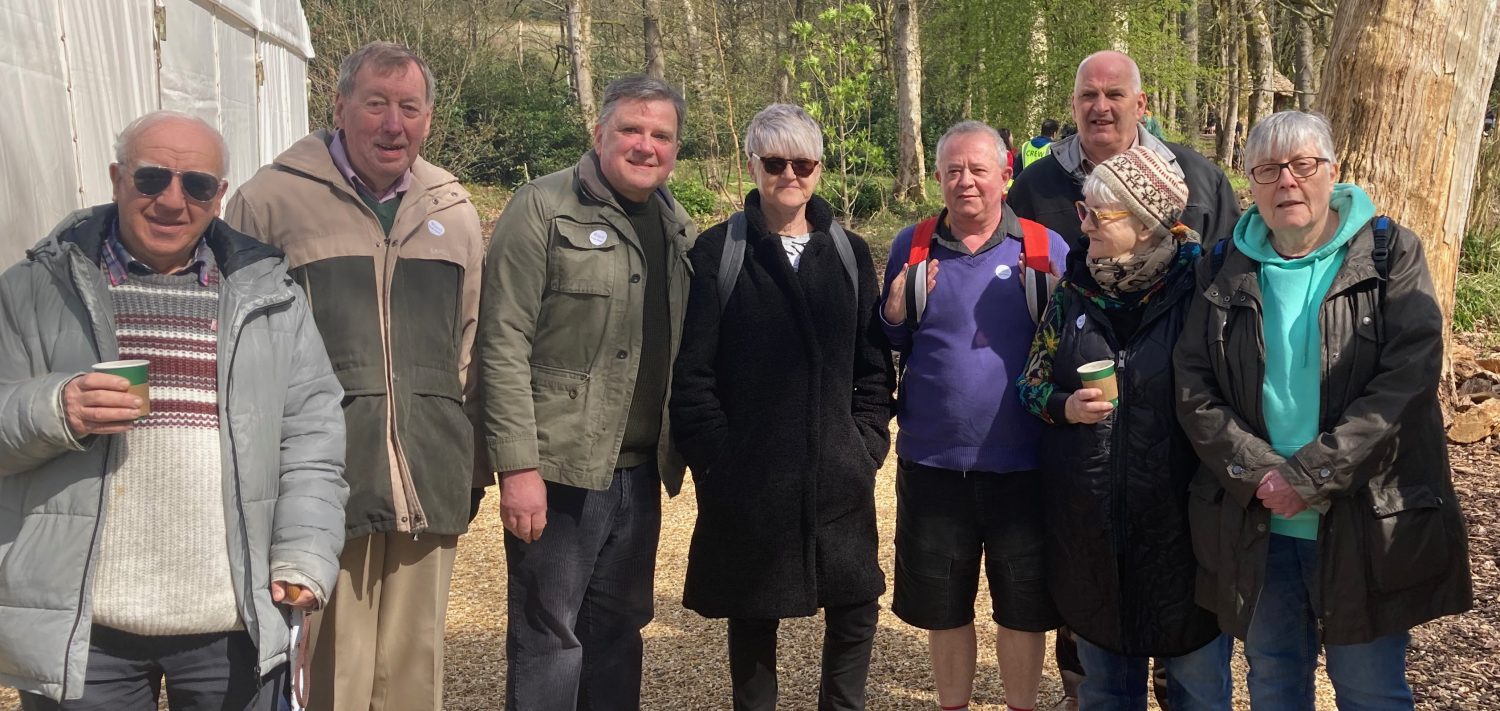
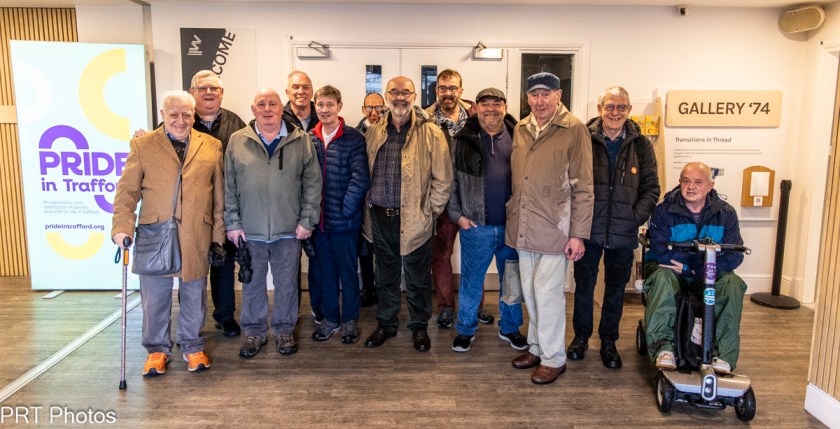
Twenty of us travelled to Sale in Trafford to visit the Waterside Arts Centre. There were three important exhibitions as part of Trafford Pride.
Thank you to Waterside Arts Centre for the complimentary teas and coffees.
Before We Were Proud
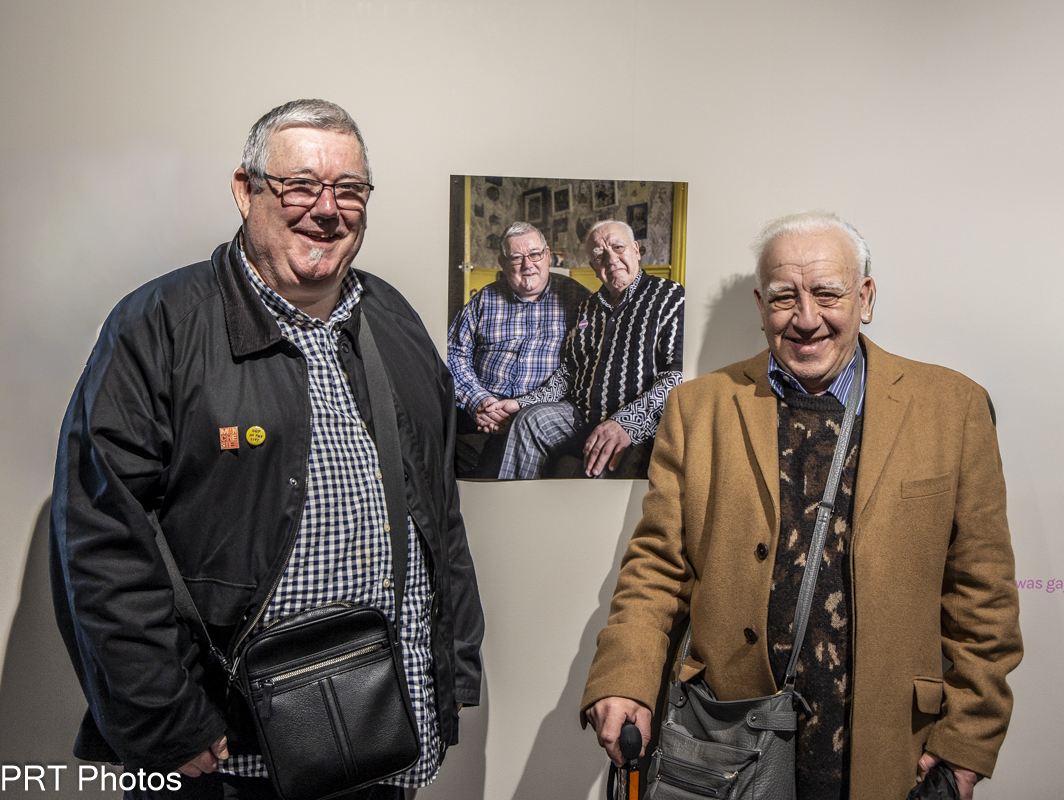
Before We Were Proud is an exhibition of portraits and interviews by photographer Steve Reeves, highlighting the personal histories of older members of the LGBTQ+ community with lived experience before the decriminalisation of homosexuality in 1967.
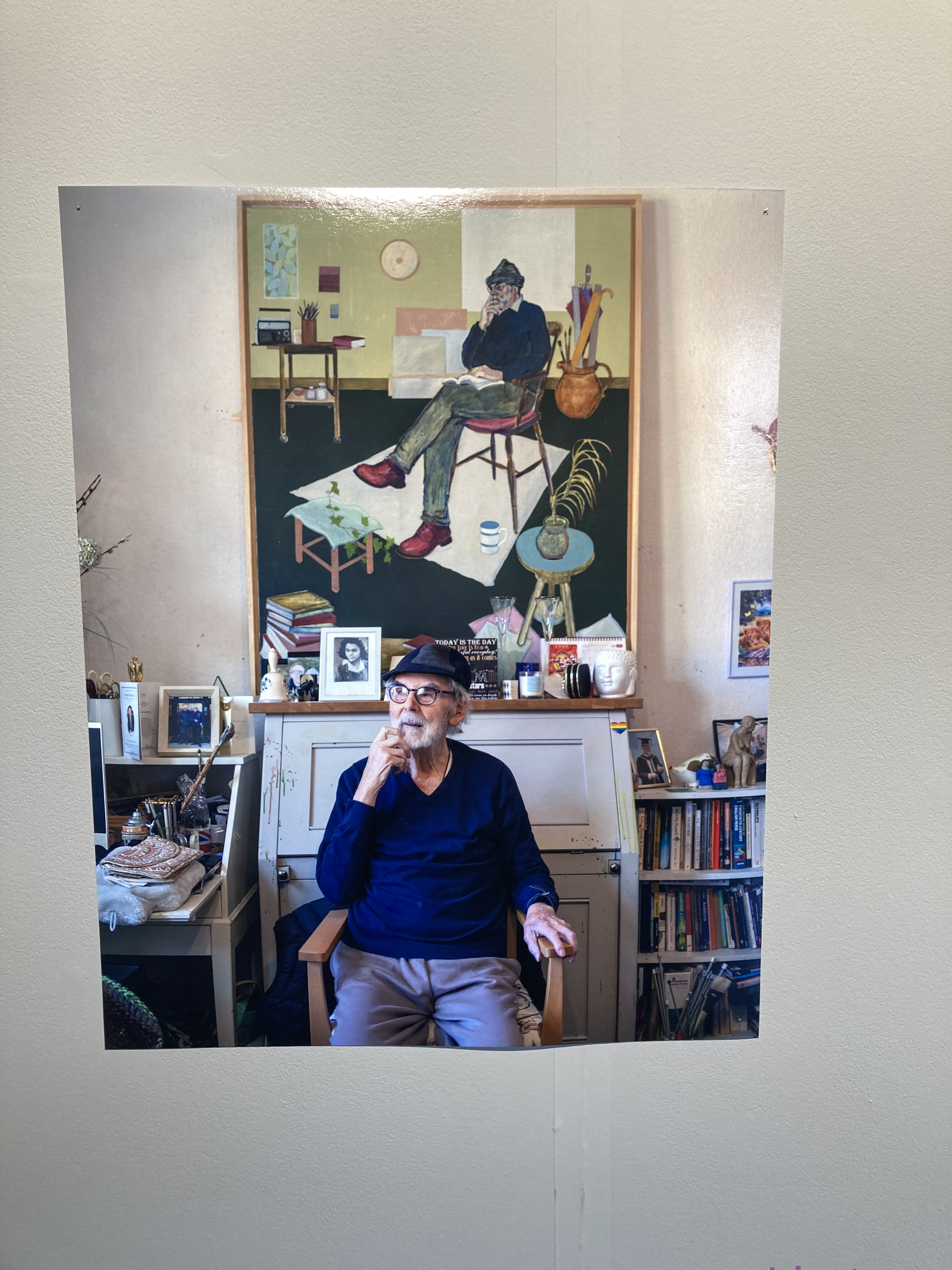
As a member of the LGBTQ+ community before this time, there was not only the risk of physical and verbal abuse, but there was also the risk of arrest and imprisonment. Every year, the Pride March has become a celebration of LGBTQ+ culture, but many people don’t realise that it started as a protest, and those brave enough to attend back in the 1970s took considerable risks. Before We Were Proud is an ongoing project aiming to tell the stories of the courageous people who lived through these times.
There are many common aspects within the lives of those who shared their stories for the project – many were unable to acknowledge their feelings, fearful of what they had to lose. Steve has been sensitive to the fact that the accounts do not solely belong to the people whose portraits are on display. The attitudes of society meant that many of the participants got married, some had children and grandchildren. It has been important to be mindful that these are their experiences too.
We hope that visitors will take time to read these stories – the project created a safe space for the participants to share their lived experiences.
Though Britain is slowly becoming a more open-minded country, members of the LGBTQ+ community still endure prejudice. These oral histories show the impact that societal attitudes had and continue to have – an important reminder to ensure that progress continues and history is never repeated.
The exhibition of photographs with interviews can be seen by following this link.
The Pansy Project
Three experiences of homophobia in one day were the catalyst for The Pansy Project. Although Paul had grown accustomed to this behaviour, he realised how shocking it remained to those around him; prompting him to consider the nature of these attacks and their effect on his life, exploring how he felt at these locations.
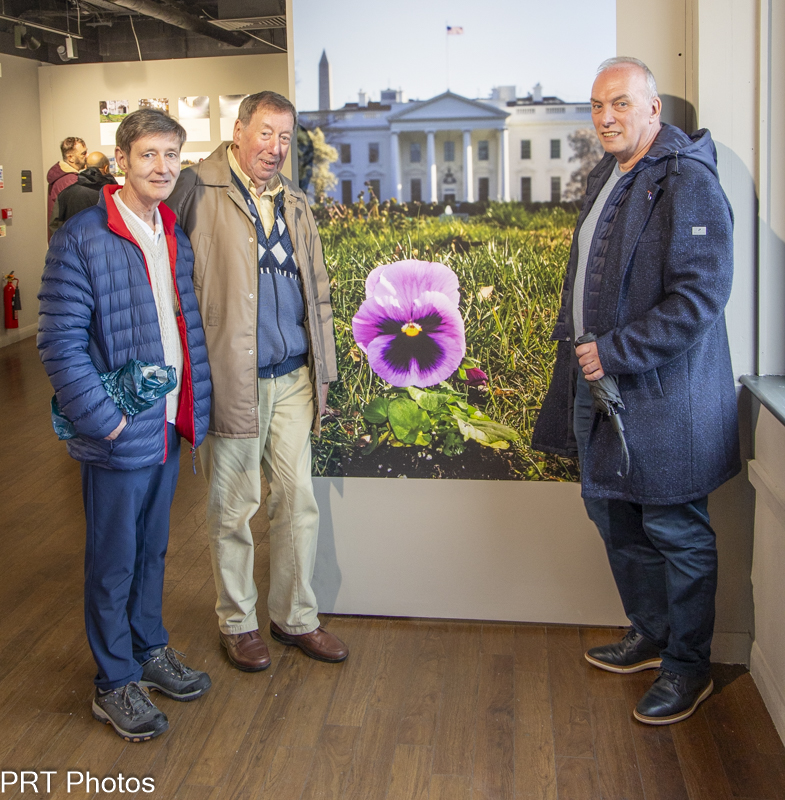
Paul noticed the significance of roadside floral memorials, but initially did not want to equate his experience of verbal abuse with a death or tragedy. Instead, he chose to plant a small, unmarked living plant at each site. A plant grows as he has through these experiences. The act felt positive: a quiet comment on the abuse, a potential remedy. With each planting the locations have shifted from sites of hatred to places of resistance.
Kneeling on pavements, in hedgerows, at the edges of roads draws attention. People pass, stare, ask questions, or depending on the location, ignore Paul entirely. Sometimes he is even mistaken for someone unwell. These moments of urban disruption have also become part of the performative nature of the work.
The species of plant was, of course, vitally important and the pansy instantly seemed perfect – a term historically used against effeminate or gay men, but also derived from the French verb “penser”, meaning “to think.” The pansy’s bowed head suggests reflection, and its subtle, elegiac quality suited the project’s intent.
Transitions in Thread
A solo exhibition of the work of artist weaver, Jenny Waterson, whose recent projects reflect her experience as the mother of a young adult changing their gender identity.
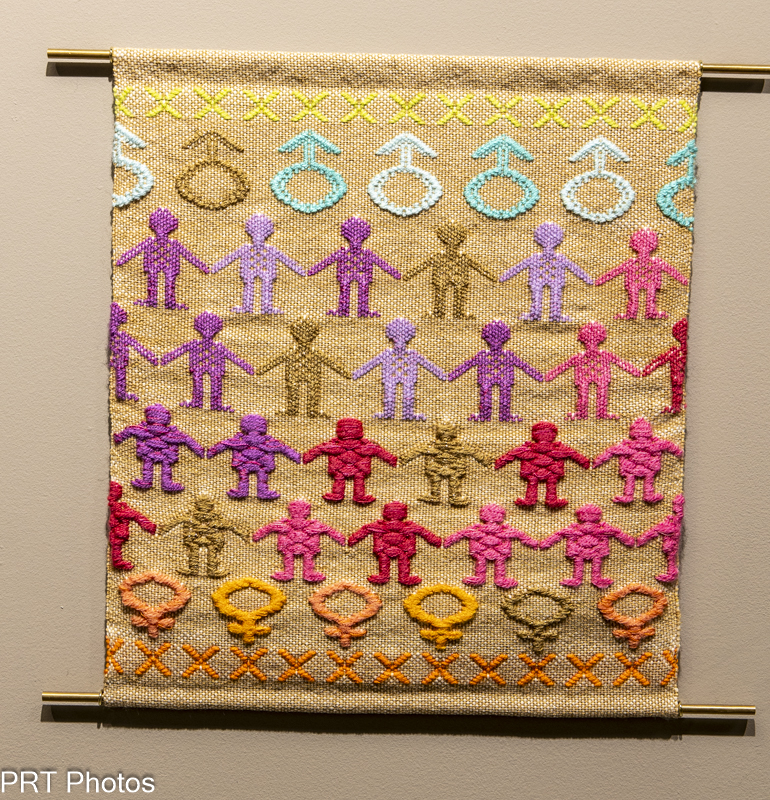
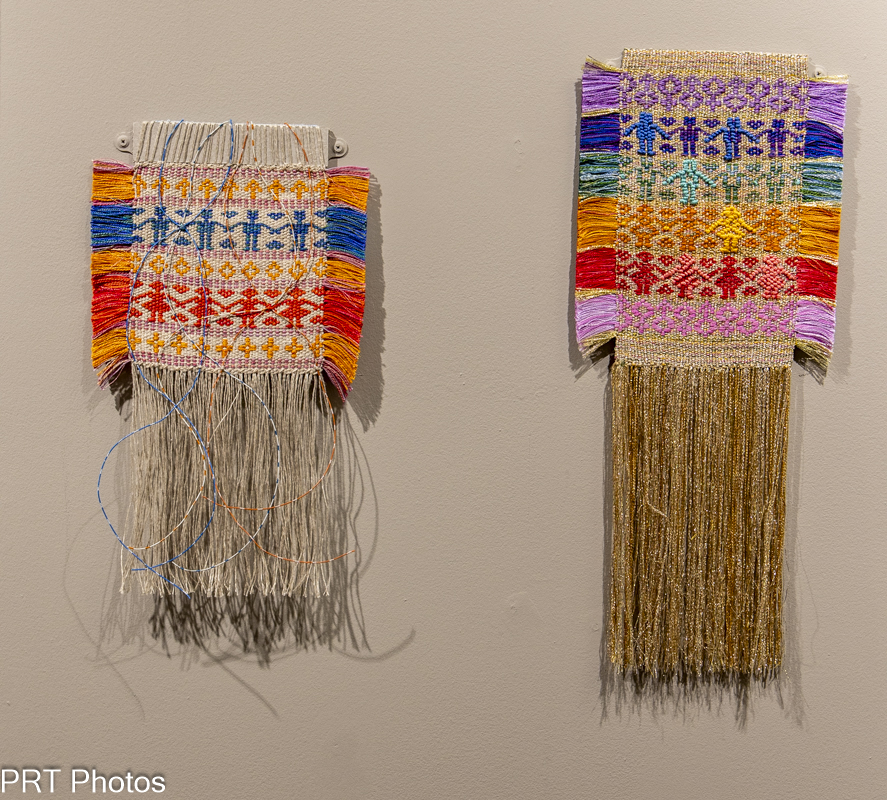
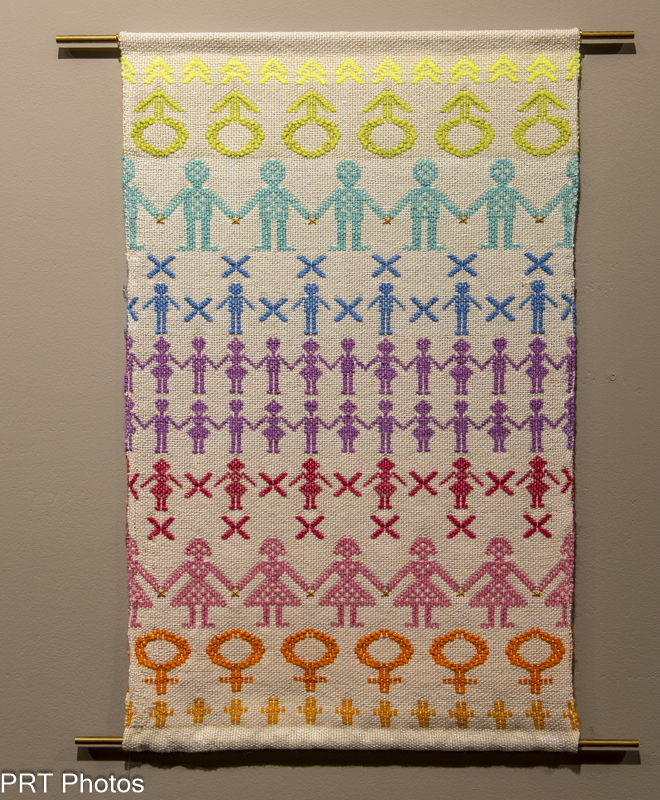
Throughout her distinct collections of work Jenny has created her own vocabulary of symbols in weave around themes of ambiguity, generational geographies and human experience. She weaves transitional pattern and colour sequences to explore an evolving narrative of identity, belonging and motherhood. Through weaving Jenny questions her assumptions and certainties about her child and her mothering, unpicking what she thought she knew and what she took for granted. She unlearns reflexes and slowly creates new neural pathways as a new narrative takes shape. Her weaving holds love and discovery and hope, side by side.
With her weaving Jenny is developing a supplementary weft technique, replacing traditional geometrics with her own figurative motifs. With this technique she can weave complex symbols on a hand loom, maximising placement and scale. She weaves layered meanings into her motifs with a complex use of colour, by creating her own composite yarns from blends of wool, rayon and metallic threads.
Jenny’s weaving explores the interplay of her woven symbols in a sampler format. For example, her Becoming series combines traditional Swedish folk motifs with iconography of identity politics, connecting both to her roots and to her child now. Her Transversing series brings together X marks, with multi-layered references to love, our chromosomes, the unknown, and treasure to be discovered; and loop motifs referencing unlimited potential, eternal bonds, endless love and protection.
Jenny is a member of the Textile Study Group of artists and tutors sharing ideas, imagination and skills. Alongside her weaving practice, she runs creative textile workshops in her studio in Altrincham. She also leads creative textile workshops for arts, community and heritage organisations.
More photos can be seen here.

The 2026 Pride Season starts!
It’s that time again, when UK pride events start. This year there are over 220 Prides across the whole of the UK. Here are the Pride events in the north west.
List of North West Prides
16 May – Trafford Pride (Sale)
23 May – Bolton Pride
23 May – Pride on the Range (Whalley Range)
30 May – Bury Pride
6 June – Blackpool Pride
13 June – Salford Pride (Pink Picnic)
26 – 28 June – Sparkle Weekend (Manchester)
11 July – Weaste Pride
25 July – Liverpool Pride
25 July – Oldham Pride
26 July – Stockport Pride
1 August – Trans Pride Manchester
8 August – Prestwich Pride
14 – 16 August – Levenshulme Pride
16 August – Wigan Pride
28 – 31 August – Manchester Village Pride
30 August – Didsbury Pride
“Am I too bold, Eve – tell me?”: This lesbian first lady’s steamy love letters were way too hot for 1890
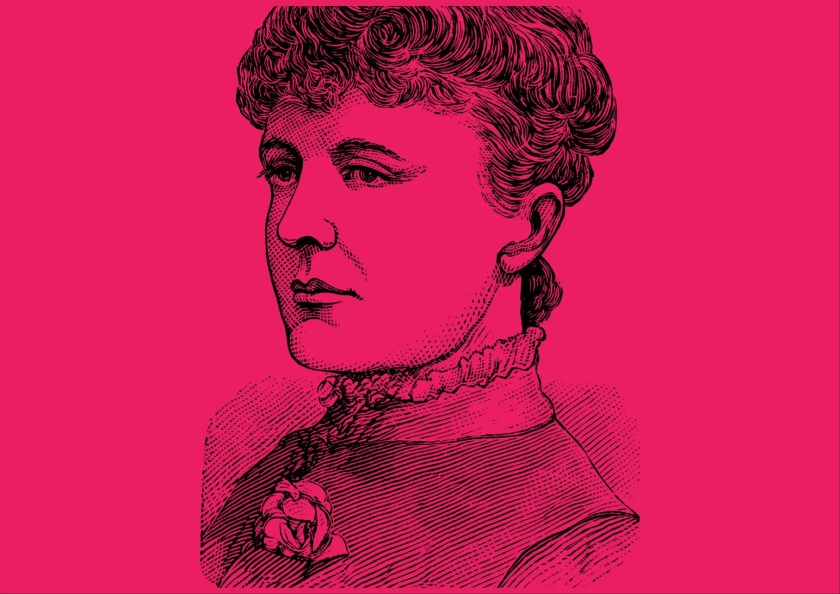
Rose Cleveland was a brilliant and unusual first lady for a few reasons. Most notably, she wasn’t actually married to the president during her time as First Lady, for the very good reason that he was her brother. Also, she was a lesbian.
Grover Cleveland would go on to marry a woman who would take over the role of First Lady later on, but for the first year of Cleveland’s first term, he counted on his sister Rose, a sophisticated woman of letters, suffragette, and education advocate, to fill the post. And she did so, remarkably well.
As a First Lady, Cleveland advanced progressive causes and fought for women’s rights, managing to publish several highbrow works during her time assisting her brother in the Oval Office.
But was she … you know … a fan of George Eliot?
She sure was. Cleveland wrote an entire book on Eliot’s work during her residency in the White House. She also wrote some other things that were less fit for print during the buttoned-up climax of the Victorian era, namely love letters to a woman who shared her progressive views and academic passions.
“My Eve! Ah, how I love you! It paralyses me,” Cleveland wrote to her lady love Evangeline Marrs Whipple (later Simpson Whipple) during a period of separation in 1890. “Oh Eve, Eve, surely you cannot realise what you are to me. What you must be. Yes, I dare it, now, I will no longer fear to claim you. You are mine by every sign in Earth & Heaven, by every sign in soul & spirit & body – and you cannot escape me.”
This was a common sentiment between the women, with Rose later declaring: “You are mine, and I am yours, and we are one, and our lives are one henceforth, please God, who can alone separate us. I am bold to say this, to pray & to live by it. Am I too bold, Eve – tell me?”
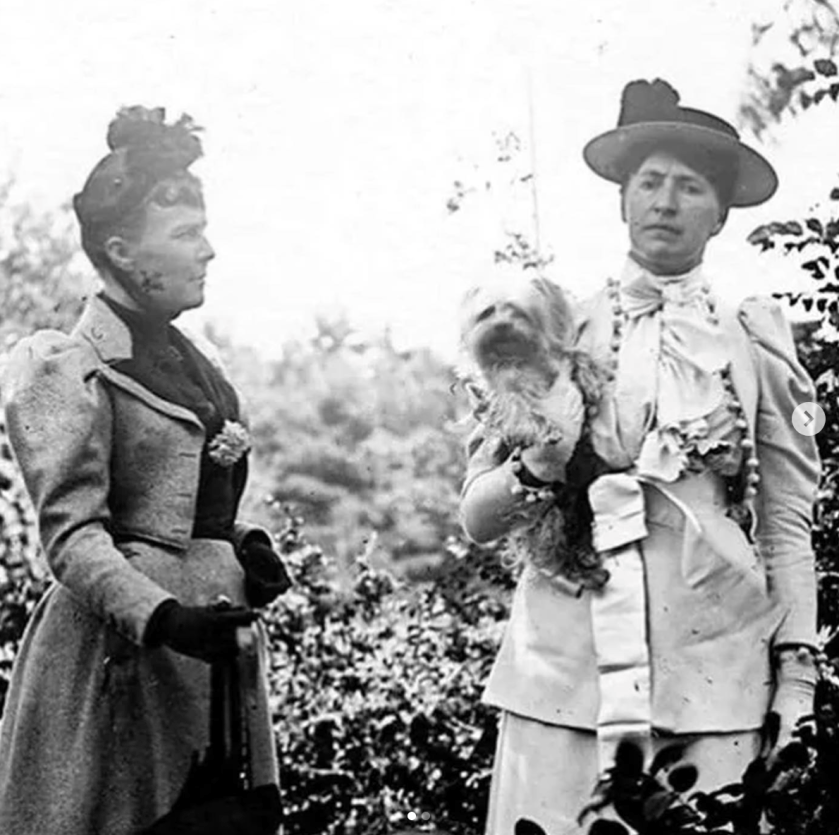
She was not too bold. Steamy as that sounds, Evangeline’s reply was even randier. “My Clevy, my Viking, My … Everything,” Whipple wrote, imploring Cleveland to “come to me this night.”
During another term of separation, Cleveland swore that: “whatever comes I know you love me and are true to me and will never be the cause of any sorrow to me, and oh, it is only this cruel outrageous time and distance – that is all!”
The communications between these women are as hot as it gets, and surprisingly, they’re not as anachronistic as they might seem at first. Just consider how raunchy Emily Dickinson’s own love letters were! There’s no doubt that “Clevy” and “Wingy”- sometimes “Granny”- were deeply in love, and for a time, didn’t care who knew it, even to the point of Evangeline’s mother meeting the loving pair early on in their courtship.
Long before Eleanor Roosevelt and Lorena Hickok, Rose Cleveland was romancing a woman passionately while using her powerful position to fight for the rights of less privileged women in America. The love between Cleveland and Whipple, like Hick and Eleanor, was longstanding. In 1901, Rose told Evangeline that “all the languages in the world, you darling, could not possibly express my sympathy – the perfect love which I feel for you.”
The women were also living through a surprising moment in American history, when “women loving women” relationships, if not accepted, were at least in evidence on college campuses and in elite Boston society. As Lizzie Ehrenhalt tells us in her introduction to Precious and Adored, the collected letters between Cleveland and Whipple, “the first uses of the word crush to mean a romantic infatuation come from this era, when female students openly courted one another and fused into couples.”
Women still had to be discreet, of course, and as Ehrenhalt notes, the letters between Clevy and Wingy, like other passionate communications between lesbians of the time, “draw their power from ambiguity.” If women couldn’t state their love openly, they could use their correspondence to say the quiet part … well … quietly.
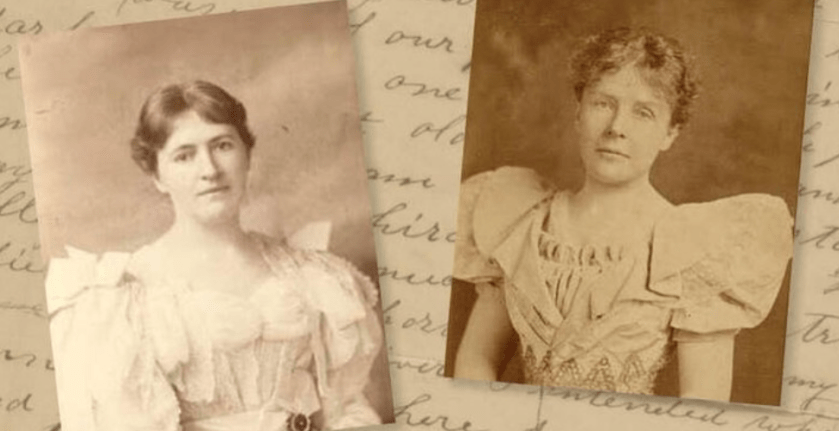
Both Cleveland and Simpson Whipple were educated women of means. They met in the orange groves of Florida in 1889, and while their romance was cut short by the widowed Simpson Whipple’s decision to remarry, they spent a number of years living, working, and travelling together, seemingly without any interest in hiding their relationship.
It wasn’t uncommon for Boston marriages of this type to thrive in this era, but as scholar Lillian Faderman points out in her foreword to Precious and Adored, choosing not to remarry could mean being shut out of professional opportunities. This is most likely the reason why Evangeline chose to marry a man 30 years her senior despite a clearly passionate (and obviously sexual) relationship with Rose.
As you can imagine, the breakup, however temporary, didn’t sit well with Rose. She begged Evangeline to reconsider – but ultimately, the marriage went through.
But there’s a happy ending to this story: Evangeline’s new husband died only four years after the remarriage, and she reconnected with Rose that same year. Perhaps the romantic part of the relationship had expired, but a passionate friendship remained. The letters continued until Rose’s death in 1918. Considering how explicit many of them are, it’s a miracle they’ve survived in the first place. First donated in 1969 – the year of the Stonewall Riots – the full tranche of letters didn’t see publication until 2019, with the release of Precious and Adored.
When Evangeline died, her final request was to be laid next to Rose Cleveland. She got her wish: In a plot in Bagni di Luccam, Clevy and Wing still rest alongside each other.
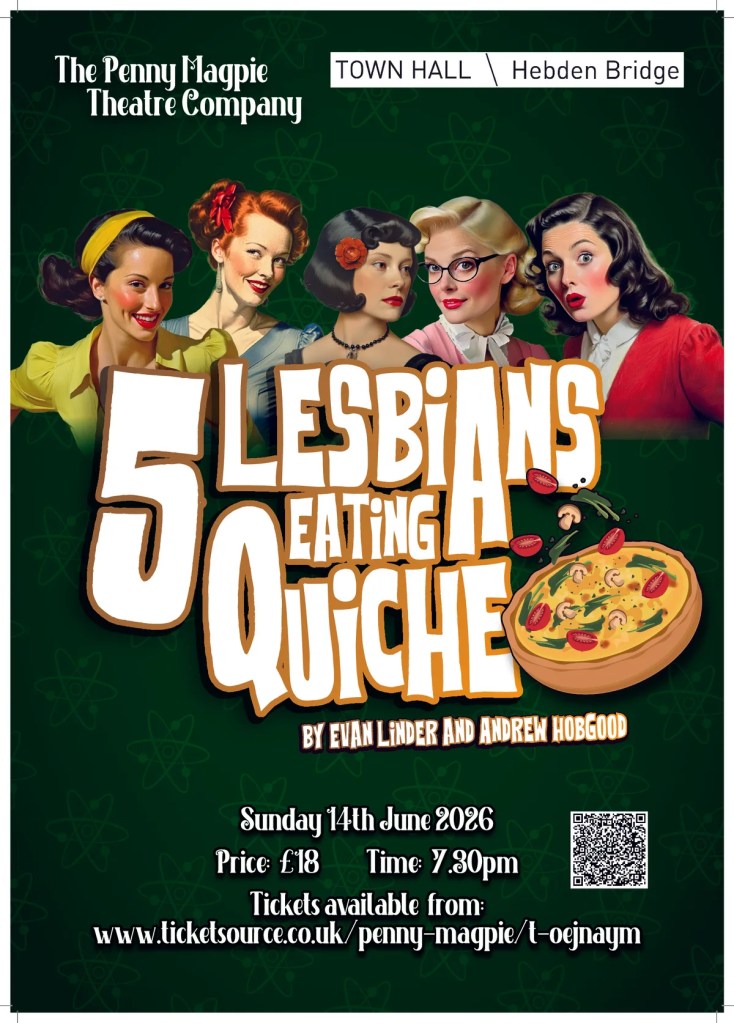
Sunday, 14 June – 7.30pm – 10.00pm – Penny Magpie Theatre Company Presents: Five Lesbians Eating a Quiche – £18 + booking fee
Hebden Bridge Town Hall, St George’s Street, Hebden Bridge HX7 7BY
It’s 1956 and The Susan B Anthony Society for the Sisters of Gertrude Stein are having their annual quiche breakfast. As the assembled ‘widows’ await the announcement of the society’s prize-winning quiche, the atomic bomb sirens sound! Has the Communist threat come to pass? How will the ‘widows’ respond as their idyllic town and lifestyle faces attacks?
Winner of a national ‘Best Amateur Production’ award after a sell-out run at Theatre@41 in York in 2024, The Penny Magpie Theatre Company bring ‘5 Lesbians Eating A Quiche’ to Hebden Bridge in a tasty recipe of hysterical laughs, sexual innuendoes, unsuccessful repressions, and delicious discoveries.
 Out in the City