Stop imposing your imperialist Western transphobia on my people
Societies across the world acknowledged and celebrated gender-diverse communities – until the British arrived to impose their Victorian values.
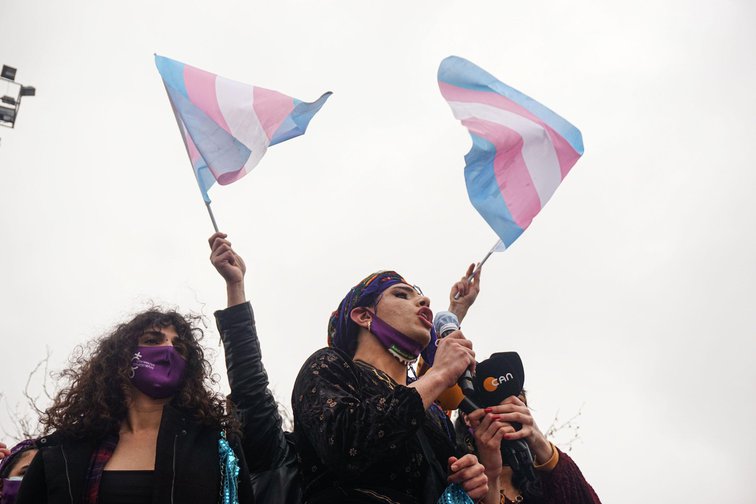
Trans rights activists at a protest on 6 March 2021 – Ibrahim Oner / SOPA Images / ZUMA Wire / Alamy Live News
“Trans people have always existed, everywhere,” writes Arya Karijo.
“We were mudoko dako for the Lango in Uganda, yan daudu for the Hausa in Nigeria. We were priestesses and priests for the Bunyoro in Uganda, a third gender for the Teso in Kenya.
We were eunuchs with powerful court positions in the Dahomey kingdom in Benin, and concubines in the Ashanti kingdom in Ghana. Native Americans thought of us as “two-spirit” people. Records of our existence go back centuries in Afghanistan, and many other countries,” she adds.
These are some of the discoveries that Arya, a Kenyan trans woman, made while on a quest to talk to other transgender people from places that share her country’s colonial past.
She found that there is a rich heritage of transgender people across many cultures that was concealed and criminalised by British colonial rulers.
Arya spoke to Nayyab Ali and Saro Imran, who belong to a gender-diverse community in Pakistan which has existed for thousands of years but was blacklisted by the UK’s Criminal Tribes Act in 1871.
She heard from Yahyia Al-Zindani, who fled his home in Yemen because Houthi militia believe his kind are a foreign concept and want to kill him.
Transgender women in Kuwait told her how they have resigned themselves to a punitive law against “imitating the other gender”, a vestige of prohibitions enforced by colonial missionaries.
In her conversations with trans and non-binary people in the former British colonies, one thing became clear: that the way trans people are treated in the UK continues to affect trans communities elsewhere.
“When the British media obsesses over trans people, when British politicians question our rights, when prominent authors try to discipline the gender-diverse community, they perpetuate this colonial cruelty against us,” she writes. “Our existence is our truth. For centuries, your people have tried to erase us. But we won’t let you.”
20 years of marriage equality: how the Dutch inspired the world
Two decades after fighting for marriage equality, veteran gay rights activist Henk Krol reflects on that struggle, and shares his own wedding news.
The Netherlands was the first country to legalise gay marriage, 20 years ago – Matthew Chattle / Alamy Stock Photo
When same-sex marriage was legalised in the Netherlands twenty years ago, on 1 April 2001 – a world first – Dutch journalists weren’t planning to cover the story. Until they found out that dozens of newsrooms from around the world were sending cameras to capture the first wedding ceremonies.
Henk Krol, a veteran gay rights activist who fought for this historic legal change two decades ago, remembers the contrast between how it was seen in the Netherlands compared to internationally.
“People here were already used to [same-sex] marriage,” he explained. LGBT couples had held ‘wedding’ ceremonies for years, and registered partnerships for same-sex people were legalised in 1998. “But the fact that we were the first country to [grant marriage equality] was news.”
I grew up in the Netherlands, and fondly remember the wedding day of my parent’s close friends in the late 1990s. The two men had lived together since I was little, and their celebration was no different to me than any other wedding. But it wasn’t officially a marriage, it was a registered partnership.
Henk Krol
“I thought it was very insulting,” said Krol, about how the 1998 introduction of registered partnerships was seen as a victory for LGBT equality.
I don’t want a ‘registered partnership party’ or a ‘registered partnership trip’, but a real honeymoon. And above all, I don’t want a ‘registered partnership night’, but a wedding night. Because the other doesn’t seem as romantic.”
This wasn’t the only reason that Krol and other activists continued to fight for equal marriage rights. Registered partnerships not only have a different name, but they also grant fewer rights to couples and their children.
Registered partnerships, Krol explained, are contracts between two people, while marriage is different – it places obligations on others too.
“If two people get married at the town hall, then your employer suddenly has to deal with it, then the tax authorities have to deal with it,” he gave as examples. “That is what makes marriage so special.”
In the 1970s, when the fight for marriage equality in the Netherlands first gathered steam, Krol was also in touch with gay rights activists in the US. He helped to raise money for pro-equality adverts in the Miami Herald and Time magazine to combat attacks from anti-rights campaigners.
Krol had worked as a journalist and as a press officer for the People’s Party for Freedom and Democracy (VVD). He managed to secure Amsterdam’s famous Royal Concertgebouw for a fundraising concert, along with the country’s most famous TV presenter at the time, Mies Bouwman, as host.
“Mies agreed in an instant. That meant that all the well-known Dutch artists of the time were also eager to take part,” Krol remembers. The Miami Nightmare concert was a big success, raising more money than needed for the ads. The rest went into other work to promote marriage equality.
Krol believes his political and media connections also helped him “to lobby much better than anyone else. It wasn’t so much a tremendous effort on my part, but a coincidence that helped the fight enormously.”
His advice for equal marriage campaigns in other countries is to “make it a broad political battle. Do not allow only left or right parties to vote in favour, make sure it is widely accepted. Because the people involved [the same-sex couples who want to marry] are both left- and right-wing supporters.”
After same-sex couples in the Netherlands gained the right to registered partnerships, not everyone wanted to fight for marriage equality.
Some saw the institution of marriage as “outdated”. But for Krol the point was not whether gay couples should get married, but whether they have equal rights to be able to marry. “You must first ensure that you can get married. If you are allowed to marry, you can then refuse marriage,” he insisted.
He gave another example of the same principle. “I’ve been a pacifist my whole life. I didn’t want to join the military. But when I was rejected [by the military] because of my homosexuality, I requested a re-examination […] I wanted to be approved, because I wanted to be able to refuse service.” Now, two decades after the world’s first legalisation of same-sex marriage – the Dutch LGBT rights milestone that inspired the world – Krol is preparing for his own wedding. “Because it’s been 20 years, I asked my partner Aldo to marry me,” he said. “After 20 years, I’m finally going to use it myself.”
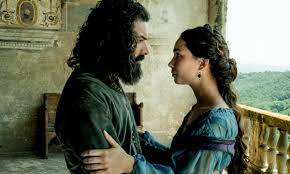
The full Poldark … Aidan Turner as Leonardo and Matilda de Angelis as Caterina da Cremona in the new Amazon series. Photograph: Vittoria Fenati Morace / Amazon Prime
The woman in Leonardo da Vinci’s life is finally getting her due. The new drama Leonardo, due to start on Amazon Prime on 16 April, drags Caterina da Cremona out of the shadows. Billed as his “muse” and played by Matilda de Angelis, this forgotten woman of the Renaissance appears in publicity images deep in intimate dialogue with Aidan Turner as Leonardo.
The show’s writer Steve Thompson has explained her role in the show. “Some of his relationships were with men; those were significant relationships,” he told Variety. “But perhaps the most significant relationship in his life was with a friend who was a woman, with whom he was very close, and we unpack that.” Leonardo is framed as a murder mystery, and it claims to use this device to get at the reality of who the great Renaissance man was.
But Caterina is a figment, a fantasy, a complete piece of tosh, invented by a 19th-century Romantic and for some reason given highly unconvincing credence by one modern biographer, Charles Nicholl.
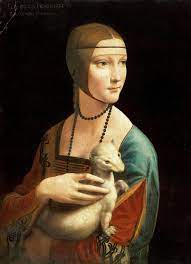
Phallic … Lady With an Ermine by Leonardo da Vinci, 1489-90. Photograph: FineArt / Alamy
If the makers of Leonardo wanted a strong woman character, they had plenty of historical options. He clearly got on well with Cecilia Gallerani, mistress of the ruler of Milan, whom he portrayed holding a very phallic pet mink, perhaps to symbolise her power over men. He was also friends with Isabella d’Este, ruler of Mantua and art connoisseur. Most fascinatingly, there was his encounter with one Lisa, wife of the Florentine merchant Francesco del Giocondo. It’s said he got musicians to play and entertained her with jokes when she posed for the painting we know as the Mona Lisa. What was it he found so mysterious about her? But no solid evidence exists that he ever had a romantic relationship with a woman – either sexual or platonic.
His reputation for loving men has never been hidden and the TV series does depict his relationships with men. Giorgio Vasari’s book The Lives of the Artists, first published in 1550, suggests he was besotted with his male assistant Salaì, “who was most comely in grace and beauty, having fine locks, curling in ringlets, in which Leonardo delighted”. Gossip solidified into social history when documents were found at the start of the 1900s that show Leonardo was accused of “sodomy” before Florentine magistrates in 1476.
All the evidence is that men having sex was common in the art workshops of Renaissance Florence. The sodomy accusation against Leonardo was made to the fantastically named Office of the Night, a unique sex crime agency set up in 1432 to counter what was seen as a specifically Florentine vice. The records of the Office of the Night, brilliantly analysed by historian Michael Rocke, reveal that in Leonardo’s day “the majority of local males at least once in their lifetimes were officially incriminated for engaging in homosexual relations”.
As for Leonardo, he lived with his entourage of good-looking assistants and pupils, dressed them and himself in luxurious clothes including pink and purple tights, and drew stupendously sensual male nudes.
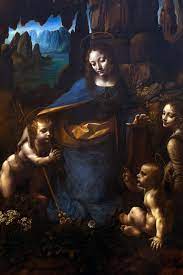
The most queer bit of painting in Britain … Leonardo’s Virgin of the Rocks, at the National Gallery. Photograph: Peter Barritt / Alamy
But for some people that leaves something missing from his life. So his affair with a woman from Cremona was invented in the Romantic age. An Italian writer claimed to have seen a mention in Leonardo da Vinci’s notebooks of his female lover called “La Cremona”. The passage is not in any of Leonardo’s surviving notebooks. And even in the Romantic age, it didn’t catch on.
Why would anyone be desperate to dig up this slender story? Yet one of Leonardo’s modern biographers, Charles Nicholl, tried to resuscitate it. Nicholl noticed a single word, “Cremonese”, in a list of names in Leonardo’s papers in the Royal Collection and claimed it might mean La Cremona. Nicholl then speculates that Leonardo, who would have been 57 at the time, slept with this north Italian sex worker. He can’t have painted female nudes without experiencing heterosexual love, he claims. It’s as if Leonardo’s homosexuality is incompatible with the universality of his art.
Instead of being bedazzled by Turner and De Angelis, why not go to the National Gallery when it reopens and look at Leonardo’s Virgin of the Rocks. The most hypnotic figure in it is an angel whose long curly hair matches Vasari’s description of Salaì and whose tender pale face is magically androgynous. This angel is the most beautiful and most queer bit of painting in Britain.
The Leonardo I want to see on screen is the man who painted this.
Film on State surveillance and LGBT spaces
We have received a request for participants in a film; the subject of which is state surveillance and queer spaces.
A student currently studying an MA in visual anthropology at the University of Manchester, with his filming partner will be gathering material for the above mentioned project. They are hoping to interview LGBT people who remember police raids in the Manchester Gay Village prior to 1990 and learn about their experiences.
They appreciate that this is an extremely sensitive topic and want to assure you that your emotional and physical wellbeing is their foremost concern and any filming work will take place in accordance with the appropriate COVID guidelines as well as the ethical guidelines set out by the university department. Likewise, anonymity might be an issue and they are keen to work around this in any way possible.
If you are interested, please contact us and we will put you in touch.
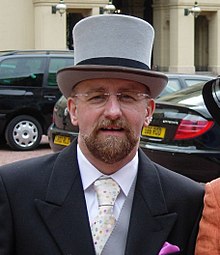
Stephen Whittle (OBE) at Buckingham Palace
Author and journalist Shon Faye talks with LGBT+ trailblazers who have something important, interesting or enlightening to say about what it means to be LGBT+ in the world today.
The conversation is with Stephen Thomas Whittle, OBE (born 29 May 1955) – a British legal scholar and activist with the transgender activist group Press for Change.
Since 2007, he has been professor of Equalities Law in the School of Law at Manchester Metropolitan University.
Having been assigned female at birth, he is described as “a radical lesbian before his sex change and now a leading commentator on gender issues”, who after the Gender Recognition Act 2004 came into force in April 2005, achieved legal recognition as a man and so was able to marry his female partner.
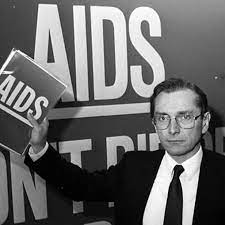
Speaker Lord Fowler backs calls for National Aids memorial
Lord Fowler, the Lord Speaker of the House of Lords, has backed calls for the UK’s first ever National Aids memorial.
Earlier this month, he announced he was stepping down to sit as an independent member of the House in order to campaign on LGBT+ issues, in particular HIV and Aids.
In his first broadcast interview since the announcement, he said a memorial would help fight stigma and discrimination.
BBC Breakfast brought him together with two people with their own memories of the Aids crisis, to discuss why the Aids Memory UK campaign for a memorial is so important.
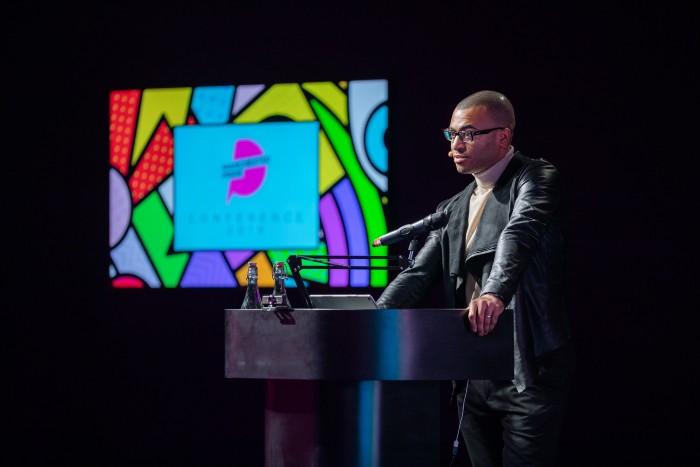
Manchester Pride conference goes virtual with Beyond the Rainbow theme
Tuesday, 20 April 2021 (10.00am – 5.00pm)
Free or £15 with swag bag
Mark Fletcher, Chief Executive Manchester Pride
Manchester Pride sees the return of its annual conference which will be held virtually, for the second year running, due to existing COVID restrictions.
The free conference is the charity’s day long event for companies, professionals, community groups and individuals to hear about important LGBTQ+ topics from some of the UK’s most successful LGBTQ+ figures in culture, business and activism.
2020’s conference provided a platform for, and drew focus to, those whose voices often go unheard.
The event saw the LGBTQ+ charity shine a spotlight on a number of important topics and issues that do not receive the coverage and attention they deserve, both within and outside of LGBTQ+ and non-LGBTQ+ communities and spaces, in mainstream media and beyond.
The theme for 2021 is ‘Beyond the Rainbow: Driving Inclusion and Equality All Year Round.’
The day will be broken down to invite virtual delegates to be part of many important conversations, panels, workshops, speeches and discussions aiming to educate and inspire change.
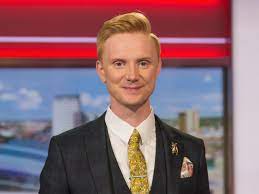
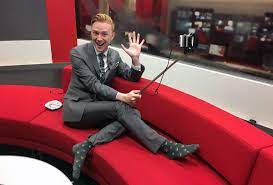
Leading the conference will be host, BBC weatherman, Owain Wyn Evans with spotlight presentations from theatre-maker, writer, performer, producer and HIV activist, most recently notable for his role in It’s A Sin, Nathaniel J Hall and 2021 Drag Race UK star, Ginny Lemon.
In depth conversation sessions will include the topics of Living With A Disability, Creating Inclusive Culture, Being Your Authentic Self, and The Power of Being an Ally LGBTQ+ and Mental Health.
Owain Wyn Evans
Workshops during the event will focus on Labels and Language and How To Set Up Your Own LGBTQ+ Network with Amy Stanning.
The day will end with a round up from CEO for Manchester Pride, Mark Fletcher and an interview with the special guest fashion designer and Queer Eye star, Tan France.
Delegates can also pick up a limited edition Manchester Pride Conference ‘swag bag’ featuring branded tote bags, notebooks, pens and post-its for £15.00 (inc postage) with proceeds going to the charity’s vital work.
Mark Fletcher
“For a second year we will be bringing the conference to our communities in Manchester virtually,” said Manchester Pride CEO Mark Fletcher.
“It’s important to continue with the conference whether it’s in person or virtually, as it is an opportunity for us to connect with the various communities of Manchester and talk to them about the issues facing LGTBQ+ people in Greater Manchester.
The theme for the Conference 2021 is Beyond the Rainbow: Driving Inclusion and Equality All Year Round.
2020 saw a huge number of conversations about equality and inclusion across society and as an organisation it’s vital that we empower the LGBTQ+ communities all year round.
With that in mind we are committed to achieving this, even in light of the current unpredictable situation we are experiencing.
Our virtual conference promises to cover a range of important topics that impact LGBTQ+ people every day through an impressive line-up of highly respected speakers and panels to create an engaging and informative event.”
The conference on Tuesday 20 April 2021 will stream virtually on Hopin, with those who would like to attend being able to sign up here
International Transgender Day of Visibility is an annual event occurring on 31 March dedicated to celebrating transgender people and raising awareness of discrimination faced by transgender people worldwide, as well as a celebration of their contributions to society.
The day was founded by US-based transgender activist Rachel Crandall in 2009 as a reaction to the lack of LGBT recognition of transgender people, citing the frustration that the only well-known transgender day was the Transgender Day of Remembrance, which mourned the murders of transgender people, but did not acknowledge and celebrate living members of the transgender community.
Rachel Levine becomes the first openly transgender official to win Senate confirmation
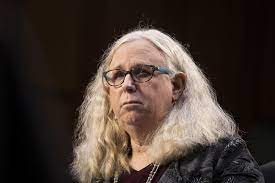
Rachel Levine is the first openly transgender federal official to win Senate confirmation. Photograph: Caroline Brehman/AFP/Getty Images
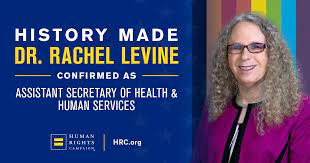
The US Senate on 24 March confirmed the former Pennsylvania health secretary, Rachel Levine, to be the nation’s assistant secretary of health. She is the first openly transgender federal official to win Senate confirmation.
The final vote was 52-48. Republican senators Lisa Murkowski of Alaska and Susan Collins of Maine joined all Democrats in supporting Levine.
Levine had been serving as Pennsylvania’s top health official since 2017, and emerged as the public face of the state’s response to the coronavirus pandemic. She is expected to oversee Health and Human Services offices and programmes across the US.
President Joe Biden cited Levine’s experience when he nominated her in January.
Levine “will bring the steady leadership and essential expertise we need to get people through this pandemic – no matter their zip code, race, religion, sexual orientation, gender identity or disability,” Biden said.
Transgender-rights activists have hailed Levine’s appointment as a historic breakthrough. Few trans people have ever held high-level offices at the federal or state level.
Senator Rand Paul, a Republican from Kentucky, confronted Levine about medical treatments for transgender young people – including hormone treatment and puberty blockers – during her confirmation hearing.
Paul asked: “Do you believe that minors are capable of making such a life-changing decision as changing one’s sex?”
Levine replied that transgender medicine “is a very complex and nuanced field with robust research and standards of care” and said she would welcome discussing the issues with him.
In the past, Levine has asserted that hormone therapy and puberty-blocking drugs can be valuable medical tools in sparing some transgender youth from mental distress and possible suicide risk. A graduate of Harvard and of Tulane Medical School, Levine is president of the Association of State and Territorial Health Officials. She’s written in the past on the opioid crisis, medical marijuana, adolescent medicine, eating disorders and LGBTQ medicine.
New film about remarkable fossil hunter Mary Anning is sensationalised
Kate Winslet plays pioneering palaeontologist Mary Anning whose life’s work was stolen by men. Her story is now being told in film Ammonite, also starring actress Saoirse Ronan.
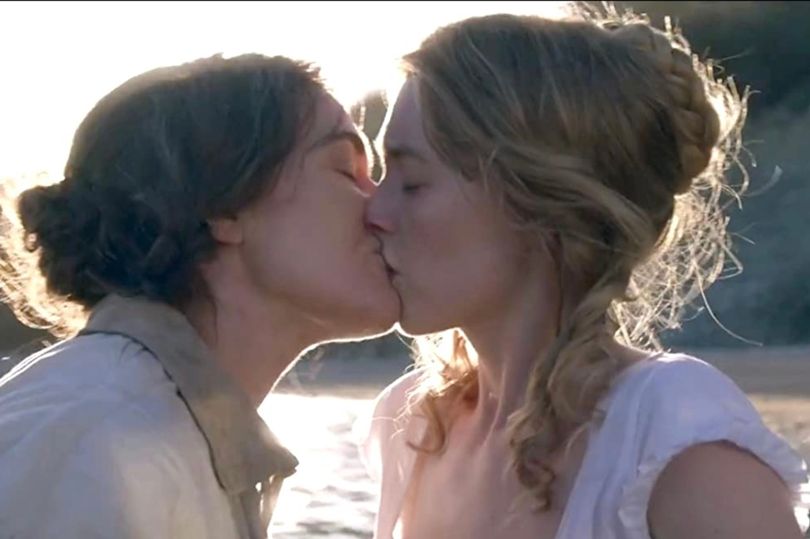
Kate Winslet and Saoirse Ronan kiss in film Ammonite
A new film about famous fossil hunter Mary Anning has been sensationalised – by depicting her as a lesbian.
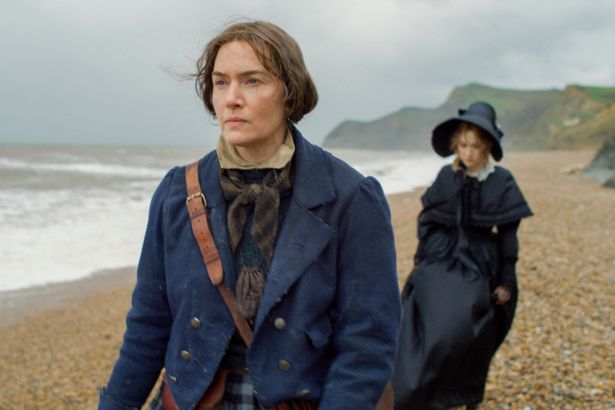
In the film Ammonite, actress Kate Winslet stars as the pioneering palaeontologist with Saoirse Ronan playing geologist Charlotte Murchison.
But what is the truth about the 19th century palaeontologist?
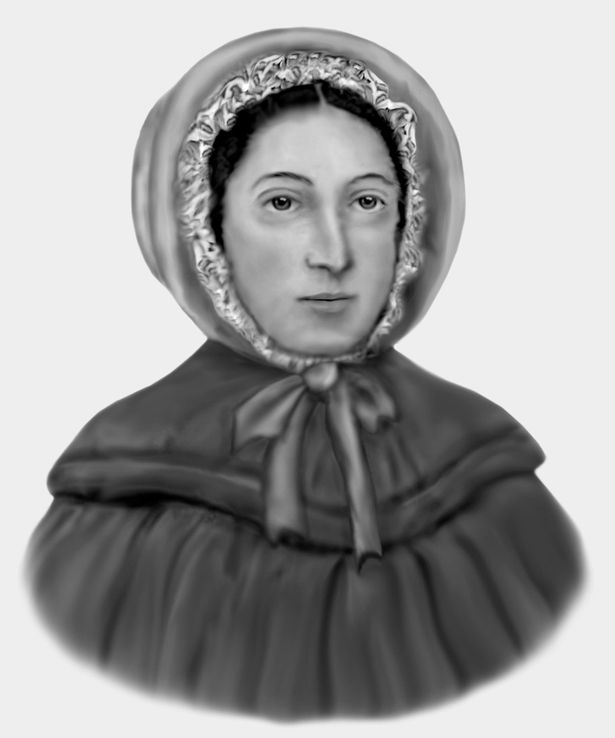
Thanks to her ground-breaking scientific discoveries, Mary has been dubbed “the greatest fossil hunter”.
Yet she had a humble background, born in Lyme Regis, Dorset, in 1799, as the daughter of a poor cabinet maker and one of ten children.
Mary Anning has been dubbed “the greatest fossil hunter” (Image: Alamy Stock Photo)
Named after a sister who had died in a fire aged four, Mary was one of only two to survive into adulthood.
As a baby she was struck by lightning, along with three women who were sheltering under an elm tree. Yet while the adults all died, onlookers managed to revive little Mary. Formerly a sickly infant, she was said to have developed a healthy glow and locals would later link her intelligence and energy to the incident.
Mary’s father Richard supplemented his income by collecting fossils from the rich deposits in nearby cliffs, along what is now known as the Jurassic Coast, selling them on to tourists.
From the age of five she was helping him source and clean up the fossils.
The actresses play lovers Anning and Murchison in the film
Despite little formal education, she learned to read and write and started taking an interest in the new science of geology.
When her dad died aged 44, partly from injuries sustained in a cliff fall, Mary and the rest of the family continued to fund themselves from fossil collecting, selling two of the most common types – ammonites and belemnites – for a few shillings each.
Then, when Mary was aged 12, she and her brother Joseph discovered the huge skull of a strange beast among the rocks.
She painstakingly began digging out the rest of its skeleton to reveal a 17ft monster. Bought by a collector, the specimen was originally thought to be of a huge crocodile.
It was sold on to the British Museum and given the name ichthyosaurus or “fish lizard” – and later identified as the first complete fossil of a 200 million-year-old marine reptile.
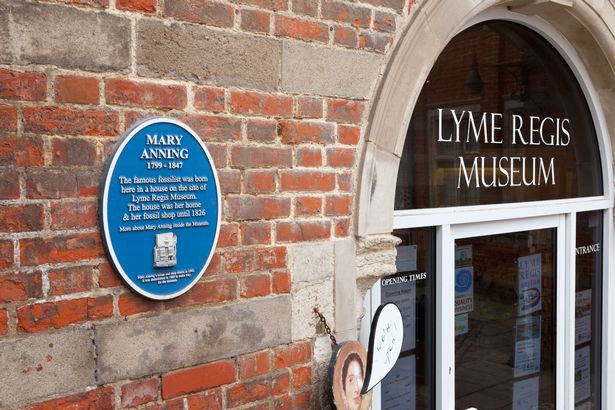
The Museum at Lyme Regis, Dorset, with the plaque for Anning (Image: Alamy Stock Photo)
As time went on, Mary would dig up more amazing fossils that would spark fierce scientific debate about the possibility of extinct creatures, in a world before Charles Darwin had yet published his theories about evolution or the word “dinosaur” had been coined.
Her other startling finds included the first complete skeleton of a plesiosaur – another massive marine creature. Mary also unearthed the first British pterosaur, a flying reptile also known as a pterodactyl, as well as a string of other important species.
Having become something of a celebrity, she opened up a fossil shop that was frequented by the rich and famous.
Fossil finding was dangerous work because the best prehistoric treasure was to be found in the perilous debris of the crumbly Blue Lias cliffs left behind after stormy weather, which could collapse suddenly.
Once Mary nearly drowned while seeking out a find and she defied death again in 1833 when a landslide that consumed her black-and-white terrier came within inches of burying her alive too.
In a letter to her friend Charlotte, also a keen scientist, she recalled: “The death of my old faithful dog has quite upset me, the cliff that fell upon him and killed him in a moment before my eyes, and close to my feet … It was but a moment between me and the same fate.”
She and Charlotte did meet, but there’s no evidence that they became lovers, despite the sex scenes depicted in the new film. Its director, Francis Lee, justified the storyline saying: “I wanted to give her a relationship that felt worthy of her, that felt equal.”
Winslet, who lived on her own in a cold cottage lit by candles to get into the role of Anning for the movie, adds: “She never married – so we had a bit of freedom in terms of inventing our version. I love that Francis chose to pair her with a woman.”
But her relative Barbara Anning has said: “Do the film-makers have to resort to using unconfirmed aspects to make an already remarkable story sensational?”
The film does highlight that Mary received little credit for her discoveries during her lifetime, having sold on most of her famous finds.
Yet as well as unearthing them, she studied the science involved and even pioneered the study of fossilised poo.
But she is barely mentioned in the papers of professors, who often took credit for her work and wasn’t allowed into debates analysing her finds.
The Geological Society of London also refused to admit Mary as a member.
She wrote angrily: “The world has used me ill … These men of learning have sucked my brains and made a great deal of publishing works, of which I furnished the contents, while I derived none of the advantages.”
Mary died at the age of 47, from breast cancer – still relatively poor – but today many of her finds are displayed in London’s Natural History Museum.
Along with the new film the Royal Mint is releasing commemorative coins celebrating her life and a new statue is set to be erected too.
David Attenborough has described Mary as “truly remarkable” and her work is finally getting the recognition she deserves.
● Ammonite was released on 26 March and is available to rent
UK’s first purpose-built LGBT+ Extra Care housing facility in Manchester moves forward
Anchor Hanover Group have been chosen as the preferred development partner to deliver and manage the Extra Care homes.
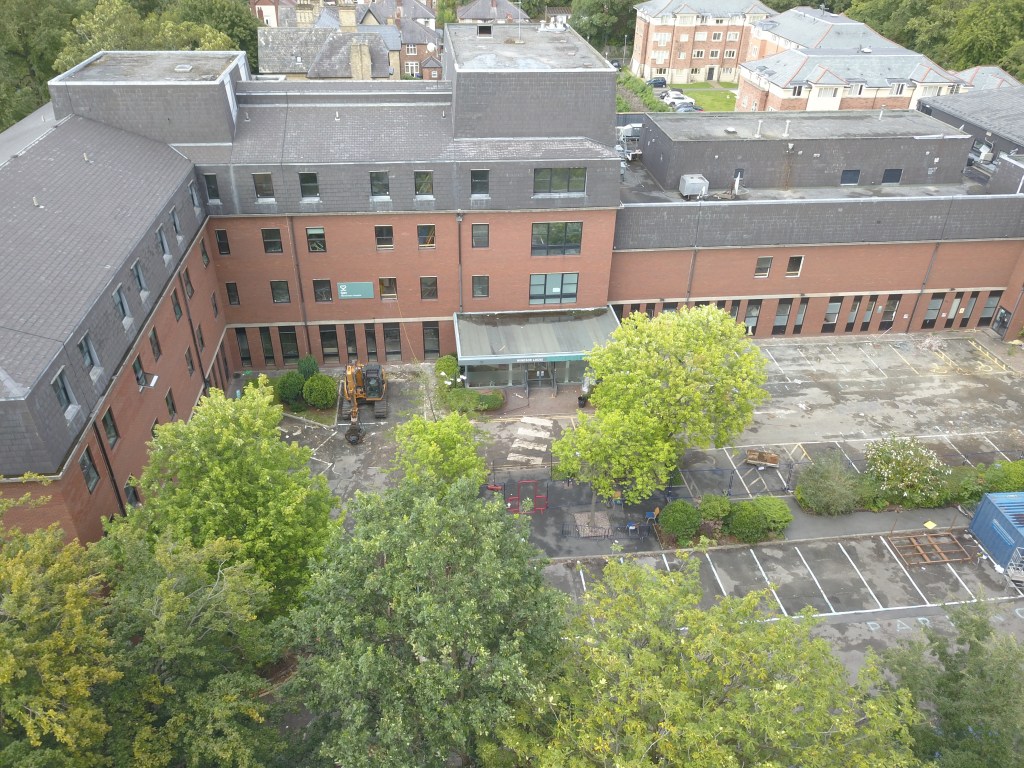
The site on Russell Road in Whalley Range, South Manchester is also the first LGBT+ older person’s housing project that has been co-produced with LGBT Foundation and the local community.
LGBT Foundation has also received Homes England funding to produce an online Learning Journal about the history of the Manchester scheme, to help other Councils and cities develop LGBT+ Extra Care schemes across the country.
Proposals to deliver the UK’s first purpose built and co-produced LGBT+ older person’s housing scheme have taken a significant leap forward this week as Anchor Hanover – England’s largest not-for-profit provider of housing and care for people in later life – has been chosen as preferred partner to deliver the scheme.
The innovative project will deliver more than 100 apartments for people aged 55 or over, with a mix of affordable rent and shared ownership tenures, to ensure the homes are as accessible as possible to Manchester people.
Anchor Hanover’s Extra Care housing schemes provide residents with high-quality housing and the reassurance and flexibility of having essential on-site services, such as care and catering, which may be more appropriate to their needs in later life.
Extra Care locations create safe, vibrant communities which enable residents to live independently as their needs and lifestyle change.
Pre-demolition
The specific offer at the Russell Road LGBT+ Extra Care will be developed in collaboration with a local Community Steering Group – which is made up of members of the Council, Councillors, local residents and importantly members of the LGBT communities.
Anchor Hanover has been chosen to develop the scheme following a competitive process. They were selected after demonstrating their experience in delivering similar projects across England, including New Larchwood, an LGBT+ inclusive retirement housing scheme in Brighton, and showed an ambition to create a facility that meets the needs of the city’s LGBT+ community.
Subject to Anchor Hanover Board approval, the organisation will invest approximately £20m to develop the LGBT+ Extra Care facility.
Anchor Hanover is committed to the local area and currently has 110 housing locations in Greater Manchester as well as a large programme of retirement developments across England.
Mid-demolition
The Learning Journal summarises the need for the LGBT Extra Care Scheme and how we have reached this point in its development. It is based on interviews with those involved in the project thus far and groups the lessons learned under a range of themes such as evidence of need, roles of partners and community engagement. The journal is an honest appraisal of the challenges and successes of the past, and it gives people the opportunity to share their views as the journal grows.
Manchester’s LGBT Extra Care scheme was first announced and agreed by the Council’s executive in 2017.
Since then, the Council has been working closely with the LGBT Foundation to develop the core principles of the scheme, how it should operate and what care should be available onsite to support LGBT+ people as they get older.
Once the right site was acquired in Whalley Range, South Manchester (the site was formerly a Spire Hospital) the Council and LGBT Foundation have worked to develop strong relationships with the local community to help guide the scheme.
Mid-demolition
The Community Steering Group was set up in 2020 with the aim of co-producing the principles of the scheme and agree design concepts that will complement the local area.
In collaboration with the Community Steering Group, Anchor Hanover will develop the plans for the Russell Road site, with a view to submitting its first planning application by Winter 2021/2022.
Manchester’s older LGBT population is growing. There are more than 7,000 people in Manchester over the age of 50 that identify as LGBT+ – and this figure is expected to rise over next two decades.
Thanks to funding from Homes England, LGBT Foundation was able to carry out further survey of the communities’ needs and hopes for the scheme as well as creating an online Learning Journal, to track the journey of the development of the Manchester’s LGBT+ Extra Care scheme from the early discussions over five years ago.
An LGBT Foundation report, commissioned by Manchester City Council, indicated higher levels of loneliness and isolation amongst LGBT older people, experience and fear of discrimination in existing accommodation and a desire for affordable, accessible LGBT specific accommodation where they can be open about their identity in later life.
The Learning Journal will exist on LGBT Foundation’s website, where it will be updated by the range of stakeholders involved as the development of the scheme progresses. It is hoped that, through the journal, other regions can see what has worked and what can be done differently as they plan their own housing solutions for older LGBT people.
Cllr Bev Craig, Manchester City Council’s lead member for adult health and well-being, said:
“Manchester was proud to be the first place in the country to announce such a scheme so it’s great to see this scheme come to fruition. Our ambition came on the back of years of research and engagement with older LGBT people.
We’ve been working closely with the LGBT Foundation and local people for some time to ensure the site, location, the principles of the scheme, and eventual design principles work – both for the LGBT+ community, but also for the local people in Whalley Range.
We already know LGBT+ people are more likely to be lonely later in life, and as this community is growing, it shows that this Extra Care is not only welcome but absolutely needed.”
Cllr Suzanne Richards, Manchester City Council’s executive member for housing and regeneration, said:
“Extra Care housing has proven hugely popular and the LGBT+ scheme on Russell Road will add to more than 330 apartments that will be completed for older people through to September this year. Crucial for us is that these schemes are accessible for Manchester people and we will ensure these homes will be affordable to Manchester people.”
Anchor Hanover’s Head of New Business, Charles Taylor, said:
“We are delighted to be working on this innovative new Extra Care retirement housing project in Manchester, to deliver accessible homes in a place where there is a thriving LGBT+ community. We look forward to collaborating with Manchester City Council and the LGBT Foundation to develop a place where people can continue to love living in later life.”
Paul Martin OBE, CEO LGBT Foundation:
“It’s fantastic to see the LGBT Extra Care Scheme move forward into the next stages of development. Everyone deserves to have access to safe, affordable housing where they can be sure they feel secure and welcome. Many older LGBT people have grown up in a world hostile to their identities, and are worried about their future, particularly if they are likely to require care in later life. This scheme is a vital and exciting step forward for our communities and the Learning Journal will track our journey and share recommendations for other schemes that will follow.”
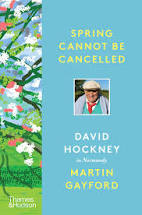
Spring Cannot Be Cancelled by David Hockney and Martin Gayford – review
Lockdown blossom … a lavishly illustrated record of the exchanges between the artist, in Normandy, and the critic, in Cambridge, during the past year.
In the autumn of 2018 David Hockney made a brief trip to France. He wanted to look at art – paintings from Picasso’s blue and rose periods and the great tapestries of Paris, Angers and Bayeux – and to enjoy “all that delicious butter and cream and cheese”. (As well as a country “more smoker friendly than mean-spirited England”.) While in Normandy Hockney declared a desire to capture the northern French spring as he had done a decade or so before in east Yorkshire, producing work that became the focal point of his blockbuster 2012 Royal Academy show. “There are more blossoms there,” he wrote to the art critic Martin Gayford. “You get apple, pear, and cherry blossom, plus the blackthorn and the hawthorn, so I am really looking forward to it.”
In impressively short order a large half-timbered farmhouse 40 minutes from Bayeux was acquired. It was a bit like “where the seven dwarfs live in the Disney film”, Hockney explained. “There are no straight lines; even the corners don’t have straight lines.” Set in four acres and surrounded by meadows, orchards and streams, it was quickly renovated and within just a few months Hockney was emailing out drawings from, and of, his new home to friends all over the world.
For someone so closely associated with his locations – the blue Californian skies and swimming pools early in his career, more recently the muddy lanes and hedgerows of the Yorkshire Wolds – Hockney rarely stays in one place for long. He has made work in China, Japan, Lebanon, Egypt, Norway and, of course, France. He lived in Paris for a couple of years in the mid-70s and, as Gayford points out, while the new house was bought, apparently, on the spur of the moment, “It was surely not entirely chance that an artist long admiring of French painting and the Gallic way of living, eating and smoking, with a French assistant, happened to find an ideal resting point just where and when he did.” It was time for a new venture.
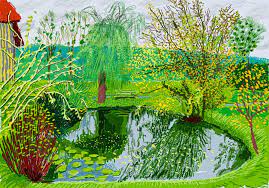
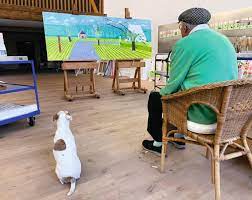
Gayford has been a friend and sort of Boswell to Hockney for a quarter of a century and has written two previous books that were both with and on the artist. He visited Hockney in France during the summer of 2019 and it was assumed he would return the following year. Of course that was not to be. But what had begun as one type of project soon turned into a different and larger one as Covid-19 exerted its grip. Perversely, the new restrictions on movement had presented an opportunity for Hockney. One of the selling points of the house was that he wouldn’t have to drive anywhere to find his subjects, as it was all there in the trees, streams and skies on his grounds. Now his patch of land became his sole focus, and his excitement at the arrival of the 2020 spring, one of the most abundant for decades, was palpable. “It’s spectacular,” he wrote to Gayford. “And I’m getting it down.” Instantly, in those early days of the pandemic, the work became a source of hope and solace to a fearful public with his vivid iPad paintings of landscapes and still-lifes from his garden, made as the world locked down around him, appearing on the front pages of newspapers and on the BBC news.
By now Hockney and Gayford’s conversations had moved to FaceTime, Gayford with a glass of wine in Cambridge, Hockney with a beer in Normandy, happily intrigued by the weirdly distorting light effects a dodgy wifi signal could render on the screen. This book is Gayford’s record of their exchanges placed within the context of a wider appreciation of Hockney and his work, of art history in general and of some pleasingly digressive musings on the “new things said and done by an old friend, and the thoughts and feelings they prompted in me”. Gayford artfully deploys the notion of perspective, a longstanding artistic preoccupation for Hockney, as a recurring motif when examining the men’s relationship as it evolves over time with their vantage points equally recalibrated by major events – the pandemic, Gayford having a minor heart attack in January 2020 which required a stent, as Hockney had 30 years earlier – and by small observations about gardens or sunsets or rain.
Gayford convincingly conveys Hockney’s growing enthusiasm and energy for his task. When he alluded to Noël Coward’s dictum that “work is more fun than fun”, Hockney’s rejoinder was to quote Alfred Hitchcock’s variation on the old saying “All work made Jack”. Hockney’s burst of productivity manifested itself in a constant stream of new images arriving in Gayford’s inbox ready for distanced scrutiny. Some of this work will feature in a new Royal Academy show due to open this May. Examinations of Hockney’s lines made with crayons, charcoal, pencils and the ultra-thin marks available via an iPad led Gayford to ruminations on drawings by Rembrandt and Van Gogh. Paintings of the garden expanded into thoughts on Monet. Mention of the work of Hockney’s support team – Hockney often says “we” rather than “I” – spilled into assistants as a sub-genre of art taking in Velázquez, Tintoretto, Rubens, Warhol and Lucian Freud.
Gayford is a thoughtfully attentive critic with a capacious frame of reference and his brief excursions into houses in art, Hockney’s reading (Flaubert, Proust, Julian Barnes), his musical tastes (Wagner), and that almost definitive Hockney subject, the depiction of water – described by Hockney as always a “nice problem“ for an artist – consistently illuminate both Hockney’s work and the other artists his work brings to mind. (It should be added that the reader can see in the comprehensive illustrations almost everything Gayford mentions.)
While Picasso is the artist Hockney most often talks about, Gayford cites more often another favourite, Van Gogh, who liked to attach little sketches to his letters much like Hockney does with his emails. Living in the scruffy outskirts of Arles, and somewhat isolated as no one much liked him, Van Gogh just got on with making memorable and beautiful art with what was around him. The unprepossessing flat farmland of Hockney’s Yorkshire and now Normandy would similarly be seen as not obviously ripe locations for such close inspection, but as Gayford says, the moral is that “it is not the place that is intrinsically interesting; it is the person looking at it”. Following the spring Hockney continued to capture his four acres on through the summer and the harvest and the glimpses of autumn moons in anticipation of this year’s spring, for which he was intending to ban visitors to his home from March to May, lockdown or not.
• Spring Cannot Be Cancelled is published by Thames & Hudson.





 Out in the City