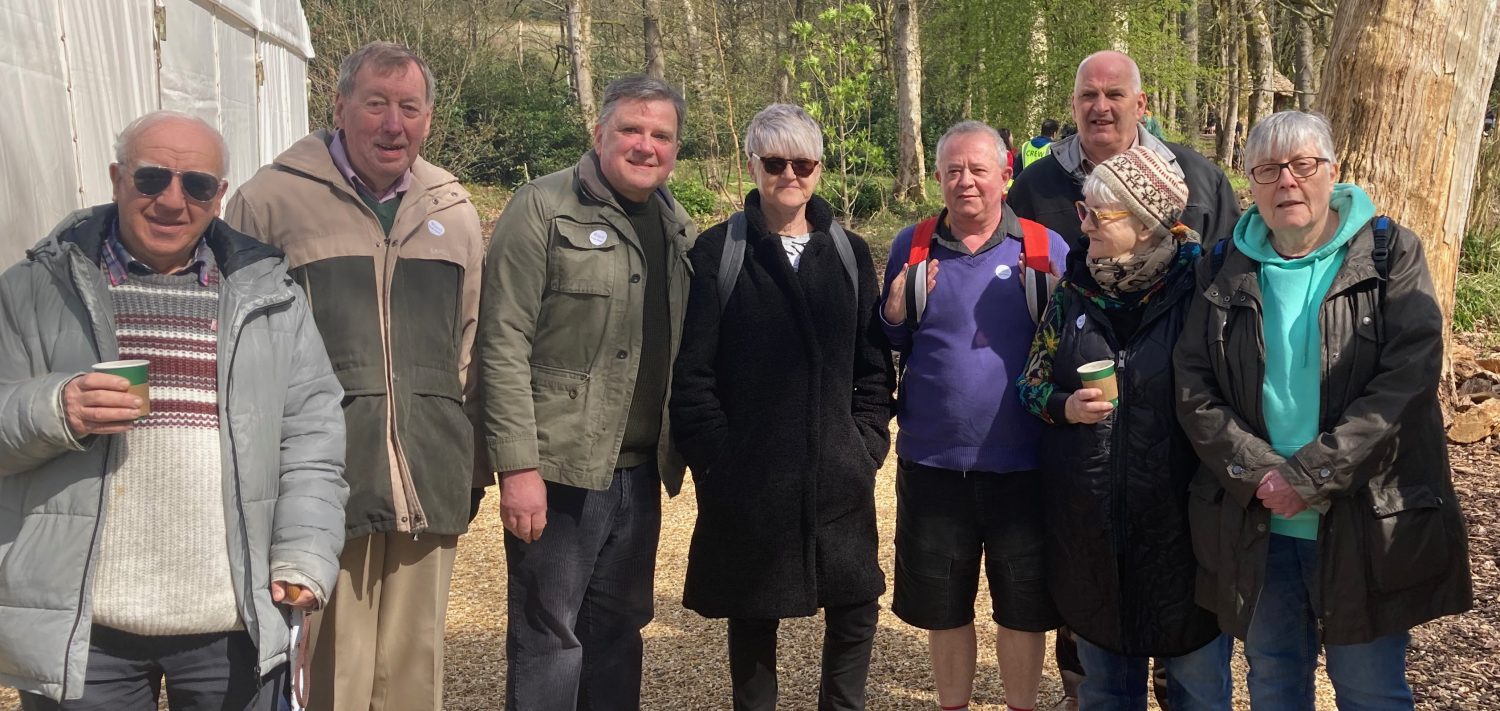
We met at Via on Canal Street for lunch, before taking the tram to New Islington. We were heading for the Community Room in Mayes Gardens.
Mayes Gardens is an estate of 48 one and two bed bungalows and apartments in the New Islington area of Ancoats. It’s an almshouse charity founded in 1635 to provide modern, safe and independent homes.
We had great fun playing Chess, Connect Four, Scrabble and more!
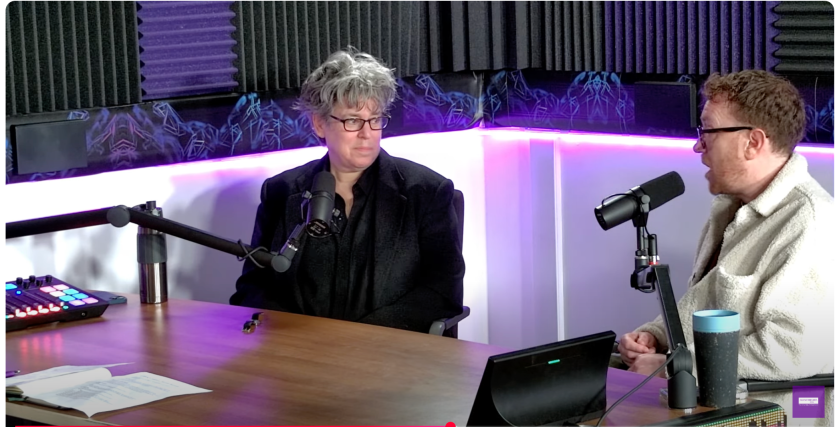
Important Lessons From LGBTQ+ History – Podcast
In this podcast for LGBTQ+ History Month, the guests will be discussing best moments from Manchester’s queer history, how to take care of ourselves and each other in the current political climate and what lessons we should take with us when thinking about our future.
Please be aware, this video contains frank discussion about experiences of transphobia and homophobia, including mention of slurs and violence.
Chair: Aisha Akram, Wellbeing and Liberation Officer, University of Manchester
Guests: Monica Pearl, English and American Studies Professor and ACT UP activist; and
Dominic Bilton, Curator and Programme Developer, Queer the Whitworth.
Listen here:
ACT-UP
ACT UP (AIDS Coalition to Unleash Power) was formed on 12 March 1987, at the Lesbian and Gay Community Services Center in New York City.
ACT UP Manchester was formed in 1990. We punched above our weight as we were all about lying in the road, telephone-blocking, fax-zapping, letter-writing, informing, condom-dropping, researching, lobbying, talking, shouting, screaming, stickering, misbehaving, lying-in, dying-in, painting, retaliating, creating and having fun.
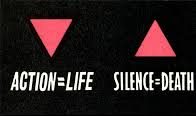
Action = Life – Silence = Death
Exist – Resist – Persist
Wake Up – Rise Up – Act Up
Queer Treasures of the Manchester Central Library – 3
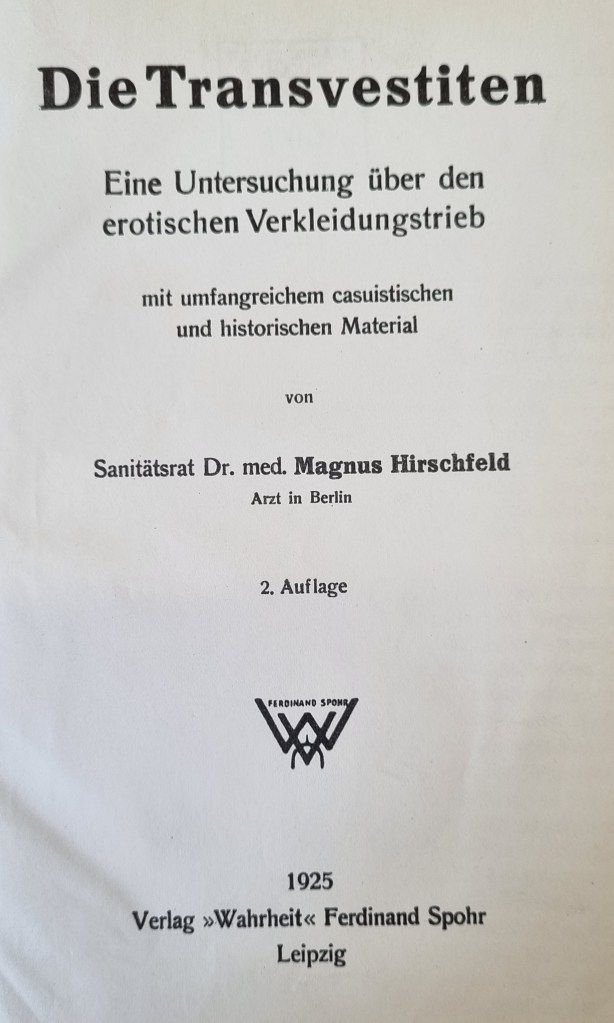
‘Die Transvestiten’ by Magnus Hirschfeld
This is the third of a short series of articles about queer treasures that are currently to be found in the Archives held at Manchester Central Library.
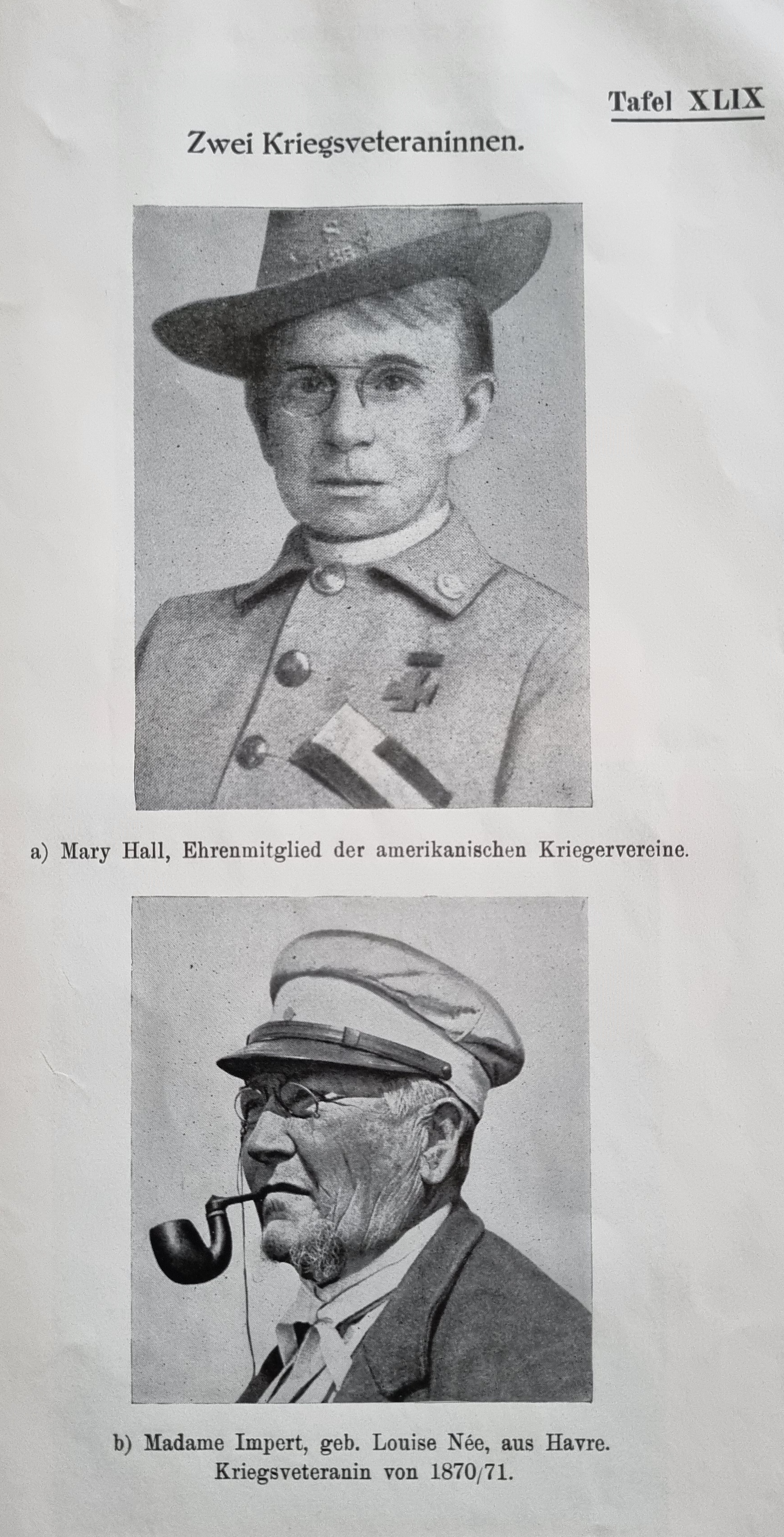
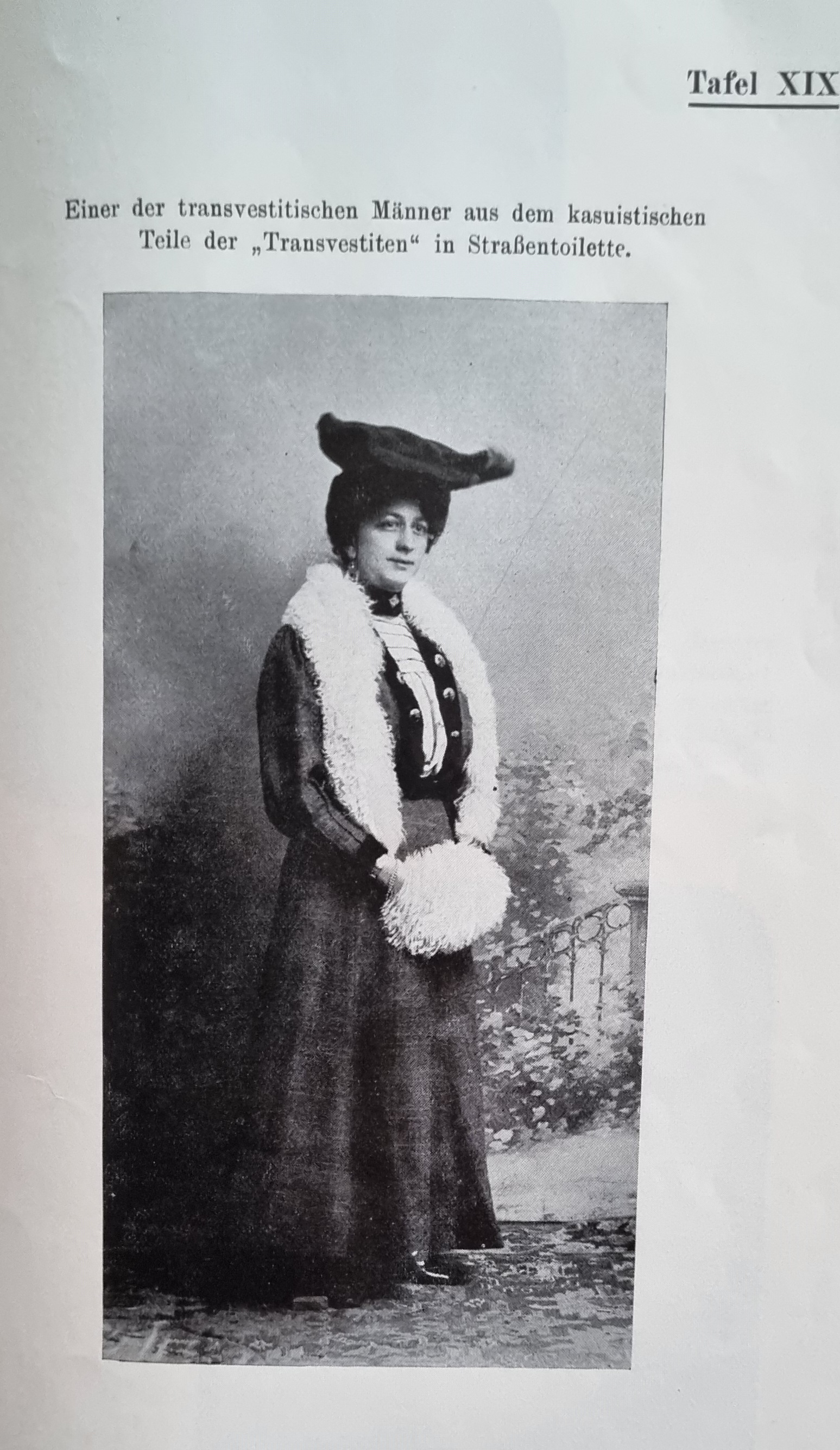
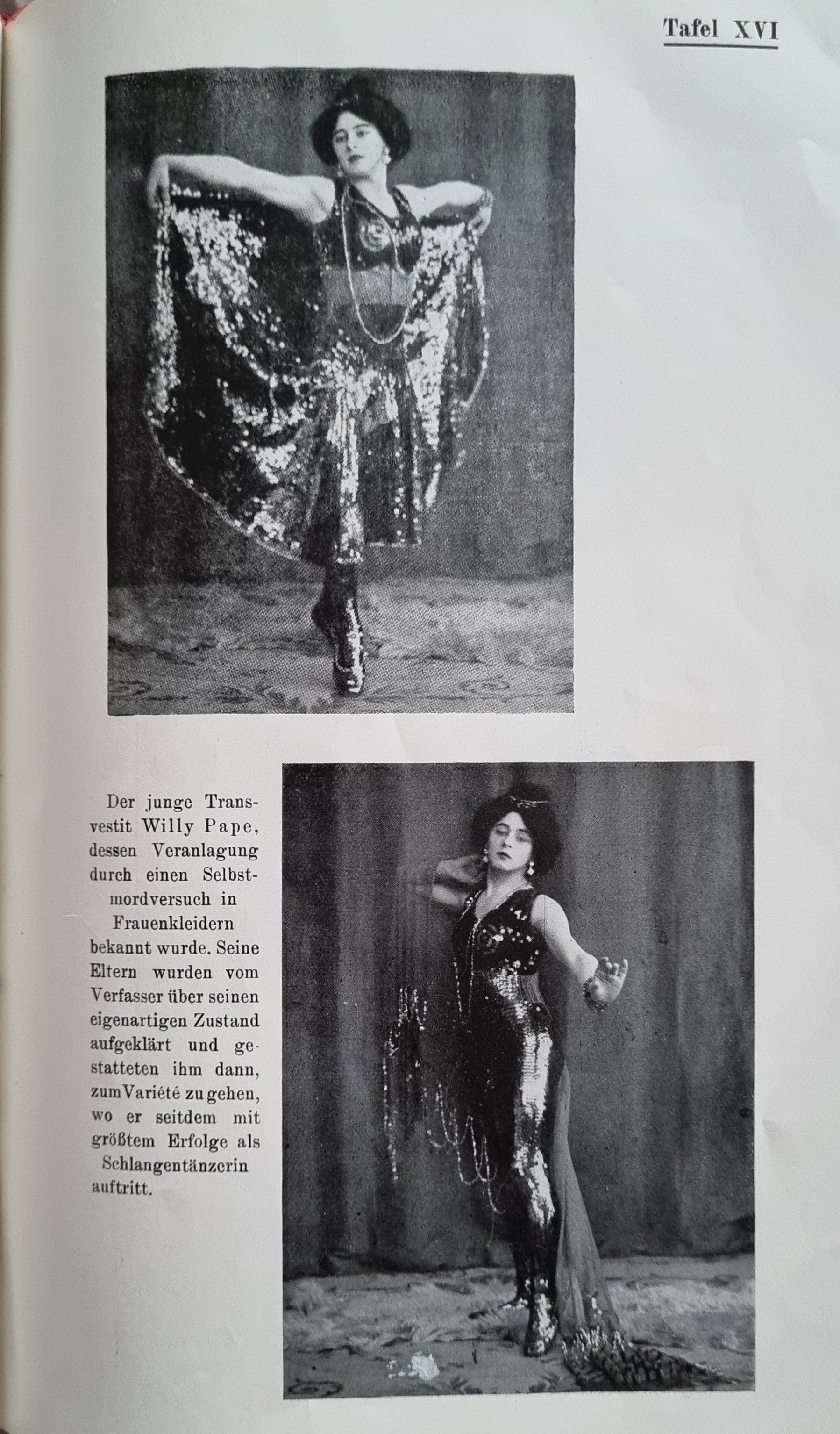
The Archives holds an early copy of Magnus Hirschfeld’s groundbreaking work on what we would now call ‘trans’ people. ‘Die Transvestiten’ (The Transvestites), subtitled as ‘Eine Untersuchung über den erotischen Verkleidungstrieb’ (An investigation into the erotic drive to disguise) was the first systematic, modern and scientific look at the variety of people who chose to cross-dress throughout history and in the present day, and to understand their reasons for doing so.
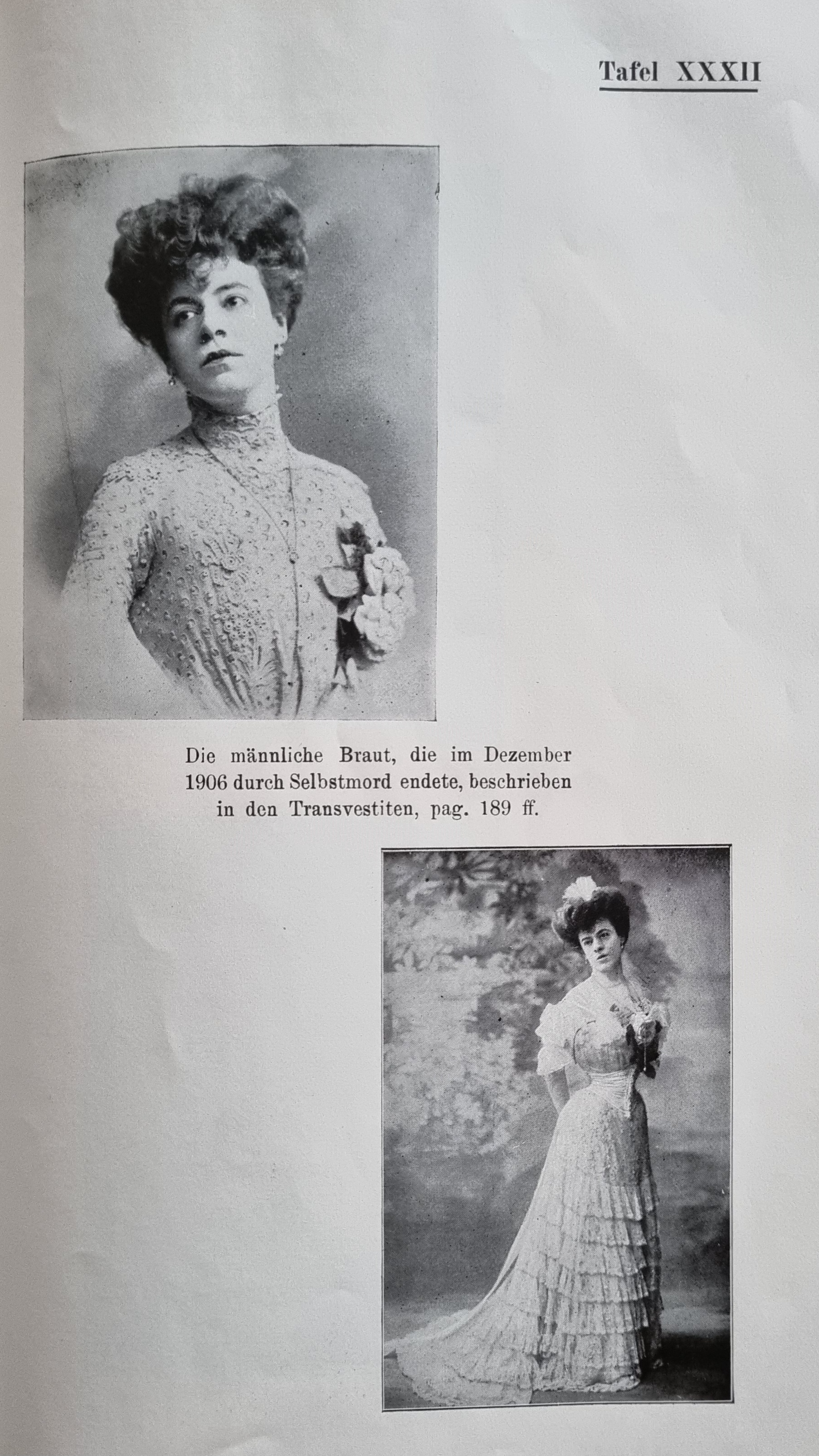
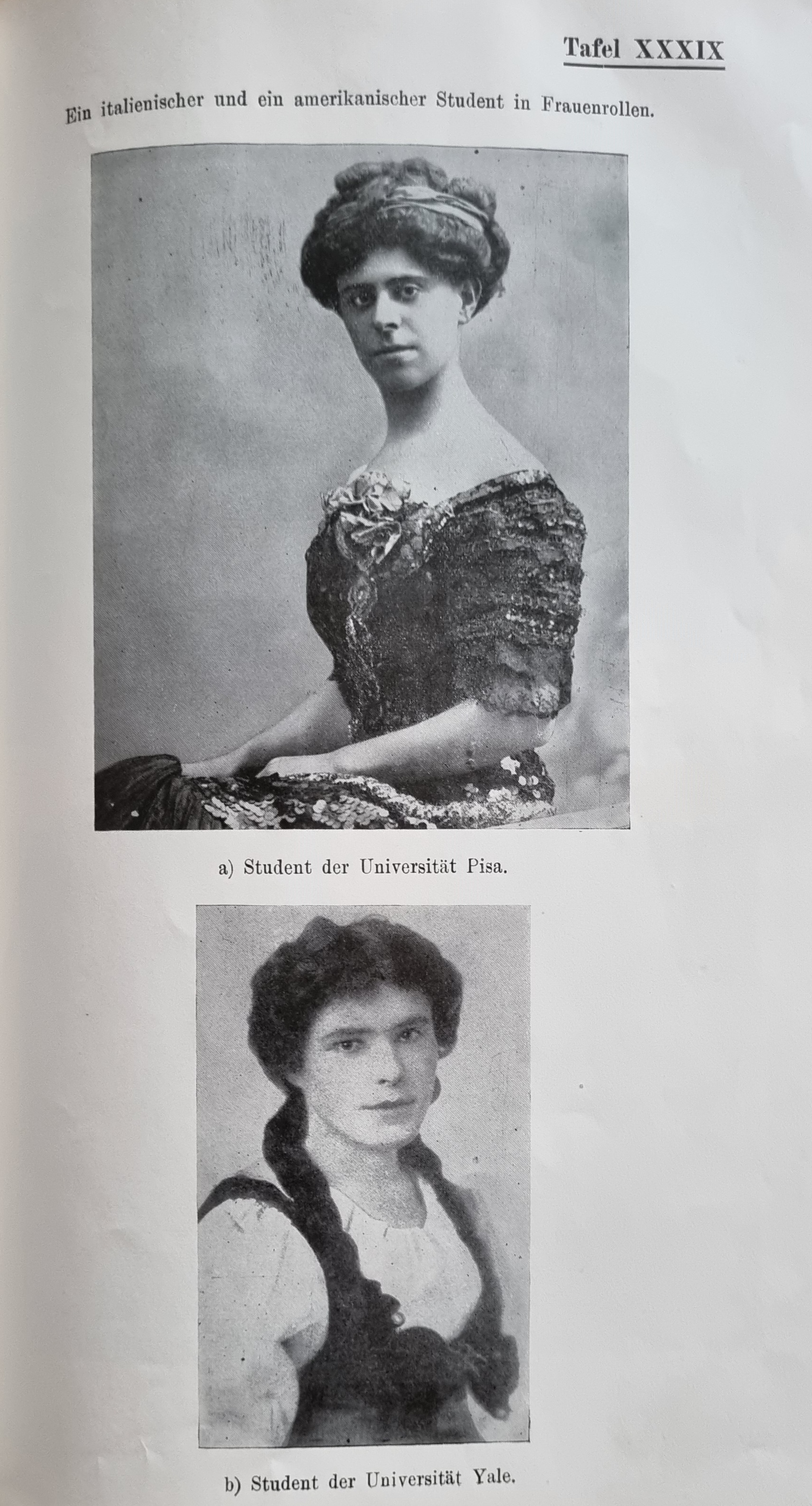
In Hirschfeld’s study, anecdotes of the past ‘transvestites’ were used, as well as contemporary ‘case histories’, (including the first-person narratives of cross-dressers themselves), to attempt to obtain a wholistic perspective on the subject. Sadly, Manchester Library’s copy does not contain the supplemental volume of pictures.
Hirschfeld himself was gay, but could never come out without finding himself being investigated under Paragraph 175 of the German Penal Code which forbad sexual relations between males. Nonetheless since the 1890s onwards he was publicly involved in organising petitions in support of law reform and, subsequently, in establishing the Institute for Sexual Science in Berlin (Institut für Sexualwissenschaft). With the collapse of cinema censorship after the First World War, in 1919, Hirschfeld worked on, (and appeared in), the first serious full-length film ever made about male homosexuality, called ‘Anders als die Andern’ (Different from the Others).
Whilst a critical contemporary audience would find much to disagree with in Hirschfeld’s handling of his project, and some of his conclusions, nonetheless ‘Die Transvestiten’ was groundbreaking, as the Digital Transgender Archive records –
‘Moving away from the methods of other sexological research at the time that lumped all types of sexual and gender diversity into more all-encompassing groupings, Dr. Hirschfeld theorized a distinction between sexual desires and gender expressions. With this distinction came a whole new category of interpreting and understanding gender non-conformity – the “transvestite.” And with a new identity marker came new opportunities for community building, more social awareness, and even a more scientific and less stigmatizing way of encountering gender difference.’
Hirschfeld’s truly pioneering works and social activism paved the way for all who do not conform to gender and/or sexual stereotyping norms in societies to be better understood and publicly accepted.
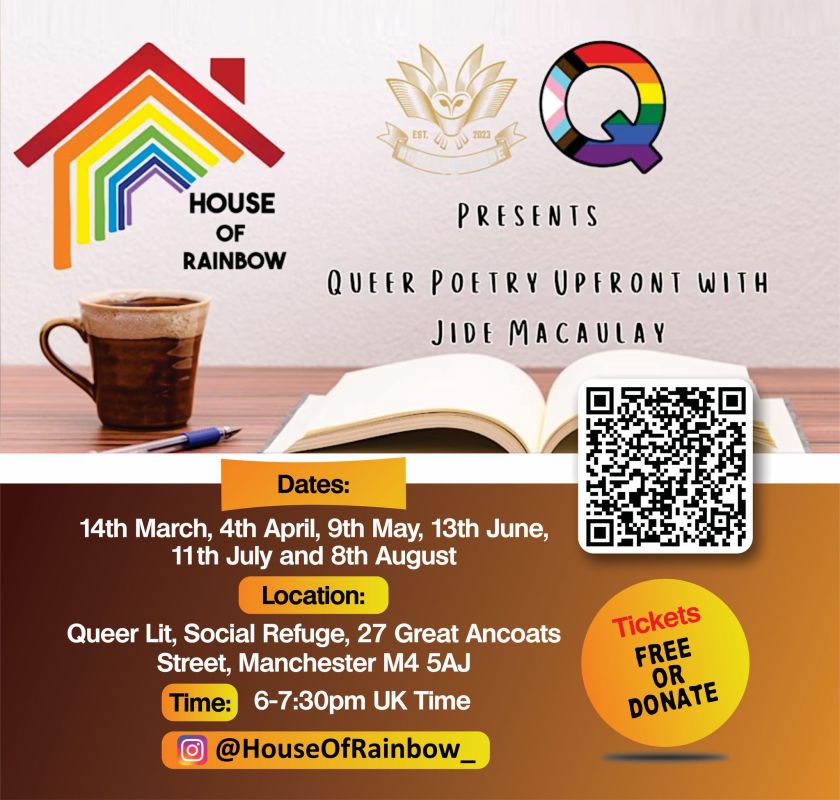
Queer Poetry Lovers! – Friday, 14 March from 6.00pm to 7.30pm – Free
Queer Lit, Social Refuge, 27 Great Ancoats Street, Manchester M4 5AJ
Are you passionate about poetry? Come along to our new poetry workshop. Join Jide Macaulay for an evening of poetry and community on the following dates:
14 March, 4 April, 9 May, 13 June, 11 July and 8 August.
This workshop is open to all – whether you’re a seasoned poet or just starting out. Come along, connect with a supportive community, and let your words take flight. Scan the QR code to register and secure your spot!
2025 is a Special Year – It’s a Year of Anniversaries:
First edition of Round the Horne at 2.30pm on Sunday, 7 March 1965 on the BBC Light Programme
60 years ago – Round The Horne
Writers Marty Feldman and Barry Took use gay slang Polari in the innuendo-laced Julian and Sandy sketches in Round the Horne, with literal straight-man Kenneth Horne.
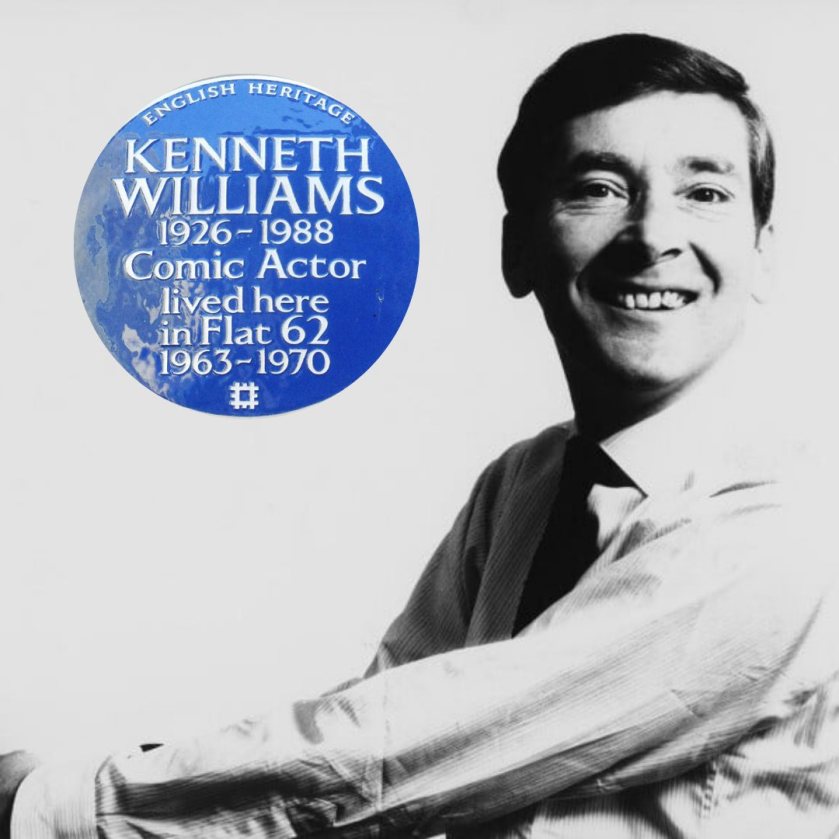
Millions listen at Sunday lunchtimes to the highly gay stereotyped characters played by Hugh Paddick and Kenneth Williams.
Polari has origins in the Roma communities, Italian, slang and other sources. Its aim is to confuse outsiders, especially ‘Betty Bracelets’. (Polari for the police!)
50 years ago – LGBT Foundation Helpline
Fifty years ago, on 2 January 1975 a telephone rang for the first time. It was a helpline – the Manchester Gay Switchboard – and was situated on the stairway in a rented Longsight flat.
There have been name changes and relocations over the years, but to date it’s estimated that more than 250,000 people have rung up, registering more than 3.7 million minutes worth of advice and support.
40 years ago – George House Trust
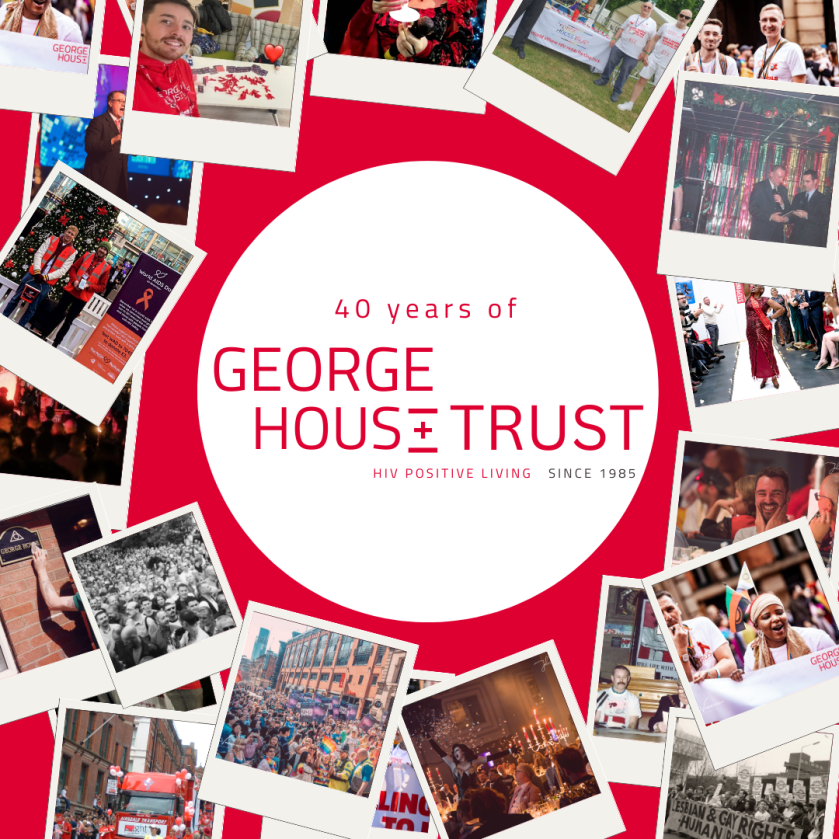
This year is a big milestone for George House Trust as they mark their 40th year of providing advice, support and information for people living with, and those affected by, HIV.
The symbol for a 40th anniversary is ruby and they will be painting everything red this year, so please join in and show your support by wearing your red ribbon whenever and wherever you can.
30 years ago – Gaytime TV begins
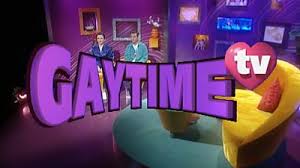
Gaytime TV was a late night gay-themed comedy and lifestyle magazine programme broadcast on BBC 2. It was presented by Rhona Cameron and Bert Tyler-Moore and later Richard Fairbrass. The programme ran until 1999.
20 years ago – Out In The City
Out In The City is a social and support group for members of the LGBT+ communities over the age of 50. It started in 2005 as part of the Ageing Well service provided by Age UK Manchester, but has been a self-organised group since 2018.
20 years ago – Schools OUT
Over the past 20 years, since the first LGBT+ History Month in 2005, Schools OUT have highlighted the incredible things LGBT+ people in all our diversity have achieved throughout history in all areas of life.
20 years ago – Sparkle
The Sparkle Weekend is the original celebration of gender diversity – featuring live entertainment, workshops, wellbeing activities, family and youth provision, sober spaces, market traders, food, drink, and much more! There have been 20 years of celebration, advocacy, and education.
10 years – Stand By Your Trans
On Saturday, 25 July 2015 Trans Pride was held in Dorset Gardens, Brighton. It was hosted by Kate O’Donnell, singing “Stand By Your Trans” with the Rainbow Chorus.
Celebrate International Women’s Day
Manchester is set to mark International Women’s Day (IWD) 2025 with a dynamic and inclusive programme of events aimed at celebrating, empowering, and advocating for women across the city.
It is International Women’s Day on 8 March, the annual event that celebrates women’s achievements and focuses attention on the continuing fight for gender equality.
Manchester is the home of strong influential women. The fight for women’s rights was forged for many here in Manchester – not only the city’s radical past contributing towards greater political power in the form of the Representation of the People Act 1918 – but here the Suffragette movement was also founded.
The event has particular resonance in Manchester where suffragette Emmeline Pankhurst was born and later rallied the troops from her home on Nelson Street.
Suffragette activity emerged out of The WSPU – with marching rallies through the city centre and public speeches from the Pankhurst family.
Specific Manchester buildings have their share of women’s history here, too. For example, the Free Trade Hall is not only the place where Emmeline’s daughter Christabel and friend Annie Kenney interrupted a Liberal Party conference by demanding greater rights for women and were arrested, but the first public meeting on the issue of women’s rights was held here even earlier in 1868; itself led by a woman – Lydia Becker.
And the history of strong women here has continued.
International Women’s Day in Manchester
Accelerate Action at Manchester Central Library
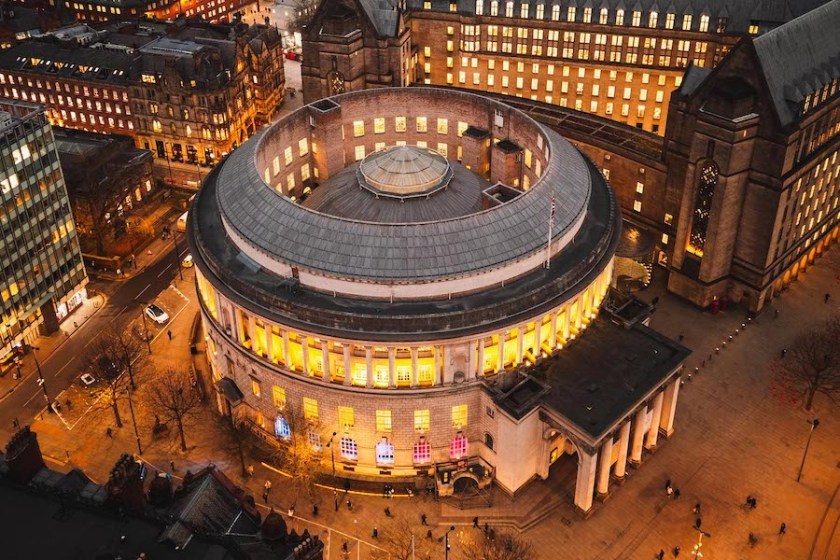
Taking place at Manchester Central Library on Saturday, 8 March, the council’s celebrations promise to be an intriguing gathering of women, allies, and community organisations working towards gender equality.
With the theme ‘Accelerate Action,’ IWD 2025 calls on supporters to challenge the systemic barriers that women from all backgrounds continue to face in their personal and professional lives.
Instead of its traditional ‘Walk for Women,’ Manchester City Council has collaborated with various women-led community organisations to design a fresh approach that better reflects the city’s diverse female voices.
Thanks to funding from the annual IWD grants programme, multiple community organisations will host events citywide, culminating in a special programme at Manchester Central Library under the banner of ‘HER: Heal, Encourage, Revive.’
Here’s the full line up:
Heal (Performance Space)
Flourish Together: Mindfulness and relaxation session, 11.00am – 1.00pm
Equal Education Chances: Letter writing and positive affirmations, 11.20am – 12.15pm
Encourage (Performance Space 2 and 3)
Community Thriving Together: Personal storytelling and overcoming challenges, 11.00am – 11.50am
Trailblazers: Creative activity session including bookmark-making and stitching
Young Identity with Shirley May: Poetry performances, 11.55am – 12.15pm
Flourish Together: Fireside chat with Nickala Torkington on women changemakers, 12.20pm – 12.50pm
Revive (Performance Space 2 and 3)
Bollyfit: A multicultural dance-inspired exercise class, 1.00pm – 1.30pm
Closing speech from Councillor Erinma Bell, 1.35pm – 1.45pm
Uplifting DJ set to conclude the celebrations.
Additionally, a pop-up spa in the Glass Room / Sensory Space will offer 20-minute Indian Head Massage treatments from 11.00am – 2.00pm, providing a well-being retreat for attendees.
Throughout the day, key organisations such as Manchester Action on Street Health (MASH), Manchester Rape Crisis, Fikawele African and Caribbean Mental Health, Walksafe, and the Ahmed Iqbal Ullah RACE Centre will be present to promote their services and raise awareness of important issues affecting women in Manchester.
Councillor Erinma Bell, Lead Member for Women, expressed enthusiasm for this year’s programme: “Manchester has long been a city that champions gender equality, and this year’s International Women’s Day celebrations highlight the creativity and innovation of women’s voices in our community. This event is an opportunity to drive further action in ensuring that women can thrive in all areas of life. I encourage women from all backgrounds and generations to get involved and advocate for greater allyship.”
For more information or to book a place at the Women’s Community Festival, visit the event’s official website by clicking here.
The Ladybarn Community are celebrating International Women’s Day on Friday, 7 March! Come along for loads of stalls, activities and free food from their wonderful cook Emily!
If you’re observing Ramadan, you don’t need to miss out – they’ve got takeaway containers so you can eat your food later.
Art Workshop Call Out – Call Out to LGBTQ+ Folks (60+ years) Living in Manchester
Friday, 28 March from 12.00 noon to 5.00pm at Castlefield Gallery, 2 Hewitt Street, Manchester M15 4GB.
Come and join this exploratory workshop which brings Manchester-based early career artists and LGBTQ+ elders together to explore the theme of urban connections and self-making.
Focusing on LGBTQ+ urban life, the workshop will draw on art-based methods to explore questions including: How do we connect in an urban environment? Where do these connections happen? What kinds of spaces are needed to allow connections to flourish? How could we create these spaces? And how do these experiences influence our individual identity and sense of community belonging?
Through pairing artists (who may or may not be elders) with elders (who may or may not be artists), the workshop will result in a collaborative piece that reflects both urban connections as they are, and as they could be.
This workshop will be hosted by Madeleine Vietmeier and Dr Emma Spruce. As a dyke artist and queer theorist respectively, we are interested in facilitating socially engaged work that amplifies the creative knowledge already present in our communities. It is our hope that this workshop marks the start of a longer collaborative project that will unfold over the coming year(s).
If you would like to participate or find out more about this or future projects, please contact: selfinspace@gmail.com by 17 March.
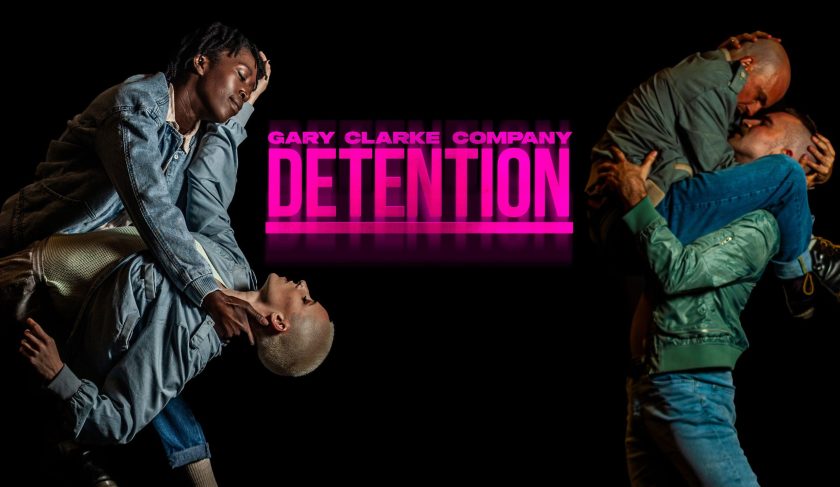
Detention at The Lowry – Wednesday, 14 May – 8.00pm
Gary Clarke Company proudly presents its highly anticipated new dance theatre show, DETENTION, sequel to the multi award-winning COAL and critically acclaimed WASTELAND.
DETENTION explores the impact of Section 28: a piece of largely hidden legislation from Margaret Thatcher’s Conservative Government in 1988, which ‘prohibited the promotion of homosexuality’, forcing people from the LGBT+ community into a place of secrecy, fear and shame at a time when the country was in industrial turmoil and the gay community was being ravaged by the onslaught of AIDS.
Gary Clarke’s powerful and personal working-class storytelling draws on public and private stories and testimonies, including a rare insight into the LGBT+ Switchboard Logbooks, combined with vivid choreography performed by a company of exceptional dancers, an evocative narrator, a local cast of LGBT+ people, striking designs in film, sound, light and costume and music tracks by the iconic band Test Dept.
DETENTION is a bold and moving exploration of the violence, loneliness, protests, debates, unlikely allies and the remarkable individuals and organisations of the time.
How London’s older LGBT+ people struggle with financial stress and isolation
A new report by a non-profit housing provider focuses on a financially precarious community of older LGBT+ people in London. But there are lessons for all social landlords.
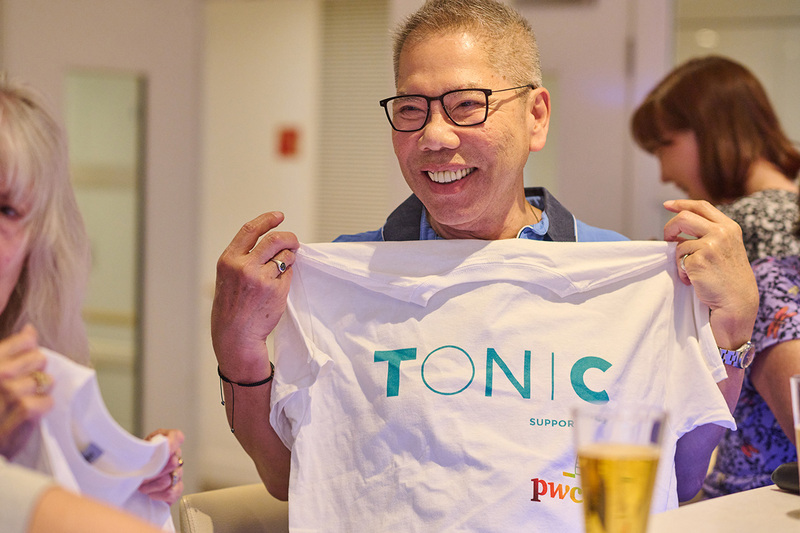
Min Ong, a Tonic Housing resident (picture: Dan Joseph)
“I think the city of London has me in its chokehold.” As this comment from a 55-year-old gay man shows, living in the capital can be a double-edged sword, the benefits of its more tolerant environment curbed by high financial stress.
This is the topic of a new study by Tonic Housing, a non-profit organisation which runs a retirement community for LGBT+ people in the capital. It reveals the challenges faced by a “hidden population” of LGBT+ over-50s in London.
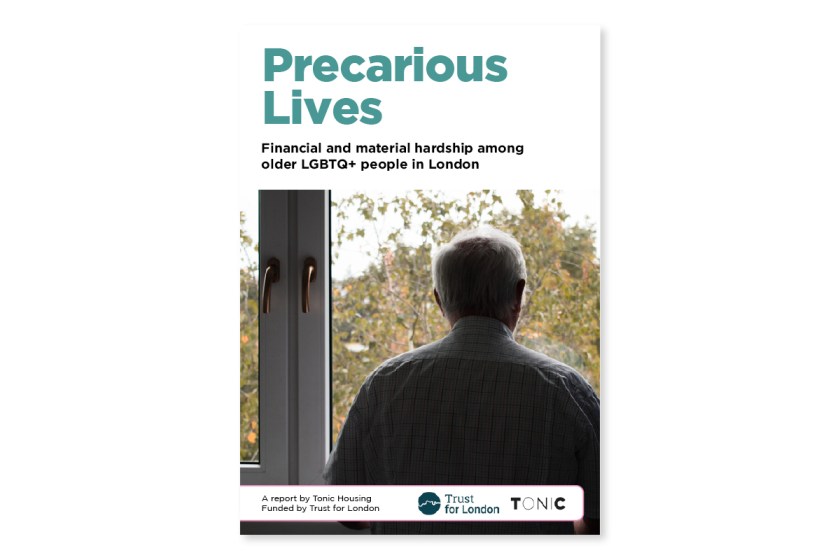
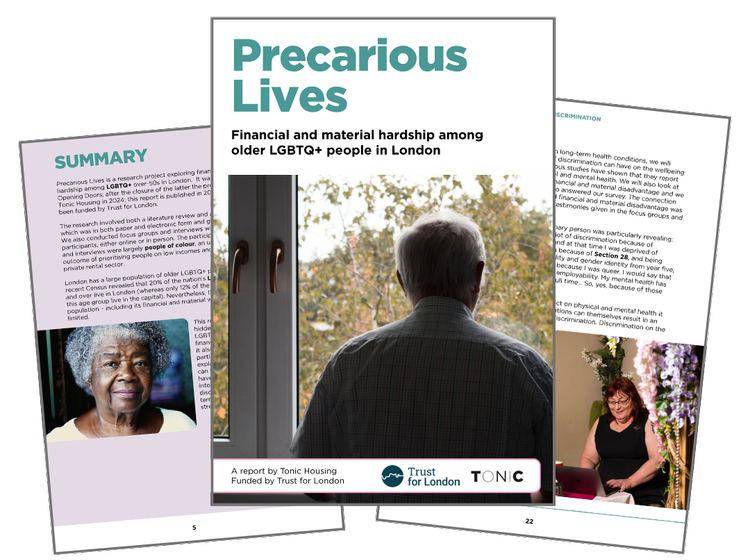
Titled Precarious Lives, the report surveyed 134 people across London to explore issues such as the long-term impacts of discrimination, long-term health conditions and financial stress. It also conducted focus groups and interviews with an additional 39 participants.
Its findings were “deeply unsettling”, said Tonic Housing’s chair Terry Stacey, and highlighted how certain people – namely LGBT+ people of colour, LGBT+ disabled people and trans and non-binary people – face “particularly profound hardship”.
Mr Stacey said the report emphasised the need for community-led solutions to address the needs of older LGBT+ people. This was “particularly crucial” following the closure of Opening Doors, the LGBT+ charity that was originally running the Precarious Lives research, but which closed last year.
Following its closure, Tonic took over the report, with the project funded by Trust for London.
So what are some of the issues that LGBT+ older people face as they grow older, and how should social landlords change their approach to make sure they are properly serving this community?
Intersectionality
One of the key findings was the high social isolation of those surveyed. According to the report, 64% of those surveyed live alone. It also found that single-person households were six times more likely to rely on food banks than those living with others (18% vs 3%).
The survey also revealed that 60% of respondents were disabled. Of these, 58% expected no social support in times of crisis.
Overall, among all survey respondents, 36% would not expect any social support – from a spouse or partner, family members or friends – in the event of serious difficulties.
Meanwhile, 58% of respondents said that they would not expect help from support services if they had serious difficulties.
“As we grow older, our communities – and with them, our circle of safety – tend to shrink,” says report author Mark Sladen. “The result is that both our social and institutional support systems can be threadbare, making individual circumstances that bit more ‘precarious’.”
Mr Sladen said one important takeaway from the report was intersectionality, and how many respondents faced a “compounded” set of challenges. “So, being LGBT+ is a good indicator of challenges ahead; but if you are LGBT+ and Black, or LGBT+ and disabled, you can find almost all aspects of living in 21st century London markedly more difficult.”
Financial hardship
Many people in the LGBT+ community value living in the capital, the report found, because it is relatively tolerant and because of the opportunities to find a sense of community.
However, living in London comes at a high financial cost. According to the report, many respondents were on low incomes and, overall, 41% of people surveyed were finding it ‘somewhat’ or ‘very’ difficult to manage financially.
It found 34% of LGBT+ over-50s surveyed have a household income below £15,000. For 15%, it was less than £10,000 a year.
One of the lessons from the report, according to Mr Sladen, is how experiences differ based on housing tenure. “It is clear that those in the private rented sector are far more precarious,” he says. “Add that to all the other costs of living in London and it becomes very clear that there needs to be more social housing, and more housing provided at affordable rents.”
Lessons for landlords
Asked what advice the report holds for social landlords, Anna Kear, chief executive of Tonic Housing, notes that many older LGBT+ people don’t have children. Yet despite this, there are often expectations from housing associations for residents to have someone who can advocate for them.
“Social landlords, therefore, must not assume that people have those children in place. People can be very isolated and vulnerable.”
Landlords also have to be sensitive to the fact that many LGBT+ people carry the trauma of the past with them, says Ms Kear. “As one resident put it recently: ‘I’ve got too much time to think and I am going over the past.’
“It’s a past that included criminalisation, ECT (electroconvulsive therapy – known commonly as electro shock therapy) – just for being gay or trans; the AIDS crisis, and the death of friends and partners; Section 28. Put those together, and what you have is a complete distrust of institutions.”
Ms Kear gives the example of Maudsley Hospital in south London, which today is a centre of excellence for mental health issues, but once was the place someone might have been sent to for ECT. “The idea that people can just reach out and navigate institutions today without some acknowledgment of that past is massively flawed.
“Yet too many large organisations expect individuals to do that without a second thought. That needs to change.”
Becoming a registered provider
When Tonic set up its first retirement community, it began with shared ownership on the banks of the Thames – a tenure unlikely to be accessible to older people on low incomes.
But Tonic has now applied to become a registered provider with the aim of offering social rent homes in its communities. “We were not initially set up as a registered ‘social landlord’. Because, as a small start-up, we did not meet the criteria. Ten years on, we have a solid track record and are now actively working to gain registration,” says Ms Kear.
Ms Kear says the organisation has found the regulatory application process to be “quite a mystery”, adding: “We think we have done everything to meet the requirements, but we won’t know until they tell us either way. In the meantime, we can’t plan for future homes,” she says – there is no way to approach lenders, developers or scope out possible Section 106 sites.
Getting registered provider status would allow Tonic to provide a range of tenures, says Ms Kear, including affordable rented homes.
Extra care scheme
In September last year, a ‘first of a kind’ project aimed at older LGBT+ people achieved planning permission. It is an extra care social rent housing scheme in south Manchester.
Manchester City Council’s planning committee approved proposals from Great Places to develop the project on the site of the former Spire Hospital on Russell Road, Whalley Range.
Plans were put together by Great Places Housing Group in collaboration with the Russell Road Community Steering Group, Manchester City Council, and the LGBT Foundation. The aim is for this scheme to deliver 80 one and two-bedroom apartments for older people within a high-quality sustainable building.
Low-carbon design takes into account the surrounding conservation area. In addition, there will be shared communal facilities including lounges, treatment rooms and landscaped gardens aiming to ensure an overall net gain of trees on the site.
Residents will be aged 55 years or over, with the majority being drawn from Manchester’s local LGBT+ community. Great Places aims for the scheme to deliver an open and inclusive, physical and psychological place of safety for the older LGBT+ community, as well as a welcome addition to the Whalley Range area.
The Russell Road development has been widely welcomed. Paul Martin, chief executive of the LGBT Foundation, says: “Older LGBT+ people are currently at greater risk of discrimination, poor health outcomes and social isolation, and many do not have the support networks of family and friends. This scheme aims to address these challenges and create a safe and affirming environment where our community can age with pride.”
Bisexual Health Awareness Month
Bisexual Health Awareness Month (BHAM) is an annual event held in the United States during the month of March. The purpose of the event is to raise awareness of the unique health challenges faced by bisexual individuals and to promote greater understanding and acceptance of bisexuality.
Bisexual individuals face a number of health disparities, including higher rates of depression, anxiety, and substance abuse, as well as greater risk for certain physical health issues. Additionally, bisexual individuals may face discrimination and stigma both within and outside of the LGBT+ community, which can have negative effects on their mental and physical health.
During BHAM, individuals and organisations around the country participate in a range of events and activities to raise awareness of these issues and to promote better health outcomes for bisexual individuals. This may include educational workshops, webinars, social media campaigns, and community events.
The goal of BHAM is to increase understanding of bisexual health issues and to promote greater inclusivity and acceptance of bisexual individuals in healthcare and other settings. It is also an opportunity for bisexual individuals to share their stories and for allies to learn how to be better allies and advocates for bisexual individuals.
Google wants to erase Pride, but we’re not going to let them. Here’s how to resist …
In the current United States presidential administration’s war against diversity, equity and inclusion, not even our calendars are safe.
Google has removed Pride Month from its Calendar app, alongside other minority-centred events like Black History Month, Women’s History Month and Holocaust Remembrance Day.
Apparently, Google’s programme will now only display public holidays and national observances because “manually” maintaining “a broader set of cultural moments” globally wasn’t “scaleable or sustainable,” according to an unnamed spokesperson.
Of course, their timing is suspicious, to say the least. In January, CEO Sundar Pichai attended Trump’s inauguration after donating $1 million to the cause.
Furthermore, the tech giant’s decision comes in the wake of an executive order dismantling federal Diversity, Equity and Inclusion programmes, and companies like Meta, Walmart, Target and Amazon following suit.
Unfortunately, Trump’s team has been especially fastidious in erasing the queer community; according to the Gay and Lesbian Alliance Against Defamation (GLAAD), “nearly all LGBT and HIV focused content and resources” have been eliminated from WhiteHouse.gov and relevant federal agencies’ websites.
That said, we don’t have to let them win.
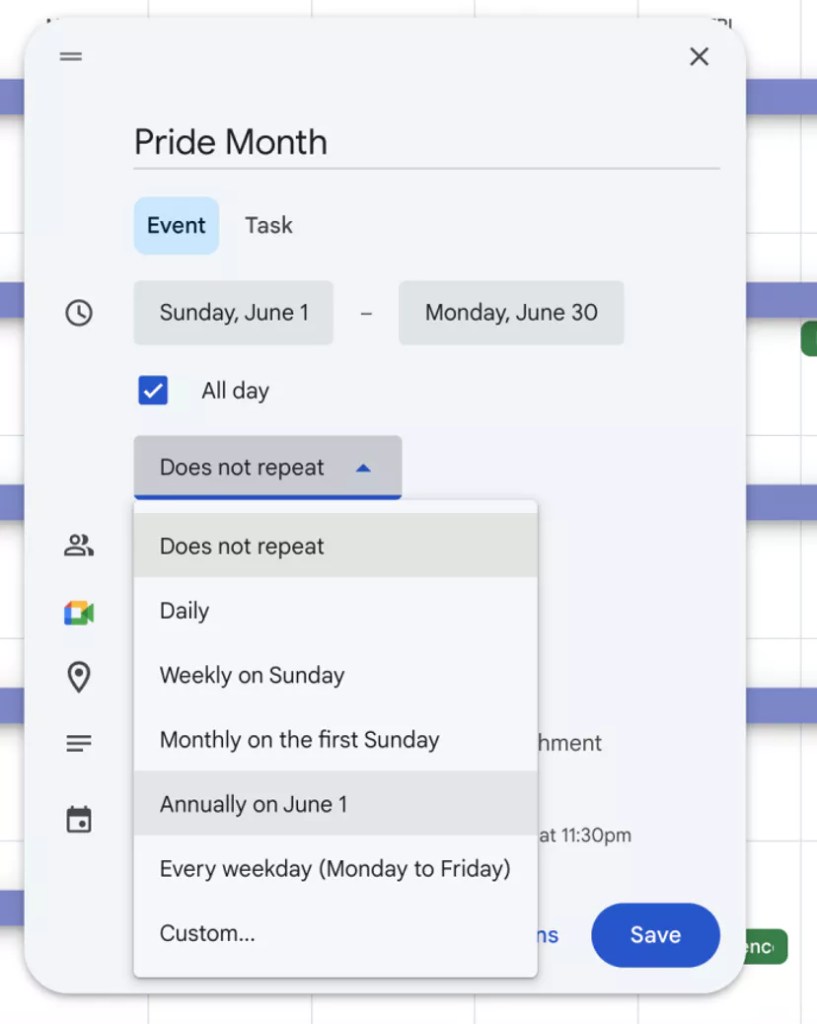
Here’s a step-by-step guide to adding events like Pride Month back to your Google Calendar.
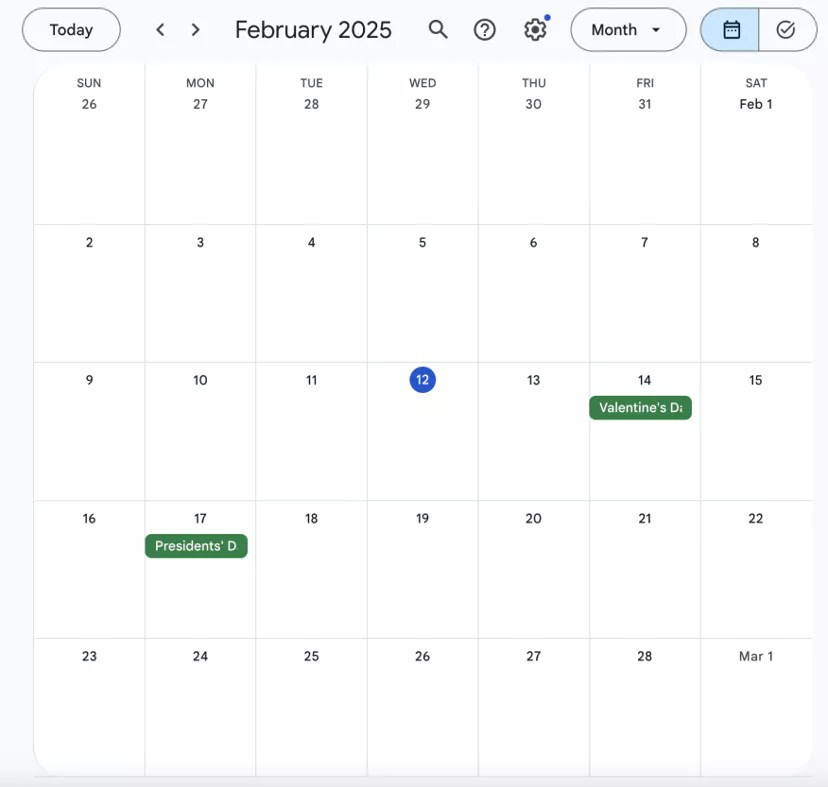
1. Open up your Google Calendar
Make sure you’re signed into your Google account and navigate to the Calendar app.
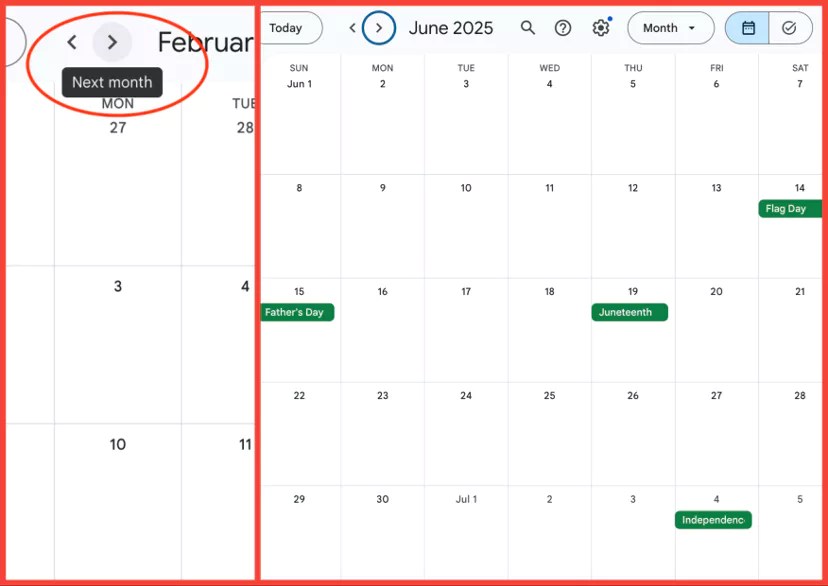
2. Navigate to the month of June
Using the arrows next to the month, scroll over to June 2025.
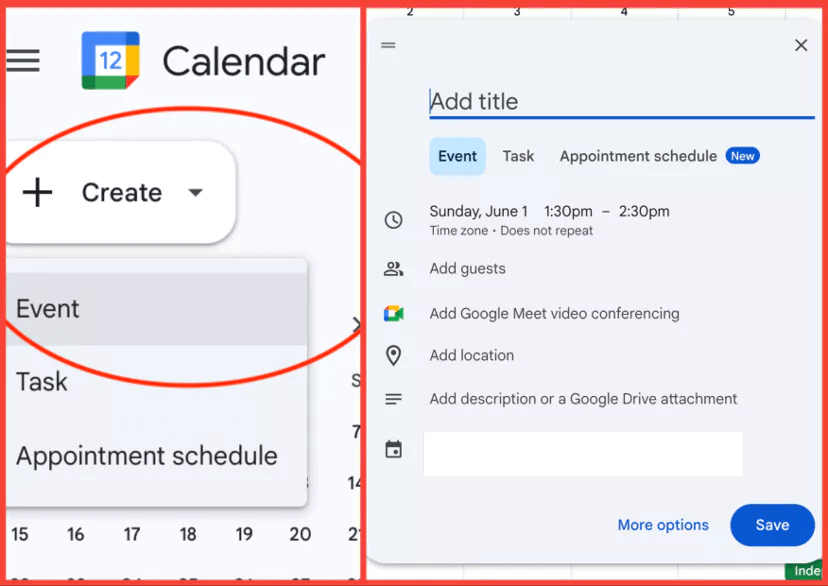
3. Create a calendar “Event”
Click “Create” and “Event.” Now, a pop-up window will appear.
4. Type out “Pride Month” and select a duration
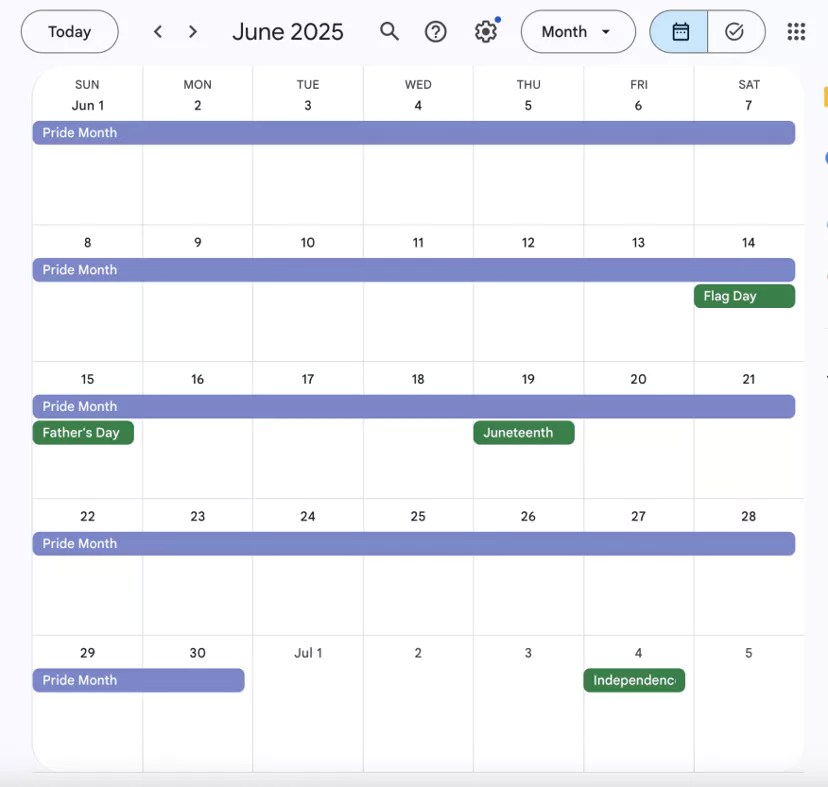
You can type out “Pride Month,” and click on the clock to edit its duration. Select Sunday, 1 June to Monday, 30 June and make sure “All day” is checked.
You can also click on “Does not repeat” and then toggle the selection to “Annually on June 1”. This will ensure that Pride Month appears on your calendar every year.
After selecting “Save”, you will notice Pride Month has a not-so-subtle marker on every day in June (and by creating it as an “event” and not a “meeting” or “task,” your notifications shouldn’t get too crazy – like we need a daily reminder!)
OK, so this is a small and singular act of defiance in a larger system that seems determined to move the LGBT+ equality movement backwards.
That said, we didn’t get permission for the first Pride Month, and they can’t take future ones away from us.
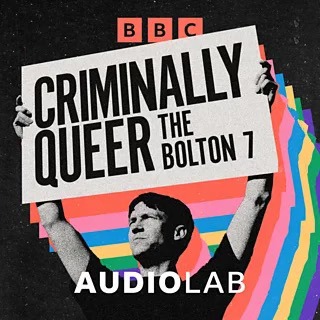
Criminally Queer: The Bolton 7
Hugh Sheehan explores a landmark legal case, in a five part series on BBC Sounds, examining the case of the Bolton 7. The case was termed “the last great homosexual show trial”, and played a significant role in the fight for gay rights.
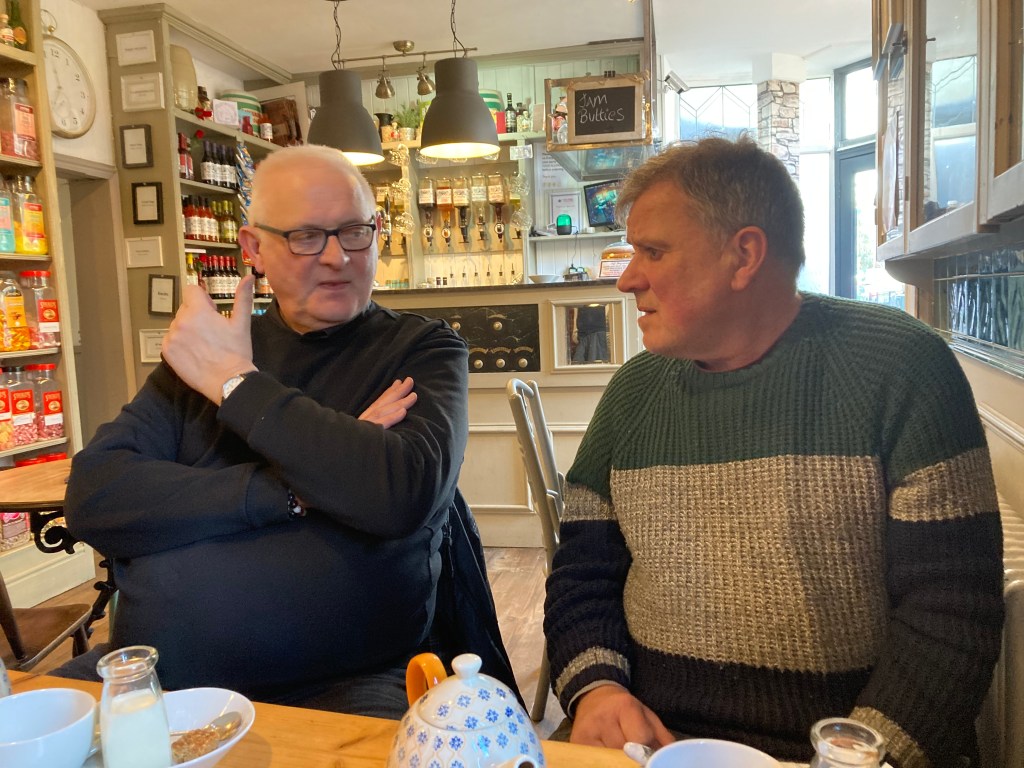
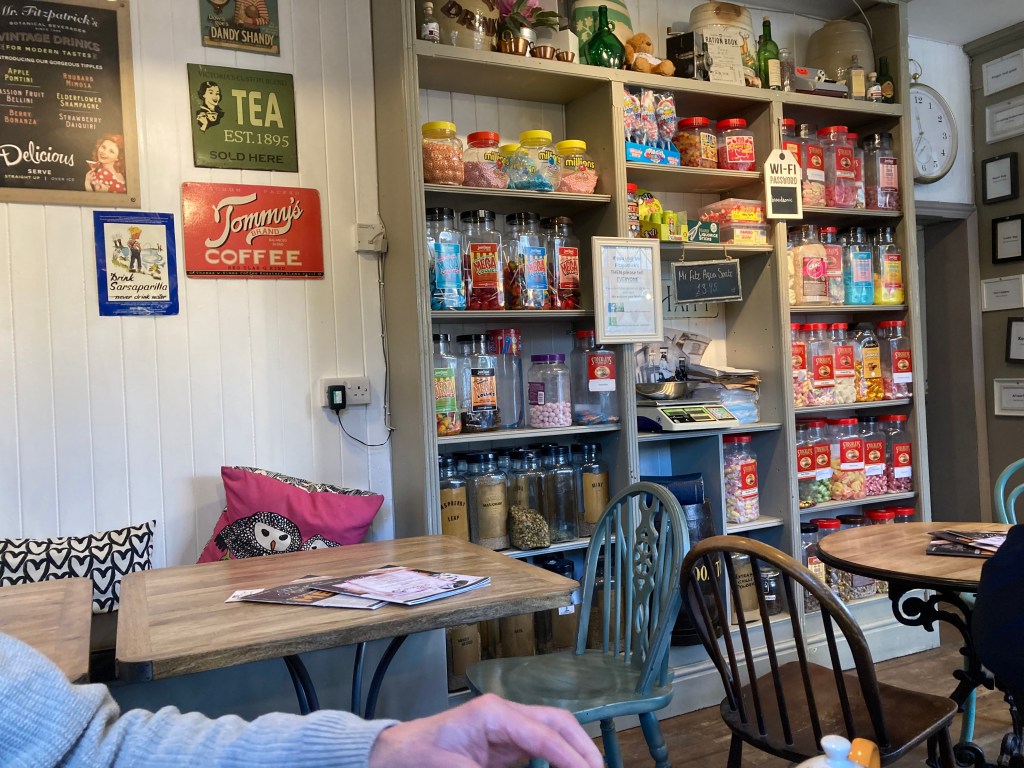
Twenty of us set out from Shude Hill Interchange on Bus X43 to Rawtenstall. We stopped for lunch but due to the size of our group we split up into various cafes, before meeting up again. Some settled into The Queen’s Arms whilst others enjoyed the delights of The Fitzpatrick – Britain’s last original temperance bar.
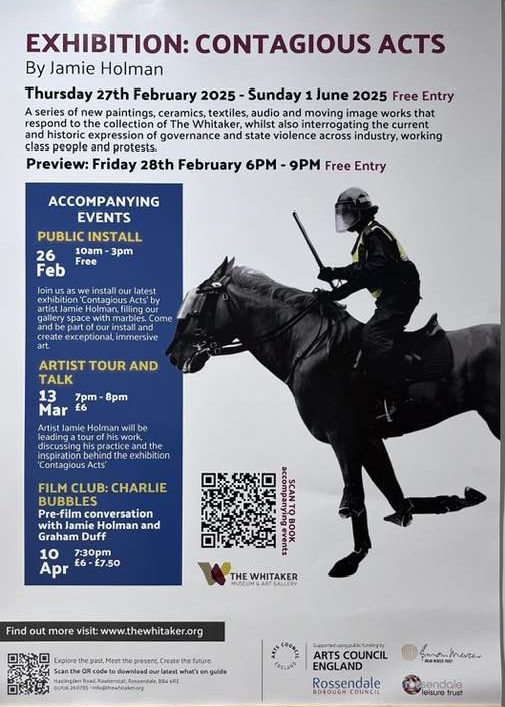
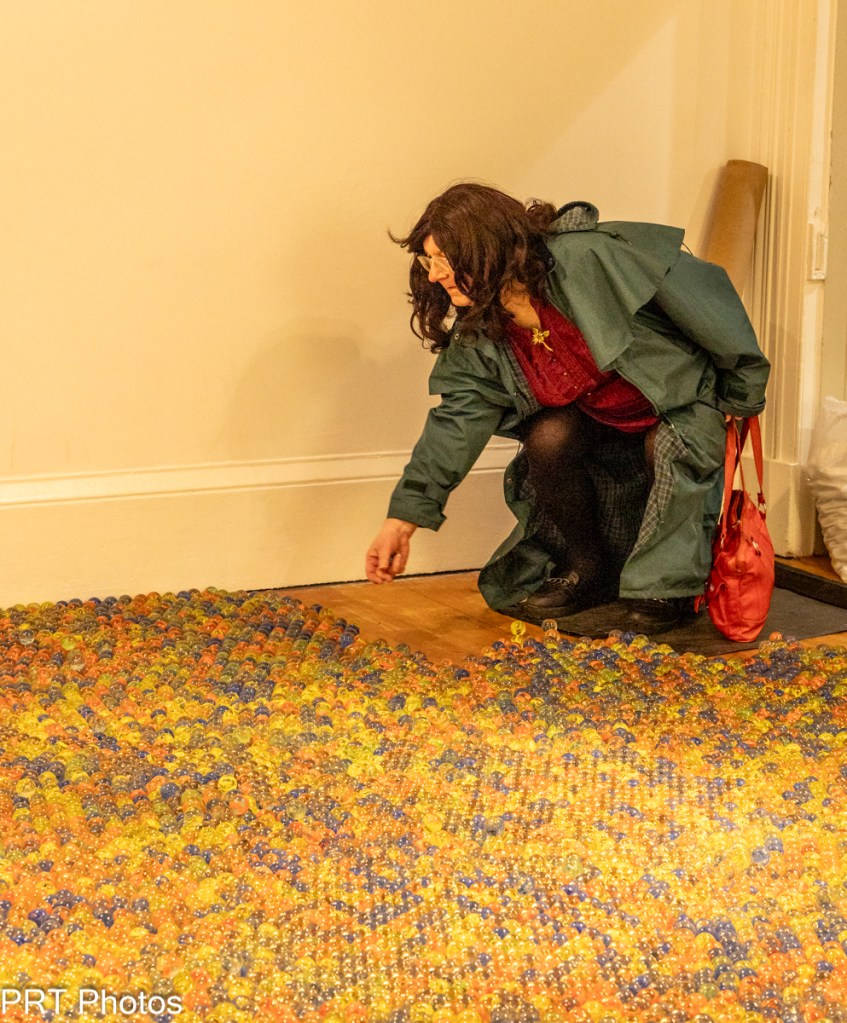
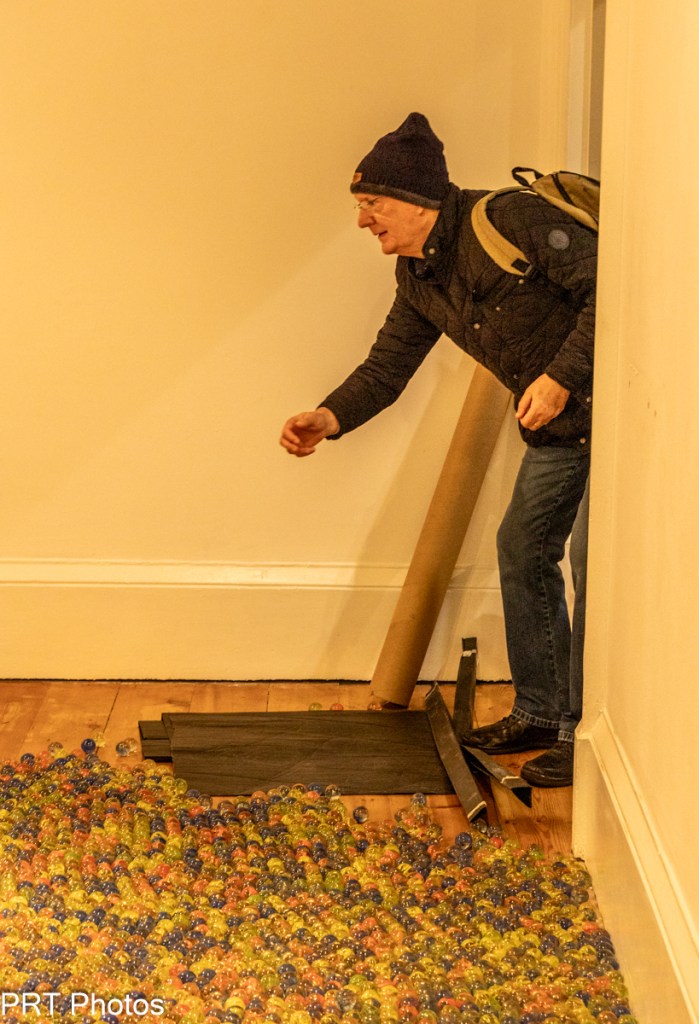
It was a fifteen minute walk (uphill!) to The Whitaker, but it was well worth the exercise. We had come to take part in the installation of an exhibition Contagious Acts.
Contagious Acts is a solo exhibition by artist Jamie Holman at The Whitaker Museum & Art Gallery. The exhibition explores the politics of gathering from medieval battlefields to dance floors.
Jamie explained what the exhibition was about:
The exhibition considers how gathering spaces are battlegrounds of power and protest and sites of cultural production and resistance.
He combines medieval art history with contemporary iconography.
He explores the politics of collective gatherings and how they are tied to class, identity and belonging.
The exhibition fills the gallery space with marbles, as a symbol of resistance to state control. We had fun adding extra marbles to the gallery space.
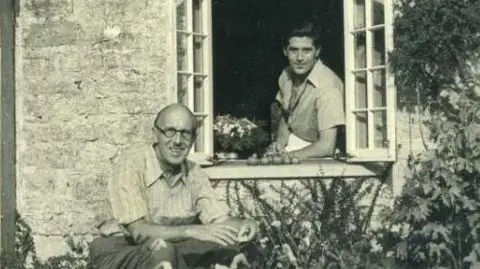
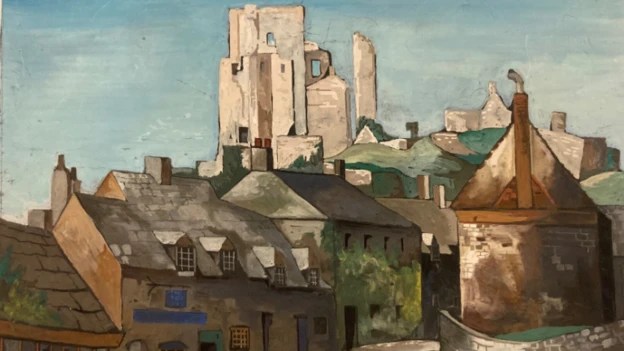
Norman Notley and David Brynley lived together in Corfe Castle for 57 years
The lives of a gay couple who lived in a Dorset village for nearly six decades have been turned into an exhibition.
Norman Notley and David Brynley moved to Corfe Castle in 1923 and lived openly as a couple, despite homosexuality being illegal at the time.
The two men were successful musicians who sang together in Britain and the United States and they had many friends in the art world.
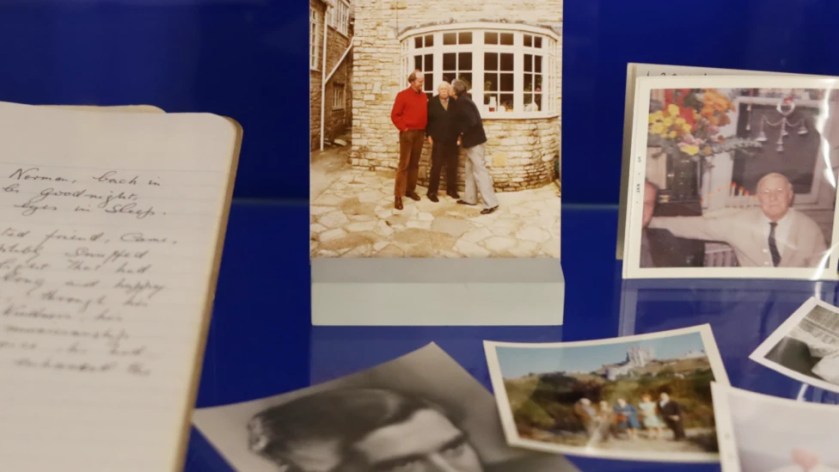
Photographs and diaries on display at Dorset Museum reveal they lived peacefully with the local community for 57 years until their deaths.
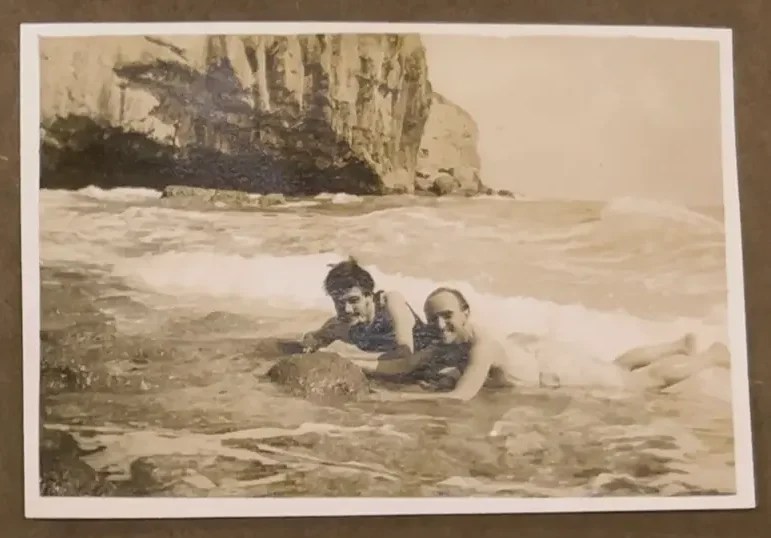
David Brynley and Norman Notley at the beach
In 1973, local people organised an event for the couple to celebrate their 50 years in the village.
Museum director Claire Dixon said: “They were known as ‘the boys’ quite affectionately by the community.
They didn’t throw the party, the community threw it for them.
When lots of people were having to hide the fact that they were gay, or think about their behaviour in public space, it seems that they were able to live quite a peaceful life in the village.”
Notley bequeathed his paintings to Dorset Museum
The couple shared a passion for creating art as well as collecting and Notley bequeathed his collection of paintings to Dorset Museum.
Despite being able to live authentically, the only image in the collection of them being affectionate to one another is a photo of Brynley kissing Notley on the cheek.
Notley died in 1980, aged 90, and Brynley a year later, aged 81.
Maisie Ball, an archaeology student at Bournemouth University, began digitising the couple’s photographs and transcribing their journals and letters as part of a work placement at the museum.
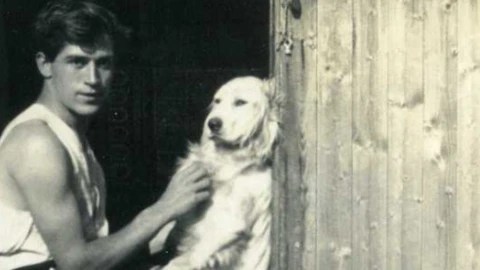
Photographs include Brynley with his dogs
She said: “Being able to share their story has been so important as there are not many collections like this that give a glimpse into the lives of LGBTQ+ people from this time period.
The photographs that have stuck with me the most are the ones with their many dogs and the rare few of Norman on his own, where you get to see a glimpse of his personality.”
The display, curated by Ms Ball, with advice from Prof Jana Funke of the University of Exeter, is on display throughout February to coincide with LGBT+ History Month.
There is only one photograph of the couple showing physical affection.
Queer Treasures of the Manchester Central Library – 2
Thanks to Arthur Martland for the second of a short series of articles about queer treasures that are currently to be found in the Archives held at Manchester Central Library.
‘Curiosities of Street Literature’ by Charles Hindley
In 1871, Charles Hindley published a collection of broadsides and broadsheets that he had gathered over the previous six decades. As Michael Hughes in his Introduction to a later reprinting of the volume explains, ‘Broadsides (single unfolded sheets of paper printed on one side only) and broadsheets (printed on both sides) … were the first medium of mass communication. They were simple pieces of paper on which was printed the news of the day, sermons, politics, satire, public events, proclamations, romantic and humorous tales, descriptions of murders – anything, in fact, which would excite popular interest and be saleable’.
Hindley’s book helped to preserve many of these ephemeral documents, including four of notable queer interest.
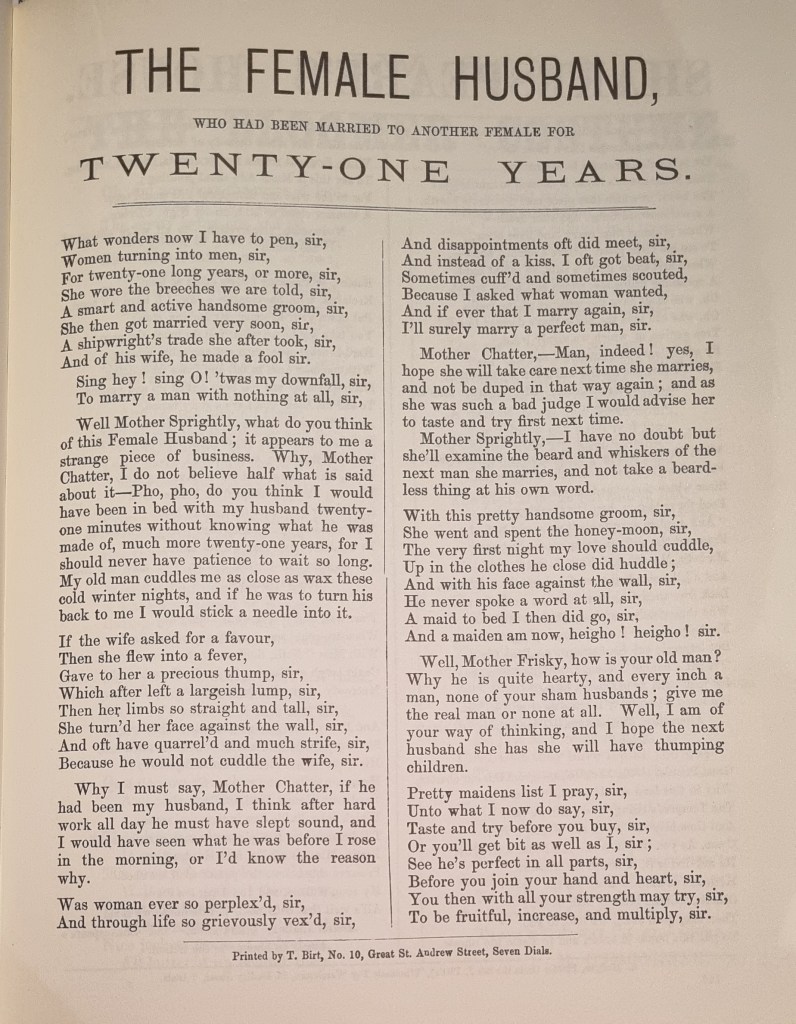
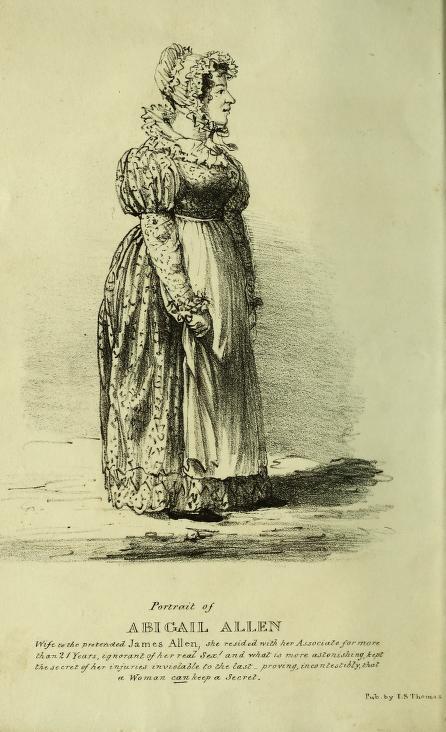
The first is a ballad concerning ‘The Female Husband, who had been married to another female for twenty-one years’ which begins –
What wonders now I have to pen, sir
Women turning into men, sir,
For twenty-one long years, or more, sir,
She wore the breeches we are told, sir, (p119)
The whole is a warning to young ladies to ‘Taste and try before you buy’ and ‘See he’s perfect in all parts, sir, Before you join your hand and heart, sir’.
The ballad refers to the case of James Allen, a trans man. In 1807, Allen, a sawyer, had married Abigail Naylor at St Giles’s church in Camberwell. After his death from an accident at work in 1829, an autopsy was conducted at St Thomas’s Hospital in London and his sex declared to be female. His wife Abigail said she was not suspicious of her husband’s sex because he was ‘so strong’. A sensational pamphlet called ‘An Authentic Narrative of the Extraordinary Career of James Allen, the Female Husband’ was soon published after his death. Throughout most of the work though Allen is referred to by male pronouns and hateful people who tried to disrupt his funeral are described as ‘ignorant beings of the very lowest class’.
A second ballad of interest is the ‘She He Barman of Southwark’, a song based on the life of Mary Ann Walker. Mary loved dressing up in male clothing from a young age and spent much of her early life in helping her father run a pub. When he died in 1860, Mary donned male clothing, presented herself as a man and took a number of jobs that were usually, at that time, strictly reserved only to men. Mary worked as a porter at Jesus College, Cambridge, an engine cleaner for the Great Northern Railway at King’s Cross Station and spent two years as a ship’s steward for the Cunard Line, before taking a job as a dock labourer. In 1867 she assumed the name of Thomas Walker and became a barman in the Royal Mortar Tavern in Southwark. As the ballad puts it –
She did not like the petticoats,
So she slipped the trousers on,
She engaged herself as a barman,
And said her name was Tom. (p141)
Tom was subsequently however accused of stealing monies after marked coins were found in his possession and swiftly remanded into custody pending trial. On his reception into the prison, the gaoler described him as ‘having a full masculine face, rather sunburnt, hair cut short and slightly curled and a masculine speaking voice’. When Thomas was obliged to take a bath though, he was forced to confess to being, anatomically-speaking, female. On his conviction at trial he was sentenced to three months’ imprisonment with hard labour.
Nevertheless, on leaving gaol, he continued to live as a man and obtained work on the Great Western Railway but lost that job when his landlady discovered his secret. After several other unsuccessful jobs, Tom eventually found fame on the Music Hall stage by returning to his former name of ‘Mary’.
Appearing on stages across the country, he was billed as ‘Mary Walker, the female Barman’, and frequently dressed in male clothing or naval uniform, giving a ‘sort of auto-biographical recitation to the tune of Champagne Charley’.
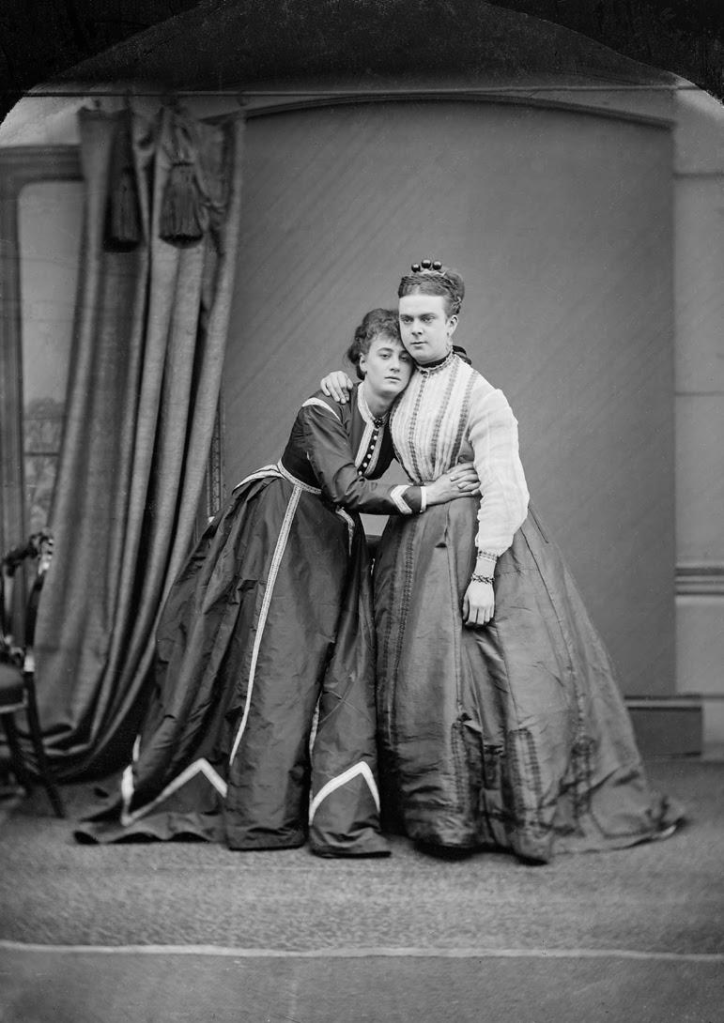
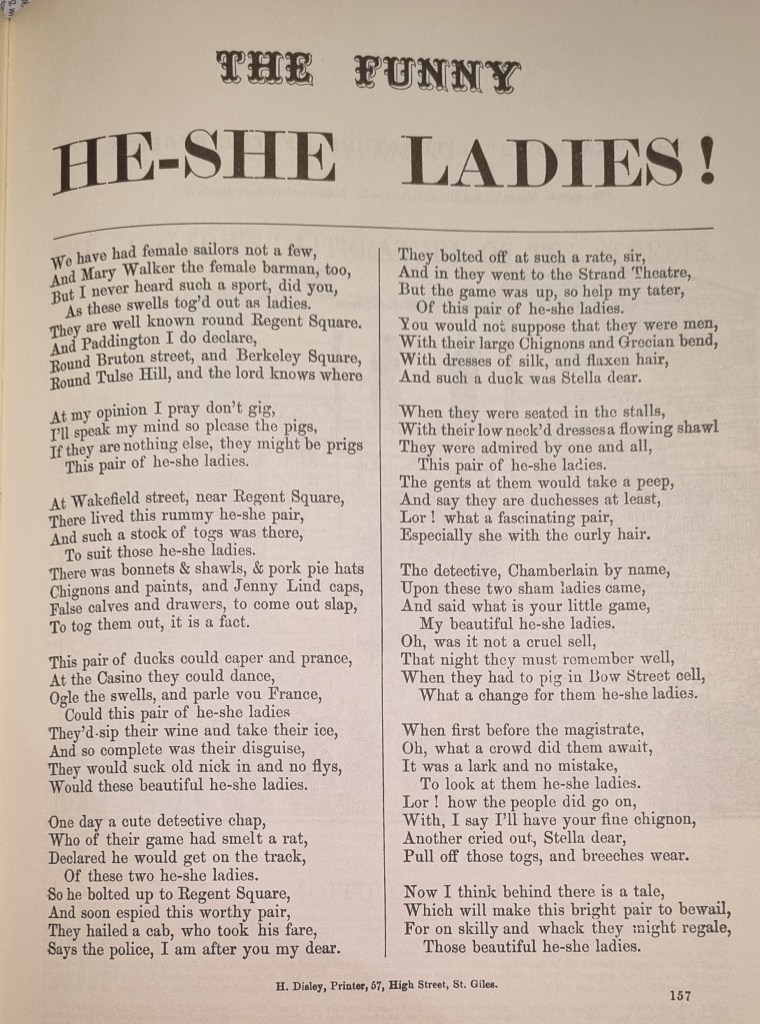
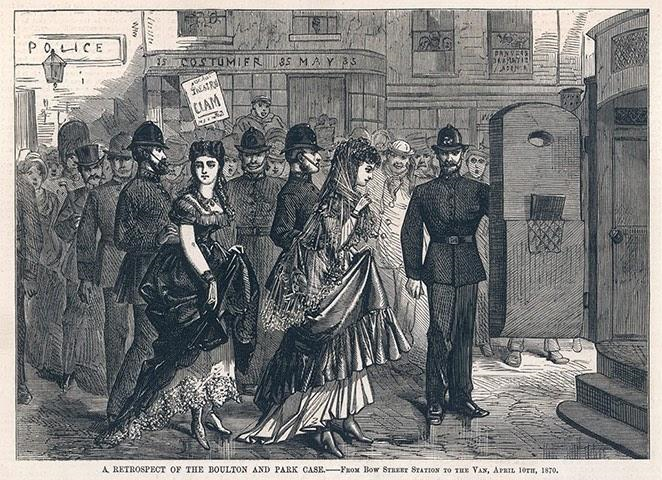
A third ballad of queer interest is ‘The Funny He-She Ladies!’ which tells the tale of Thomas Ernest Boulton and Frederick William Park, better known now perhaps as ‘Fanny and Stella’. The two men became known for their flamboyant clothing and for their dressing in what was seen as ‘female’ attire; as the balladeer sings –
You would not suppose that they were men,
With their large Chignons and Grecian bend,
With dresses of silk and flaxen hair,
……. With their low-neck’d dresses a flowing shawl
They were admired by one and all,
This pair of he-she ladies (p157)
Fanny & Stella
Over several nights Boulton and Park were followed by police detectives as they cruised, in full drag, around the streets of the West End. Eventually, and perhaps inevitably, they were arrested and charged with committing the abominable crime of buggery, conspiring to induce and incite other persons feloniously with them to commit the said crime; and with disguising themselves as women and frequenting places of public resort thereby to openly and scandalously outrage public decency and corrupt public morals. In 1871, after six sensational and widely reported days at trial, the cases against them collapsed and they were declared not guilty. After their acquittal, the two returned to work on the stage, touring Britain as a theatrical act, but the scandal of their arrest never left them.
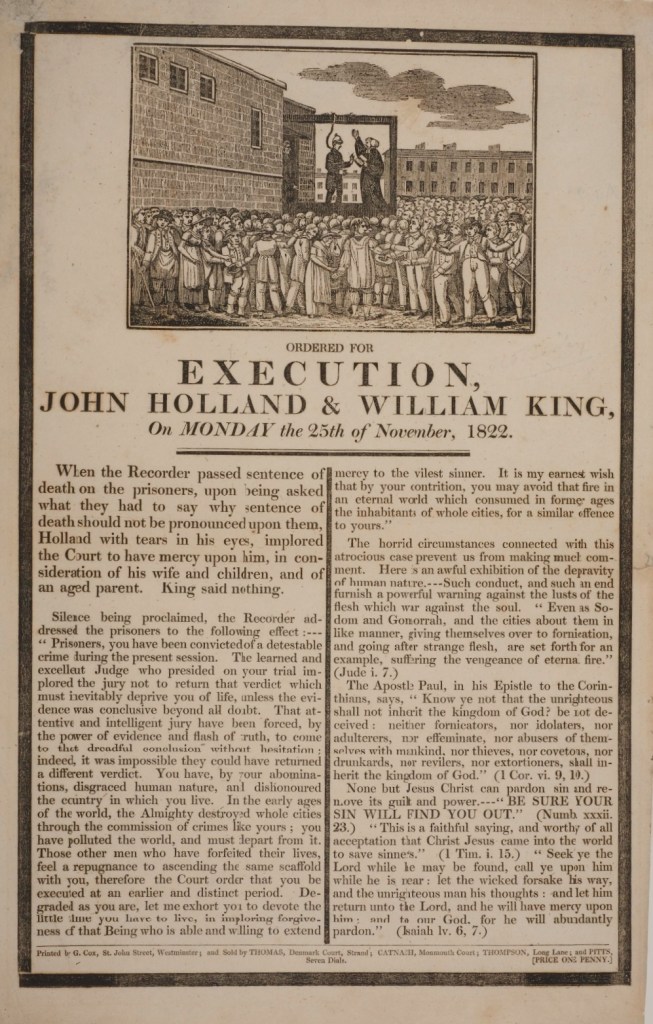
The final part of Hindley’s book concerns what he terms as ‘the Gallows Literature of the Streets’. This section deals predominately with broadsheets that dealt luridly with crime and public executions. The fourth item of queer interest is the broadside recording ‘The Sentences of All the Prisoners in the Old Bailey’ on ‘Wednesday 11th September 1822’. Amongst the list of hapless felons are the names of Holland, King and North, who were to be executed ‘for an unnatural crime’. William North (61 years old) was a retired schoolmaster in the Royal Navy who had been accused of attempting to rape a younger male.
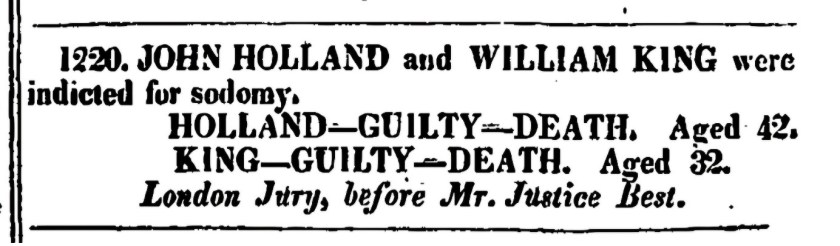
But John Holland (42 years old) and William King (32 years old) however, were heavily condemned as they appear to have had consensual contact. Their ‘unnatural crimes’ together were seen as so despicable that the official record of their trial contains no details of what precisely was alleged to have happened, simply that they were both convicted of sodomy. Courts, not unusually at that time, failed to fully record evidence details which the judges and magistrates in charge deemed unsuitable for the public to hear about.
The curt, undetailed entry in the official record of their Old Bailey trial.
The judge, Mr Justice Best, was scathing in his closing comments at their trial, as recorded in various newspapers at the time –
‘Prisoners, you have been convicted of a detestable crime during the present Session … You have, by your abominations, disgraced human nature, and dishonoured the country in which you live. In the early ages of the world, the Almighty destroyed whole cities through the commission of crimes like yours; you have polluted the world, and must depart from it.’
The judge continued, ‘Those unfortunate men who have forfeited their lives, (that is, the other prisoners condemned to die for non-sexual ‘crimes’), ‘feel a repugnance to ascending the same scaffold with you, therefore the Court order that you be executed at an earlier and distinct period. Degraded as you are, let me exhort you to devote the little time you have to live, in imploring forgiveness of that Being who is able and willing to extend mercy to the vilest sinner. It is my earnest wish that by your contrition, you may avoid that fire in an eternal world which consumed in former ages the inhabitants of whole cities, for a similar offence to yours.’
(Morning Post – 25 September 1822)
John Holland’s father, Edward, petitioned for clemency on his son’s behalf, claiming that his son was mentally deranged, but to no avail and both men were hanged. Newspapers were filled with lurid accounts of their final moments on the scaffold –
‘EXECUTION. – On Monday morning, John Holland … and William King … were executed in front of the debtors’ door of Newgate, for an unnatural crime. Holland, when on his trial, was apparently in perfect health, but on Monday morning he was little better than a skeleton, and was so weak as to be almost incapable of sustaining the weight of his emaciated frame. He has left a wife and two children, of whom he took leave on Sunday, after attending the condemned sermon. – King has been attended since his condemnation by the Rev Mr. Baker, to whose advice he paid respectful attention, but observed a sullen taciturnity till the moment of his death. – Holland acknowledged his crime, and the justice of his fate, and ever since the arrival of the warrant for his executing, his time, night and day, has been employed in loud exclamations and petitions to the Supreme Being for mercy and pardon. At a quarter before 8 o’clock, Holland was relieved of his irons. This man had a very effeminate voice, and his screams of mental anguish were most appalling. His whole frame was agonized with terror. King was brought from his cell next, and he approached the anvil, to be relieved of his irons, with the greatest firmness. At a quarter past eight o’clock the executioner said that all was prepared, Dr. Cotton commenced a reading a prayer, and in the middle of it took out his handkerchief, and gave the customary signal, the bolt was drawn, and the men launched into eternity’.
(Devizes and Wiltshire Gazette – 28 November 1822)
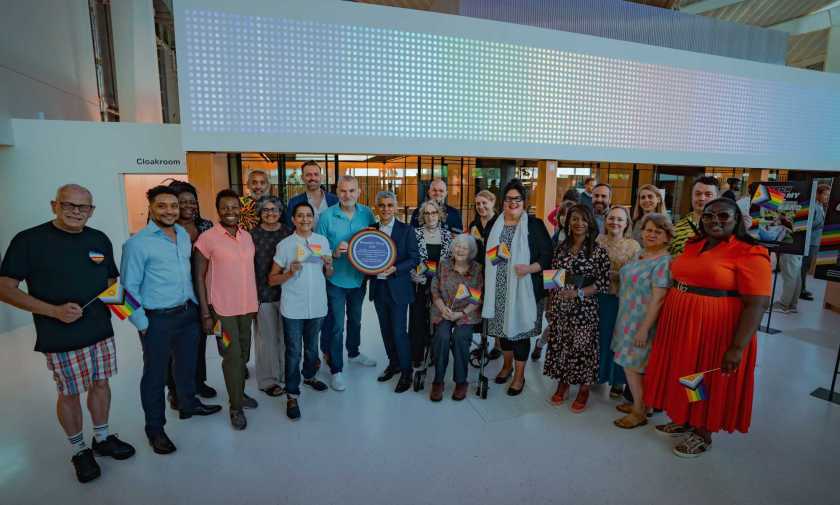
Trailblazing lesbian journalist and activist to be honoured with rainbow plaque
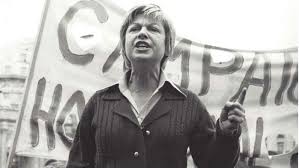
The plaque will honour lesbian journalist Jackie Forster
One of the few out lesbians in the public eye, Jackie Forster, who also worked under the name Jacqueline MacKenzie, was an actress before forging a successful career in journalism.
In the 1960s, she joined the Minorities Research Group and wrote for the UK’s first lesbian-specific publication, Arena Three, and set up the long-running magazine and social group, Sappho.
After coming out publicly, she joined the Campaign for Homosexual Equality and marched in the first London Pride parade in 1971. She went on to be a member of the Greater London Council’s women’s committee, a curator for the Lesbian Archive, and set up Daytime Dykes.
In 2017, she was celebrated in a Google Doodle on what would have been her 91st birthday.
After Forster died in 1998, aged 71, writer and academic Gillian Hanscombe told The Independent: “If she had served any cause other than lesbian rights, she’d have been festooned with honours.”
Forster’s plaque will be will be unveiled on 26 February.
Supported by the mayor of London, Sadiq Khan, the Rainbow Plaques scheme has sought to identify and make visible LGBT+ history in local communities up and down the country.
“It’s fantastic to see a new rainbow plaque unveiled in Warwick Avenue to celebrate the life of Jackie Forster,” Khan said. “These plaques honour the huge contribution that our LGBTQIA+ communities have made, and continue to make, to life in our capital. So it is fitting that we remember Jackie’s significant role in promoting and championing LGBTQIA+ rights.
“Our diversity is what makes London the greatest city in the world and we will continue to ensure that everyone feels represented in our public spaces, as we continue to build a fairer and safer London for everyone.”
Anne Lacey, Forster’s partner, described the plaque as a “fitting tribute to a wonderful woman and a great character in the history of LGBTQIA+ rights”.
She went on to say: “Jackie spent the last half of her life working unceasingly for LGBTQIA+ rights and visibility. From the day she came out at Speakers’ Corner (in London’s Hyde Park) in 1969, she fought for the celebration of the word ‘lesbian’.”
If you’re raging that ‘Netflix made Alexander the Great gay’, it’s time to learn some LGBT+ history
Matt Cain, author of “One Love” wrote this article for The Guardian on 13 February 2024.
At the start of this LGBT+ History Month, Netflix unveiled its new series about Alexander the Great, only to see complaints that the streaming service had “turned him gay”. When these drew the response that Alexander is widely believed to have had same-sex relationships, a typical reply was that this was “unproven speculation”. As a patron of LGBT+ History Month, I see this as an opportunity to argue for the importance of knowing our queer history.
For centuries, LGBT+ history has been wiped from the record. Oppressors have found it all too easy to deny our existence because in most of the world – for most of history – our lives have had to be led in secret. Exposure could lead to familial rejection, social and professional ruin, imprisonment, torture and even execution. Any evidence of queer lives that did exist was often destroyed, sometimes by descendants keen to protect reputations.
The Renaissance artist Michelangelo, for example, was known to have had several relationships with men, but burned all his papers before he died. And in 1623 his great nephew published an edition of his poetry with many of the masculine pronouns changed to feminine ones (an act of cultural vandalism that wasn’t rectified until the 19th century).
A transgender neurobiologist whose research revolutionised our understanding of brain cells. Ben Barres in 2006. Photograph: San Francisco Chronicle / Hearst Newspapers / Getty Images
Of course, labels such as lesbian, gay, bisexual and transgender didn’t exist for most of history, making it impossible to know definitively how any figure would have identified in their own time. But it would be ridiculous to use this as justification for erasing us from the past. The understanding of our sexuality contributing to any sense of identity (rather than just sexual activity) may be a relatively modern one, but we have always been here.
It doesn’t help that, as queer people, we’re one of the few minority communities who don’t often have parents from the same minority, so little understanding of our cultural heritage is passed down through the generations. All of this has allowed historians to straightwash the past, to write off our relationships as passionate or intimate friendships, or to declare we were married to our work.
Years of campaigning – not to mention a Hollywood film – means that most people now know the name Alan Turing. But the story of Bayard Rustin is only just coming to prominence, thanks to another film: he was one of the leading organisers of the black civil rights movement and a key adviser to Martin Luther King, but he was kept in the background to avoid his sexuality damaging the movement.
Sally Ride (1984) the first American woman in space, had a 27-year relationship with a woman. Photograph: AFP / Getty Images
And how many people have heard of Ben Barres, a transgender neurobiologist whose pioneering research at Stanford University revolutionised our understanding of brain cells?
Or that the astronaut Sally Ride, the first American woman in space, had a 27-year relationship with a woman?
And did you know that Florence Nightingale wrote in a letter in 1861: “I have lived and slept in the same beds with English countesses and Prussian farm women. No woman has excited passions among women more than I have”? Why historians ever believed she was celibate is beyond me.
In 19th-century Russia, Tchaikovsky lived life as a gay man with a degree of openness that was remarkable for the time, writing about his feelings in letters to friends and his brother, who was also gay. He even signed one of these using the female name he’d given himself, Petrolina.
But although he enjoyed close friendships with gay men (one, Petashenka, used to pop round to his place to ogle the cadet corps opposite), other letters show that he never stopped wanting to change his sexuality, lived in fear of being outed and disgraced, and struggled with alcoholism and depression.
Like many gay men of his time, he briefly married a woman to maintain a respectable front, but she later accused him of using her to hide his “shameful vice”. Tchaikovsky found release in his music, and this could be why his work has such a joyous quality. Likewise, the range of emotions he experienced in life could have given his ballet scores the depth necessary to tell dramatic, sweeping stories.
Today, Tchaikovsky is considered a national treasure in Russia, but official accounts of his life remove all mention of his sexuality, as does the Tchaikovsky State House-Museum near Moscow. Meanwhile, the widespread persecution of queer people continues in the country, as does anti-queer legislation and the state-sponsored spreading of shame.
When I visited Moscow in 2017, I met LGBT+ people and heard their shocking stories, visited queer venues and saw signs in shop windows announcing “No faggots allowed”. But if Tchaikovsky’s queerness was widely understood and acknowledged as part of his artistry, it would be more difficult for Putin and his government to continue their oppression – or at least to argue that queerness is a foreign import and somehow “un-Russian”.
For me, the response to Netflix’s series about Alexander the Great sums up why we need LGBT+ History Month, and the story of Tchaikovsky is a chilling illustration of the dangers of not knowing our queer history.
Understanding history is empowering, and for too long queer people have been disempowered. History can teach us – and others – that we’ve always made a contribution to society, help us understand our place in the modern world and give us pride in who we are.
LGBT+ History Month Coming to an End
Try this quiz to see what you have learnt. Don’t worry the answers are below.
Out In The City Women’s Meeting Reminder that Out In The City Women’s meeting is on Thursday, 27 February 2025 from 2.00pm to 4.00pm. The meeting is at Cross Street Chapel, 29 Cross Street, Manchester M2 1NL and is a drop in. There is no need to book.


















 Out in the City