Two of Us (Deux) … Love Letters Podcast … Stanley Baxter comes out at 94!

News

The film directed by Filippo Menegheti is released in the UK on 13 November 2020.

Nina and Madeleine, two retired women, are secretly deeply in love for decades. Everybody, including Madeleine’s family, thinks they are simply neighbours, sharing the top floor of their building. They come and go between their two apartments, enjoying the affection and pleasures of daily life together, until an unforeseen event turns their relationship upside down and leads Madeleine’s daughter to gradually unravel the truth about them.


Love Letters

Hosted by Boston Globe advice columnist, Meredith Goldstein, this is a podcast called “Love Letters”. Meredith is an excellent host and storyteller and each episode is always insightful and leaves us with both helpful advice and optimism.

This episode features Jenny and Molly – two older lesbians and their relationship.


Scots showbiz legend Stanley Baxter’s secret agony as he announces he’s gay at 94

The Scottish stage and screen star told how he spent nearly 50 years married to his wife Moira despite knowing he was homosexual.

Show business legend Stanley Baxter has revealed he is gay at the age of 94.

The Scottish stage and screen star told how he spent nearly 50 years married to his wife Moira despite knowing he was homosexual.

In a new authorised biography The Real Stanley Baxter, journalist Brian Beacom reveals the secrecy and sadness that have haunted the entertainer all his life.

Baxter originally refused to have the book published before his death amid fears he would be judged and admitted he is still not comfortable with his sexuality.

The Glasgow-born star, best known for TV’s The Stanley Baxter Show, said: “There are many gay people these days who are fairly comfortable with their sexuality. I’m not. I never wanted to be gay. I still don’t. Anyone would be insane to choose to live such a very difficult life.”

He added: “The truth is, I don’t really want to be me.”

In the biography, Stanley reveals that for the past 25 years he has lived as a virtual recluse at his flat in Highgate Village, London, as he “didn’t want to be seen as someone who was once Stanley Baxter”.

He reveals that he knew from a young age that he found men more attractive than women because at the cinema he could not take his eyes off the half-naked Johnny Weissmuller as Tarzan rather than Maureen O’Sullivan’s Jane.

However he reveals it was something he did not understand until he met schoolmate Bill Henry.

Baxter said: “I was in love with Bill but he certainly wasn’t in love with me. He probably knew the way I felt about him. Although we’d spend lots of time in each other’s beds, nothing happened.”

He admits Moira knew he was homosexual before they were married and allowed him to have lovers to their home. Baxter added: “Thankfully, Moira was very understanding”.

“If there were someone I were interested in, I could bring them home. And she was very good about letting them go to bed with me. She would go off to our bedroom and let me take the one opposite.”

He remained married to Moira until she died of an overdose in 1997.

Baxter also reveals in the book that he once considered taking his own life when he was arrested for soliciting for sex in a public toilet in 1962. He visited the lavatories in Holloway, London hoping to have casual sex with a man but was taken into police custody.

The decriminalisation of gay sex between consenting adults was still five years away and Baxter was convinced he was on the verge of ruin.

However, barrister David Jacobs convinced the court that he was the only man in the toilet apart from the arresting police officers and could not have been soliciting. The charges were dropped on condition that Baxter agreed not to sue the police for wrongful arrest.

Baxter said: “I was going to top myself. I thought, ‘My career will never survive this. And if I don’t have a career, what do I have?’”

Sonder Radio … Petition to make LGBT conversion therapy illegal

News

Sonder Radio

Sonder Radio has two amazing opportunities starting in November 2020.

Beginning on the 23 November (with a taster session on the 19 November), Sonder Radio is running a two week online radio making course via Zoom.

During the course, those attending will learn new creative digital skills, develop confidence, make new friends, build skills for employment and even plan and broadcast their very own live show as a group.

There will be additional support / well being sessions and opportunities for volunteering following these dates.

Those interested can reserve their free place now by getting in touch via email or by phone.

BuddyLine

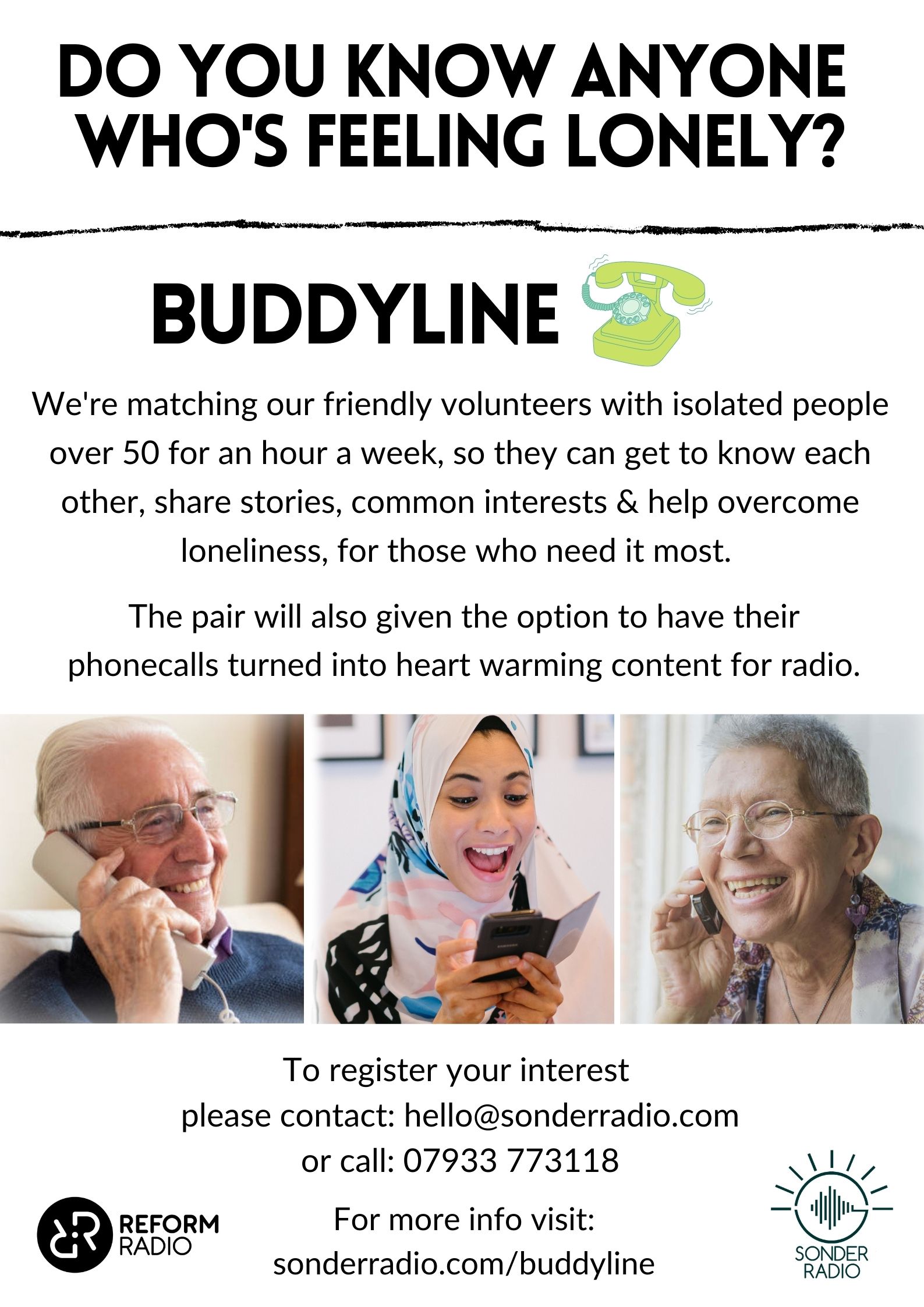
In early November, Sonder Radio are bringing back their BuddyLine programme. BuddyLine is a series of intergenerational telephone conversations between people from the Sonder Radio Community of over 50s and the Reform Radio Community of under 28s.

Taking advantage of the technology available to them, the conversations will be recorded from each of the participant’s homes during isolation.

Through these honest conversations, the listeners enter into an intimate and genuine meeting between two people who would not otherwise interact in everyday society.

Sonder Radio will match people with stories that will enlighten both the listeners and each other, and demonstrate that isolation does not have to be isolating, and can create long-lasting friendships.


Petition to make LGBT conversion therapy illegal in the UK

A petition to make LGBT conversion therapy illegal has attracted 256,390 signatures and will be considered for a debate in Parliament.

The petition stated:

“I would like the Government to:
• make running conversion therapy in the UK a criminal offence
• forcing people to attend said conversion therapies a criminal offence
• sending people abroad in order to try to convert them a criminal offence
• protect individuals from conversion therapy.

Despite all major counselling and psychotherapy bodies in the UK, including the NHS, condemning LGBT conversion therapy, it is still legal and LGBT individuals in the UK are still exposed to this psychological and emotional abuse to this day. The very thought of this sickens me, and I would like to see it stopped one day.”

The petition was closed on 13 September 2020.

See attached correspondence from Catherine McKinnell MP and Elliot Colburn MP with Rt Hon Elizabeth Truss MP, Minister for Women and Equalities.

download.pdf

download-1.pdf

Interesting fact … Pride Listening Group … New Plan to Tackle Hate Crime

News

It’s an interesting fact that 2 November 2000 was the last time all humans were on the planet together.

Since then at least one person has remained on the international space station.


4 November 2020 – Pride Listening Group – LGBTQ+ 55+

Reminder that the LGBTQ+ 55+ Listening Group is coming up on 4 November from 2.00pm – 4.00pm.

This will be a relaxed conversation and a chance for you to provide any feedback about the things you’d like to see more of from Manchester Pride.

The meeting will be held on Zoom and the ticket link is here: https://www.manchesterpride.com/listening-groups-2020


New plan to tackle hate crime and bring communities together launched in Greater Manchester – will “age” be a new strand?

A comprehensive new plan has been launched, outlining how hate crime will be tackled and communities brought together in Greater Manchester over the next three years.

The Plan to Tackle Hate Crime will raise awareness of hate crimes and encourage people to report them, while also improving support for victims of hate incidents.

Hate crime is defined as ‘any criminal offences perceived, by the victim or any other person, to be motivated by hostility, prejudice, towards someone based on a personal characteristic’. In Greater Manchester hate crime is monitored across six strands: race, religion, sexual orientation, trans identity, disability and alternative subcultures.

Figures show there were 488 hate crime prosecutions in Greater Manchester from March 2019 to March 2020.

Work has already begun in our city-region to tackle the problem of hate crime through advisory and scrutiny panels. Activist Carl Austin-Behan is Greater Manchester’s LGBT Adviser, while an LGBT Panel and Disabled People’s Panel have been established to support the development of policies and drive meaningful change. Work is also underway to establish the Women and Girl’s Equality Panel and the Race Equality Panel to build on this approach.

Other priorities in the plan also include the development of local plans for specific communities, provide appropriate action and support for victims and continued work on the Travel Safe Partnership to combat hate crime on the transport network.

A total of 817 people were consulted on the hate crime plan, with 90% of respondents agreeing with the proposals. There was broad support for the inclusion of hate against women and girls to be monitored as a strand of hate crime, while age was the next most suggested strand. The results will be used to inform the delivery of the plan.

Proposals are also in place to increase the number of hate crimes referred to the Crown Prosecution Service for a charging decision by 50%. A pilot programme is currently taking place in Bolton where once a hate crime has been reported, it will be overseen by a new appointed Greater Manchester Police Hate Crime Coordinator and dedicated CPS lawyer. While the pilot takes place any police decisions regarding hate crimes will not be actioned, until they have been reviewed by both staff members.


Forgotten stories of queer Black Britain … Avanti West Coast Pride … Pope Francis

News

This Black History Month, Jason Okundaye is uncovering the forgotten stories of queer Black Britain

by Jason Okundaye (a London-based writer, and columnist at Tribune Magazine)

We know about the laws and riots. What about the spaces and intimate relationships communities carved out to survive?

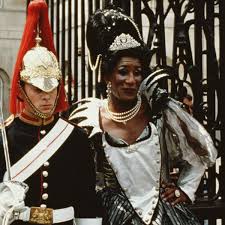
‘My vision of Black British queer history isn’t one that follows the template of how Black history is currently taught.’ A drag queen with a member of the Household Cavalry at Buckingham Palace in 1995.Photograph: Steve Eason / Getty Images

I’ve long respected the principle that, as a Black gay man in Britain, I owe the relative security and increasingly more tolerable environment that I enjoy to those who came before me. It’s just over 20 years ago that the footballer Justin Fashanu – who endured media storms and intrusions into his private life – killed himself. Now, the kind of explicitly homophobic and racist media vilification that Justin faced is unthinkable – even if, of course, homophobic and racist media still persist.

The idea of the past as host to revolutionary struggles that mapped out a better world for Black Britons is at the core of Black History Month, as well as major cultural events such as Notting Hill carnival. An American import, Black History Month was first celebrated in the UK in October 1987 thanks to the work of Akyaaba Addai-Sebo, who had been a special projects officer at the Greater London Council. In more recent years, Black Britons have accelerated our criticism of the outsized role the US plays in Britain’s Black History Month, with author Yomi Adegoke writing in 2017 that “calls for a British focus during October’s celebration are not new, but they are now louder than ever”.

But as a writer and researcher who focuses on Black British gay men, it sometimes feels as if this re-centring of Black Britishness doesn’t extend to my queer British forefathers. Instead, people and institutions tend to focus most on African American queer figures such as Marsha P Johnson, Stormé DeLarverie, or Bayard Rustin. There are multiple reasons for this. Particularly among white queer people, and usually in Pride month, conjuring received wisdom from African American queer figures, such as the often repeated but false statement “Don’t forget, Marsha P Johnson threw the first brick at Stonewall,” is a method for superficially engaging with Black queerness. The focus on singular and mythical brick-throwing moments allows Black queer figures to be presented as sacrificial lambs fighting in service of a broader queer movement, rather than people operating with the primary goals of self-organisation and self-preservation. Of course, the organising of Black queer and trans people such as Marsha should be honoured and taught, but it doesn’t hold much relevance to Black British queer history.

Another reason why these histories don’t tend to receive much coverage or specific engagement is because the story of Black Britain is often framed by legislation and policy changes, such as the first Race Relations Act in 1965, or moments of high drama, such as the 1981 Brixton riots. But what about the spaces, networks and intimate relationships that Black queer communities carved out for survival? As I set out to learn about the histories of Black British gay men, I discovered there’s been no legislation to reference and little by way of publicly recorded events to retrace. So, the best way forward has been to engage with a history from below, drawing on the knowledge of intimate networks.

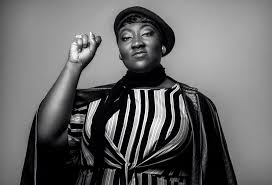
Lady Phyll

In Brixton, queer and trans Black British people found refuge in the late 1970s in a shebeen, an illegal bar, on Railton Road, which provided a space for socialising and cruising. Today, Railton Road and neighbouring Mayall Road are home to some of the most formidable Black British gay activists – whose organising around the Aids crisis, media homophobia and Section 28, among other issues, is too little known.

I only became aware of this rich community when I met one of my queer elders, Marc Thompson, whom I will call Uncle Marc because that is, of course, the respect he deserves. Uncle Marc, co-founder of PrEPster, an HIV prevention service, helped me with my undergraduate research on disparate HIV rates among Black British men who have sex with men. Since speaking with him and learning of his organising from the early days of the Aids crisis up until now, I’ve become aware of a wealth of Black British queer history that is under-studied and under-explored. There is much left to uncover – I want to learn, for example, about the short life of the Black Lesbian and Gay Centre in south London – how it came into being, and what Section 28 meant for its dependence on local government funding.

And what of the Black Pervert’s Network, a community safe space for experimental sex and play, run by Black queer artist Ajamu X? How did community safe spaces allow friendships and romances to flourish in an environment that was often hostile to Black queer life? As for Justin Fashanu, what’s often omitted from his story is the long, intensive campaigning and organising that Black queer activists engaged in to oppose the homophobic coverage of his coming out, while challenging the homophobia that plagued Black British media.

Uncovering the social histories of Black queer people requires going out and speaking with the community of elders who have lived, fought and loved through it. This is something I would task all Black people with – because understanding the intimate histories of our communities often relies on old-fashioned conversation and social knowledge, rather than on big policy changes or even what may be considered key moments in the history of race relations. After all, I wouldn’t define my own short personal history as a Black gay man by the passing of the 2010 Equality Act; I would define it through my networks, organising, friendships, romances and community. My vision of Black British queer history isn’t one that follows the template of how Black history is currently taught; it’s one I’m learning through coffees and Zoom calls with the giants whose shoulders I stand on.

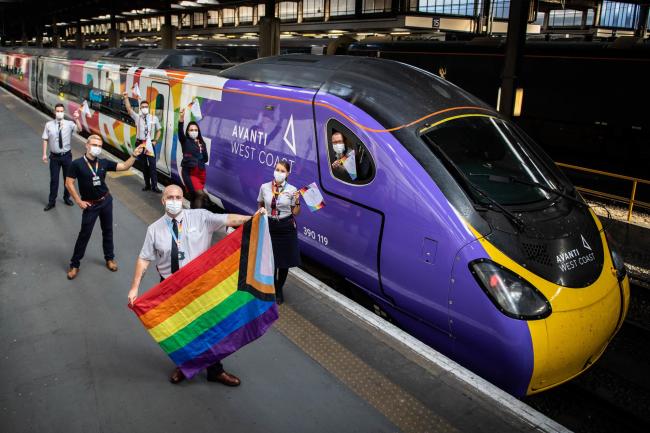
Recently, Avanti West Coast gave the world a glimpse of how they’re planning to Live Proud, including a train dressed head to toe in Pride colours. But, alas! It needed a name.

That’s why they asked us to find us a fitting title that would capture the heart and soul of Pride – what’s been achieved so far and how it can continue to make a difference long into the future. After receiving over 1500 amazing names and supporting stories, they’re delighted to have discovered a worthy winner.

The new name for this very special train is Progress.


Pope Francis

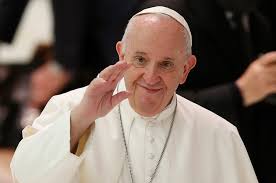
Pope Francis endorsed same-sex civil unions for the first time as pope while being interviewed for the feature-length documentary “Francesco,” which had its premiere at the Rome Film Festival last Wednesday.

“Homosexual people have the right to be in a family. They are children of God,” Francis said in one of his sit-down interviews for the film. “What we have to have is a civil union law; that way they are legally covered.”

UK’s first LGBTQ+ extra-care housing scheme … ALL FM Project … “Old Frame, New Picture” … Manchester Pride Listening Group for LGBT+ 55+

News

‘A game changer’. The UK’s first LGBTQ+ extra-care housing scheme gets go ahead

Accommodation in Manchester will support older LGBT+ people, whose loneliness has been exacerbated by the pandemic.
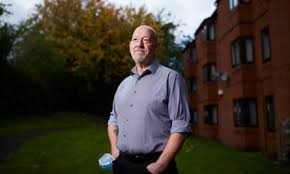
Bill Moss is the only gay person in his sheltered flats in Salford: ‘I do feel isolated. I could do with having LGBT+ neighbours to have a chat with.’ Photograph: Christopher Thomond / The Guardian

Bill Moss, a retired prison officer, felt isolated before Covid. As the only gay person in his block of sheltered flats in Salford, corona virus has heightened his sense of loneliness. Single, without any close family and cut off from an active social life in Manchester’s gay village, he spends most of the day with only the TV for company.

Bill, 57, has been through a pandemic before. Aids robbed him of the love of his life, Henry, and at least 50 friends. So he appreciates how serious this one is, but he cannot get that message across to his fellow residents congregating unmasked at the entrance of the flats and wandering corridors and lifts unprotected. Their lack of understanding underlines his feeling of being alone.

“It’s as if they do not think Covid affects them, but nobody is above this,” says Bill. “I do feel isolated. I could just do with having LGBT+ neighbours to have a chat with. It would allow me to be myself. There are things you don’t have to explain and things you can talk about that are impossible with straight listeners.”

After years of having to hide his sexual identity at work, Bill says now as a “proud, gay man”, it would just be easier to live in his old age supported by LGBT+ people and services.
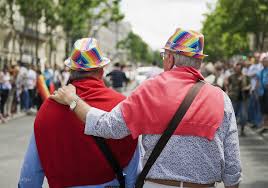
He is not alone. A report and housing survey by the Manchester-based LGBT Foundation, reveals that 74% of responders want a home for their old age aimed at them and delivered by a LGBT-specific provider, but 43% had no idea where they would get care and support in the future.

For Bill and some of the other older members of Manchester’s 7,000-plus LGBT+ community, it could soon be a reality, with the imminent construction of the UK’s first extra-care housing scheme for LGBT+ people.

Manchester City Council has put out to tender a scheme to build an LGBT-affirmative extra-care scheme in Whalley Range, south Manchester. An 18-member LGBT+ steering group will help to develop the scheme. Just over half (51%) of the 150 places are to be allocated to LGBT+ people aged over 55, who need extra physical or mental support.

With two-thirds of care home staff surveyed by Manchester and Nottingham universities in 2014 saying they did not have a gay, lesbian, bisexual or trans resident, the scheme could not come soon enough.

“We know this cannot be true”, says Bev Craig, Manchester City Council’s member for adult health and wellbeing. “LGBT people have long been drawn to Manchester in the knowledge that the community here is strong and supported. However, we know that there is an issue with loneliness among older LGBT people in this city and a core reason for this is access to safe, affordable and secure housing.

As the number of older people in the city continues to grow, having a real understanding of what the community needs and wants from their extra-care housing will be vital.”
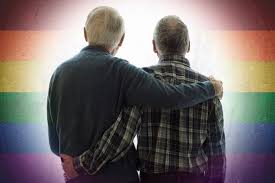
Mindy Meleyal, 69, from Wythenshawe, is a lesbian and has lived with her partner for 30 years. She sees the LGBT housing scheme as a “game changer” in a care system reluctant to acknowledge sexuality of any kind in older age.

“I’ve always thought I would rather die than go into a care home, but as you get older you need to feel secure. If I knew that the manager was LGBT affirmative, I would feel very differently,” she says.

An earlier survey by the LGBT Foundation on the impact of Covid on members of its community, revealed that many were alone, or with families who did not accept their identity. Almost two-thirds (64%) lacked support from an LGBT+ specific organisation, 42% wanted mental health support and 8% felt unsafe.

Stuart, 55, a gay trans man, who came out less than three years ago and recently moved to the city, lives alone and has fibromyalgia, which limits his activity. He says: “Because I never made friends in Manchester and all the contacts I have are from the LGBT Foundation, I have been very, very isolated during Covid. I know I will need care in the future so a place targeted at LGBT+ people would mean I would not feel the need to hide what I am”.

Manchester blazed an international trail for gay rights with the building of Europe’s first gay centre in 1986 and a thriving gay village. It is also the UK’s first age-friendly city region. The extra-care scheme has been in discussion since 2014. Cuts of more than £500m to the local authority’s budget over the last decade, threats to the government funding model for extra-care schemes and now the pandemic means it may be another three years before its doors open.

Similar schemes exist in Germany, Sweden and Spain. Bob Green, an LGBT Foundation consultant for the project, visited three projects in the US to learn from their experiences. In Minneapolis, he found that the complex was taken over by “straight people”. He believes that this was because of the inadequacy of the application and allocation system.

In Philadelphia, he was inspired by LGBT+ residents regarding the care facility as their first real “home”. The scheme he saw in Los Angeles was not exclusive to LGBT+ residents but welcomed other groups as the Manchester care home will too. “We do not want to cut ourselves off as a community,” Green says.

He is clear that any targeted care home needs to be part of a wider package of measures to benefit Greater Manchester’s growing elderly LGBT+ population. For this reason, the LGBT Foundation is piloting the UK’s first accreditation scheme for housing providers in the city. They will receive training and support to be able to prove they are aware and considerate of LGBT+ residents’ needs.

Lawrie Roberts, the manager of the Pride in Practice scheme, says: “We are building on our accreditation for primary care, which started off in Greater Manchester before expanding nationwide. Adapting it to adult social care and housing has huge potential.

It demonstrates to residents that these services are willing to do more to improve care for LGBT people and that staff have gained confidence and knowledge from undertaking the training we provide. We know from LGBT communities that they want something meaningful like this award to signify which are the trusted and most welcoming schemes locally to them.”

Bev Craig believes the new Manchester care home will also help to drive up standards across the country. “Only 150 people get the chance to live in this scheme. But it should lead to an improvement in provision across the UK,” she says.

As for the Whalley Range local community, April Manderson thinks the care home will be welcome. “I’m all for it,” enthuses the 56 year old, who is black. “I’d even be happy to live there myself in an environment that is multicultural, diverse and age-friendly.”


The project: ALL FM would like to broadcast 100 older Manchester people
ALL FM is a local community radio station serving south, central and east Manchester and based in the South Manchester suburb of Levenshulme.

Do you fancy being recorded and broadcast either as part of Out In The City or as an individual (over 50) project?

It could be anything from plugging something you’re doing – a project or voluntary work, sharing expertise or episodes of your life or work history, showcasing creative work, group discussions or interviewing someone.

Whatever it is, ALL FM want your voices on the radio.

The idea is to meet up with people in small groups, pairs or individually  – social distancing, or on zoom, to start a chat about what people might want to broadcast. This could be in a safe community venue or outside in a park, or in a café … all as flexible as possible to make sure everyone feels safe.

Then we’d plan it together, record it and in the next few months broadcast it along with up to a 100 other people’s voices, with their music choices added. Our ultimate aim, once we can all move more freely, all those 100 will be invited to join ALL FM, do radio training and have their own live show.

Recording and broadcasting Manchester’s older people is top of the agenda for ALL FM.

We would love it if the airwaves were full of our voices.

If you want to be involved please contact us.


Old Frame New Picture: how older people are represented in the media and what we can do about it

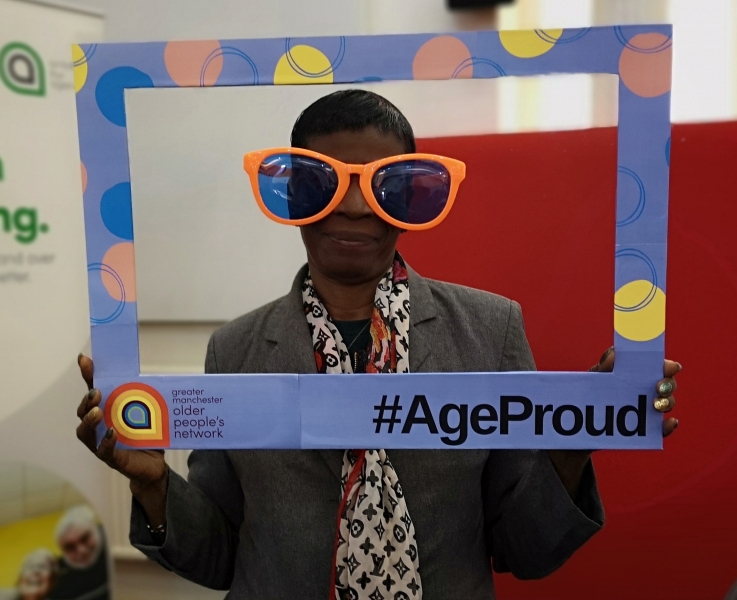
The Greater Manchester Older People’s Network have recently launched the “Old Frame, New Picture” photography competition to gather positive and diverse images of older people.
You are invited to attend an event designed to examine the issue of negative and stereotypical representations of older people in the media.

Wednesday, 28 October 2020, 10.00am – 12.00pm

To register, please use the link to Eventbrite below:

https://www.eventbrite.co.uk/e/old-frame-new-picture-how-older-people-are-represented-in-the-media-tickets-125453353357

Have you seen one too many photos of wrinkly hands or other dehumanising pictures of people over 50 in adverts and news articles?

This online event is an opportunity to examine and challenge how older people are portrayed in the media with negative and stereotypical images of vulnerability and fragility. How can we challenge this narrative with one that celebrates the diversity of older people’s lives and their contributions to society?

This event will include presentations and provocations from a range of speakers who will draw on professional and personal insights to explore why we represent older people in this way and how this has been compounded by Covid-19. This will be followed by a broader discussion on ageing, media and representation where attendees will have the chance to also share views, ideas and ways in which we can change the picture in the frame.
The speakers include:

Alex Rotas, leading photographer who specialises in challenging ageing stereotypes through photography

Thomas Scharf, Professor of Social Gerontology in the Population Health Services Institute at Newcastle University

Pauline Smith from the Greater Manchester Older People’s Network

Sabrina Fuller, 2020 bOlder artist

Heather Bell, emerging photographer

More info via https://manchestercommunitycentral.org/old-frame-new-picture


Manchester Pride: LGBTQ+ 55+ Listening Group

Wednesday, 4 November 2020, 2.00pm – 4.00pm

The Listening Group will be a structured, but informal, conversation about the ways in which Manchester Pride can better support you and your community in the future.

The session is a chance for you to have your say and help to shape Manchester Pride’s activities in the future.

The session will be held via zoom and you will be able to attend using full video and audio, either video or audio or just using the chat function if you would prefer.

Any questions? Contact engagement@manchesterpride.com or 0161 831 7700.