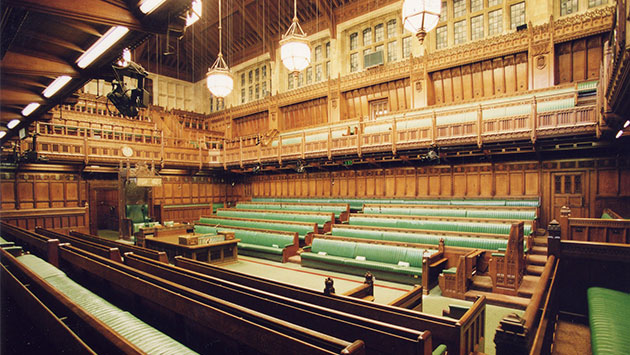
Parliament debated the petition “Make LGBT conversion therapy illegal in the UK” on 8 March 2021.
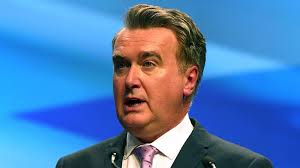
John Nicolson, Scottish National Party representing Ochil and South Perthshire made a contribution, which began:
John Nicolson, SNP
““Converting gays” – just wonder for a moment about how primitive that concept is. It is a cruel hangover from a darker time – a time when to be gay, lesbian or trans was to be flawed or inadequate.
I do not know why I am gay. I do not know why I have green eyes or curly hair, but I do know that no one made me gay; I was born gay. When I was younger, to borrow from Alfred Kinsey, I would have taken a magic pill to make myself straight, but I now know that that was not because I hated being gay, but because I did not want to be the victim of prejudice. Who does? We know that there is no magic pill, nor do we need one. We need love and acceptance.
LGBT conversion is the very antithesis of that. It promises a cure where none is available and none is needed. We look back in horror at the tortures endured by our LGBT brothers and sisters, even in recent history – electro-shock therapy, lobotomy and the chemical castration endured by Alan Turing at the hands of a vicious and ungrateful political class and legal system.
Changing people’s sexual orientation is, as we know, scientifically impossible, but that does not stop bigots from trying. “Pray away the gay,” cry some religious groups, who somehow see no contradiction with the command that thou shalt love thy neighbour. People who hold out the promise of conversion are cruelly targeting the most vulnerable. It is abuse.”
Census 2021 will provide a snapshot of modern society
Households are being asked to take part in the nationwide survey of housing and the population. It has been carried out every decade since 1801, with the exception of 1941.
Information from the digital-first census will help decide how services are planned and funded in your local area. This could mean things like doctors’ surgeries, schools, housing or new bus routes.
Households will receive a letter with a unique access code in the post, allowing them to complete their questionnaire online. Paper questionnaires will be available on request. Census day is 21 March.
The census will include questions about your sex, age, work, health, education, household size and ethnicity. For the first time, there will be voluntary questions for those aged 16 and over on sexual orientation and gender identity. This will provide true data on the LGBT+ communities, so that resources and services can be supplied where most needed. Private, individual forms can be requested.
While there are estimates of sexual orientation at a national and regional level, it is not possible to produce robust estimates for all local authorities – that’s what census data will give.
There is no robust data available on gender identity at all. These data are needed by local authorities and service providers to inform the provision of services. The sexual orientation and gender identity questions will be voluntary for people aged 16 and over.
Without robust data on the size of the LGBT+ population at a national and local level, decision-makers are operating in a vacuum, unaware of the extent and nature of disadvantage which LGBT+ people may be experiencing in terms of health, educational outcomes, employment and housing.
There is also a separate new question asking people whether they have served in the armed forces.
Anonymous results will be available within 12 months, although personal records will be locked away for 100 years, kept safe for future generations.
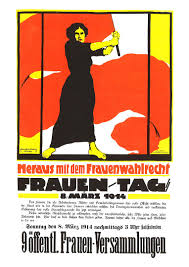
German poster for International Women’s Day, 8 March 1914. This poster was banned at the time.
International Women’s Day (IWD) is celebrated on 8 March around the world. It is a focal point in the movement for women’s rights.
After the Socialist Party of America organised a Women’s Day in New York City on 28 February 1909, German delegates Clara Zetkin, Käte Duncker, Paula Thiede and others proposed at the 1910 International Socialist Woman’s Conference that “a special Women’s Day” be organised annually.
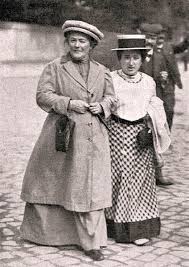
Clara Zetkin and Rosa Luxemburg in January 1910
After women gained suffrage in Soviet Russia in 1917, 8 March became a national holiday there. The day was then predominantly celebrated by the socialist movement and communist countries until it was adopted by the feminist movement in about 1967. The United Nations began celebrating the day in 1977.
Commemoration of International Women’s Day today ranges from being a public holiday in some countries to being largely ignored elsewhere. In some places, it is a day of protest; in others, it is a day that celebrates womanhood.
IWD 2021
The 2021 UN theme for International Women’s Day is “Women in leadership: Achieving an equal future in a COVID-19 world”, highlighting the impact that women worldwide had as health care workers, caregivers, innovators and community organisers during the COVID-19 pandemic.
Manchester has a long list of impressive women who have lived and worked in the region, including the formidable Emmeline Pankhurst.
Other remarkable Mancunian women include Victorian writer Elizabeth Gaskell, women’s health trailblazer Marie Stopes, and one of England’s first female doctors, Eleanor Sykes.
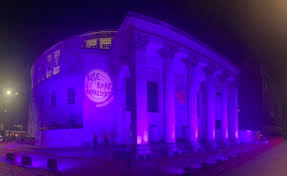
Manchester Central Library lit up to celebrate IWD
Covid-19 Vaccines
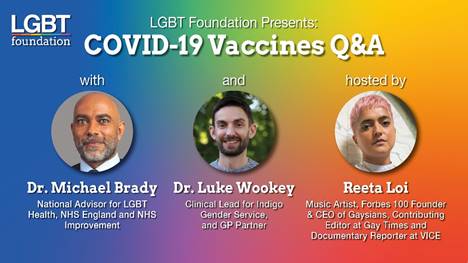
As part of their COVID-19 vaccination campaigning, LGBT Foundation is holding a Q&A event on Thursday 11 March at 6.00pm so LGBT people can get answers to questions may they have. Two of the country’s leading LGBT doctors are joining the panel:
Dr. Michael Brady– National Advisor for LGBT Health, NHS England and NHS Improvement;
Dr. Luke Wookey– Clinical Lead for Indigo Gender Service, and GP Partner.
The event is being hosted by Reeta Loi, Music Artist, Forbes 100 Founder & CEO of Gaysians, Contributing Editor at Gay Times and Documentary Reporter at Vice.
Pride in Ageing’s Virtual Rainbow Death Café is back
Monday, 15 March from 4.00pm to 5.00pm
This event is a chance to talk openly about death and dying in a relaxed, LGBT-friendly group space. Free tickets can be booked here
Tickets are free and a link to access this event will be sent to you on the day. Spaces limited to 12 per session, please book early.
This event will be hosted on Zoom (video conferencing application). Please email lawrence.roberts@lgbt.foundation if you have any questions about connecting or additional access requirements for this session.
This event is presented by the Pride in Ageing programme at LGBT Foundation. Find out more about their other events here: https://lgbt.foundation/prideinageing
The health and care needs of older LGBT+ people
Age UK have published a new article on the health care needs of older LGBT people, which argues that more research and considerations need to be given to this area.
Among its many effects, the outbreak of COVID-19 has brought healthcare requirements into sharper focus. Even before the emergence of the pandemic, however, Age UK was working to highlight the specific needs of groups within society, including older LGBT+ people and their experiences of care, and what can be done to improve those experiences.
Many older LGBT+ people have experienced lifetimes of persecution and prejudice. While the Equality Act of 2010 offers legislative protections for non-heterosexual and non-binary people, and progress has been made, experiences of discrimination, past and present, can directly impact health. It can exacerbate mental and physical health issues, making LGBT+ people more likely to engage in unhealthy behaviours and habits, such as excessive alcohol consumption and drug use. And as LGBT+ people grow older, there’s an extra level of complexity to the issues they face, an intersection between sexuality/gender identity and age.
“I was comfort eating, and I ate to excess and that damaged me physically. My pancreas has practically packed in.” Norm
The healthcare needs of older LGBT+ people
There is limited evidence on the health and care needs and outcomes for older LGBT+ people, however analysis of evidence that does exist suggests that there are health inequalities between older LGBT+ people and the rest of the older population. For example, non-heterosexual men aged 50+ have lower life satisfaction and are more likely to have attempted suicide in their lifetime, and non-heterosexual women aged 50+ are more likely to smoke. Evidence also suggests that there is a higher prevalence of mental health in older LGBT+ people.
Furthermore, there is evidence that some older LGBT+ people have worse experiences of accessing healthcare than their peers. In a recent Government survey of LGBT+ people of all ages, 16% had a negative experience while accessing (or trying to access) public health services. Meanwhile, at least 38% had a negative experience because of their gender identity. Poor experiences of health services can lead to people delaying treatment and in turn lead to worse health outcomes.
Norm, 63, is bisexual. He came out in 2011, having kept his sexual orientation a secret from his family, who subsequently ostracised him, leading to a complicated series of issues. “The main problem I had when I came out was the mental health — depression,” explains Norm. “I was comfort eating, and I ate to excess and that damaged me physically. My pancreas has practically packed in.”
Norm continues: “Because of my diabetes… I lost my job. That made me even more depressed.”
Transphobia and healthcare
At present, there’s little UK research focusing on the health needs of older transgender adults. A US study, however, has found that transgender older people were at higher risk of poor physical health, disability and depression when compared to cisgender respondents (people whose personal identity and gender corresponds to their birth sex).
Pauline, 71, a trans woman from Manchester, has shared her experiences with us. “My perception of the LGBT community is that everybody in it, to some extent, has mental health issues,” she says. “Although society is more tolerant of us than they were, and gay people probably got the first look at that, everybody I know has either been discriminated against or treated badly in all kinds of different ways.”
“There were two nurses… and they were saying some hideous things about me as a trans person.” Helen
Helen, from West Yorkshire, who describes herself as “very old”, has had direct experiences of transphobia, including within the NHS, having been misgendered and the subject of hate speech. “There were two nurses… and they were saying some hideous things about me as a trans person,” she explains. “I didn’t make a complaint. I didn’t want to get them into trouble.”
This has made Helen worry about the future. “I’m getting older and obviously think about long-term care and even though I’ve got a partner, how long is she going to be able to look after (me). Say I’d had (a) stroke or something, the fear of going into a care home or nursing home with staff like (those) I was telling you about fills me full of dread. And that is a really ongoing worry for me.”
Pauline has similar fears about needing care. “One of my fears is ending up in an old people’s home and having to be a man all the time. I hope that I die before I ever get into a care home.”
Concerns about care
Most of the older LGBT+ people Age UK has spoken to expressed confidence the NHS would meet their future needs — even those, like Helen, who have encountered discrimination while accessing healthcare. It’s complicated, though, by the fact that research shows that fear of discrimination and previous experiences of prejudice still remains an impediment to people seeking healthcare services.
This fear was much more significant when it comes to accessing social care services. People expressed a few reasons for this. First and foremost, with coverage of the underfunding and resourcing of the social care system in the press, many people will worry that the care system will be unable to meet their needs. This would be particularly problematic for those who would worry that a lack of care provision may result in the need for informal care from family members who have not accepted their sexuality or gender or without support completely from friends and family leaving people reliant on limited state support.
Additionally, there is an understanding that care services are potentially more frequent and have greater levels of intimacy than those provided by NHS and that this may interact more closely with their day to day lives and so their gender identities and sexual orientation. A professional working with LGBT+ older people has told us: “People hide their magazines, they take their pictures off the wall, because they don’t know who’s going to turn up.”
There were also high levels of concern about the people delivering these services, who may come from socially conservative countries and therefore hold homophobic and transphobic views.
The experiences of LGBT+ people with dementia
Everyone worries about what would happen to them if they were to be diagnosed with dementia. But what of LGBT+ people who fear their advocacy and identity will be neglected when they receive care? Dementia naturally results in distress and confusion, but this may be exacerbated in LGBT+ people with dementia who may struggle to deal with negative perceptions of their sexuality or gender while in residential care or face issues when they are not able to advocate for themselves. An older transgender person experiencing cognitive decline, for example, may forget who they have come out to, or indeed that they have transitioned.
David and Elmar, who live in London, have been together for 14 years. Elmar, who is 20 years older than David, has Alzheimer’s disease, and their experiences of healthcare have so far been positive, something they put down to London being a place of greater acceptance. The two men don’t access care services yet, though the possibility of it is something that David has some concerns about.
“Thinking about care homes, it’s difficult because the people who are employed there may not be so tolerant.” David
“I think we’re lucky that Elmar’s got me to look after him,” explains David. “Thinking about care homes, it’s difficult because the people who are employed there may not be so tolerant. For example, there may be people of different religions, who don’t accept gay people or people who don’t have the contact with gay people as well, so they just don’t understand their needs.”
These are worries that David, who found coming to terms with his sexual orientation challenging, considers when he thinks ahead to when he’s one day alone. “In care I’d prefer it to be specialist. You never know if you’re in a home which is mixed. You never know if you’ll get negative people.”
There’s more to be done
These insights help to build a picture of the health and care experiences and requirements of older LGBT+ people but are by no means the full picture. It’s also worth remembering that some of the stories we have shared have come from individuals confident enough to be interviewed and participate in research. But what of those whose experiences have been so unsettling and so damaging that individuals not only distrust health and social care services but are uncomfortable coming forward to discuss these issues?
It’s also important to note that it is not possible to generalise the needs of all older LGBT+ people, but understanding individuals needs and histories and what that might mean for their health and care needs will be key to delivering true personalised care and ensuring the reduction in health inequalities faced by older LGBT+ people.
Our research has also discovered good practice and examples from throughout the health and care sector to better support older LGBT+ people, but there is still room for further considerations and more research, and this is something Age UK will continue to advocate for.
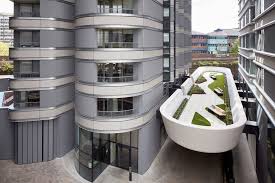
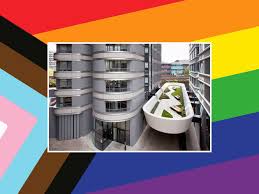
Britain’s first LGBT+ retirement village to open in Vauxhall at Norman Foster-designed Bankhouse
The scheme hopes to help older people who feel forced to go ‘back into the closet’ in conventional retirement homes.
Britain’s first retirement community for older LGBT+ people is to be created in Vauxhall.
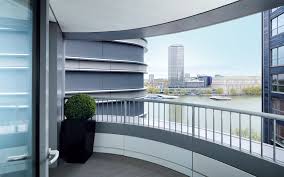
Housing association Tonic said it would purchase 19 already built flats at the Lord Foster designed Bankhouse development next to the Thames using a £5.7 million loan from the Mayor.
The one and two bedroom apartments will be made available on a shared ownership basis from “late Spring” with residents moving in from mid-summer. The scheme will have a restaurant, a roof terrace and gardens.
The flats are not exclusively for LGBT+ people and straight couples who support the values of the gay community are also welcome to apply. However it is expected that the vast majority of the residents will be from an LGBT+ background.
Occupiers will be able to purchase shares of between 25 and 75 per cent and pay rent on the remaining portion.
They will be able to buy support and care packages depending on their needs.
‘Significant milestone’: Tonic Housing plans to purchase 19 flats in the riverside Bankhouse development
Deputy Mayor for housing Tom Copley said the scheme was a significant milestone because so many older LGBT+ people have been forced to go “back into the closet” in conventional retirement homes.
He said: “Many older people have grown up when society was a lot less accepting and to someone moving into a new community and you are not sure how accepting people will be towards you that can be quite intimidating.”
Tonic Housing’s chief executive Anna Kear said: “We are making history today, realising a long-held dream to provide a safe place for older LGBT+ people to live well, in a community where they can be themselves and enjoy their later life. We applaud the Mayor of London for recognising and supporting the needs of older LGBT+ Londoners.”
Derek Jacobi
Sir Derek George Jacobi CBE; born 22 October 1938 is an English actor and stage director.
A “forceful, commanding stage presence”, Jacobi has enjoyed a successful stage career, appearing in such stage productions as Hamlet,Uncle Vanya, and Oedipus the King.
“I knew I was gay very early on, although it wasn’t called gay back then. I knew that I wasn’t into girls in the way that I should be. I dated girls, and we sat in the back row of the cinema, and I did all that I was supposed to do, but I wasn’t enjoying it. I confessed to my mother while I was at university and she very typically and sweetly said: ‘All boys go through this stage.’
I was a loner for years, but I’ve been with my partner (Richard Clifford) for 43 years, which is quite an achievement. It remains a stable and loving relationship. It was another piece of luck in my life.”
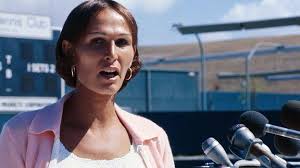
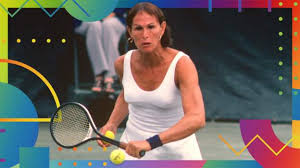
Renee Richards’ journey from tennis outcast to trans pioneer
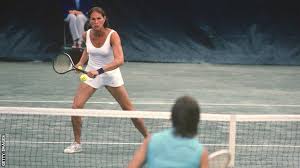
Renee Richards briefly broke into the top 20 of the women’s world rankings.
“I had death threats. I had people who hated me. People told me I was immoral.”
Transgender tennis player Renee Richards was already proving to be a divisive figure when the level of scrutiny surged.
Shortly before the 1977 US Open, the 42-year-old American won a legal battle to compete in the women’s events, leaving her at the centre of a polarising story which made headlines across the world.
“Everybody had a reaction. They were either for her or against her,” says Britain’s Sue Barker, who played against Richards twice in her career and remembers her being booed off court during one of the matches.
“I was a supporter of Renee, I was one of the few in a way.”
The dissent from the sport’s rule makers, which was backed by several leading players, centred on the belief the 6ft 1in Richards would dominate because of an unfair physical advantage over her rivals.
Others, even aside from those making the threats to her life, were less covert with their objections.
Wherever they were on the sliding scale of disapproval, their bottom line was Richards should not be allowed to play against the likes of Sue Barker, Chrissie Evert and Martina Navratilova.
Richards, who was born in 1934, excelled in a range of sports, got married and started a family.
After graduating from Yale University, the affluent New Yorker trained to be an ophthalmologist, going on to specialise in eye-muscle surgery.
Combining a medical profession with an amateur tennis career, Richards reached the second round of the US Open men’s singles in 1955 and 1957.
“I had a very good and a very full life as Richard. But I had this other side of me which kept emerging,” Richards told the BBC in 2015.
Shaving her legs and wearing skirts while dog-walking allowed her to do what felt natural. But being born a man and living as a woman was not widely accepted in 1960s America, stigmatised and classified as a mental illness.
“I kept pushing back until finally it was not possible to submerge Renee anymore – and Renee won out,” she said.
In 1975, aged 40, she had gender reassignment surgery.
Initially, her plan was to move to California and start afresh in a place where nobody knew her.
But her previous identity was unveiled when she started playing amateur tennis tournaments, leading to a newspaper exposé, more headlines and an insistence from United States Tennis Association (USTA) officials that she could not compete in women’s tournaments.
“I never planned to play professionally as a woman. But when they said ‘you’re not going to be allowed to play’ that changed everything,” said Richards, who is now 86 and living out of the public eye in upstate New York.
“I told them ‘you can’t tell me what I can and can’t do’. I was a women and if I wanted to play in the US Open as a woman – I was going to do it.”
To armour their blockade of Richards, the USTA introduced a chromosome test for the women’s players before the 1976 US Open. Richards failed the tests and was barred from entering.
That led her down the legal route and culminated in a year long battle for the right to play. The odds were stacked against Richards.
“The USTA had the top lawyers in New York, they brought in witness after witness saying I should not be allowed to play,” she said.
“My lawyer Michael Rosen only had one witness for me.”
That witness proved pivotal. Billie Jean King, who had played doubles with Richards, was a powerful voice after her tireless campaigning for gender and sexual equality.
In an affidavit submitted to the New York State Supreme Court, 12-time individual Grand Slam champion King insisted Richards did “not enjoy physical superiority or strength so as to have an advantage over women competitors in the sport of tennis”.
The judge agreed. Eight days later, Richards was playing in the 1977 US Open.
‘People wondered if it would be a gamechanger’
Tennis had never seen anything like it. Not only did the women’s players now have to take chromosome tests, their preparations for the Grand Slam were disrupted by constant questioning about Richards’ participation in a fervent media storm.
The sport was broadly split into two camps: rejection and a fear she would dominate the game, or acceptance and a show of empathy.
“I was open minded,” said Barker, who used to hit with Richards on the practice courts, “but the ruling frightened a lot of people. They feared she would serve-volley the rest of us off the court and wondered if it would be a gamechanger for the sport.”
Reigning Wimbledon champion Virginia Wade played Richards in the first round but was untroubled in a straightforward victory.
Richards did reach the women’s doubles final alongside Betty Ann Stuart, although they were beaten by top seeds Navratilova and Betty Stove.
Richards’ best finish in women’s Grand Slam singles events was reaching the third round at the 1979 US Open.
Frostiness in the locker room thawed when it became apparent Richards would not offer too much threat. Or, as Richards put it, that she would not “take their money away”.
While she beat some notable names, and climbed into the world’s top 20, Richards lacked the athleticism and mobility of her younger rivals to topple Evert and Navratilova at the summit.
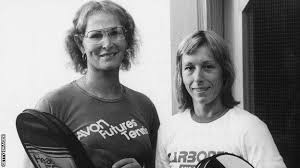
Richards retired aged 47 in 1981 and went on to coach Navratilova to three Grand Slam singles titles.
“It didn’t become the story which a lot of people thought it might become,” says Barker. “She just melted into the tour and didn’t dominate. She won matches and she lost matches. It didn’t alter the game as some predicted. But she achieved what she wanted to do, to play professionally as a woman and was welcomed by the vast majority.”
‘Confrontational’ crowd forced Richards off court and into tears
Hostility and suspicion eventually faded in the locker room, but Richards still faced obstruction and abuse.
She was barred from competing in many tournaments, including Wimbledon and the French Open, where rulebooks said only players whose biological sex was female could play in the women’s events.
This meant most of her appearances came in the United States, travelling around new cities and being made to feel like a circus act as she played in front of a new crowd.
Barker remembers playing Richards in the American’s early days on the women’s tour and says the atmosphere was “confrontational”.
“There were probably about 7,000 people there in this huge arena and she was not well-received by most, if not all, of the crowd,” says Barker. “It was just horrible. They were shouting things, booing every time she hit the ball and cheering every mistake.”
Despite Barker and the umpire trying to simmer the crowd, tournament officials eventually decided to take them off the court.
The pair were beckoned to a room underneath the stand. Richards started to cry.
“It was really sad and I felt so sorry for her. I told her she didn’t have to put herself through it,” remembers Barker. “Eventually we went back out but it was clear she wasn’t thinking about the tennis. I think she wanted to just get off the court. All she wanted to do was to play tennis.”
Occasionally Richards used to open up to her colleagues, many of whom were curious about her life.
There was a feeling the scrutiny – with Richards later saying she couldn’t “go anywhere in the world without being recognised” – caught her by surprise and took its toll.
“We all admired her courage after the emotional and difficult journey she had been through,” says Barker.
“She used to talk about the emotions she went through and often asked whether she was doing the right thing. I’m not sure she realised the impact it was going to have. I can’t think of another athlete who has had anywhere near that level of attention. It was an incredibly brave thing to do.”
After retiring in 1981, Richards started coaching Martina Navratilova and helped her win several Grand Slam titles.
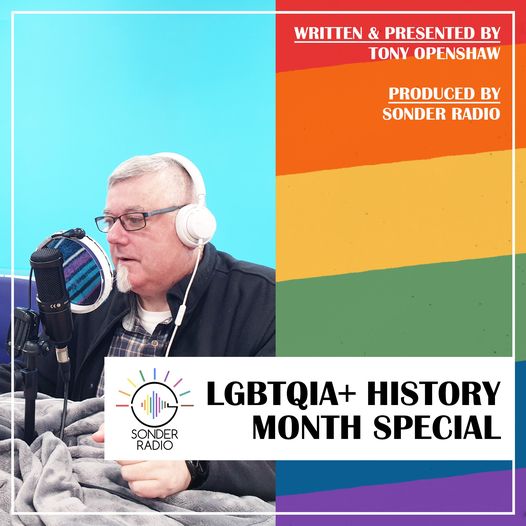
As LGBT+ History Month comes to an end, there are still lots of untold stories … here is something special and unusual as Rachel Oliver travels back to some important dates in our Transgender history. Tune in to 1930s Berlin, 1950s Copenhagen, 1960s Los Angeles and 1990s Eurovision and many more … well worth a visit plus the music is awesome as always.
Running time: 37 minutes (It’s well worth watching all the film, but Out In The City is featured at 9 minutes 30 seconds in.)
The film The Year Without Pride? was produced by members of the LGBTQ+ community on their online filmmaking project, EDEN Shorts. EDEN stands for Equality, Diversity, Educate and Nurture.
The film looks at the ways people have managed to maintain and embrace the community in a year when physical and in-person contact wasn’t possible.
EDEN Shorts launched February 2020 in Sheffield via in-person filmmaking workshops, where 16 members of the LGBTQ+ community were set to produce a short film raising awareness on important LGBTQ+ issues. The group had attended five in-person workshops that covered areas of filmmaking – however, due to COVID-19 the project had to be postponed in the planning stage.
Given the circumstances EDEN Film Productions decided to adapt the project online. The project included interactive online filmmaking workshops, online planning sessions and group discussions. The participants of the project filmed interviews via Zoom with a variety of organisations and individuals discussing the impact of the pandemic on the LGBTQ+ community and the hopes for the future.
Pride Interviews
LGBT+ History Month is an annual month long observance of lesbian, gay, bisexual and transgender history, and the history of the gay rights and related civil rights movements. The overall aim of LGBT+ History month is to promote equality and diversity for the benefit of the public. This year’s LGBT+ History Month theme is Mind, Body and Soul: Claiming our past, celebrating our present and creating our future.
To tackle isolation amongst young LGBT+ people, Manchester Pride launched Youth Pride MCR as a new strand of Manchester Pride Festival in 2019. The first event of its kind in the UK, it provided a safe, supportive, fun and inclusive space for young LGBT+ people to express themselves, connect with others and find community.
To mark LGBT+ History Month, the Youth Pride MCR group wanted to learn more about the history of their community. This intergenerational, youth-led project aims to connect our community and to learn more about what life was like for LGBT+ people in years gone by.
Here we speak to Christine, 71 and Linda, 74 about the importance of Pride, Section 28, discovering community and finding love.
How did people react to you coming out? Linda: I didn’t come out until I was 50. I was teaching in a university and I didn’t feel comfortable talking to more than a couple of people about it. Coming out made me feel brave. No one reacted negatively to it. People were celebratory and people recognised it as a brave step. I discovered a lot of allies and I joined the lesbian and gay chorus.
Christine: I was 40 odd, and I was a senior manager, so I just came out. Gay liberation and the fight against Section 28 was rife and so I just came out. I was 40, senior, confident and political. Some people’s reactions were ‘what took you so long?’ I had lived with a lesbian in a flat share for years so I was comfortable with understanding it. People took it in their stride. I didn’t tell my parents, I just lived my life and wouldn’t refer to my ‘girlfriend’ but would refer to them by name. But later I told my father, after my mother had died, and he said ‘as long as you’re happy’ which was very sweet. In a way my journey was towards gay identity, and I was a confident woman so I took it all in my stride.
Do you remember your first Pride celebration? Linda: Yes, I cycled down into town and standing with my nose pressed against the barriers and thought it was fantastic and was such fun. It would have been one of the first Pride marches in Manchester – I remember going into the concerts and provocative cabaret acts that were brilliant. The atmosphere was so positive and creative. It was all around Canal Street and it was an opportunity for people to dress up and have fun!
Christine: My first Pride celebration that I attended was in Manchester, and it was relatively recently. Between 2010 and 2015 I was a volunteer with the Lesbian Immigration Support Group. Being at Pride is a very important thing for Lesbian Asylum Seekers. I went to Pride several times in those years. The atmosphere was a huge highlight, and the solidarity and the way in which in Manchester, because of the history of gay liberation, the wider population welcomes Pride.
How difficult was it to express yourself in society? Did you experience discrimination? Linda: None really because I didn’t come out until I was 50. Being gay has given me a lot of confidence to go and do other things in my life. Overcoming the fear of prejudice has given me a lot of courage to do other things in my life and I’ve been much less frightened about speaking up.
Christine: It was 1979, I went up to Newcastle to work and I got involved with Lesbians In the Voluntary Sector – working in projects like women’s refuge and women’s health projects. At that time I didn’t identify as lesbian. But I became aware of lesbian culture. Then we jump forward to 1988 and people would say things to me like ‘If you were gay you’d be very comfortable.’ I personally had a sense of difference for years, but I attached it to what I was passionate about, ie being anti-sexist rather than a lesbian. I was busy earning my own living as a solo independent woman. I haven’t been victimised but I have been stereotyped.
When was the first time you saw yourself represented on TV? Linda: Probably it was a novel I read, something about the Woodshed. It was a novel about women who didn’t come out easily and it made me feel really lucky, and privileged.
Christine: The stereotype was ‘The Killing of Sister George’ which is a renowned film. Set in 1968, in a famous club which details the stereotypes of butch and femme lesbians. The big gay deal was Michael Cashman in Corrie. I didn’t watch it but my parents did, but that was the emergence.
Have you found someone you love? Christine: Yes I have found someone I love. I have never been married. I first met Linda back in the 1980’s and we became partners in 1995. I was working as a community worker in adult education and she came to give a workshop, ironically about ‘Community History’ – just like this interview! We are planning to get civil partnered. As a feminist I was very critical of the institution of marriage.
Linda: We’ve been together for 25 years, and it takes a while to figure out if you do want to get married. I met Christine because we were working on an oral history project, we had something professional in common and we both found each other doing challenging work that we were both interested in. It was about finding something we had in common. It took a long time for us to realise that we liked each other more than just professionally.
Section 28 was the first new anti-gay law in over 100 years. As a result nearly 20,000 people from all over the UK marched through Manchester in protest. Do you remember this? Christine: Section 28 was a massive attack on Lesbians and Gay men. Margaret Thatcher used the term ‘pretend families’. I came down to the big Section 28 demo in Manchester from Newcastle, a big coach load of us came down.
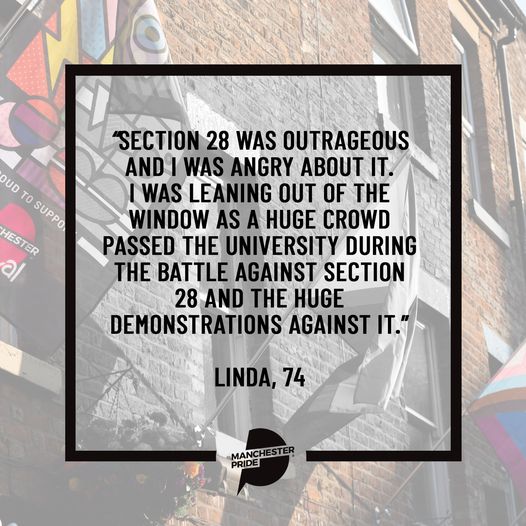
Linda: I was leaning out of the window as a huge crowd passed the university, in the battle against it and the huge demonstrations against it. It was outrageous and I was angry about it.
The group also interviewed Pauline, 72, and Phil, 57 about coming out, their first Pride experiences and the importance of representation.
How difficult was it to express yourself in society? If you experienced discrimination, how did you deal with it? Pauline: In the 60’s there was no internet, we existed but it was more difficult to connect. I went to an all boys school so who was I going to talk to about it. I started expressing myself as a trans person when I was 9. I felt I was the only person in the world who did it. I had zero education about LGBTQ+ information until college when I went and bought my own book about it. When I was a teenager it was still illegal to go out dressed as a woman if you were assigned male at birth. I only ever did it in private when no one was home. I had no one to talk to and buried this part of myself so deeply it took a long time to understand and accept who I was.
Phil: I had no concept of being gay, despite knowing what I was attracted to, so I was in my 40’s before I came to accept my sexuality. I didn’t exist to experience discrimination. I grew up in Cheshire, not a large city, so for me it wasn’t even an option. I think repression is a more fitting word.
How did people react to you coming out? Pauline: I didn’t come out until 1997, when I was 50. I was married to a woman, when my wife found out by finding some women’s clothes that I’d been hiding. We subsequently divorced.
I then told my parents and they were fantastic, and supportive and were great about it. Both parents were very sympathetic about how I’d had to hide such a big part of myself. I do feel fortunate to not have been ostracised by my family.
Phil: I told my sister first. I took her to lunch and on the way I told her and she was fine and fairly supportive. I felt unable to tell my Dad and asked my sister to tell my mum. I told my best friend, who was initially supportive and said he didn’t care but afterward decided that he didn’t want to continue our friendship. Now, I feel like I am against the idea of ‘coming out’. Straight people don’t have to come out and I feel like it shines a spotlight on the fact that I’m ‘different’ when in fact I’m not.
When was the first time you saw yourself represented on TV? Pauline: I don’t think I ever did, because in my head I wanted to be a woman, I didn’t want to be an impersonator like Lily Savage for example, I wanted to be a woman. If you’d told me at fifteen that you could wave a wand and I could have gone to a girls school and worn a dress, I’d have been ecstatic, but I didn’t have those things, it was a different world.
Phil: I don’t think I have, sorry.
Do you remember your first Pride celebration? Pauline: The first one I went to was in Amsterdam in 2000, they were hosting the Gay Games. I remember watching a drag cabaret show with the host as a KLM air hostess, it was the height of summer and the weather was glorious.
Phil: My first Pride celebration was not long ago through work about 6 years ago going to Manchester Pride Festival and watching the Parade. I live in Cheshire so it was a big thing to make the decision and get a train ticket and come along. Watching the Parade was powerful and made me realise that I wanted to be walking in it – it wasn’t enough to be stood watching. The energy was infectious.
What question would you like to ask a younger LGBTQ+ person? Pauline: Have you identified for yourself who you are and who you want to be?
Phil: How do you expect being gay to impact your career choices, and how you think your future employers will react to you being gay?
Ian is 72 and lives in Manchester. He spoke to the Youth Pride group about coming out in his 50s, the discrimination he has faced, meeting the love of his life and his first ever Manchester Pride Festival experience 20 years ago.
How did people react to you coming out? Were there any barriers for you to overcome?
I didn’t ‘come out’ until ‘99 so much later in life. I was 51. I used to work in the Civil Service and I came out there, and overwhelmingly they accepted it. My Chief Exec was also LGBTQ+ so they were in full support. I did experience discrimination from neighbours though.
How difficult was it to express yourself in society?
I came out to a church I used to belong to and that was where I experienced discrimination but not too much with wider society. We were told we weren’t allowed to have communion because we were gay – I argued the point and could tell that they weren’t interested in listening, so we left the church. I have found a new congregation in the United Reform Church.
When was the first time you saw yourself represented on TV?
Through the soaps – maybe some like Anthony Cotton in Coronation Street, from there onwards there were several.
Do you remember your first Pride celebration?
My first experience with Pride was at Manchester Pride Festival with my late partner Alan back in 2001. The Parade was a highlight with all of its colour, and back then it was only small, about 150 people and it was the first time we’d been to it. I also remember the Candlelit Vigil, and having a minute’s silence for those who’ve passed away.
Have you ever been married to someone you love?
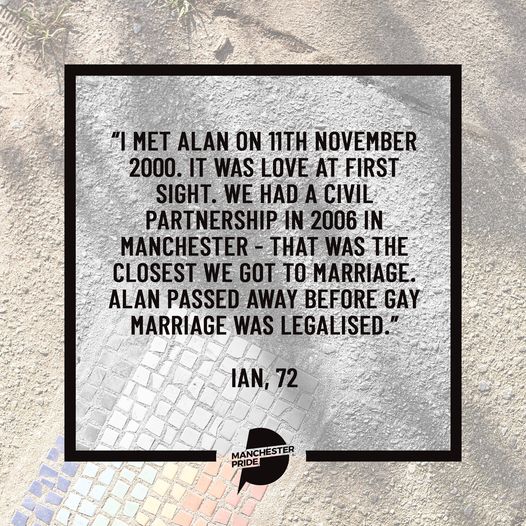
Yes, we had a civil partnership in 2006 in Manchester. That was the closest we got to marriage. I was single until I met Alan, we met on 11 November 2000 and were introduced through a mutual friend and it was love at first sight. Alan passed away before gay marriage was legalised.
What question would you like to ask a younger LGBTQ+ person? I’d like to know how it is growing up now as LGBTQ+. Do you find acceptance in the family and community?
Tony is 65 and lives in Manchester. He spoke to the Youth Pride group about his Roman Catholic upbringing, the difficulties he faced growing up, and how volunteering for the Manchester Gay Switchboard gave him confidence.
How difficult was it to express yourself in society? Did you experience discrimination? How did you deal with it?
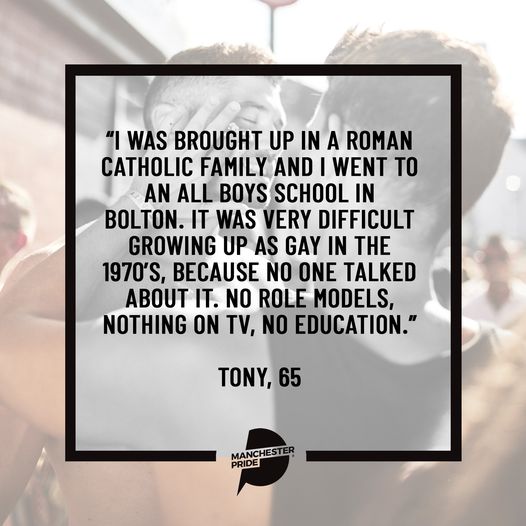
I was brought up in a Roman Catholic family and I went to an all boys school in Bolton. I found out there was a gay pub on the street I lived on, about one bus stop away from where I lived. I didn’t find out about that pub until I was about 20 years of age. I’m amazed by the secrecy, and how no one talked about it. I was going to pubs from the age of 17, but no one ever mentioned this. And then to find out there was a gay pub, so close to me was a real surprise.
I realised I wasn’t heterosexual when I was about 16. I went to see my priest and told him that I thought I was attracted to men, and he told me I had to be celibate. At the time the age of consent was 21. It was very difficult growing up as gay, because no one talked about it, there were no role models, nothing on TV, there was no education. So it was very hard to have the words to understand.
How did people react to you coming out? How did you overcome those barriers?
It was the mid 70’s, my parents thought it was a phase I was going through. They sent me to see a psychiatrist – because homosexuality used to be considered a mental disorder. The psychiatrist told my parents I wasn’t gay. I persisted that I was gay and my family ex-communicated me and ostracised me, to this day. Both parents are deceased but they never came around to accept me. I knew I was gay, you know you are and so there was no denying it for me. I strongly knew, in my head, that I was attracted to men. In 1980, in my mid 20’s I met Phillip (at Icebreakers in Manchester) – I was attending LGBT groups in Manchester at the time. Within six months we moved in with each other.
When was the first time you saw yourself represented on TV?
It was on a documentary in about 1970 about the life of Quentin Crisp – and this blew my mind. I didn’t feel as camp and showy as he was but it resonated with me. So I then went to the library to read his book, it was only on the reserved list, so I had to order it before I could read it.
Do you remember your first Pride celebration?
In the 70’s I went down to Pride in London, several times and there were coaches from Manchester – organised by the gay centre, and I enjoyed the parade and celebrations afterwards before coming back on the same day. In 1981, National Pride was moved from London to Huddersfield in solidarity with the LGBT community there because of continual police raids on the Gemini club. There were about 2,000 people in the parade that year, so it was much smaller but it was a real highlight! We faced more discrimination and people shouting things but it was important to stand in solidarity with The Gemini.
Did you marry someone you love?
In 1980, I met Phillip and we lived together for 31 years. That happened before marriage became available, there was no such thing as marriage or civil partnerships. Those things came about in 2005 and 2014 but we’d lived together for 25 years at this point. In 2011 Phillip went to the GP to get checked out, as he had lost his appetite. He was referred to MRI (Manchester Royal Infirmary), and was kept in over the weekend to get some tests done because they couldn’t identify the issue. I lost him within three days to advanced pancreatic cancer. He was 54 when he died.
The Manchester Gay Switchboard was formed in 1975 – do you remember this? How significant was that for Manchester’s community?
Yes, I became a member of the Switchboard. We were based at 178 Waterloo Place – near to Sidney Street. I used to go and answer the telephone there. And it was amazing, it gave me a lot of confidence and we had so many people ringing up, even though we didn’t have much information.
How did you learn about issues like this that were facing Manchester’s LGBTQ+ community?
I remember going to New York New York and there were no leaflets or magazines on show. There used to be a magazine under the counter called the ‘Pink Paper’ but you had to ask for the ‘Football Pink’ to get hold of it. It was really with these publications that you got to understand what’s going on and then from this you joined groups – like the switchboard and different organisations that were campaigning – like ACT UP.
Hope Mill Theatre announces rescheduled dates for Turn On Fest 2021, the annual LGBTQIA+ festival in partnership with Superbia, Manchester Pride’s year round programme of arts and culture.
Due to the ongoing restrictions Hope Mill Theatre has decided to take the festival completely online, running from 17 to 28 March.
Headlining the festival will be an evening in conversation with Hope Mill Theatre patron Russell T Davies hosted by Julie Hesmondhalgh.
Ru Paul’s drag star Divina De Campo will be joined by special guests in An Hour with Divina De Campo for two performances, directed by Kirk Jameson.
Superbia, Hope Mill Theatre’s partnering organisation, will also host two key events within the festival.
Manchester based company, Green Carnation Theatre will also be screening four short monologue films called Queer All About It, an evening of film, discussion and conversation.
An Evening with Ryan Jamaal Swain will see the star of smash hit television series Pose discuss his career as a dancer and writer in an online discussion.
Hope Mill Theatre has also offered development grants worth £1,000 as well as mentoring to four Manchester based queer theatre makers.
The festival is now on sale and streamed events can be booked here.
There will be an option to purchase a festival pass to access all events throughout the festival.
Speaking about the rescheduled Turn On Fest dates, Hope Mill Theatre Artistic Director Joseph Houston said:
“We started 2021 having to postpone Turn On Fest, which was deeply saddening for our venue and artists involved. However, along with the support of the companies, artists, partners and venue team we have managed to not only reschedule the festival but also create a fully online festival for our audiences. In these difficult times it’s important to continue to share stories, create opportunities and engage with audiences, but also in a safe and secure way, which means that at this time we don’t feel it is possible to plan for any live performances during the festival but we are thrilled we are still able to share the amazing line up with everyone.”
Queer Contact 2021 Is Coming …
Thursday, 29 April to Saturday, 1 May – Online
We’ve been teasing this one for a while, but now we can bring you the full details of Queer Contact 2021 in all it’s vibrant glory, as a fully digital extravaganza delivered straight to your screens.
No dress code (we’re sure you look fabulous in whatever you’re wearing), and plenty of time to get settled in with four days exploring LGBT+ culture past, present and future. Get ready for everything from talks to cabaret acts, plus a dance party beamed into your home.
What’s happening at Queer Contact 2021?
Cheddar Gorgeous, star of Channel 4’s Drag SOS, hosts an interactive cabaret, followed by a party with Manchester DJ collective RebeccaNeverBecky.
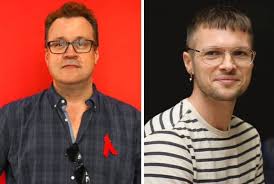
Legendary TV writer Russell T Davies (It’s a Sin, Queer as Folk, Doctor Who) joins It’s a Sin actor (and HIV activist) Nathaniel Hall to discuss portrayals of HIV and AIDS on stage and screen.
Poet and performer Ella Ottomewo brings a group of talented wordsmiths to her spoken word night, Outspoken and writer Darren Atta will be reading excerpts from his Stonewall Book Award-winning work Black Flamingo.
Musician Deanz chats to vogue performer Oskar Marchock about queering dance hall music, and young queer artists Mark Croasdale, mandla rae and Roma Havers premier films with live artist Q+A.
Russell T Davies on It’s A Sin and the romance of Canal Street
The screenwriter talks to Stockport actor Nathaniel J Hall about the legacy of Queer as Folk and his latest show It’s A Sin.
It’s no exaggeration to say the work of Russell T Davies changed the face of British television.
His dozens of writing credits and creations have tackled subjects such as sex work, desire, faith, death and the future, with much of his work set in Manchester.
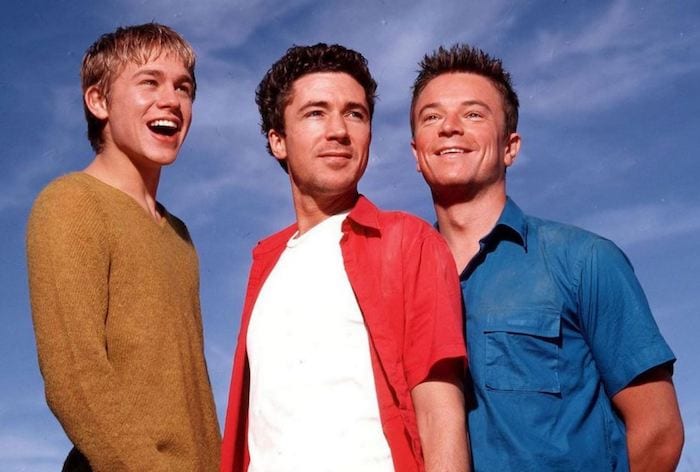
At the turn of the millennium, Queer As Folk brought Manchester’s Gay Village and the messy, sparkly realities of queer life to the public consciousness in a never before seen way.
In 2005, Russell lovingly revived a British institution when he brought Doctor Who back to the screen with inventive writing, genius casting and a politically charged inclusive worldview.
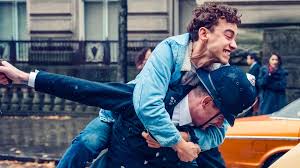
And this year, we’ve all been glued to Channel 4 drama series It’s A Sin, which follows a group of friends whose lives are changed irrevocably by the HIV/Aids epidemic.
In August 2020, Russell was interviewed by Stockport-born actor, writer, theatre-maker and activist Nathaniel J Hall for Superbia Sunday, part of Alternative Manchester Pride Festival.
Nathaniel’s award-winning one-man show First Time dramatised his experience of becoming HIV positive at a young age, and he starred as a boyfriend of lead character Richie Tozer (Olly Alexander) named Donald in It’s A Sin.
In these extracts from their candid interview, the pair discuss the impact of Queer As Folk, ructions on Canal Street, and of course, Russell’s new series.
On Queer as Folk and Manchester’s gay scene
Nathaniel: “Russell, you’ve had a hugely successful career but I would say that Queer As Folk is what most people know you for.
What inspired you to write about Manchester’s gay scene? What was happening at the time that sparked that idea?”
Russell: “It’s funny because I was actually asked to write it – sometimes it takes someone else to point out something really obvious to you!
There’s a woman called Katrina McKenzie at Channel4 who said ‘Why don’t you write about that?’
Up until that point I didn’t think it was possible to write about that and then I turned around and realised that I had 20 years of going out and clubbing and watching that scene.
I had always loved going out on Canal Street, obviously but I love going out on my own. If I bumped into friends I used to say ‘Oh go away!’ I would change clubs to be on my own.
I realised afterwards it was like research – I used to stand at the railing of Cruz 101 and watch everyone dancing, and I’d be watching such a magical space.
You’re watching – even now today – a space that people escape to.
You know, the heat and the light and the cigarette smoke and the noise, and you’re just watching people dancing thinking ‘You’re a bank clerk normally, you’re in the closet, you can’t be out to your mum and dad, you know, but you’ve come here and you are yourself.’ What a dramatic place!
I genuinely love the romance of places like Canal Street. The romance of a gay space.
It’s a true romance, it’s the drama in there – there’s honesty and there’s liberation. You are yourself and sometimes you’re not yourself you can go and be a completely different person. Sometimes you construct a self to go down there.
I’ve always said I think it was a matter of time before someone would put that on screen, and a matter of time before a gay drama came along and I’m so glad it was me. Not everyone is, but I am!
I remember after the first episode I went to Cruz 101 and the man at the desk said ‘That’s set us back 20 years!’.”
On representation
Russell: “There were so many people unhappy with the representation, there was like a public meeting on Canal Street after Episode Five, where I was shouted at by furious lesbians who, of course, didn’t have a presence in the show and when they did, I took the piss out of them slightly because I think that’s very accurate of gay men and of the scene.
It was a lot of fury at the time, it wasn’t an easy ride, it was a rough ride on Canal Street because people waited so long for the representation that of course they didn’t see themselves.
There was this huge public meeting in that bar that used to be called Prague Five.
There was a man who said ‘I read a book every night so they don’t represent me’ and I was like ‘Oh what a great drama that’s going to be. A man sitting there reading’.
I’m taking the mickey now, and unfortunately I did that night. I wasn’t exactly kind that night, but there’s a bigger point to be made that there was a lot of shame and fear that we were seen having sex.
It took a good few years for Queer as Folk to be seen as a good thing and there’s still people out there angry about it.”
On portraying Manchester as an LGBT+ party capital
Nathaniel: “The show inspired lots of people to come here. Every city has its problems but it is genuinely an LGBT+ friendly city and I know I feel very comfortable in Manchester.”
Russell: “People on Canal Street were telling me that I ruined it because hen parties were coming here and lots of women were coming.
Interestingly, in episode three of Queer As Folk – which was written before anyone had seen Queer As Folk – they are complaining about the hen parties on Canal Street, so they were already there.
It’s kind of a fantasy that there’s a perfect gay space in existence somewhere, it’s not anywhere, it just doesn’t exist, but nonetheless, point taken.”
On It’s A Sin
Photo: Channel 4
Russell: “It’s the story of the HIV and AIDS crisis in the 1980s, but told by ordinary people. It’s not in the laboratories, and it’s not in the corridors of power.
It covers all 10 years from 1981 to 1991, with five lovely mates who all live in a flat.
Back then I had a bunch of friends who all lived in a big flat in London, they called it ‘the pink palace’ and they were gay and camp and funny, and along comes the virus. It’s to show that, but with the passage of time.
It’s not just one story, there’s an overlapping concertina of stories that expand and show the development of how the disease was understood, and how life went on as normal at the same time.
At the time that these characters were 18 in 1981, I was 18 in 1981. It’s trying to show that the world didn’t stop, we didn’t all say, “Oh my god there’s a disease”, and stop.
It’s also trying to show the ignorance that was around at the time, the prejudice – but not just that anger.















 Out in the City