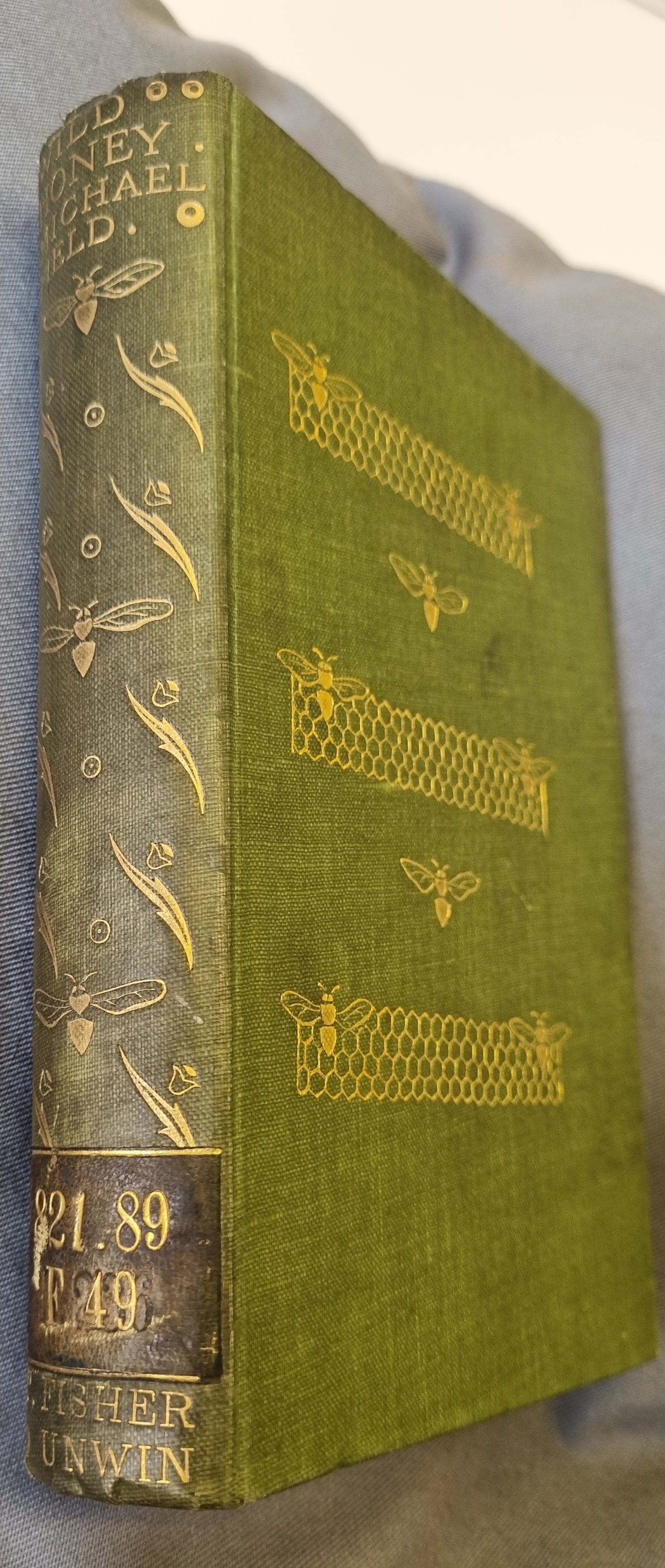
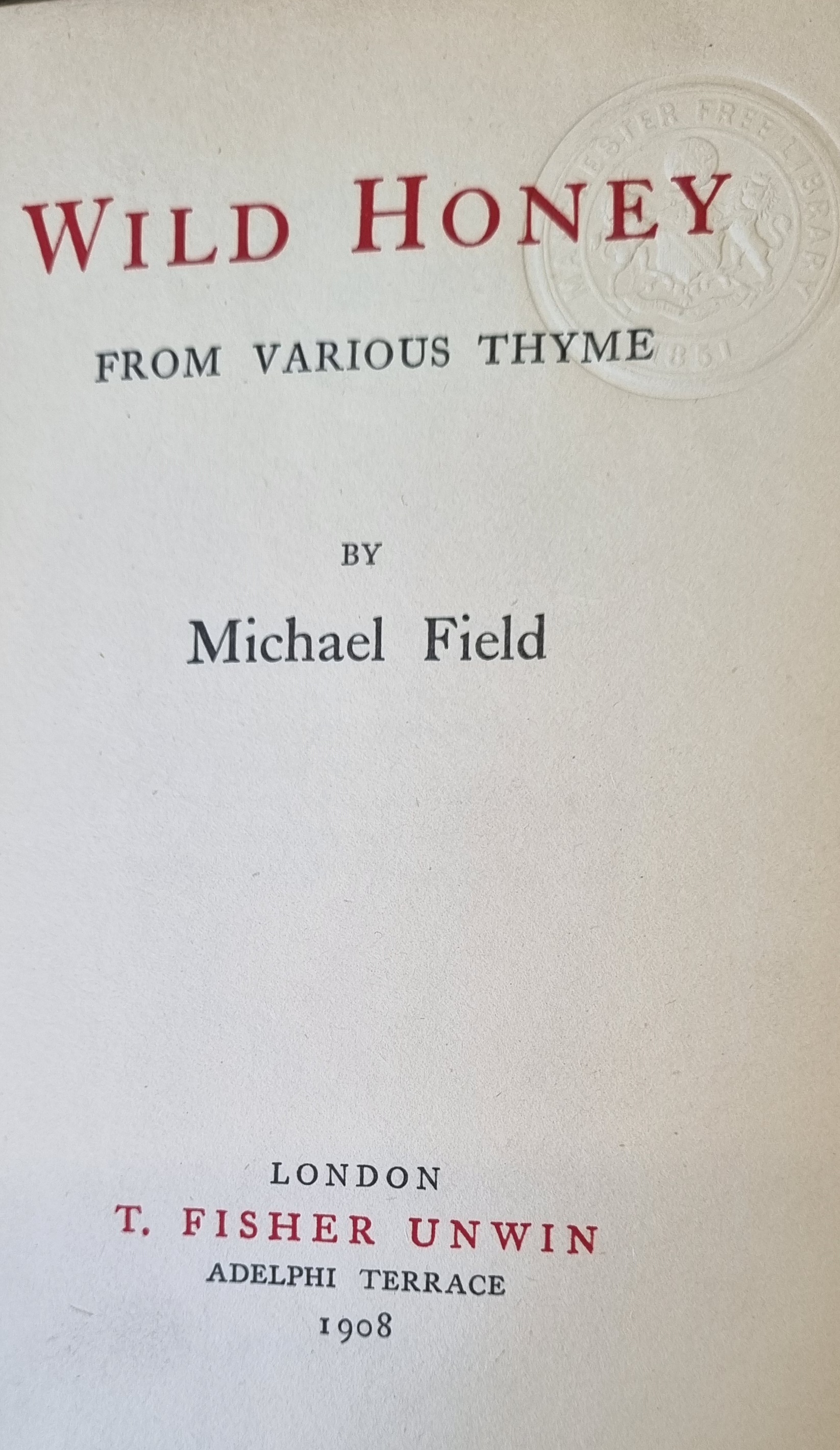
‘Wild Honey from Various Thyme’ (1908) by Michael Field (pseudonym)
(This is the sixth in a series of articles about queer treasures that are currently found in the Archives held at Manchester Central Library.)
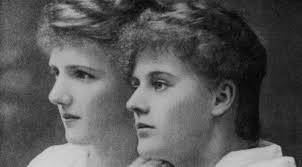
Michael Field was the pseudonym adopted by the English lesbian couple Katherine Harris Bradley (1846 – 1914) and Edith Emma Cooper (1862 – 1913), who together under the name of Field wrote approximately 40 volumes of verse and prose writings. Their adopted nom de plume was intended to remain a secret, but was carelessly revealed to the public by their friend, the poet, Robert Browning.
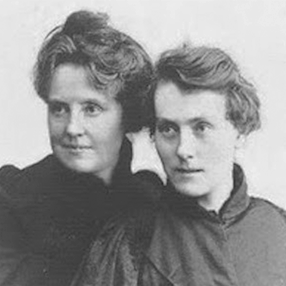
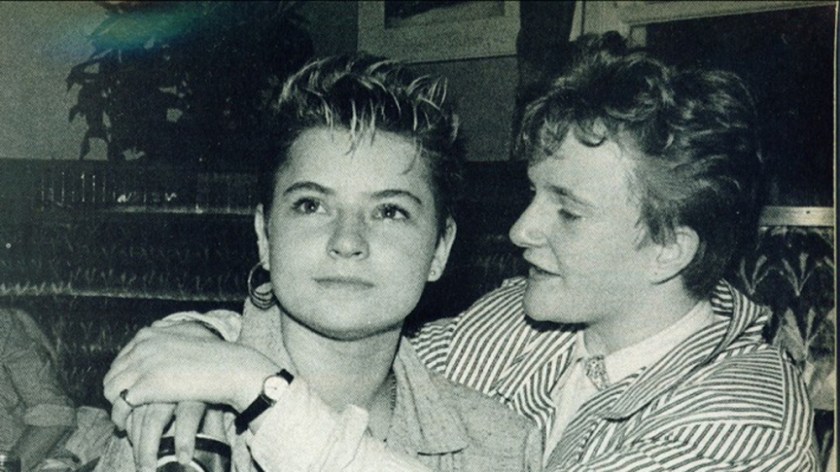
Katherine and EdithKatherine Bradley
Edith was Katherine’s niece and became her ward when ill health prevented Edith’s mother from caring for her. By the mid-1880s however their relationship had developed into an intense love affair that lasted for over 30 years. In their letters they often addressed each other using the terms of ‘Sweet Wife’ and ‘my own husband’. Yet they also had infatuations with some men, with whom they formed close bonds of friendship. Their relationship with each other did not initially present problems to them, though others adversely commented on their apparent excessive closeness.
They were enthusiastic supporters of Aesthetic Movement ideas in Art and Literature and were friends with many other artists and writers, including the painters Charles Ricketts and Charles Shannon, and the writers Robert Browning and Oscar Wilde. Ricketts and Shannon lived openly together as a gay couple in Richmond and were very close to Edith and Katherine.
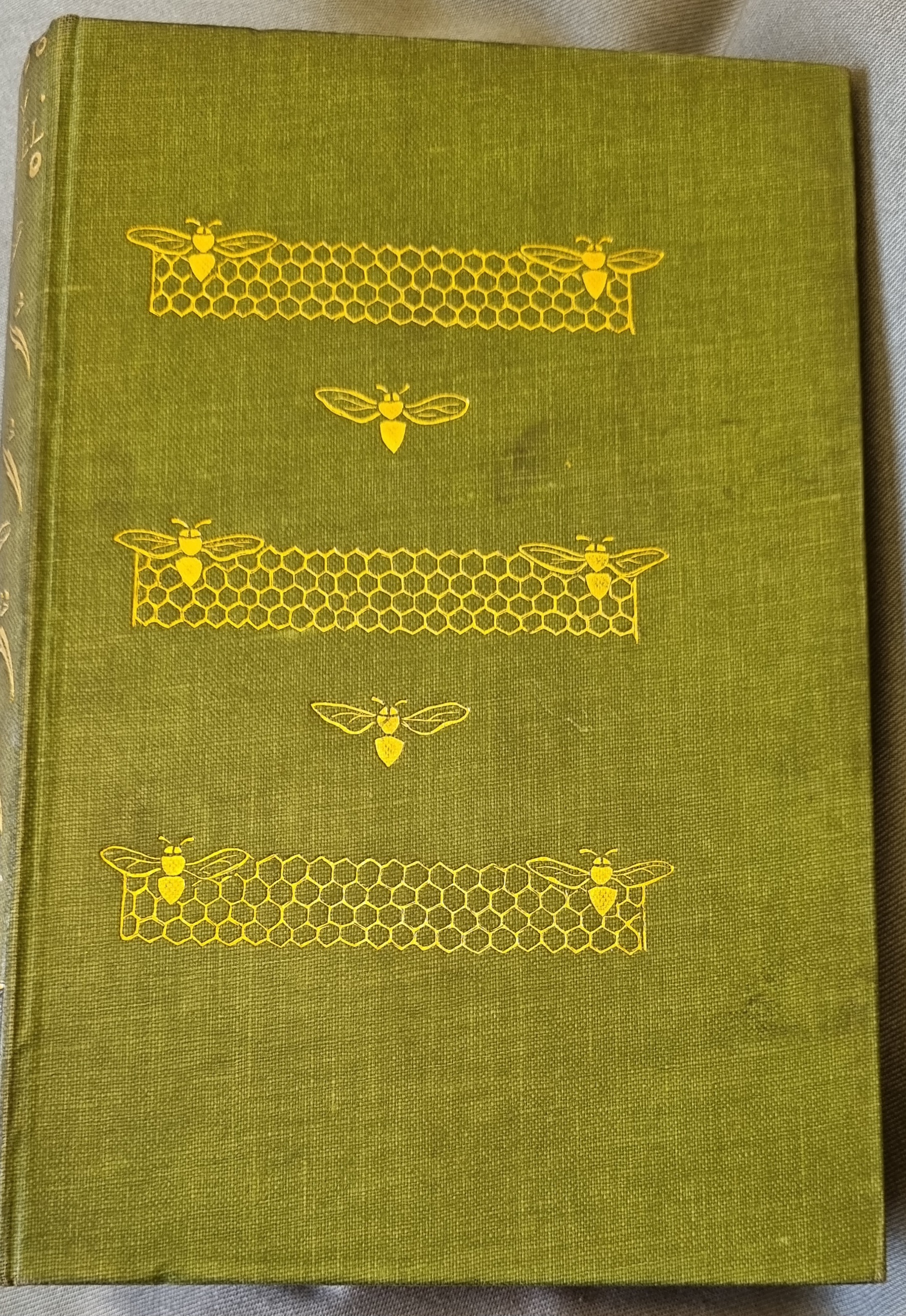
Much of the women’s early verse drew inspiration from the works of Ancient Greek Literature, in particular the poetry of Sappho, herself a celebrated Lesbian artist. ‘Wild Honey from Various Thyme’ appeared in 1908, and marks the transition in their poetry from being inspired by pagan classical themes to overtly Christian ones. True to their aesthetic disposition, the actual book itself is a work of art, with dark green silk on the outer boards bearing a gilt-embossed decoration of bees and honeycombs, designed by their friend, Charles Ricketts. On the spine there is a corresponding motif of bees and flower-bells.
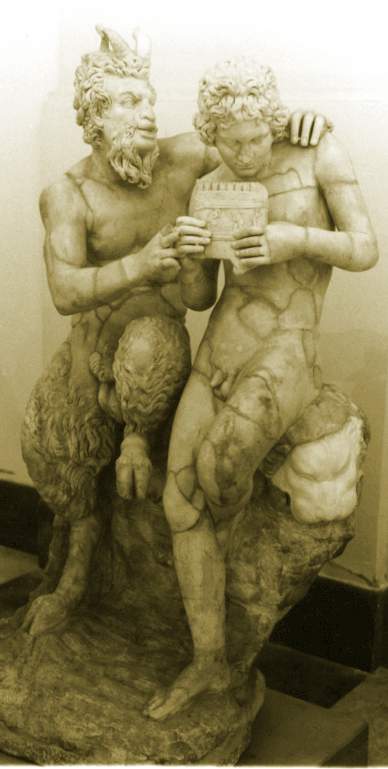
Pan and Daphnis
In Ancient Greek Literature, poets were often referred to as bees, as the sweetness of their verse was compared to honey: Sappho herself had the epithet of the ‘Pierian bee’.
‘Wild Honey’ opens with a poem addressed to the Ancient Greek pagan deity, Pan –
And while he sleeps the bees are numbering …
And smear with honey his wide, smiling lip. (p1)
Of note here is the god Pan’s fin-de-siècle popularity as a symbol for queer sexualities, indicating a knowing playfulness in their verse. As Marion Thane* in her book on Field observes –
Bees seem to have a peculiarly Decadent and homosexual sexual significance … which is born out in other writings upon poetry in the nineteenth century. This association can be traced back to 1873, when Alfred Lord Tennyson condemned ‘Art with poisonous honey stolen from France’. Here, the influence of France, is, of course, decadence; France coming to signify all that is corrupt, morally, and particularly sexually. ‘Honey’ is used here as a conventional metaphor for poetry, but it is also clear that Tennyson’s talk of ‘poisonous honey’ created a potent image of a homosexual, Decadent aesthetic. (Thane 2009 p143)
Additional poems and verses praise Eros and Dionysus, but yet others hint at the writers’ later conversion to Roman Catholicism, before the work climaxes with the Christian-inspired poem of ‘Good Friday’ (p194).
Resolute in their love for one another when inspired by the pagan world, sadly towards the end of her life, under the influence of the poisonous honey of Catholicism, Edith worried about having to confess her ‘secret sins’. Nonetheless, certain poems, such as ‘Constancy’, seem directly to address the continuing strength of their love for each other –
I love her with the seasons, with the winds, As the stars worship, as anemones Shudder in secret for the sun, as bees Buzz round an open flower: in all kinds My love is perfect, and in each she finds Herself the goal: (p173)
Edith died from cancer in December 1913; sadly, Katherine survived only a few months, before she too passed away the following September. As a testament to their love for each other, they were buried together in the cemetery of St Mary Magdalen Roman Catholic Church in Mortlake.
* Thain, M. ‘Michael Field’: Poetry, Aestheticism and the Fin-de-siècle. Cambridge University Press: 2009.
Enjoy having a scroll through the Manchester Digital Music Archive, an online archive celebrating Manchester’s music history. We particularly enjoyed this online exhibition about Manchester’s LGBT music history.
Introduction by: Jon Savage
Welcome to the Queer Noise exhibition: an online project that explores the hidden history of Manchester’s LGBT+ music culture and club life. The key word here is hidden. Despite the fact that there have now been dozens of books written about Manchester music and pop culture – relating to Factory, the Haçienda and Madchester in particular – LGBT+ people are rarely given space in the city’s ‘official’ histories.
Believing that this is a severe omission, Abigail Ward decided to set up an online project that would invite queer people from across the generations to share their memories, pictures, artefacts and stories – with the aim of constructing a fuller history of the city’s oft-forgotten queer scenes and their wider influence upon British pop and club culture.
The memories go back to the nineteen-fifties, when venues such as The Union Hotel (now the New Union), The Café Royal and the Gaumont Cinema bar provided safe spaces for gay men. In the 70s we see the launch of the Gaslight, one of the first lesbian clubs in the region, opened by Joyce Edwards.
Then there’s the early 80s peak where, despite the attentions of police Chief Constable James Anderton, venues like Hero’s, High Society and Napoleon’s flourished.
Manchester’s LGBT+ scene exploded in 1991 with the success of Paul Cons’ and Lucy Scher’s Flesh at the Haçienda (again an alternative story to the laddish ‘Madchester’ groups who dominate the histories of that club). This helped Manchester’s Gay Village to thrive, although there are many debates about the commercialisation of Canal Street and the dilution of the queer subculture.
In more recent times we have seen the emergence of a fascinating Queer Alternative scene with clubs like Bollox, Homo Electric and Club Brenda the helm. These club are all notably eclectic musically and trans-friendly, as are smaller nights such as Tranarchy and Drunk At Vogue.
But there are still many gaps, particularly from the trans scene, and we’d like your help to fill them. If you own artefacts that you think should be included in this exhibition, please upload them to the main Manchester Digital Music Archive website, or email them to info@mdmarchive.co.uk. Every contribution will be properly credited.
With your support, we hope to construct a proper people’s history and to reclaim Manchester’s vibrant LGBT+ music and club culture from the shadows.
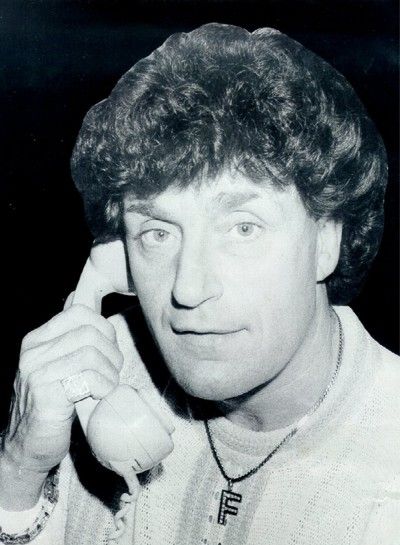
Frank LamaarManchester Lesbian and Gay Chorus
New NHS Video launched
The Pride in Ageing Advisory Group at the LGBT Foundation have been working with the Health Innovation Accelerator project by NHS Health Innovation Manchester to improve the diagnosis and treatment of disease in the Greater Manchester population.
One of the results of the project is a video about accessing health services for older LGBTQ+ people, which you can access here.
As part of the continued public and community engagement work that is being undertaken as part of the Health Innovation Accelerator programme, Health Innovation Manchester invited members of the LGBT Foundation Pride in Ageing programme to share their thoughts and experiences of engaging with the healthcare system.
These conversations focussed on potential ways to increase engagement within the LGBTQ+ community in terms of access to NHS screening, and in raising awareness of health risks associated with prevalent diseases across Greater Manchester.
Through conversation and active listening with members, Health Innovation Manchester was able to better understand lived experiences within the LGBTQ+ community, including needs, and perspectives on how the health and care system can better engage with its diverse communities across the city-region.
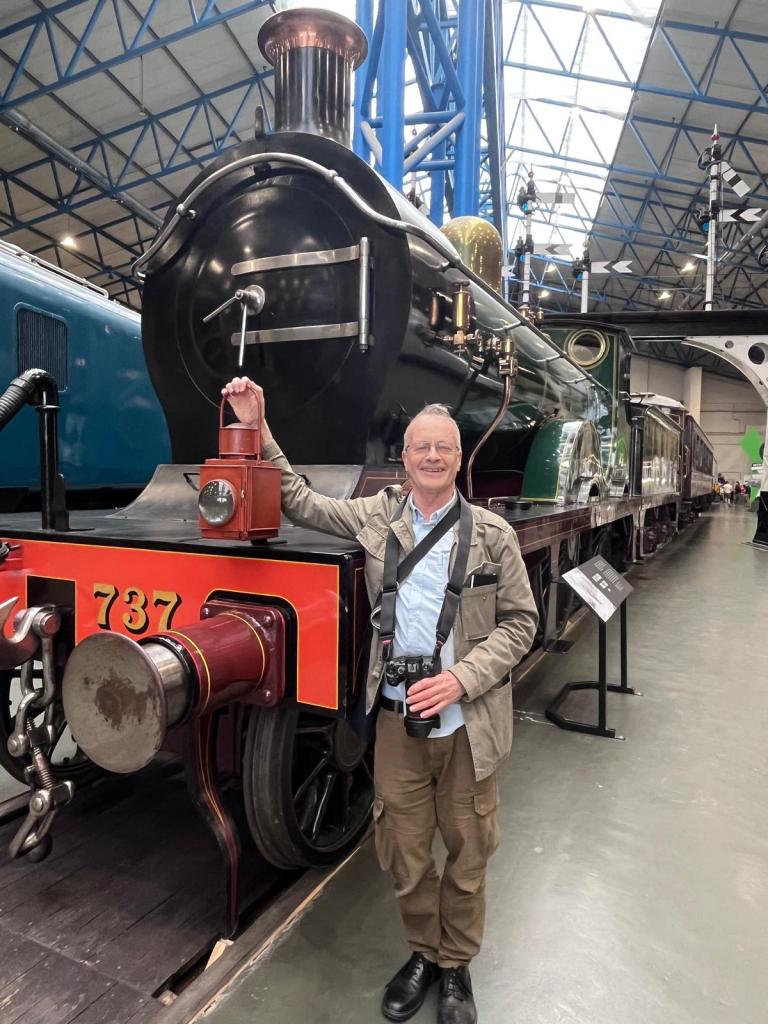
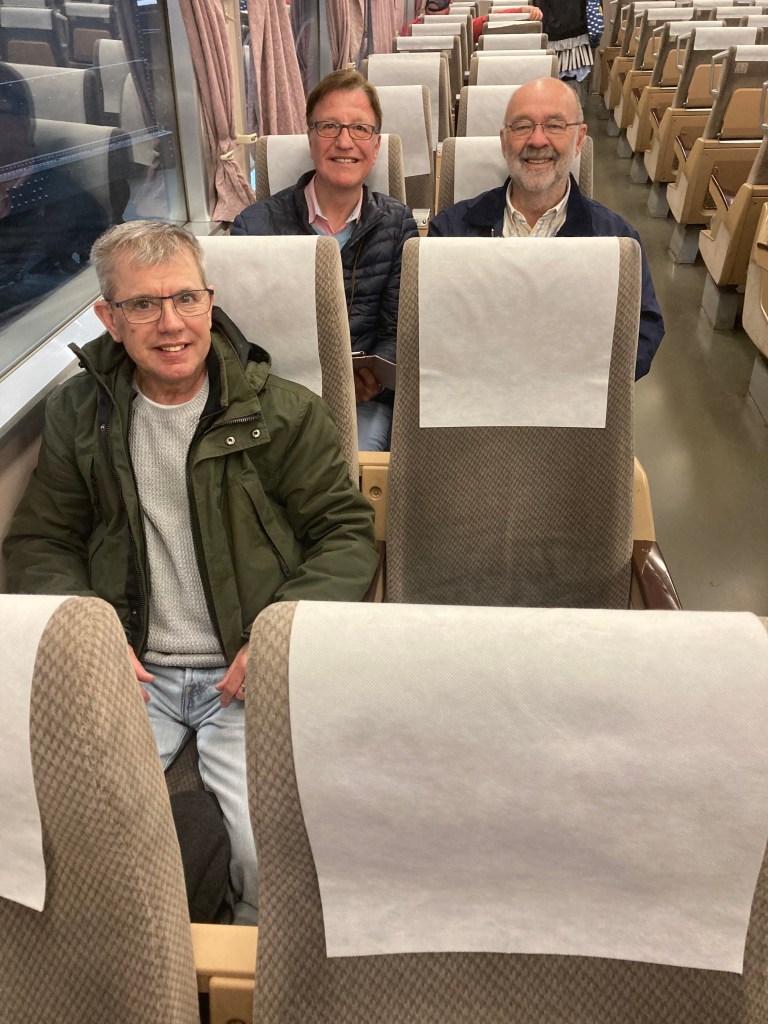
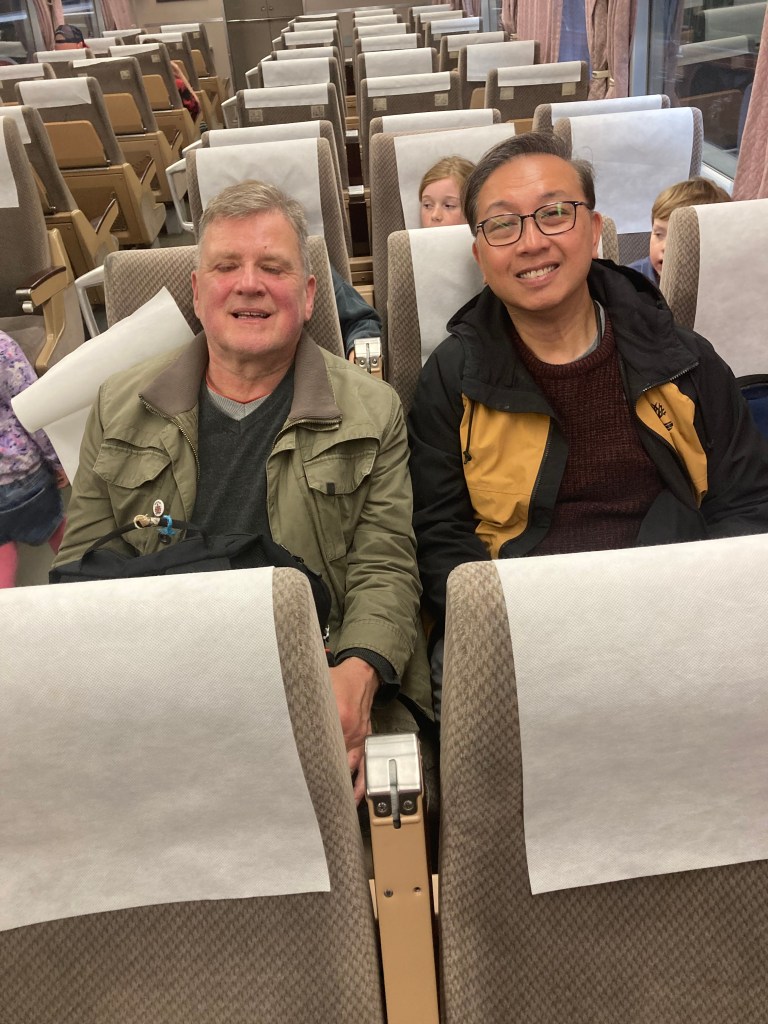
We travelled by coach to York to visit The National Railway Museum, which opened in 1975, and which has been making memories for 50 years.
We were also celebrating 200 years since the first fare-paying passenger journey on the Stockton and Darlington Line on 27 September 1825 – widely regarded as the birth of the modern railway.
The exhibitions promote the past, present and future of the railways, and in the Great Hall we were greeted by a stunning array of railway vehicles including The Rocket, Mallard and Shinkansen.
Mallard travelled at a record 126 miles per hour and we had the opportunity to view the cab. We also stepped inside the only Japanese bullet train that’s not in Japan! This beautiful Series 0 Shinkansen from the 1960s was completely restored before leaving its home country. In 1829 The Derby Mercury newspaper described the way the Rocket “darted past the spectators”, comparing it with the “rapidity with which the swallow darts through the air”.
It was fascinating to learn about how innovation and ingenuity led to a world changing transport revolution.
Fear, joy, solidarity: exhibition explores 40 years of HIV activism in Manchester
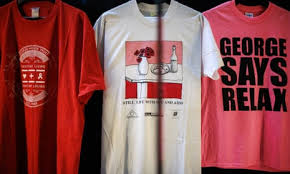
T-shirts made by the George House Trust, one from each decade of the charity’s existence, in a display case in the library’s reading room. Photograph: Joel Goodman/The Guardian
Paul Fairweather was in his late 20s when he volunteered to take calls from terrified members of the public for Manchester AIDSline, an organisation he set up with five friends in response to the impact of HIV across the city.
Though it was four decades ago now, he still remembers some of the conversations. “Some of the calls had a really big impact on you,” he says.
“I had a phone call from a woman who was phoning up about her son who had AIDS. And as she was talking, I realised that I knew her son.
She was just in tears – and it was really early on, so you wanted to reassure people, but the reality was he was probably going to die quite soon because there were no treatments.”
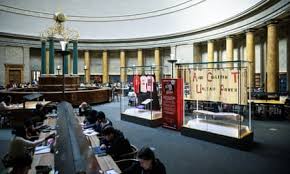
Now for the first time in history, the logbook from this invaluable service can be seen by the public as part of the exhibition ACTING UP! 40 Years of HIV Activism at Manchester Central Library, which is open until December.
Handwritten notes about calls taken over a span of a couple of days in November 1985 show how people phoned to ask questions about the risk of oral sex, to discuss virus symptoms they might have had and to ask about clinic opening times.
Many callers were the “worried well” who were anxious about catching HIV despite being at no risk, such was the stigma of the virus, says Fairweather. “People would phone up either too nervous or too scared to say anything,” he says.
“It feels really strange,” says the activist on this piece of his history becoming part of a public exhibition, which was created by the George House Trust, the HIV charity that Manchester AIDSline turned into. “It doesn’t seem 40 years ago, but it’s great to see it. To remember what it was like in those early days is really important.”
There are fundraising materials, such as raffle tickets, flyers, comics and protest T-shirts on display. Photograph: Joel Goodman/The Guardian
The logs and other materials from the George House Trust’s archive were used by the charity’s patron, Russell T Davies, in writing the Channel 4 television drama It’s A Sin, which went on to receive a record-busting 12 Bafta nominations after it aired in 2021.
Joe Tanzer, the project lead, says: “The phone calls that happen in It’s a Sin are real-life stories from the Manchester AIDSline logbooks.”
The year 1985, when the phone line was started, was also when the first HIV tests became available, and the materials made at the time helped people weigh up the positives and negatives of testing.
Tanzer says: “So people have this dilemma of: ‘Do I test for it or not, because there’s no treatment. Do I want to know that I’ve got that?’”
Fast forward to 2025 and the message has changed entirely. “It’s very different to the kind of context now where it’s all about knowing your status.”
The archive shows that, as well as the help and support provided to gay men, the charity had services specifically for women and black communities, who also found themselves affected.
Personal testimonies tell stories from the past four decades, and there is an emphasis on the oral histories of five women, who include Michelle Croston, a professor who spent much of her career as a HIV nurse, and Agatha Phiri, a woman originally from Malawi who runs a charity for women with HIV in Oldham called Agatha’s Space.
There are fundraising materials, such as raffle tickets, flyers, comics and protest T-shirts, some of which were worn by Fairweather, who was awarded an MBE in 2023 for his activism.
Tanzer said he hoped the exhibition would “put the north on the map”, adding: “Because as the history of HIV gets written, London is tending to eclipse other centres of activism, and Manchester really was one of them, and still is.”
The city is fiercely proud of its activist history around HIV. While London is working on a memorial to those killed by the disease, Manchester has had one for 25 years, a metal sculpture called the Beacon of Hope in Sackville Gardens in Manchester’s gay village.
“Manchester has been kind of leading the way in that sense but it’s not as well known,” Tanzer said.
Also featured in the exhibition, funded by the National Lottery Heritage Fund, are protest banners used in the 1980s, which are displayed in the library’s grand first-floor reading room until the end of May.
The materials on display show how the campaigners deployed wit to help spread their message.
Tanzer says: “In 1993, Virginia Bottomley, the then health secretary for the Conservative government, cut funding to HIV. So they protested against her … and at some point someone worked out her name was an anagram.
“There’s a picture of them all standing there spelling out her name, Virginia Bottomley, and they do a little shuffle, and then it says ‘I’m an evil Tory bigot’. It’s just brilliant.”
Tanzer adds: “So it’s not just sad. There’s so much involved in the activism, it’s about joy and solidarity and action, and strength in community as well.”
Lived experiences of older LGBTQI+ adults aged 60 or older
Huntley, R. et al., Journal of Homosexuality – February 2025.
Despite increasing research on LGBT+ people’s experiences, studies specifically focusing on those aged 60 and older remain scarce. This group has faced unique challenges that younger generations may not have encountered.
The aim of this study is to explore the lived experience of LGBT+ people aged 60 or older. Based on a review of eight studies, key findings highlight challenges in navigating openness, the need for recognition and belonging, and resilience despite adversity. Recommendations emphasise the need for future research on intersectional LGBT+ experiences.
A new booklet (Ageing On Our Own Terms) highlighting the need for LGBT+ inclusive support for older LGBT+ people was released in March 2025.
Published by the Furzedown Project, a London based community organisation supporting older people, the report was supported by Wandsworth Council and covers a number of areas including:
Historical context
Hopes and fears for the future
Support needs
Planning for later life.
The report also includes direct quotes from older LGBT+ people about what “living well” means for them as they get older, with common themes including not having to go back in the closet, having an LGBT+ friendly place to live, gay culture remaining part of their lives and recognition of chosen families.
Ageing On Our Own Terms is designed as a resource for commissioners, providers and regulators of health and social care to assist them in meeting the needs and aspirations of LGBT+ people as they age.
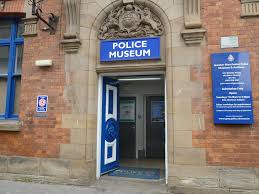
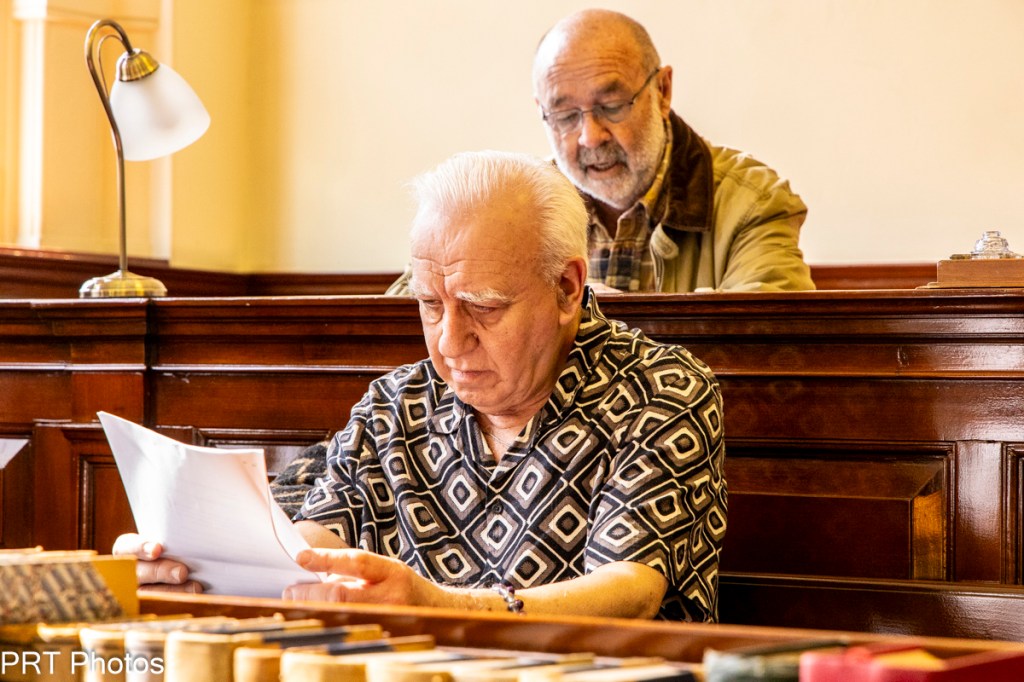
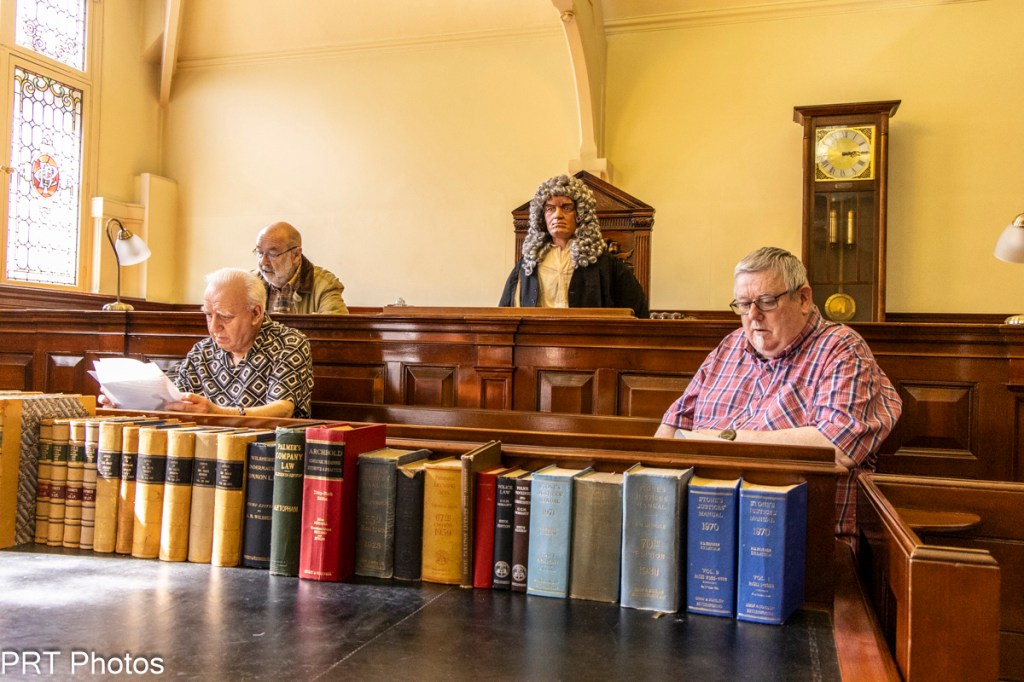
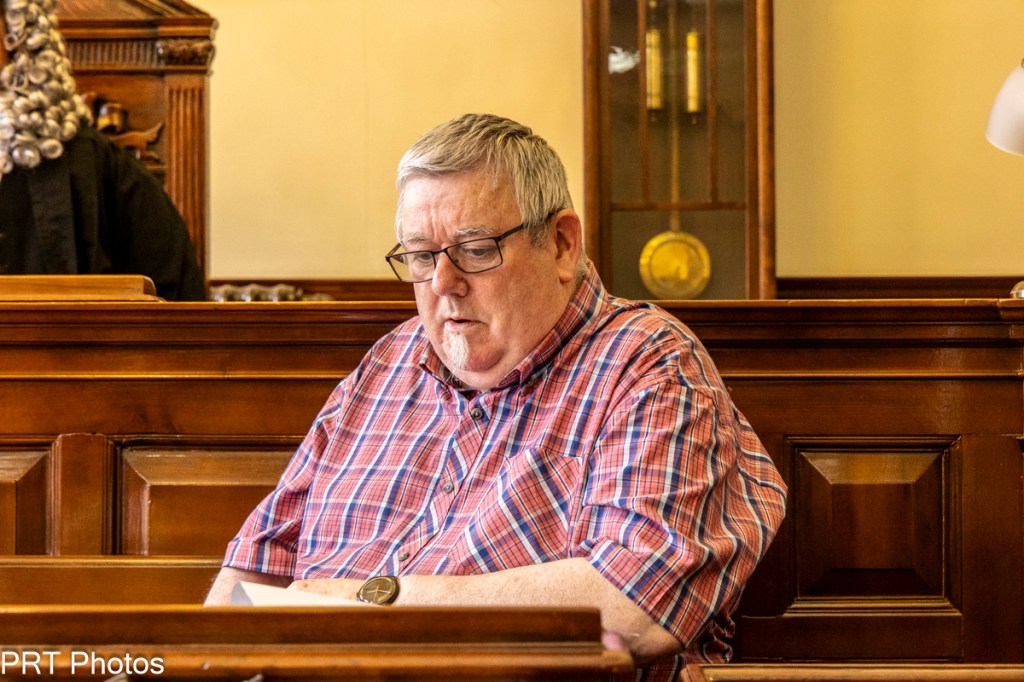
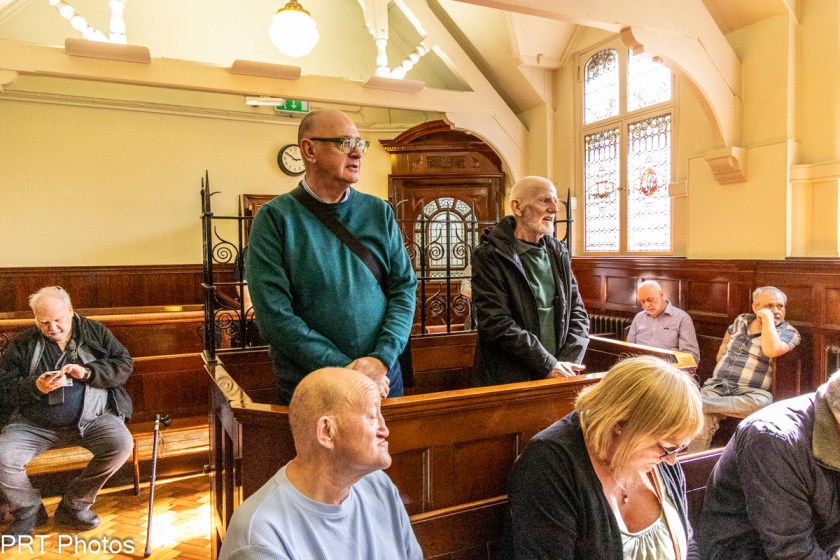
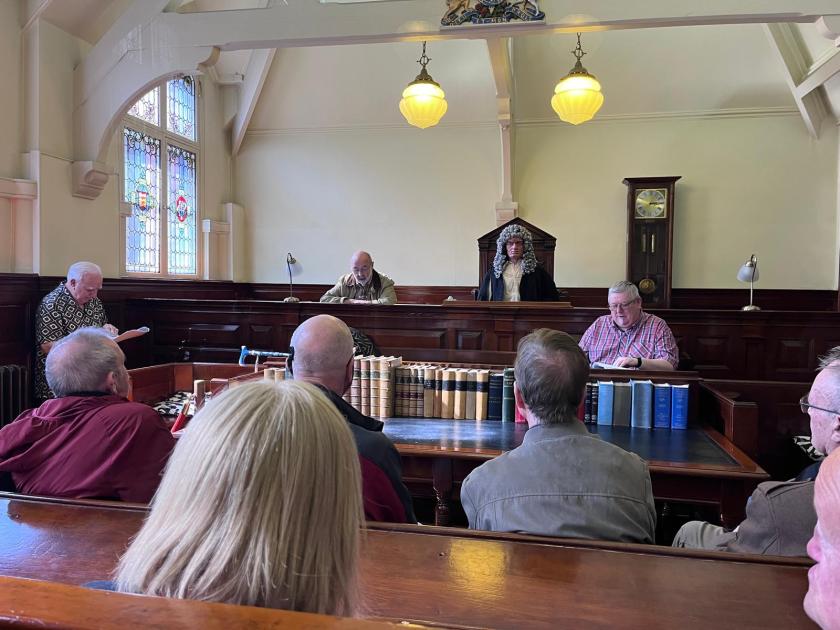
We organised a private visit to the Police Museum in Manchester, which included a guided tour and a reading of the play “Justice” whilst in the Magistrates Court. The play tells the story of the Altrincham case, and has been added to the Resources section of our website here.
In the “Good Old” bad old days of 1936 when homosexuality was not only disapproved of but also prosecuted, a conviction could destroy the lives of gay men without them having committed a single wrong act. The case was reported in The Manchester Guardian on 6 November 1936 detailing their names, ages, occupation, address and sentence.
In this article by Allan Horsfall (written in 1986), he takes a closer look at one of the largest homosexual prosecutions in British legal history and the shock waves that reverberated around the small Cheshire market town of Altrincham.
The Altrincham Case
Fifty years ago a huge group prosecution devastated the lives of the men involved and placed a mark of “shame” upon the Cheshire town of Altrincham – around which it was centred – which was to persist for generations. Because of this Altrincham became identified among a large section of the population as being synonymous with everything perverted. Whenever the town was mentioned in these circles it was almost certain that homosexuality would rear its head. And if homosexuality was discussed or – more probably – joked about, then the name of Altrincham would invariably be dragged in.
The vision was of a town populated entirely by predatory sodomites. “If you should happen to drop a half-crown in Altrincham,” people were solemnly warned, “don’t ever pick it up.”
I have heard this warning repeated where the half-crown had given way to a fifty-pence piece, demonstrating that this slanderous image of the place persisted at least into the 1970’s and there may well be areas where it lives on still.
Oscar Wilde said the road to homosexual law reform would be “long and red with monstrous martyrdoms,” and this was certainly the case in the years between 1885 and 1967 during which all male homosexual acts were outlawed.
But the pattern of prosecutions was uneven – and not only in relation to times and places. Although one might have expected that those who took the most risks would face the greatest danger, this was often not the case. A stereotypical homosexual who consistently behaved outrageously might sail through life quite untroubled by the law, while for others whose conduct was discretion itself Authority’s heavy knock on the door might come – sometimes even in the middle of the night – many years after the activity for which they were being hunted down.
The atmosphere was captured exactly by Dr R W Reid in a letter published in the Spectator on 3 January 1958:
“The pogroms continue, one in this neighbourhood having started with long and weary police court proceedings on the eve of Christmas, so that the festival may presumably be spent in contemplation of the Spring Assize.
And this for a lad of seventeen. The pattern is much the same in all these cases. The police go round from house to house, bringing ruin in their train, always attacking the younger men first, extracting information with lengthy questioning and specious promises of light sentences as they proceed from clue to clue, ie from home to home, often up to twenty.
This time the age range is seventeen to forty, which is about average. Last time a man of thirty-seven dropped dead in the dock at Assize. Just because this happens in country places and at country assizes it all goes largely unreported.”
Too Many to Ignore
But it did not go unreported when it happened in Altrincham. Although no famous names were involved, it was too big for the national press to ignore. Twenty-nine men were brought before the courts and the number was only limited because others, who had got wind of the police inquiries, had fled the country.
There were no allegations of importuning or public indecency. The men had met, it was said, in cafes and bars in Manchester. It is extremely doubtful whether each of these men knew, and were known by, more than a few of the others, but they were seen by authority -as in nearly all similar prosecutions – as a gang. “I am quite satisfied,” said the judge, “that the prisoners in the dock at this Assizes are a gang.”
Gangs, of course, need to have leaders and this role invariably ascribed not to the oldest accused, but to the one facing most charges. I recall this label being pinned on to a 24 year old man during a group prosecution in Bolton as recently as 1963.
Viewed from today, the press were strangely inhibited in their reportage of the Altrincham case. With the single exception of the ever-salacious Manchester Evening News, there was no mention of gross indecency and certainly none of buggery. The local paper referred throughout to “improper conduct” and both national and local papers reported it simply as “The Altrincham case”, which is probably why the memory of it endured for so long to haunt the town.
Mr Alfred Keogh (prosecuting) said he “did not suppose that in the criminal history of the country had a batch of prisoners been brought before a court on such serious charges – certain of the charges were about the most serious which could be brought against any man. It was something just less than murder.”
There had been no direct complaints to the police. The ages of the accused ranged from 17 to 59. The youngest, “who was unable to work for several months did not make a complaint to anybody, but his employer dragged the truth out of him. As a result the prosecution spread, one prisoner incriminating another.”
Gay Solidarity
The defendants, who had been reported as looking drawn and dejected at the start of the preliminary hearing, had apparently brightened up considerably by the second day, as evidenced by the following defending counsel, Mr Backhouse (addressing the magistrates) said, “However much you admire the Cheshire police, it is impossible for your worships to believe that one after another these men, against whom the police had no evidence, immediately volunteered statements which convicted themselves.”
This was followed by a spontaneous outbreak of applause from all the defendants. I am quite certain that this early and previously unheard-of demonstration of gay solidarity in adversity must have come as a profound shock to the prosecution and the Bench. And as quite an eye-opener to the defending solicitors and counsel as well, I should imagine.
There were signs, too, that even some of the police did not regard the defendants as belonging to the general body of criminality. Cross-examining Detective Harris on his evidence, Mr Lustgarden asked, “Did you ever know a more accommodating crowd of defendants?”
Detective Harris: “No, Sir.”
“They have an extraordinary urge to write statements?”
“They are not criminals, Sir.”
The prosecution was not content to rest its case on the confessions of frightened and confused prisoners. Dr W H Grace, pathologist at Chester Royal Infirmary, stated that he had medically examined 24 of the 29 prisoners. He came to the conclusion, as a result of his examinations, that 12 of them “had acted as receiving agents in the committal of a certain offence” (as the papers put it). He had made his examinations on the instructions of the police superintendent at Altrincham.
Strenuous efforts were made by the defence to have the trial held in Manchester rather than Chester. Mr Turner said his client lived in Stretford. He was a youth of 20 years of age and his widowed mother had raised money for his defence. It would be a great hardship if they were put to more expense than was necessary. Manchester Assize Courts were only a twopenny (tram) car ride from his client’s house.
All the solicitors in the case and all the counsel, with the exception of one, were not in the Chester circuit. It would be beyond the means of the defendants to support their own defence if the case went to Chester. But to Chester it was sent!
Beacon of Humanity
The prosecution there followed the drearily familiar pattern of such cases. Seized letters and photographs, powder, lipstick, greasepaint. Evidence of presents – slippers, flowers, chocolates. Hotel registers were produced to demonstrate who had stayed with whom and where and when. Evidence of nicknames – one of them had been known as the Queen Mother.
Perhaps worst of all, the mother of one of the defendants was put up by the prosecution to testify that her son had entertained a male friend while she was away on Good Friday.
A tiny beacon of ‘humanity’ flickered when the employer of one of the accused pleaded in court that if any treatment could be found for his workman as an alternative to imprisonment he would be willing to meet the full cost of it, including accommodation. This was the only defendant to be subsequently dealt with by way of a treatment order.
A handful were acquitted and a few were treated leniently, but brutality was the order of the day. Men were sent away for terms of two, three and four years and, in the most savage case, one man was sentenced to seven years penal servitude with 18 months hard labour.
Paul Tench, writing about the case in the Sunday Empire News, produced a strange mixture of moralising and attempted explanation.
“Less than two years ago Herr Hitler started a campaign to eradicate this brand of vice from Germany. His method was drastic and sentences against those convicted ranged from the death sentence to life imprisonment.
There is good reason for saying that the Altrincham round-up has touched only the fringe of the scandal rampant in other areas now receiving police attention.”
But the writing was already on the (admittedly distant) wall for the German dictator in a war which served to concentrate British minds wonderfully on more important and worthwhile pursuits than legalised queerbashing.
Commemoration?
And no subsequent trawl of homosexuals was to net so many victims – not even when the British police were acting under post-war pressure from the American security agencies. So the Altrincham case remains unique in the breadth and intensity of its persecution – a pinnacle of cruelty in an 82 years long homosexual wilderness – the result, as the Empire News put it, “of one of the most searching investigations that have ever been undertaken in this respect with a large number of detectives working day and night.”
Although it is easy now to portray these men as the victims which they undoubtably were, there seems to be no ready way in which their suffering and the injustice of it can be commemorated in a form more permanent than this article.
And even here I have named nobody, although most of them will now be where publicity can do no further damage and where they stand in no need of any protection from the Rehabilitation of Offenders Act.
But the time has surely come to lay the ghost so far as Altrincham is concerned. No City of Vice, this pleasant, wealthy town, but merely – like some of its unlucky sons – the hapless victim of an unjust law and a capricious prosecution policy.
The town, in its turn, has a duty to help in rehabilitating the memory of the victims. Though it may not be exactly another Tolpuddle, fate has nevertheless awarded Altrincham a minor but undeniable place in the unhappy chronicle of martyrdom.
The trial requires a permanent memorial. A blue plaque on the courthouse or the new library would be appropriate. This idea, however, is unlikely to commend itself to civic leaders who have within this decade elected as Mayor a man who, immediately before his installation to that office, prescribed “a bullet between the eyes” as appropriate treatment for homosexuals.
The political composition of the council has changed a little since that disgraceful comment was perceived as no bar to high office in the borough, but not so much as to easily permit the act of atonement which is still called for.
But it might be worth a try.
Kathleen Stock: New ruling could make it harder to prevent anti-trans bullying in UK Universities
Thanks to Jamie Wareham for this article.
The regulator who oversees universities in the UK has fined the University of Sussex over its transgender-inclusive policies that banned speakers from making anti-trans statements.
The university has been fined £585,000 by the higher education regulator, the Office for Students (OfS). It follows a three-year battle over the regulator’s rules about protecting free speech and academic freedom on campuses –BBC
The regulator said the university’s policies that included a requirement to “positively represent trans people” could lead to staff and students preventing themselves from voicing opposing views. The university plans to appeal the ruling, accusing the regulator of pursuing a “vindictive and unreasonable campaign.”
It says that if the ruling goes unchallenged, it will leave the institution and universities across the UK “powerless to prevent abusive, bullying and harassing speech.”
Arif Ahmed, OfS director for freedom of speech, said the fine could have been as high as £3.7m and there was “potential for higher fines in the future” –BBC
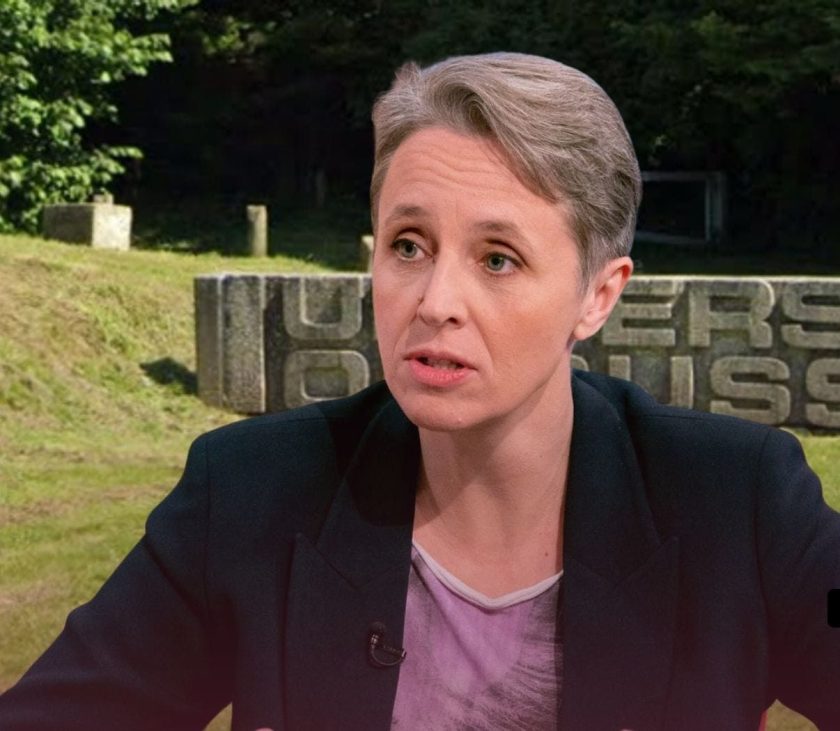
The investigation started because of the wider debate around Professor Kathleen Stock. She left the university in 2021 amid on-campus protests accusing her of transphobia because of her ‘gender-critical’ books, lectures and views –The Guardian
Who is Kathleen Stock?
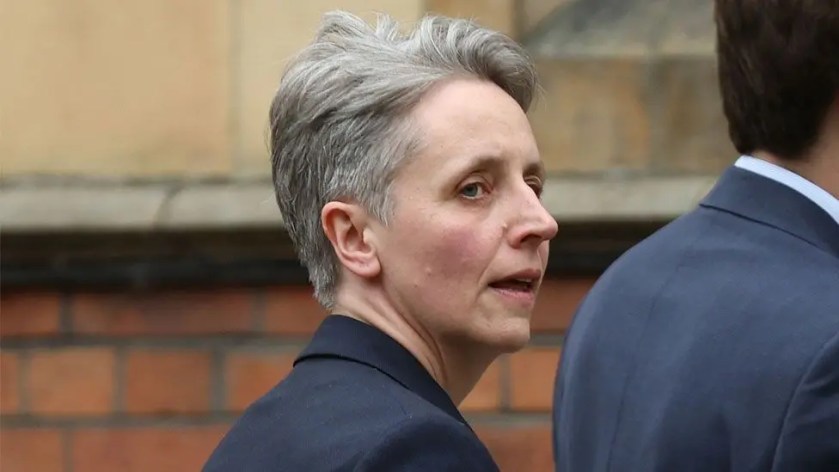
Kathleen Stock, seen here in 2023, left the University of Sussex after being accused of transphobia.
Stock is the author of Material Girls: Why Reality Matters For Feminism and has a background in philosophy, publishing academic work on sexual objectification and sexual orientation. The book, which takes a trans-exclusionary approach to feminism, was at the centre of the row that ultimately led to her leaving the university.
Stock quickly became a darling of the right-wing press after her departure.
Despite regularly claiming over the past four years that she has been silenced, she has become one of the most common commentators on broadcast TV and in right-wing newspapers on transgender rights. She has picked up a number of newspaper columns and helped prominent anti-trans and so-called ‘gender-critical’ organisations to grow in prominence.
As well as being a trustee for the LGB Alliance for a significant period, she also launched The Lesbian Project to much fanfare. The organisation said it would lobby, build communities and develop research into lesbian communities. However, since launching it has done little more than produce a short blog series and a paid-for podcast.
Analysis: A dangerous precedent from a regulator with an “absolutist” approach to free speech
When I was at university, I learned an important theory during a discussion with a lecturer in the LGBTQIA+ staff group about the approach of ‘no-platforming’ those with hateful views.
He explained how the absolutist idea of free speech is ultimately self-defeating. The logic is simple: if you allow all speech – even hate speech – that hate speech will be used to end free speech. To put it another way, hateful actors will use democratic principles in order to take over and impose their hateful views on everyone else. One look to the US, and Trump’s control over scientific research and shuttering of the Department of Education is a clear example.
That’s why whenever you hear people arguing for unlimited free speech, you should question their intentions. As a society, we’ve always had rules about where to draw the line on speech or actions that harm people and society. The claims from the right-wing press that free speech is under attack are hypocritical because they, too are arguing for a different form of control over language.
Education Secretary Bridget Phillipson says she will use “robust action” to uphold the legal right to ‘Academic Freedom’ established by the 1988 Education Reform Act. But as the University of Sussex points out, this free-for-all approach to speech has a detrimental impact. It’s the same ideology that Musk shares, and we saw what that meant for the hellhole formerly known as Twitter.
If the University of Sussex is unable to overturn this ruling, it will have a chilling effect at universities across the UK. At their best, our unis are bastions of progressive nurturing, but this precedent would undermine their purpose with hateful views when they should be focusing on imagining a better future for our world.
…………………………………………………………………………….
The University of Sussex was fined £585,000 for “failing to uphold freedom of speech”, which is the largest-ever issued by the regulator at around 15 times larger than any other sanction imposed.
The university intends to challenge the fine. Professor Sasha Roseneil, vice chancellor at the university, described the investigation as “Kafkaesque”, adding that the fine was “disproportionate”. She stated: “We will strongly contest these findings and have grave concerns about the implications of its decisions for students and staff, especially those from minoritised groups. Sussex will not be the last to face the challenge of a debate on gender, sex and identity that has become toxic.”
She added: ”Universities across England are grappling with claims and counterclaims about academic freedom and freedom of speech regarding issues of equality, identity and inclusion. … Levying a wholly disproportionate fine after a flawed, politically motivated, and wasteful investigation – when the higher education sector is in financial crisis – serves no one. ”
A University of Sussex spokesperson confirmed: “We have taken legal advice and, as our Vice-Chancellor Professor Sasha Roseneil has already said, we will be challenging the OfS’s findings proceeding via a judicial review. Our lawyers are currently drafting a pre-action protocol letter.”
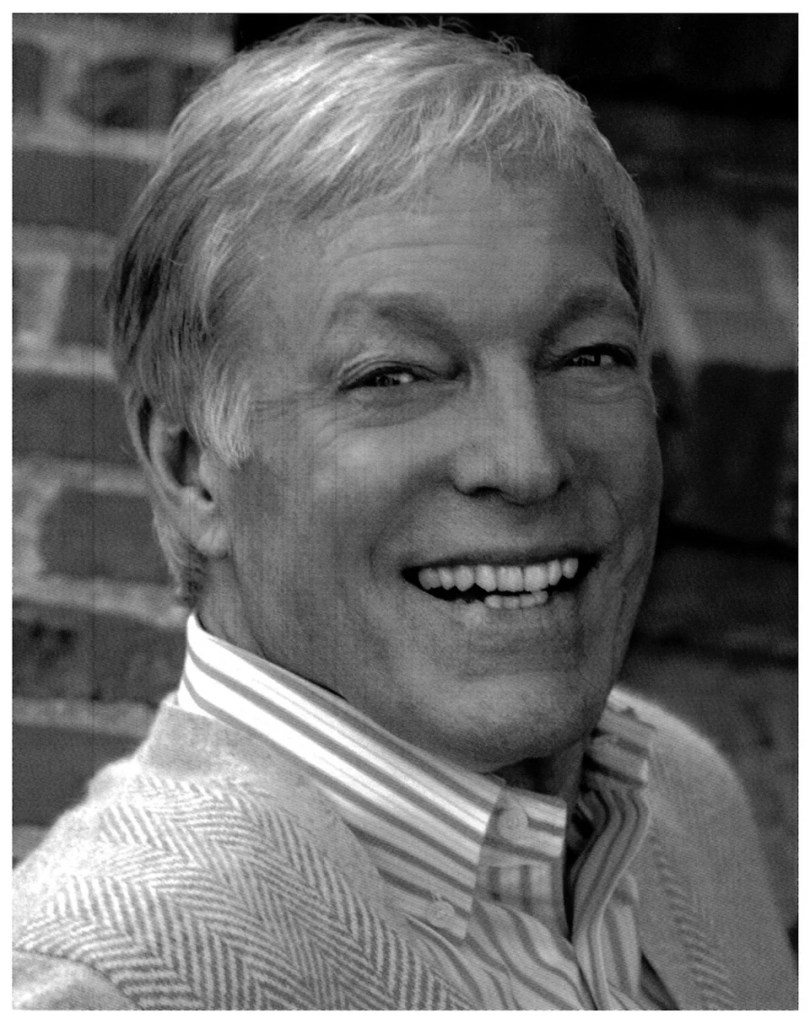
Richard Chamberlain, heartthrob actor, dies at the age of 90
Chamberlain died on 29 March at the age of 90. Photo: Richard Chamberlain Archives
Richard Chamberlain, who was dubbed “the King of the miniseries” for his iconic leading performances in some of the most celebrated television productions of the 1980s, came out of the closet to the public in 2003 at the age of 70 in connection with the publication of his memoir “Shattered Love.”
In interviews promoting the book, Chamberlain talked about the difficulty some people face in coming out.
“There’s still a tremendous amount of homophobia in our culture,” he said. “Please, don’t pretend that we’re suddenly all wonderfully, blissfully accepted.”
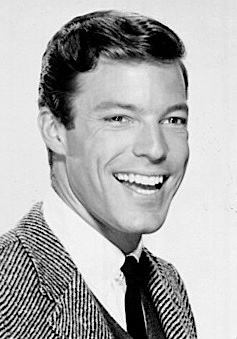
Richard Chamberlain as Dr Kildare in 1964
Chamberlain shot to fame as TV heart throb Dr Kildare on the series of the same name in the 1960s. His dashing good looks won him legions of female fans, as well as some male fans.
Cat-and-mouse game with the press
During middle age, 20 years later, his career spiked once more.
Chamberlain became king of the 1980s TV mini-series after playing a western prisoner in “Shogun” (1980) and a Catholic priest tempted by love in “The Thorn Birds” (1983).
“I played a cat-and-mouse game with the press,” Chamberlain said about keeping his love life private through the years before coming out.
“I had to be very careful and very circumspect. Magazines did lots and lots of interviews, and they sort of suspected. They would ask me questions like, when are you going to get married and have children? I would say, ‘Well, not quite yet. I’m awfully busy.’ I had to be careful for a long time.”
“It was inhibiting,” Chamberlain added. “But I got so used to it that it was just habitual to be sort of careful and on guard in certain situations. Yes, I would’ve been a happier person to be out and free and all that. But I already had so much to be happy about. I was a working actor, and that’s the main thing I wanted out of this lifetime.”
Richard Chamberlain’s death, partner Martin Rabbett
Chamberlain died on 29 March in Waimanalo, Hawaii, of complications from a recent stroke, at the age of 90, just before his 91st birthday.
“Our beloved Richard is with the angels now. He is free and soaring to those loved ones before us,” Martin Rabbett, his life-long partner said. “How blessed were we to have known such an amazing and loving soul. Love never dies. And our love is under his wings lifting him to his next great adventure.”
Rabbet and Chamberlain started their long-term relationship in 1977 and had a commitment ceremony in the 1980s. They remained a couple until 2010 when they separated. But the couple recently resumed living together. Rabbett is a writer, actor and producer, whose credits include “Island Son,” “Finite Water,” “The Bourne Identity,” “All the Winters That Have Been” and “Bare Essence.” He appeared in “Allan Quatermain and the Lost City of Gold with Chamberlain” in 1986.
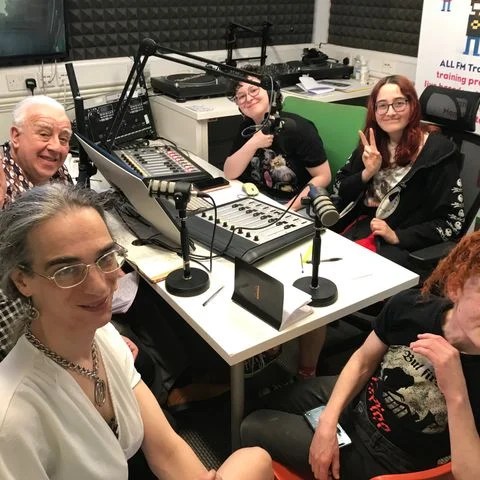
In February we advertised a radio opportunity at ALLfm 96.9 on our Facebook page. Eight people from our LGBTQ+ community across Manchester could volunteer to learn how to make radio shows.
We’ve come together and called ourselves “ALL fm Queeries”. The first live show was broadcast on 1 April! You can listen in here.
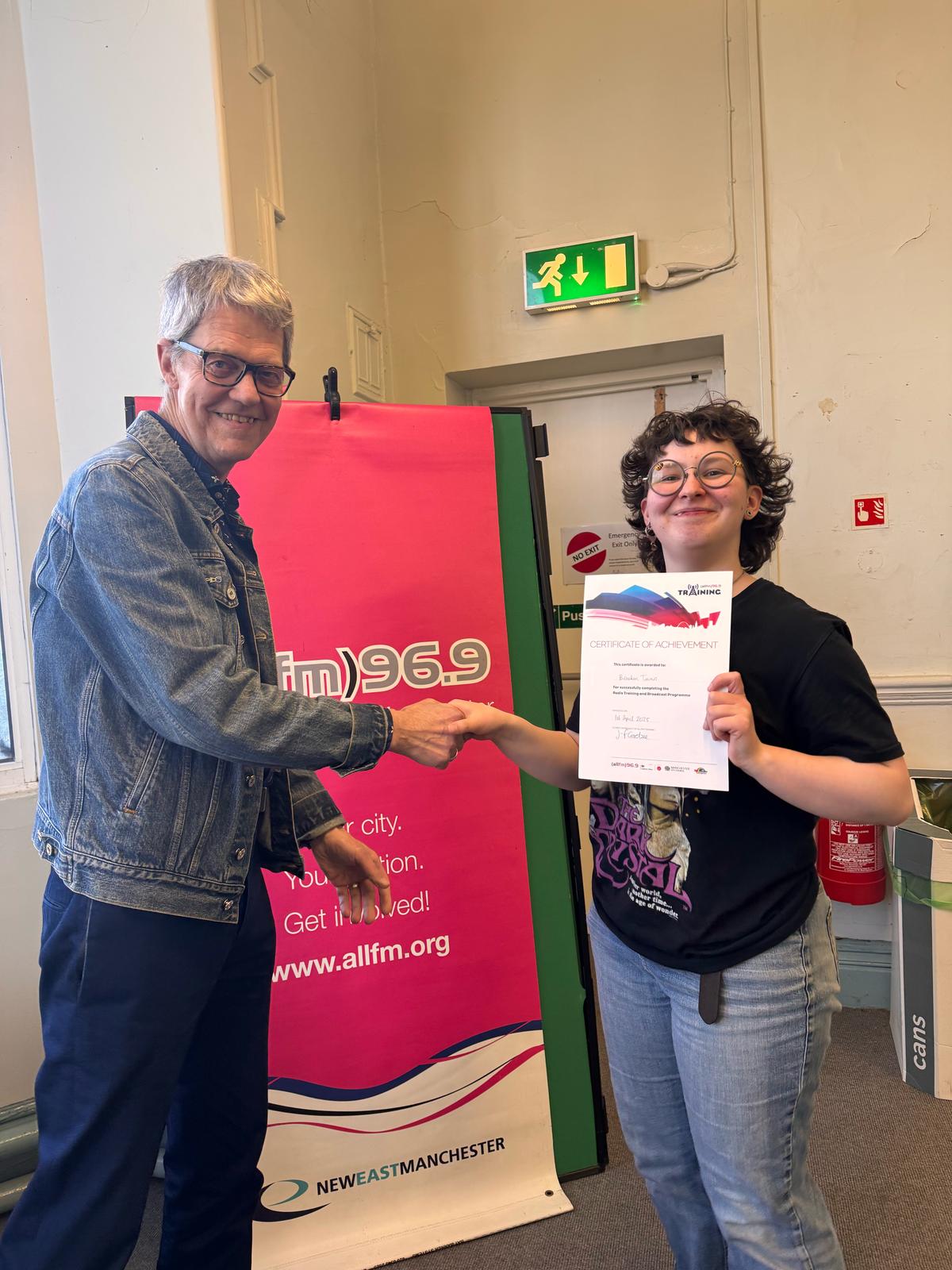
We were even given certificates for all the hard work we had put in.
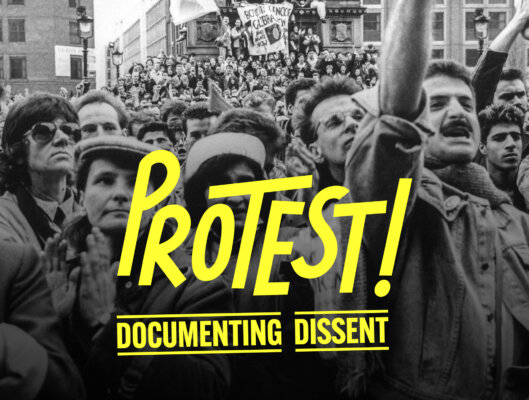
Connect, Learn and Join the PROTEST! – Trafford Archives Session
When: Saturday, 5 April 2025 – 11.00am – 3.00pm
Where: Sale Library, Waterside, Sale M33 7ZF
Come and join us and get connected and to your local LGBT+ History. All of us have a personal archive – in a special box, in a messy drawer, in a cherished album …
We are looking for YOU to share your memories of LGBT+ heritage in Trafford and beyond – badges, gig tickets, posters, home-made banners, zines and almost anything else. We want to digitise and share these important pieces of our shared heritage.
Come and meet our PROTEST! team and get involved – drop in anytime between 11.00am and 3.00pm.
Please consider responding to these research requests. Your assistance will contribute to LGBTQ+ advocacy and improved service provision.
Research for older transgender men, women and non-binary people
Dr Blair Hamilton is a researcher at Manchester Metropolitan University.
They are interested in the bone and muscle health of older transgender people. They are transgender themselves, so they are pretty keen to see what their bone is going to be like when they age!
They are running a focus group for older transgender men, women and non-binary people who have been on hormone treatment for a little while to see what challenges they face and how we can improve their healthcare.
If there are any participants who would be interested, please contact b.hamilton@mmu.ac.uk.
Travel expenses will be paid for those who are involved.
…………………………………………………………………………………
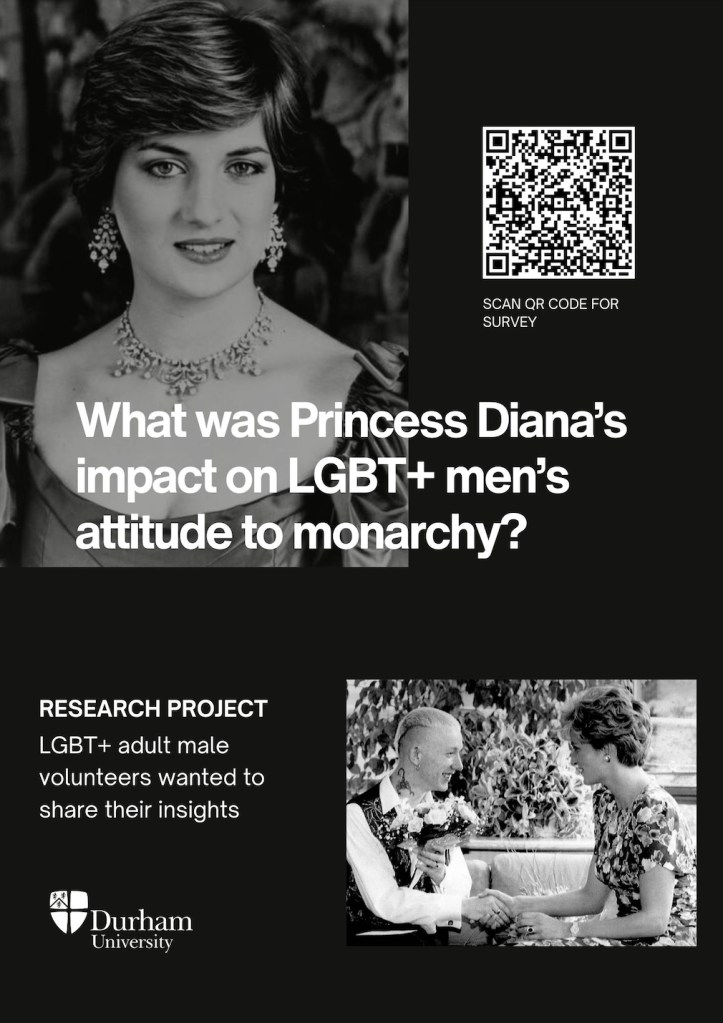
Research for gay, bisexual and queer men
Luke Sewell is a history undergraduate at Durham University.
His research project Is titled: “What was Princess Diana’s impact on LGBT+ men’s attitude to monarchy?”
He would like to survey and/or interview participants to gather their insights on Princess Diana and the monarchy.
Transcestry celebrates the Museum of Transology’s first ten years of community collecting. The exhibition is the largest display of its kind to date, showcasing over 1,000 objects and stories donated by more than 1,000 members of the community celebrating trans, non-binary, and intersex lives.
Transcestry amplifies underrepresented, and often forgotten, stories from the trans community, and celebrates resilience, identity and creativity.
Transcestry is led by E-J Scott, Founder of the Museum of Transology and Senior Lecturer, BA (Hons) Culture, Criticism & Curation. Central Saint Martins students and staff are actively involved, developing accessibility features and exploring innovative curatorial practices and queer gallery design methodologies.
This programme is generously funded by Art Fund and The National Lottery Heritage Fund.
Hope Mill is 200
As part of Hope Mill’s 200 Heritage project, they researched the local LGBTQIA+ history. In this video, join Stewart for a tour of the area:
Transcript:
Thanks to the National Lottery Heritage Fund and National Lottery players, Hope Mill Theatre have spent the past year uncovering the history and heritage of our building and the surrounding areas.
Here at Hope Mill, we are very proud to be an LGBTQIA+ led organisation. So of course we wanted to explore the lives of the queer community that came before us.
I’m outside Hope Mill Theatre at the site of what used to be Star Music Hall. In the 1870s and 80s this was a popular venue hosting a variety of entertainment acts. One of the acts that performed here quite frequently was Toots Minstrels a group of actors, comedians and musicians that toured nationwide and abroad.
Ernest Parkinson was a member of this company and listed as a harpist although he was also known as a female impersonator. Ernest was one of the men who were arrested at the Hulme Drag Ball of 1880. The Hulme Drag Ball was a widely publicised event where police raided a private party taking place at the Temperance Hall in Hulme, Manchester.
Police had suspicions about the immoral character of the event. It was officially booked as the Porn Broker’s Assistants Association Annual Ball but organisers are taken care to cover all the windows of the building raising suspicions even further.
Police burst in and arrested 47 men, 19 of whom were dressed in female clothing, Ernest Parkinson amongst them. It’s incredible to think that this place right opposite our building was not only a theatre but showcased incredible men like Ernest Parkinson who lived their lives with a constant fear of persecution.
We’re here on Every Street at the site of what used to be the Manchester University Settlement about a two-minute walk away from Hope Mill Theatre. The Manchester University Settlement was founded in Ancoats in 1895 with the aim of bringing education and culture to poor communities.
Two extraordinary women associated with the Settlement were Esther Roper and Eva Gore Booth. Esther Roper was born in Chorley, Lancashire in 1858. She was one of the first women to study for a degree at Owen’s College, Manchester and in 1895 she helped establish the Settlement.
In 1896 Esther went on holiday to Italy to recover from exhaustion. Whilst recuperating, she met Eva Gore Booth an Irish poet. The two fell in love and were soon living together in Rusholme, Manchester even declaring themselves joint heads of the household in the 1901 census, a bold move for two women of that time.
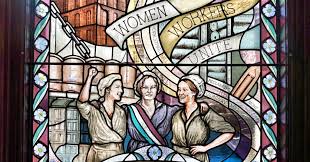
During their lifetime Eva and Esther fought tirelessly for women’s rights. They organised protests to protect female dominated professions such as barmaids and flower sellers from damaging legislation. They founded a quarterly publication Women’s Labour News and both were very involved in the suffrage movement advocating for working class women to get the vote.
After Eva’s death in 1926, Esther commissioned a stained glass window to celebrate Eva’s life and preserve her memory. It was part of the roundhouse building here on Every Street but sadly the building was demolished in 1986. These two incredible pioneering women are buried side by side in Hampstead, London with a quote from Sappho on their gravestone.
In May 1861 a man called Thomas Green appeared at Salford Police Court accused of failing to pay his debts. This was not the first time Green had been charged with this offence, and it was his reluctance to pay what he owed to a tailor for a suit of clothes that led to his arrest. He was committed to the New Bailey and after being forced to take a bath it was revealed that he’d been assigned female at birth. The newspaper coverage doesn’t have many details of how he lived as a man but we do know is that at a young age he was dressed as a page whilst in the service of a wealthy lady. At the time of the newspaper article, he was reported to be between 30 to 40 years old and had been living as a man all that time.
We don’t have much more information about Thomas except that he worked as a stitcher and hooker in a mill and was married to a woman. We’re very pleased to report that the marriage was described by his neighbours as a very happy one.
Thank you for taking the time to watch and find out more about the history of the LGBTQIA+ community in Ancoats and Manchester.
Please have a look at our website for more information.
International Transgender Day of Visibility
Each year on 31 March, we honour International Transgender Day of Visibility. We celebrate the joy and resilience of trans and non-binary people everywhere by elevating voices and experiences from these communities.
If you are frustrated with the “erasure of trans history” and continued anti-trans narratives and constantly having to remind opponents that trans people have always been here, read this (rather long) article by Dr Laurie Marhoefer from the University of Washington:
In July 2022, Marie-Luise Vollbrecht, a biology graduate student at Humboldt University in Berlin, got into a debate about history on Twitter. The thirty-two-year-old Vollbrecht had already gained national attention in Germany for her anti-trans, “gender-critical” feminism. She was no stranger to heated exchanges on the social media platform. On this occasion, the debate was about the history of the Holocaust. In a series of tweets, Vollbrecht disputed that the Nazis had persecuted transgender people. To describe trans people as victims of the Nazi state “mocks the true victims of the Nazi crimes,” she wrote.
Vollbrecht’s opponents on Twitter responded, arguing that this was not the case. The debate escalated. Vollbrecht’s critics began to use the hashtag “#MarieLeugnetNS-Verbrechen” (“Marie denies Nazi crimes”). This was a serious accusation. Vollbrecht later asserted that it amounted to saying that she was denying the Holocaust. She responded by filing a lawsuit, in which she alleged that the use of the hashtag violated her rights.
In fall 2022, I was asked by a transgender NGO to write an expert statement (Gutachten) on this case for the court in Cologne (Landgericht Köln). The NGO is the Deutsche Gesellschaft für Transidentität und Intersexualität e.V. (DGTI) (German Society for Trans Identity and Intersexuality), founded in 1998 as a self-support group for and by trans people. DGTI’s mission is to promote social acceptance of trans people. A Twitter account that DGTI helped to run had used the #MarieLeugnetNS-Verbrechen hashtag, and they were one of the parties that Vollbrecht sued. Other historians also wrote expert opinions in this case. Bodie Ashton of the University of Erfurt wrote on behalf of the DGTI. Alexander Zinn of the Fritz Bauer Institute wrote in support of Vollbrecht.
The crux of the lawsuit was whether it was accurate to say that Vollbrecht lied about Nazi crimes against trans people. That is, were transgender people victims of the Nazi state? As it turned out, historians did not agree. The case thus became one of those rare – and sometimes critically important – lawsuits in which a court ruled on the facts of history.
In November 2022, the court in Cologne ruled against Vollbrecht. To my knowledge, this is the first time that a German court has recognised transgender people as victims of the Nazi state.
What follows is the expert statement I wrote for the case. I offer it here with some caution – my work is ongoing and my findings are somewhat preliminary. At the same time, the lawsuit is national news in Germany. The public has a right to know what the state of research on this issue is – even more so since the question of whether the Nazis persecuted transgender people is coming up more and more often, on Twitter and elsewhere.
There is a pernicious assumption that sometimes creeps into this debate: that we can only recognize the humanity of trans people if they suffered horribly at the hands of the Nazis. I reject that. Everyone must recognise the humanity of trans people, regardless of this debate. Moreover, we do not commonly base our ethical principles on what the Nazis did or did not do. Nor should we.
At the same time, historians ought to answer the question. At the moment, we have not done so. The peer-reviewed scholarship on transgender people in Nazi Germany is small. Some of it is fundamentally flawed, as I discuss in the expert statement.
Vollbrecht asserted that to discuss trans victims of Nazism is to “mock” other (that is, cisgender) victims of Nazi violence. She used the term mock, which I take to be a gesture toward the old anti-trans trope of trans people as ridiculous, objects of scornful laughter. Trans people, Vollbrecht suggested in her tweet, are ridiculous. Thus one cannot speak of them in the context of the Holocaust because we cannot laugh about the Holocaust. Here is the flaw in this argument: trans people are not ridiculous, nor was their suffering under the Nazi state. In order to show that, it seems important to publish the statement I provided to a lawyer in the case.
***
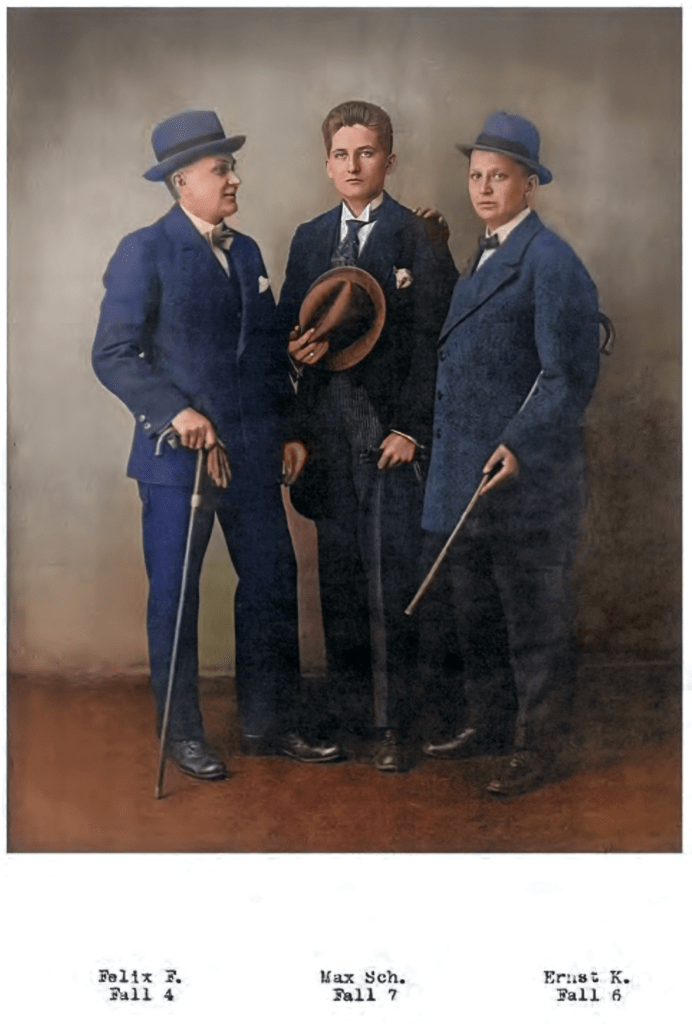
Six anonymous German subjects, most likely transmasculine people from circa 1910
Expert statement (Privatgutachten) Dr Laurie Marhoefer, Jon Bridgman Endowed Professor of History, University of Washington, Seattle, USA. Report on the Situation of Trans People during the Nazi Period. 10 October 2022.
The first scholarly publications on transgender people under National Socialism argued that they were not persecuted. To be more specific, one foundational essay argued that they were not persecuted, and another argued that some trans women were, but only insofar as officials mistakenly believed them to be cisgender gay men. This, however, is not accurate. Newer research shows a more complex and more violent situation. The newer scholarship also makes the case that racial status and other factors mattered when trans people ran into trouble with the Nazi state. Trans people were at risk. The risks they ran varied according to other things in their lives. Not all trans people suffered violence. Yet there is a pattern of state hostility and police harassment of trans people, particularly trans women. In some cases, it ended in murder. This change in the literature is due to the growing number of scholars working on the topic, to changes in how we conceptualise Nazi violence more broadly, and to changes in how scholars conceptualise transgender people. It also owes to the digitisation of archival records, which has made police files easier to find.
I am at present engaged in a large research project on transgender people under the Nazi state, part of a broader project on sex and gender “crimes,” funded by the Stroum Center for Jewish Studies at the University of Washington and the Holocaust Education Foundation at Northwestern University. From my years of research and from the published literature, I have knowledge of about twenty-seven cases of transgender men and women in the Nazi period. To my knowledge this is the largest number of cases ever discussed at once. Most scholarship deals with a much smaller number.
Often when one sees the term “persecution (Verfolgung)” in the context of the Nazi state, one thinks foremost of the persecution of Jewish Europeans. The Nazi state systematically rounded up whole communities of Jews and Roma – gay as well as straight, cisgender as well as transgender – deported them, and murdered them. This did not happen to “Aryans.” It did not happen to “Aryans” even if they were accused of “crimes” having to do with sex and gender, such as male-male sex (§175) or “public indecency (Erregung öffentlichen Ärgernisses)” (§183), a charge made against trans people. Without ever losing sight of the Holocaust, we should, however, allow that a group could be “persecuted” even if its members did not face highly organised violence like what Jews and Roma faced. So, for example, we correctly recognise gay men (regardless of racial designation) as a persecuted group. We do so despite the fact that Nazi authorities treated “Aryan” gay men and Jewish gay men in very different ways. “Aryan” men accused of breaking §175 could usually retain a lawyer. They often had a trial before a judge. They were not always found guilty. Most men convicted under §175 served their sentences in prisons, not concentration camps. Some were murdered in the camp system. Some were sent to the camps without trial. That did not happen in all cases. The majority of the approximately 50,000 men convicted under §175 in the Nazi period were “Aryans” who survived the Nazi regime. Alexander Zinn writes in his 2017 book on gay men under the Nazi state:
Magnus Hirschfeld’s 4th, 7th and 6th patients circa 1910
It is time for a paradigm shift. The reduction of the situation of homosexuals in the “Third Reich” to a history of victims, the focus on an allegedly all-powerful apparatus of persecution and a supposedly deeply homophobic population that used denunciation to help the state exclude homosexual men from the “Volksgemeinschaft” – all of this obstructs one’s view of the considerably more complex picture that emerges when one reads the sources against the grain.
Zinn also argues that “in practice, the National Socialist persecution of homosexuals was certainly considerably less consistent and goal-oriented” than a lot of people believe. Indeed, it is very possible that only a minority of the cisgender men who had sex with men in Nazi Germany ran into trouble with the police, though doubtless all feared the police. Many decades ago, people who opposed recognising gay victims might have asserted that gay men simply had to stop going to bars or having relationships and that then they would be safe, so long as they were “Aryan.” A gay man in Nazi Germany who wanted to be absolutely safe from the police would, indeed, be well advised to avoid bars and relationships. But to move from that reality to a claim that gay men were not victims is nonsensical because we recognize being gay as a fundamental part of a person, one denied only at an unacceptable cost. The same is true of gender identity.
Like “Aryan” gay men, if trans people had “Aryan” status, they were not subjected to a systematic round-up such as what the Nazi state carried out against German Jews. They did, however, face state hostility, harassment, and violence because they were transgender.
Nazi officials generally had negative views of transgender people. In what may be the only Nazi-era book on the topic, the 1938 Ein Beitrag zum Problem des Transvestitismus (Marburg: Hermann Bauer), Hermann Ferdinand Voss writes: “Their asocial mindset, which is often paired with criminal activity, justifies draconian measures by the state.” Prior to the Nazi “seizure of power,” not enough could be done about trans people, he wrote, but happily now, “There is the possibility of putting the people in question in protective custody or possibly having them castrated or, via temporary ‘appropriate detention (entsprechende Internierung)’ to impress upon them that they must put their inclination on hold.” In 1933, Hamburg officials wrote, “Police officials are requested to observe the transvestites, in particular, and as required to send them to concentration camps.” (Historians now recognise that the category “transvestite” corresponded very closely to our modern concept of “transgender.”)
At the time, many countries had anti-cross-dressing laws. Often, these were written to cover other “crimes” as well and used language about “public decency” or similar. They were, however, always intended to police cross-dressing. Between 1848 and the First World War, forty-four American cities passed such laws. So although the Nazi-era penal code does not explicitly refer to “cross-dressing,” it contained two laws that we can now see were intended to suppress it. Police and prosecutors used §183 and, less often, §360 (public nuisance, grober Unfug) against persons who wore clothing that did not correspond to their birth-assigned sex. For example, in the winter of 1944, a Berlin court tried Bruno Erfurth under §183 because Erfurth allegedly went out in public in a woman’s blouse and an “artificial lady’s bust” as well as other pieces of women’s clothing and thereby “caused a public outcry.” There was no allegation of homosexuality recorded in this file. It was purely a cross-dressing case. (Erfurth was found not guilty.)
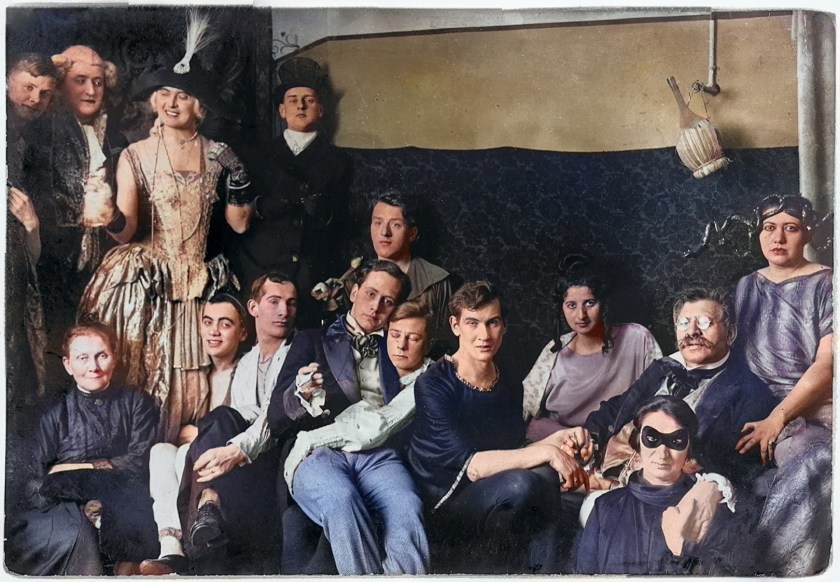
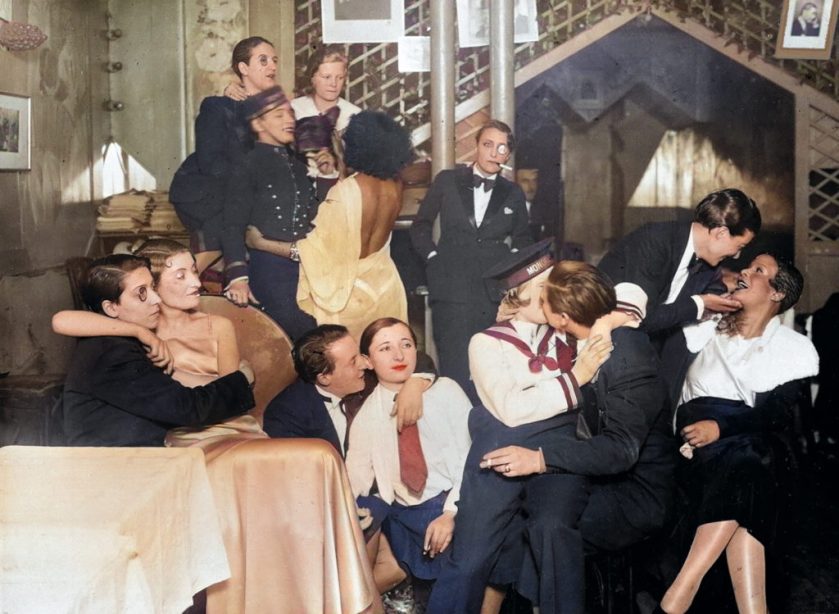
1920: Magnus Hirschfeld celebrates the Institute of Sexual Science with a costume party months after it opened in 1919.
The Nazi state made transgender lives difficult in another way: by revoking the limited gains won under the Weimar Republic. Even under the Kaiser’s regime before 1914, some police jurisdictions gave permits to “cross-dress” known as “transvestite passports” or more accurately “transvestite certificates” (“Transvestitenscheine”). In the Weimar period (1918-1933) some transgender people legally changed their names. Also in the Weimar period, a very small but vibrant transgender public sphere grew. Transgender people had their own magazines and organisations. Magnus Hirschfeld and his Institute for Sexual Science helped transgender people with legal name changes and police permits and medical treatments. Much of this was destroyed by the Nazis. Hirschfeld was driven into exile and his Institute for Sexual Science was dismantled. Transvestite magazines were shut, as were nightclubs like the Eldorado (Berlin) that showcased trans performers. Because the transvestite certificates had always been locally administered, what to do about them after 1933 seems largely to have been a decision for local officials. Overwhelmingly, police did not honour them after 1933. Not infrequently, they explicitly revoked them, such as in the case of “R” of Berlin, who was directed to stop living as woman, though she had done so for years.
There are a very few known cases where transvestite certificates were reissued under the Nazi state or where a person was allowed a legal name change. They are the exception rather than the rule. By chance, some of these cases came to the attention of historians early on, leading to conclusions that I now question. More and more, historians who work on other aspects of the Nazi state are noticing inconsistencies, even in Nazi racial policy – indeed, as Nunn cogently points out, inconsistency is a feature of modern states. As Zinn notes in the previous quotation, we see complexity in cases of cisgender gay men, too. Indeed, inconsistency in policing, as well as police and prosecutor discretion in enforcing law, are features of modern states. Moreover, even in these cases where trans people got certificates reissued or changed their names under the Nazi state, there are signs of violence. For example, a trans man in Berlin had his permit renewed, but only after he spent months in a concentration camp. Perhaps most importantly, these cases do not tell the whole story. In the large majority of the cases I have seen, permits were revoked and police forced people to stop living as their self-confirmed sex. This caused trans people extreme distress. At least one person seems to have been driven to suicide. In her comments on Twitter, Vollbrecht pointed to the “transvestite certificates” as evidence that trans people were not persecuted by the Nazi state. Looking at the historical record, however, the frequent revocation of these certificates helps to show us the pattern of anti-trans state actions, though that pattern also displays some inconsistencies.
It is the case that some transgender men and women were able to escape violence. For example, in one case, a police search of a person’s apartment found an “artificial lady’s bust.” The accused person said they only wore women’s clothing at home, never in public. Police let this person go but made the person promise to stop wearing the garments in private. In another case that Jane Caplan first brought to light, that of Gerd Kubbe of Berlin, police at first reacted harshly but later showed surprising leniency. Kubbe’s transvestite permit was revoked in 1933. Accused of wearing men’s clothing in public, he was sent to a concentration camp in 1938. Some months later, however, he was released and granted permission to wear men’s clothing and to use the first name “Gerd.” I referred to this case previously as one that demonstrates both violence and state accommodation of transness. It is difficult to know what to make of it. I am not sure that I do yet. I can say, however, that it is unusual. It was, unfortunately, one of the first cases to be published and set a flawed paradigm.
In terms of assessing how often trans people escaped violence, we are at a bit of a loss because the bulk of our evidence is police files. We know about people who ran into trouble with police but have a more limited ability to examine cases where people did not run into trouble with police. Police and prosecutors were ready to resort to violence with relatively little provocation in enough cases that I am comfortable asserting that trans people ran a general risk and were well advised to avoid police.
1921: four trans activists stand outside Hirschfeld’s Institute for Sexual Science, 12 years before Nazis stormed the facility and burned its books
The Nazi state reserved its worst violence for trans women. In particular, women who came to the attention of police as they continued to live publicly as women after 1933 were in danger. So were transgender women who sold sex. These trans women kept living as women because the alternative – being forced to live as a man – was unbearable, something Nunn shows in R.’s case. One such woman was H. Bode of Hamburg, who often went out in public dressed as a woman, dated men, and had previously held a transvestite certificate. Over the Nazi period, she racked up convictions under §360 and §175. Hamburg officials finally sent her to Buchenwald, where she died in 1943. (I believe Dr. Zinn refers to this case in his Gutachten. Bode was arrested after a night out in Hamburg with her aunt. I want to note that Dr. Zinn does not report the outcome. Bode was murdered. It is clear from the file that her “transvestitism” played a large role in that murder. On this see also Herrn, who reports her death.)
In 1933, Essen police withdrew Toni Simon’s permit and told her to stop wearing women’s clothing. She fled town. Later, she came back, and repeatedly got into trouble – insulting police officers, cavorting with known homosexuals, and breaking a law against anti-regime statements (the Heimtückegesetz), for which she served a year in prison. The final document in her file recommends sending her to a concentration camp. Though police had many reasons to deem Simon a threat to Nazi society, the fact that she was a “pronounced transvestite” was among the central ones.
Liddy Bacroff of Hamburg got a transvestite pass in 1928. She made her living selling sex to male clients. They understood her to be a woman. After 1933, she repeatedly ran into trouble with police. According to what police wrote in her file, she was “fundamentally a transvestite.” That, along with sex work, made her a “morals criminal of the worst sort” who “must therefore be ausgeschaltet (eliminated) from the Volksgemeinschaft (people’s community).” Bacroff was sent to Mauthausten and died there in 1943.
If I may address one final point – some earlier histories asserted that people like H. Bode, Toni Simon, and Liddy Bacroff were only sent to concentration camps because police believed they were gay men. It is the case that Nazi officials denied the gender identification of transgender people. For example, they claimed that Liddy Bacroff was a man even though she lived as a woman and many people whose words are recorded in her file thought she was a woman (including men who had sex with her). Police referred to her as a man although she told them, “My sense of my gender is fully and completely that of a woman.” When trans people gave true accounts of their gender, Nazi police refused to listen. We should not. Trans people were a distinct community of people. They are distinguished by their quests to live as their self-confirmed sex. Determining whether they suffered persecution has nothing to do with the question of why Nazi officials believed they ought to be persecuted.
Moreover, Nazi officials did not simply think trans women were gay men. They recognized trans women as different from gay men in ways that mattered. Nazi officials had a concept of “transvestitism” as distinct from, though related to, homosexuality. To quote Voss’s 1938 book: “By transvestites we generally mean those persons who have the wish to primarily wear the clothing of the other sex and to act more or less as the opposite sex.” In all of the cases I have examined, state officials refer to the accused people as “transvestites,” even when they also identified them as homosexual (which they did not always do). Officials often claimed that transvestitism was an aggravating factor, something that made the case more dire, the accused person more deserving of a heavier sentence. In general, transgender people who could distance themselves from homosexuality were more likely to get off with a warning from police. Yet I have seen cases in which transgender people whom police deemed “heterosexual” nevertheless suffered. One such case is R.’s – police forced her to detransition and she spent time in a concentration camp.
To conclude: though there is a bit of variation and disorganisation, and race matters, we see a pattern of state violence and oppression here, motivated by a hostility specific to transgender people.





















 Out in the City