Bridgewater Hall Christmas Concert … HIV Vaccine … Centre for Ageing Better … Diversity Role Models … Human Rights Day

News

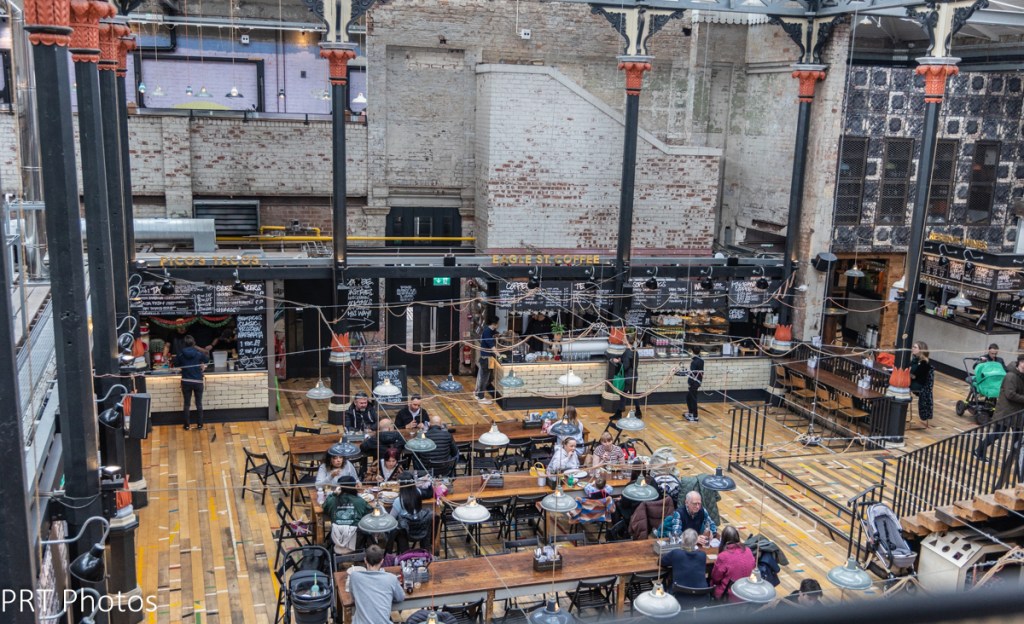
Bridgewater Hall mid-day concert

A group of us went to the lunch time concert which featured a selection of Christmas songs from Europe (including Ukraine) and Central and South America.

The Manchester Chamber Choir was formed in 2002 and has become one of the UK’s most versatile and accomplished vocal ensembles. The programme was very varied and really enjoyable.

An early-stage HIV vaccine is showing positive results. If it works, it would be first successful HIV vaccine after almost 40 years of research

An HIV vaccine candidate is showing positive early results, prompting a critical component of the human immune response in 97% of vaccine recipients.

It was a small phase 1 trial testing a vaccine that was made out of an engineered version of a protein that exists on the HIV virus. This particle was designed to get the body ready to generate broadly neutralising antibodies, which are thought to be critical to create immunity against HIV. Broadly neutralising antibodies would recognise a large swath of HIV subtypes, which is necessary to provide immunity because the HIV virus mutates frequently. 

48 participants either received the vaccine candidate or a placebo, and 35 out of 36 of those dosed with the vaccine candidate showed activation of broadly neutralising antibody precursor B cells that could produce the first step on the way to immunity. The crux of this technique is essentially to train the immune system to recognise a wide array of naturally occurring HIV subtypes, according to William Schief, one of the authors of the study. Schief is a professor in the department of immunology and microbiology at Scripps Research.

“There’s only a few patches on the surface of the HIV spike that remain the same or relatively the same across different isolates. And we’re trying to elicit very specific antibodies that have very specific properties that allow them to bind to those exact patches,” Schief said.

In the phase 1 study, no one reported serious side effects, and other side effects like pain at the injection site or headaches were mild to moderate, and they resolved in one to two days. 

These results, published in the academic journal Science on 1 December 2022, which was World AIDS Day, were first announced in 2021 at the virtual conference hosted by the International AIDS Society HIV Research for Prevention. The trial was co-run by the International AIDS Vaccine Initiative and Scripps Research. 

Researchers have been trying to create an HIV vaccine for nearly 40 years.

HIV is notoriously difficult to vaccinate against. Part of this is because of HIV’s tendency to mutate. By evolving and changing quickly, it can avoid the immune system by making itself harder to recognise.

Additionally, virtually no one, short of a few high-profile cases, has been cured of an HIV infection. That means we don’t know what sorts of immune cells in the body can actually protect against infection. 

Theoretically, this vaccine will be the first in a series of multiple shots, each using a different HIV particle to train the immune system. As the shots progress, the molecules get closer and closer to that of the actual HIV viruses, until antibodies produced can bind to many different kinds of HIV.

“That’s sort of a whole new way of thinking about how to make a vaccine,” Schief said.

Moderna is developing its HIV vaccine based on similar research.

It will take time before phase 2 trials can begin, according to Schief, and there’s no guarantee that the vaccine will ultimately work.

But if it does, this technique could be used to make other vaccines, he said, like a universal corona virus or flu vaccine.

“We’re optimistic that there’s some chances that this approach may be helpful for more than just HIV,” said Schief, “even though if it only helps HIV that would be enormous.”

This article was originally published by Business Insider.

Centre for Ageing Better

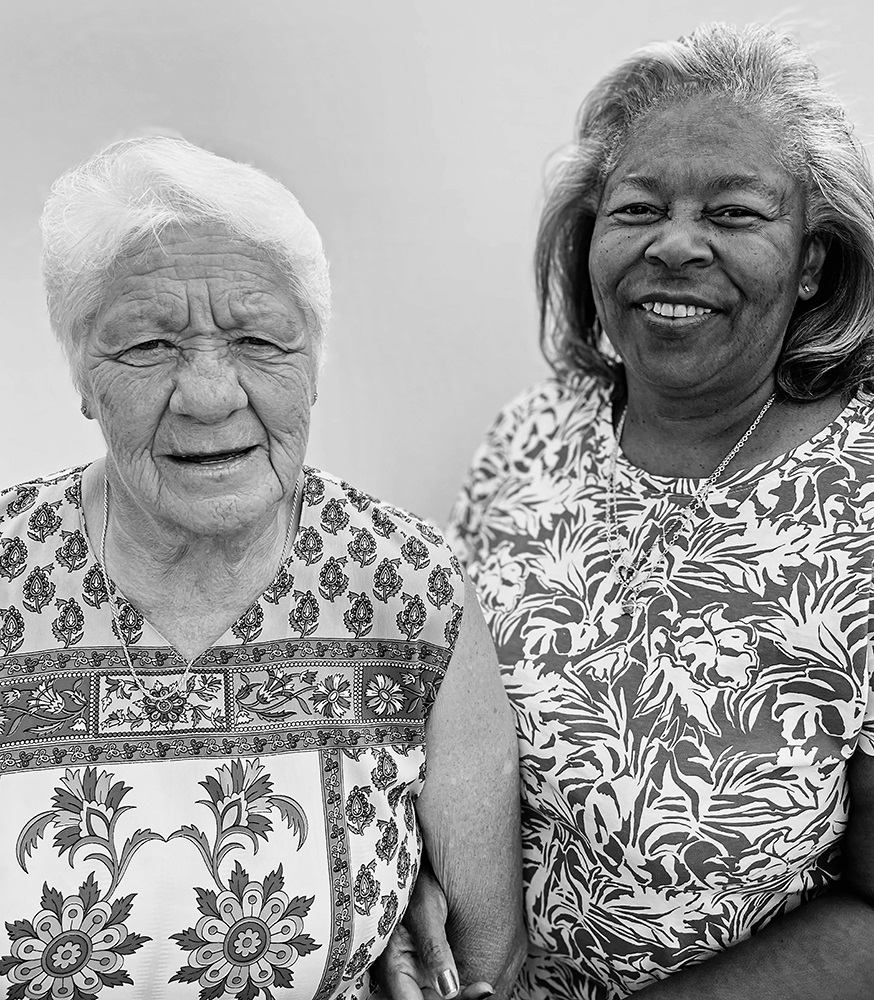
Would you be interested in being photographed as part of the Centre for Ageing Better’s age-positive image library?

They are looking for LGBT+ people (and couples) over 50, based around Manchester who are happy to be photographed. The library is a publicly available resource, so anyone (communications professionals, journalists, advertisers etc) can download the photos.

They would like the shoots to take place either on week commencing 12th or 19th December, depending on people’s availability.

They would also give participants a voucher as a thank you for their time (if it’s less than an hour, £10, if it’s 1-3 hours, £35).

If you are interested in taking part, please drop an email to Dora Buckle at Dora.Buckle@ageing-better.org.uk

Diversity Role Models

Diversity Role Models, an education inclusion charity, seek to tackle homophobic, biphobic and transphobic bullying. Their vision is an education system where everyone can be themselves without fear of being judged and can thrive.

Historically, they are an LGBTQ+ charity but with funding from the Department for Education for their anti-bullying staff training project ‘Embracing Difference, Ending Bullying’ they have been able to recruit an even more diverse pool of volunteers. 

The volunteer role models are often from marginalised or underrepresented groups, who come to schools (both in person and digitally) to share their lived experience stories with students and staff to develop empathy and trigger attitudinal change. They have many opportunities across Manchester (and the country using zoom/teams) for role models to join them in sessions to share their stories.

Here is a link to their website

If you want to sign up, then they would train and DBS check everyone at no cost to you. Please contact us here and more information will be sent.

Don’t Tell Us Who We Are

Human Rights Day is celebrated annually around the world on 10 December every year. The date was chosen to honour the United Nations General Assembly’s adoption and proclamation, on 10 December 1948, of the Universal Declaration of Human Rights.

Show your support for people enduring human rights abuses.

Yren Rotela and Mariana Sepúlveda want to live their lives freely and do things they love, like playing volleyball, dancing and going to the theatre. However, as trans women, Yren and Mariana are busy defending themselves against discrimination. They’ve been bullied, physically attacked and prevented from speaking out about the issues they face in their daily lives.

Trans people in Paraguay cannot legally change their names or obtain identity documents that match their gender identity, among other discriminatory practices.

This means trans students cannot get school certificates in their chosen names, which makes finding a job difficult. This inequality has motivated Yren and Mariana to become activists, to demand change. But protesting isn’t easy for trans people in Paraguay. Paraguay is a very conservative country that treats trans people and the wider LGBT+ community unfairly. It tries to make them invisible. Because of this, protests by trans groups are often banned, and in some cases demonstrations have been attacked.

Yren and Mariana have been fighting for years to change their legal names. If they could get documentation that matches who they are, it would mean the state had started to recognise their existence as trans women. As Yren says: “I came into the world to show who I am, not to be told who I am.”

Tell Paraguay to legally recognise the identity of trans people so they can exercise their rights.

  • Send an appeal letter (in English or Spanish) to the Paraguayan Authorities

Write to: President of the Supreme Court of Justice

Palacio de Justicia del Paraguay

Mariano Roque Alonso y Testanova

9° Piso, Torre Norte

C.P. N°001001

Asunción, Paraguay

    Salutation: Dear Mr President

In your letter ask him to legally recognise the identities of transgender people so that they can exercise their right to freedom of expression, association and protest under their self-perceived identities.

or email to: secretariageneralcsj@pj.gov.py

  • Send a message of support and solidarity

Address: Yren Rotela and Mariana Sepúlveda

c/o Amnesty International Paraguay,

Hassler 5229 entre Cruz del Defensor y Cruz del Chaco,

Asunción, Paraguay

The Bi Flag … ACT UP Disrupt St Patrick’s Cathedral, New York

News
The bisexual flag was launched on 5 December 1998

It is now ubiquitous in bi circles but it took a while to catch on.

The pink, purple and blue colours that have come to represent the bi community in their stripes were not new back in 1998, but refashioning them into a very simple flag was a bright idea from Michael Page of online chat forum BiCafe (a website which ran from 1997 until 2012 – sadly gone).

The USA-based BiCafe website was launched in 1997 and the flag was launched at its first birthday celebrations, on 5 December 1998.

In correspondence with a writer for the flagspot website Michael explained, “The pink colour represents sexual attraction to the same sex only (gay and lesbian), the blue represents sexual attraction to the opposite sex only (straight) and the resultant overlap colour purple represents sexual attraction to both sexes (bi).”

The “correct” bi flag design is made up of three distinct colour blocks, but sometimes people use a wash of colours from pink to blue via purple.

However that’s pretty well in keeping with his original concept, as Michael explained: The key to understanding the symbolism of the Bisexual pride flag is to know that the purple pixels of colour blend unnoticeably into both the pink and blue, just as in the ‘real world,’ where bi people blend unnoticeably into both the gay / lesbian and straight communities.”

Wouldn’t the rainbow flag do the job?

Michael wrote that the vast majority of bi people I have spoken with, feel no connection to the rainbow flag, the pink triangle, the black triangle, the Lambda symbol or the double-edged hatchet. These symbols are viewed as gay and lesbian icons, which was their initial intent.

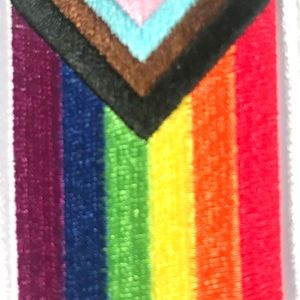
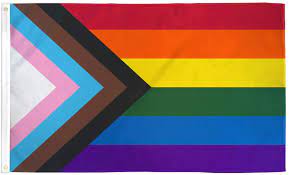
The recent “progress flag” version of the rainbow flag adds stripes to address marginalisation and exclusion of trans people and people of colour from the rainbow, but leaves bi exclusion as an unaddressed issue.

After its launch the bi flag slowly spread as an image around the bi world, including appearing on the back of the programme booklet for the next International Bisexuality Conference, in 2000.

Despite this, in the late 1990s and 2000s it was still fairly unknown as a symbol in the wider LGBT scene, not least because in the days when colour printing was so much harder to afford, promotional materials for bi events, groups and projects tended to be in black and white.

But the growing internet access helped transform that. Today there are a plethora of web graphics using the three colours, as well as lots of bi-coloured accessories to subtly communicate your bi-ness to others.

The flag itself – now easily obtainable online for a few pounds as a small hand-held flag-on-a-stick or as a five foot long fabric sheet – makes a simple and popular cape to wear at LGBT pride events, turning the usual problem of bisexual invisibility on its head by literally wrapping yourself in the flag.

Over the years since it has flown from town halls worldwide and given us a code by which to know one another, it has helped end bisexual invisibility.

In 2020, it was at the centre of internet controversy over its ownership, which ultimately reaffirmed its place as a freely usable symbol for us all. So all of our thanks to Michael, and happy birthday the pink, purple and blue flag this 5 December.

ACT UP Disrupt Mass at St Patrick’s Cathedral, New York

On 10 December 1989, AIDS activist group ACT UP (AIDS Coalition To Unleash Power) undertook one of their most controversial actions. In conjunction with the Women’s Health Action and Mobilization (WHAM!), they picketed outside St Patrick’s Cathedral but also took direct action inside.

Poster announcing the action at St Patrick’s Cathedral

The protesters had given advance notice of their intentions, which prompted a range of responses from authorities. The most drastic was having sniffer dogs sweep the Cathedral for explosives earlier in the day. Hundreds of uniformed police officers were assembled outside and plain clothes police officers mingled with the congregation inside.

Some 4,500 protesters gathered outside, some of them lying down in the street to block traffic on Fifth Avenue. Others carried a giant condom with the words “Cardinal O’Condom” written along the side. This was a reference to Cardinal John O’Connor who, in addition to his homophobic, anti-condom and anti-abortion preaching, was also a staunch opponent of sex education in schools.

The protesters also included artist Ray Navarro dressed as Jesus, supposedly covering the event for “the Fire and Brimstone Network”.

But it was events inside the Cathedral that proved the most controversial. It began with activists pretending to be ushers and handing out flyers to those entering the church, explaining why there would be a protest. Then, as O’Connor began to take Mass, activists lay down in the aisles or chained themselves to the pews. More activists stood up in the pews and shouted things like “Why are you murdering us?” and “Stop the Madness!”

O’Connor, hoping to drown out the protests, asked the congregation to stand and pray. Activists merely shouted louder and started blowing whistles. Police and church heavies moved in to carry the protesters out. The majority had to be carried out on stretchers as they refused to get up from the floor of the aisle.

But even when this group of activists had been removed, there were still others inside, sitting quietly and pretending to be worshippers. These were the so-called ‘Speaking in Tongues’ group. Their strategy was to wait until Communion, then walk up as if to receive Communion. When they were offered the Communion wafer they would each make their own political statement.

The first member to do this was Tom Keane. The priest gave him the wafer and said, “This is the body of Christ.” Keane responded by saying “Opposing safe-sex education is murder.” He then laid on the floor himself in an attempt to prevent others from receiving Communion. The priest simply stepped over him and continued giving Communion.

Keane was one of 111 people arrested inside and outside the Cathedral. Ultimately, all of the protesters were charged with minor offences and given community sentences. Those who refused to undertake community service were tried but did not serve time in jail.

National Media Museum … Expansion of Russia’s “Gay Propaganda” Law … Lesbian Chronicles

News

National Media Museum

We travelled by train from Manchester Victoria arriving at Bradford Interchange just in time for lunch. The “City Vaults” pub was recommended, and it was a good choice as we all enjoyed our meals.

It was then a short walk to the National Media Museum, which is linked to the Museum of Science & Industry in Manchester. The museum has five floors of exhibits and is free to enter. The exhibits featured many items which reminded us of our youth – Humpty, Jemima, Big Ted and Little Ted from Playschool, Andy Pandy, Bill and Ben the Flowerpot Men and Muffin the Mule.

We had a lot of fun in the interactive section, and we particularly enjoyed the mirrored maze and the light and sound features.

There was an Out and Proud section which confirmed that attitudes towards LGBT+ people on television have shifted dramatically since the 1940s, from no mentions at all to a celebration of uniqueness. When positive storylines first appeared on soaps they had a powerful impact on viewers by opening conversations, deepening understanding and even leading to changes in law.

We ended our tour with refreshments in the museum cafe.

Lots of photos can be seen here.
Lower house of Russian Parliament passes anti-LGBTQ propaganda law

A new law which expands Russia’s “gay propaganda” law signed by Russian President Vladimir Putin in June 2013 passed the lower house of the State Duma on 24 November 2022.

The legislation, which still needs the approval of the upper house of the Duma and Putin, introduces an expanded “all ages” ban on “propaganda of non-traditional relations,” paedophilia, as well as a ban on the dissemination of information about LGBTQ people in the media, the Internet, advertising, literature and cinema. 

The language of the bill, according to the official Russian state news agency TASS, also introduces a ban on issuing a rental certificate to a film if it contains materials that promote non-traditional sexual relations and preferences is established. The document also provides for the introduction of a mechanism that restricts children’s access to listening to or viewing LGBTQ information on paid services. 

The newly expanded law provides for the Russian Federal Service for Supervision of Communications, Information Technology and Mass Media, abbreviated as Roskomnadzor, to be vested with the right to determine the procedure for conducting monitoring on the Internet to identify information, access to which should be restricted in accordance with the federal law on information.

A requirement is also set on paid services to enter codes or perform other actions to confirm the age of the user. At the same time, access to LGBTQ information is prohibited for citizens under 18 years of age.

Also, the law “on the protection of children from information harmful to their health and development” is supplemented by an article on the promotion of non-traditional sexual relations, paedophilia and information that can make children want to change their sex.

The latter language pointedly inserted as transgender people have been a frequent target of attacks by the Russian president in speeches recently blaming the West for a global decay in moral values that run counter to what Putin describes as “Russia’s strong morals.”

In an October speech announcing the illegal annexation of four Ukrainian territories, Putin attacked Western nations on the issue of gay and transgender rights.

“Do we want children from elementary school to be imposed with things that lead to degradation and extinction?” he asked. “Do we want them to be taught that instead of men and women, there are supposedly some other genders and to be offered sex-change surgeries?”

It’s not just the Russian leader. Patriarch Kirill, head of the powerful and influential Russian Orthodox Church, portrayed the war with Ukraine as a struggle seeking to reject Western values and LGBTQ Pride parades.

A spokesperson for Human Rights Watch said that this expansion of the 2013 “gay propaganda” law“ is a classic example of political homophobia. It targets vulnerable sexual and gender minorities for political gain.

Human Rights Watch noted that given the already deeply hostile climate for LGBTQ people in Russia, the organisation warned there will be an increase in often-gruesome vigilante violence against LGBTQ people in Russia — frequently carried out in the name of protecting Russian values and Russia’s children. Legal scholars say the vagueness of the bill’s language gives room for government enforcers to interpret the language as broadly as they desire, leaving members of the Russian LGBTQ community and their allies in a state of even greater fear and stress filled uncertainty.

Lesbian Chronicles: Coming Out Later in Life

Do relationships — gay or straight — truly have longevity? Melisa and Alli talk about the hardships couples face and how hard it is to commit to forever — especially later in life.

Listen to the podcast here.
World AIDS Day 2022 … World AIDS Day 1990 … Tory Government cuts £400 million in HIV funding … Job at LGBT Foundation

News

LGBT Foundation Archive Pop-Up for World AIDS Day

1 December, 11.00am – 1.00pm at Manchester Central Library, St Peter’s Square, Manchester M2 5PD (Ground Floor)

Drop in to Manchester Central Library on World AIDS Day to see a selection of items from the LGBT Foundation Archive at Archives+ which tell the story of HIV and AIDS awareness and activism in Manchester.

The Sexual Health Team will be on hand to discuss HIV testing and support through the years and what is accessible in Greater Manchester today.

FREE, no need to book.

Bury LGBTQI+ Forum: HIV Past – Present – Future

1 December, 4.00pm – 6.00pm at Fusilier Museum, Moss Street, Bury BL9 0DF

To book a place, contact paul.fairweather@buryvcfa.org.uk

Thursday, 1 December – World AIDS Day Vigil – Sackville Gardens – 6.00pm

Information can be found here

Friday, 2 December – Superbia Cinema returns to Mini Cini for a series of short films in recognition of World AIDS Day

Ducie Street Warehouse, Ducie Street, Manchester M1 2TP

Superbia Cinema is a celebration of queer filmmaking, and each month they showcase films by talented LGBTQ+ creatives.

Superbia Cinema is a great way for film enthusiasts and those interested in LGBTQ+ arts to come together and immerse themselves in queer culture.

The films:

  • HIDEOUS
  • As Much As I Can
  • Kia LaBeija
  • Trans People Taking PrEP
  • RATED X
  • My Neighbor, Miguel
  • Young Women in South Africa – At Greater Risk of HIV/AIDS

Stick around after the film screenings for a special Q&A with Gerry Potter, Monica Pearl and Paul Fairweather!

Schedule:

Screening 1 – 6:00pm

Screening 2 – 7:20pm

Q&A – 8:30pm – 9:00pm

Please note:

Please choose the screening time that you would like to attend when booking your ticket. Free tickets are limited to 1 per order – each attendee must register for their own ticket.

World AIDS Day 1990

On World AIDS Day, Saturday 1 December 1990, Act-Up Manchester held an action in central Manchester to highlight the issue of women and AIDS.

Twenty two group members handed out condoms and leaflets to shoppers and passers-by. At the peak of the shopping day Act-Up then entered the Arndale shopping centre and launched 5,000 AIDS awareness leaflets over the edge of the upper shopping mall onto the main lower concourse. The leaflets which were backed with an image of £5 and £10 notes read, “Aids doesn’t affect women … don’t bank on it”.

Act-Up were able to leave the shopping centre without any arrests being made – just!

Tory government cuts hundreds of millions in HIV funding despite promise to eradicate virus by 2030

Rishi Sunak (Getty Images)

The UK government has cut funding to a major player in the fight against HIV, a decision that has prompted condemnation from MPs across the divide.

The UK government last year pledged £1.4 billion to The Global Fund, which fights HIV/AIDS, tuberculosis, and malaria worldwide, but this year funding has been slashed to £1 billion.

Since being established by the G7 in 2002, The Global Fund is believed to have saved 50 million lives.

Just last year, it gave lifesaving antiretroviral therapy for HIV to 23 million people and helped 5.3 million with treatment and care for tuberculosis.

The move has been criticised by the All-Party Parliamentary Group (APPG) on HIV and AIDS, which said it could “jeopardise the UK’s own domestic efforts in ending HIV”.

“As we’ve clearly learned from COVID-19, pandemics don’t respect borders. If we can’t control HIV globally, it’ll jeopardise our domestic efforts,” a statement said.

The cross-party group said that while the pledge is “welcomed” in the fight against HIV and AIDS, the government’s decision to cut funding by £400 million was “disappointing”, especially as other G7 nations increased their funding.

Labour MP Lloyd Russell-Moyle, who lives with HIV, told PinkNews that Tory ideology was risking progress and was a threat to the goal of ending new HIV transmissions this decade.

“While I welcome the funding pledge, which has come already two months late because of political turmoil in the Tory party, it is almost a 30 per cent cut in funding, when all other G7 nations have increased their contribution by almost 30 per cent.

This cut will mean less research into curing HIV/AIDS, TB and Malaria, it will make it harder to reach our ambitious target to eliminate new HIV transmissions by 2030 and it will slow vital research.

All because the Tories have an ideological cap of 0.5 per cent GDP on aid, treat all Ukrainians living here getting support as aid, and have wrecked the economy creating a £60 billion black hole, one which could be covered by abolishing the upper limit on National Insurance and having corporation tax at the same as other G7 nations.”

Government cuts to foreign aid and funding for HIV and AIDS organisations including UNAIDS were criticised in 2021, with a report stating cuts were “setting the stage for a resurgence of the [HIV/AIDS] pandemic”.

The report, by STOPAIDS, Frontline AIDS, and the APPG on HIV and AIDS, states: “Even before COVID-19, the HIV response was already in a precarious position.

The global HIV response is now teetering – caught in a perfect storm of waning political and public engagement, diminishing funds, and the global shock of COVID-19”.

The report added that while the UK has been an “historic leader” within global healthcare, a “renewed leadership from the UK government for the HIV response is desperately needed”

Job at LGBT Foundation

Strategic Housing Manager

Are you a forward thinking, innovative and strategic individual with a flare for enabling successful partnership working?

If you think you have the skills and knowledge to support the development of a brand new set of LGBTQ+ services and projects, designed to support the most marginalised of our communities then this may be the role for you!

LGBT Foundation is looking for a Strategic Housing Manager to work with the Community Steering Group, the wider LGBTQ+ community, the appointed Housing Provider, a range of stakeholders and Manchester City Council to support the development of the LGBTQ+ Extra Care Scheme in Whalley Range.

The role will also support the Pride in Ageing Accreditation Scheme across housing and care services in Manchester and will work with the Chief Executive to support the development of new housing services and projects.

Job Title:              Strategic Housing Manager
Salary:                  £34,568
Hours:                  37 hours per week
Special Terms:    Full time, permanent (subject to funding – initially 3 years)
Closing Date:      9.00am on Thursday, 8 December 2022.

Interview Date:   To Be Confirmed.

The link to this role is at https://lgbt.foundation/jobs

Salford Museum & Art Gallery … Five Gay Authors … Sir Lady Java

News

Salford Museum and Art Gallery

A small group of us gathered at Piccadilly Gardens Bus Station to take the short bus ride to Salford.

A pair of rainbow crossings greeted us on The Crescent leading from the bus stop to the Salford Museum. Salford Council opened the rainbow crossings about two years ago to celebrate LGBT+ Pride in the city.

The museum café was quite busy but we enjoyed soups, toasties and sandwiches before visiting the various galleries. The Victorian Gallery is packed with paintings and sculptures. The other galleries feature a changing programme of contemporary art exhibitions, but the highlight was Lark Hill Place. This is an atmospheric re-creation of a typical northern street during Victorian times.

Photos can be seen here.
Five gay authors whose stories show us how to age gracefully

With year-end “best of” lists coming out fast and furious over the final weeks of 2022, there are more notable LGBT+ writers to choose from than ever before. The year provided a remarkably broad and diverse number of authors with novels, history and poetry sharing points of view neglected in the past by publishing’s traditional gatekeepers.

In the early 1980s gay male writers were instrumental in centring gay themes in literature, inspiring later and diverse generations of authors to write about what they know and where they came from.

These new gay books from 2022 reflect on age, impermanence and the subjective quality of time:

James Hannaham – “Didn’t Nobody Give a Shit What Happened to Carlotta”

Hannaham, 54, is a visual artist as well as a writer. He studied art at Yale and creative writing at the Michener Center at the University of Texas. His debut novel from 2009, God Says No, was a Lambda Literary Award finalist, while his 2015 novel, Delicious Foods, won the PEN / Faulkner Award and Hurston / Wright Legacy Award. He lives in Brooklyn with his husband.

His latest work, the irreverent and heartbreaking Didn’t Nobody Give a Shit What Happened to Carlotta tells the story of the titular character, Carlotta Mercedes, over the course of a Fourth of July weekend in Brooklyn after she’s released from a men’s prison; 20 years earlier she’d gone into stir as a man.

As the years changed Carlotta, so too did the Brooklyn she once called home, where time is a prison all its own. “Carlotta remembered that people used the same term for coming home from prison and coming back from outer space,” Hannaham writes. “Re-entry.”

Andrew Holleran – “Kingdom of Sand”

Holleran, 78, is best known for Dancer from the Dance, published in 1978. His debut novel achieved cult status for its depiction of halcyon days and nights in New York’s discos and on the beaches of Fire Island in the years between Stonewall and the AIDS epidemic.

His latest novel, Kingdom of Sand, is a bookend to that story of young, reckless beauty. Now, aging while gay is another kind of reverie, and time is not fleeting but stretched, seemingly endless, something to be studied and admired. Alone in a house by a lake in Florida, Holleran’s narrator observes: “Now the drought had gone on so long that something unexpected had happened: the dry lake bed had become more beautiful than the lake.”

Harvey Fierstein – “I Was Better Last Night: A Memoir”

Every decade has a Harvey Fierstein cameo. In 1979 Gay Presses of New York published Fierstein’s play, Torch Song Trilogy. The actor made a name for himself in the 1980s starring in the show on Broadway as well as the film version, which he also wrote. In the ’90s, Fierstein made Mrs Doubtfire and in the 2000s, Fierstein sang and danced the character Edna Turnblad in the musical version of Hairspray on Broadway.
Stories of those productions and others fill his memoir, I Was Better Last Night, a meditation on the 70-year-old actor and writer’s place in the universe in general, and on Broadway and in Hollywood specifically. Of the latter, Fierstein never felt a good fit. Of the former, he was gobsmacked from the start by the smell of the grease paint and the roar of the crowd.

Torch Song came about because Fierstein found The Boys in the Band and A Taste of Honey, both gay breakthroughs in their time, burdened with self-loathing. His gay breakthrough would be written with joy.

David Sedaris – “Happy-Go-Lucky”

If you were lucky enough to discover David Sedaris in real time, when he read his Santaland Diaries in 1992, or you picked up his first collection of essays, Barrel Fever in 1994, or you were gifted Naked  in 1997, then you’ve probably stuck with the acerbic and self-deprecating author – and you probably look forward to reading the latest instalment of what’s become a long-running serial detailing his dysfunctional and perfectly normal American family, his long time and forever boyfriend Hugh, his own quirks and foibles and sexual proclivities, his slashing wit, his despair, his compassion.

The latest collection of essays, Happy-Go-Lucky, is just that. It follows an onslaught of output from the 65-year-old writer. He’s published seven books in the last five years alone, including two more essay collections, two diaries clocking in at 500 pages each, along with a visual compendium and an e-book.

Edmund White – “A Previous Life”

At 82, Edmund White is the éminence grise among gay literati. He’s best known for his The Joy of Gay Sex, written with Charles Silverstein in 1977, along with his trilogy of semi-autobiographical novels, A Boy’s Own StoryThe Beautiful Room Is Empty, and The Farewell Symphony.

In the 1980s, while White was in residence in France, where he learned he was HIV-positive, he wrote the definitive biography of French writer Jean Genet. In 2019, he received the National Book Award’s Medal for Distinguished Contribution to American Letters.

Set primarily in 2050, A Previous Life flashes back and forward through a couple’s sexual histories, including a meta-meeting of the minds between one of the protagonists and an 80-year-old White himself, which ends with the author’s heart broken.

Sir Lady Java is a transgender pioneer who fought discrimination

Sir Lady Java was a pioneering transgender activist fighting against a Los Angeles law that restricted drag performance. Photo: Sir Lady Java

Sir Lady Java was a waitress, dancer, singer, comedian, and drag performer in the 1960s Los Angeles club scene. She delighted audiences with her stand up routines, go-go dancing gigs and performances with the likes of Sammy Davis Jr and Richard Pryor. She also was a pioneering transgender activist who fought against laws that restricted drag performance.

As a black gender non-conforming activist, she witnessed a point in history – the intersection of discriminatory law enforcement tactics targeting black communities as well as lesbian and gay communities in Los Angeles in the 1960s. These types of police campaigns also took place in numerous cities across the US.

Only a few years into Sir Lady Java’s career, police began attempting to shut down her shows specifically because she was an “impersonator.” In one of their first attempts, the Los Angeles Police Department (LAPD) sent around 50 officers to arrest her under the “three-piece rule.” This rule stated that a person must be wearing at least three articles of clothing that corresponded to the sex they were assigned at birth, or they would be arrested for cross-dressing. Java thought quickly and pointed out her socks, wristwatch, and bow tie—which had all been deemed “male articles” by the LAPD—and avoided arrest. 

Rule #9

Passed in 1958, LA’s notorious ordinance Rule #9 said bar owners couldn’t hire anyone who performed as the opposite sex to the one they were assigned at birth.

Java was targeted because she was successful, and the idea was that shutting down the show of a top performer would cause all other impersonator performances to stop. By targeting trans and drag performers through the guise of “impersonator” performance, police also targeted establishments that were considered safe spaces for gay people.

The impacts of the law reached a fever pitch for her in 1967 during a run of performances at the Redd Foxx, a black-owned nightclub.

The club applied for a performance permit, but in October 1967, the Los Angeles Police Department denied the request.

After the permit was refused, she protested at the Redd Foxx, arguing for her right to work.

Historic protest, court case

Sir Lady Java made history because she was the first person to not only protest the law, but also challenge it.

The American Civil Liberties Union (ACLU) sued the city on her behalf, but the court refused to hear the case because only bar or club owners could file a lawsuit.

The ACLU couldn’t find a bar owner willing to sue Los Angeles, and the case was dismissed, but her protest did raise awareness and visibility about the issue.

Two years later, the ordinance was overturned in a separate lawsuit.

With the law overturned, Sir Lady Java returned to the stage and continued performing in LA nightclubs in the 1970s and early 1980s.

ACT UP Los Angeles, “Sir Lady Java,” 1989. ACT UP Los Angeles picket sign collections,
ONE National Gay & Lesbian Archives at the USC Libraries

Painted jars ready for World AIDS Day on 1 December