Tributes have poured in following the death of singer songwriter Claire Mooney.
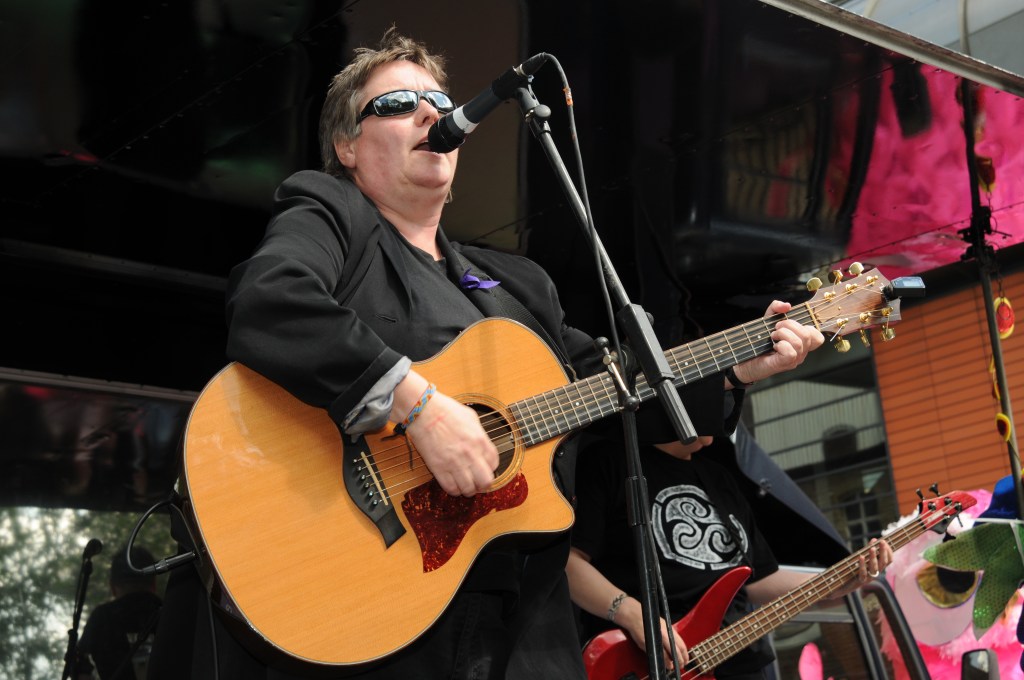
Claire appeared at Oldham Pride in 2009 when she wowed the crowd. She supported many prides and organisations and was generous with her time. Claire was a fighter in more ways than one, she fought for women’s rights, the repeal of section 28 and made the world a better place for everyone.
She will be missed and as someone has already said “Rest in Power Claire”.
Claire Mooney
New Christopher Isherwood Biography
Christopher Isherwood book cover insert. Courtesy Farrar Straus and Giroux
“Christopher Isherwood: Inside Out” is an insightful biography of the prolific writer, author of “Goodbye to Berlin” (the inspiration behind “Cabaret”), “A Single Man” and “Christopher and His Kind”, among others. Katherine Bucknell, director of the Christopher Isherwood Foundation, as well as editor of several collections of Isherwood’s diaries and letters, draws on his letters, journals, creative work and interviews to build an extensive look at this talented writer.
Christopher William Bradshaw Isherwood (26 August 1904 to 4 January 1986) was born in High Lane, Cheshire to landed gentry, with properties, a large house and servants. His father was in the British Army and the family moved around for a while, including a stint in Ireland. His father went to fight in World War I and died in France, leaving his mother to look after Isherwood and his younger brother. This clearly affected Isherwood, although he wouldn’t discuss it until much later. While this section of his childhood is important to Isherwood’s later development, the many details make for slow reading.
Christopher Isherwood en route to China, 1938
The book really picks up when Isherwood travels to Germany in 1929, where he fully embraced his sexuality. In Berlin, he first lived next door to Magnus Hirschfeld’s Institute for Sexual Science, a centre which pioneered research and treatment for various matters regarding gender and sexuality and which advocated for the decriminalisation of homosexuality. Isherwood met many young German men, falling in love with Heinz Neddermeyer, who he tried to help get out of the country as the Nazis gained power. His short novels “Mr Norris Changes Trains” and “Goodbye to Berlin” are fictionalised versions of the people he met and his experiences there, although they don’t tell the whole truth about his sexual adventures.
Decades later, as the German translation of “Christopher and His Kind”, a nonfiction account of Isherwood’s time in Germany, was to appear, Neddermeyer, now with a family, wrote to Isherwood despairing that the book would out him. The translation wouldn’t be published until after Isherwood’s death.
Isherwood emigrated to America with his school friend, the poet W H Auden, in 1939. The two collaborated on several plays and covered Japan’s invasion of China, even sleeping together several times. This move, near the start of World War II, plus Isherwood’s pacifist refusal to fight, caused bitter feelings with some friends in England.
He settled in Los Angeles where he discovered the Vedanta Hindu-inspired philosophy. He translated the Bhagavad Gita with the religious leader Prabhavananda, who he deeply admired. Although Isherwood struggled to practice all of Vedanta’s teachings, including celibacy, the religion accepted him completely.
He also met Don Bachardy on Valentine’s Day in 1953 with whom he would spend the rest of his life. Thirty years younger than Isherwood, Bachardy shared with Bucknell the challenges in their relationship. While Isherwood encouraged him to study art in England, Bachardy had affairs there, as did Isherwood back in LA. In their letters, Isherwood was “Dobbin” while Bachardy was “Kitty.” Seeing their love grow and develop is one of this book’s pleasures.
Despite the biography’s length and slow start, it reveals an honest yet sympathetic look at Isherwood’s life and work. It should inspire readers to pick up his books, either again or for the first time. ‘Christopher Isherwood: Inside Out’ By Katherine Bucknell 864 pages
The Candlelit Vigil
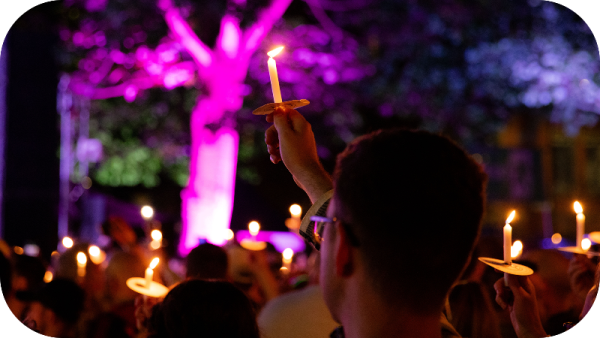
The Candlelit Vigil in partnership with George House Trust is the heart of Manchester Pride Festival and the culmination of the weekend’s celebrations. Each year, The Vigil closes the celebrations with a moment of reflection in Sackville Gardens – the home of the Alan Turing memorial, The National Transgender memorial and the Beacon of Hope, the gardens are transformed into a sea of flickering candles as the celebrations calm and come to an end.
Carefully curated by three respected individuals: Nathaniel J Hall, Kate O’Donnell, and Cheryl Martin, this moment of reflection is a time to come together to honour those who are suffering, persecuted and have lost their lives due to HIV. It serves as a poignant reminder of the challenges faced by LGBTQ+ communities, both in the UK and around the world. Through the soft glow of candlelight, attendees create a united front, demonstrating their unwavering commitment to combating HIV, raising awareness, and fostering a more inclusive and accepting society.
The Candlelit Vigil is completely free to attend, but if you cannot attend in person, you can watch the vigil livestream on YouTube. Follow this link from 9.00pm.
George House Trust is an organisation providing HIV support, advice and advocacy services since 1985. The Candlelit Vigil is a powerful symbol of remembrance, solidarity, and hope. George House Trust plays a pivotal role in curating this meaningful event, leveraging their expertise and dedication to improving health outcomes and supporting those affected by HIV.
Our trip this week was to the “Lost Gardens of Fallowfield”.
In The University of Manchester’s bicentenary year, the Firs Botanical Grounds is opening its doors – inviting the community to visit the hidden oasis, located in Fallowfield, home to an historic living plant collection, including greenhouses and outdoor spaces.
The Firs traces its history at The University of Manchester back to 1887, when the house and grounds were bequeathed by Sir Joseph Whitworth. With over 100 years of active research, it is the longest continuously running research facility at the University. The site is home to the Firs Environmental Research Station and the University’s Living Plant Collection.
From ten–feet-tall cacti to genetically modified rice, the Firs greenhouses are home to plants from nearly every continent. This enables leading research right from the centre of Manchester.
Their mission includes engaging the community about biodiversity, food security and the environment.
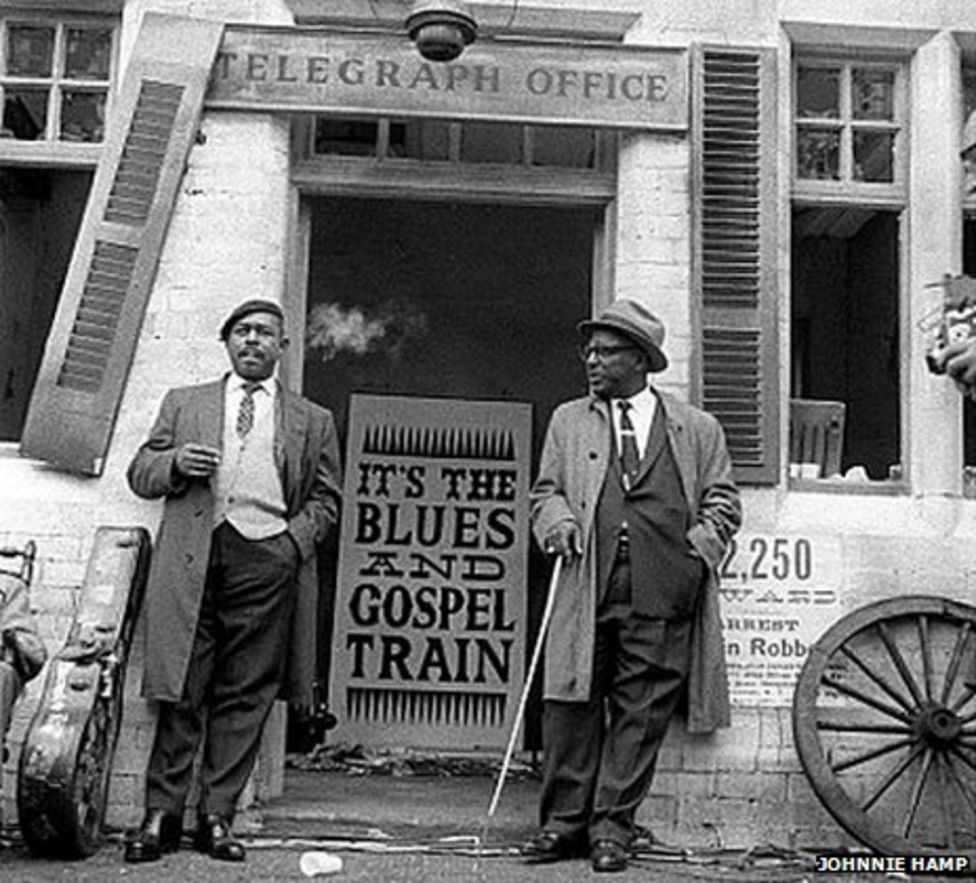
On 7 May 1964, a gaggle of excited passengers alighted on to a rainy disused railway station platform in south Manchester (now Chorlton tram stop) and took their seats for a massively culturally significant gig.
Eric Clapton, Jeff Beck, Keith Richards and Brian Jones came from London in a minibus just to watch the concert.
The bill featured big names in blues, including Sonny Terry and Brownie McGhee
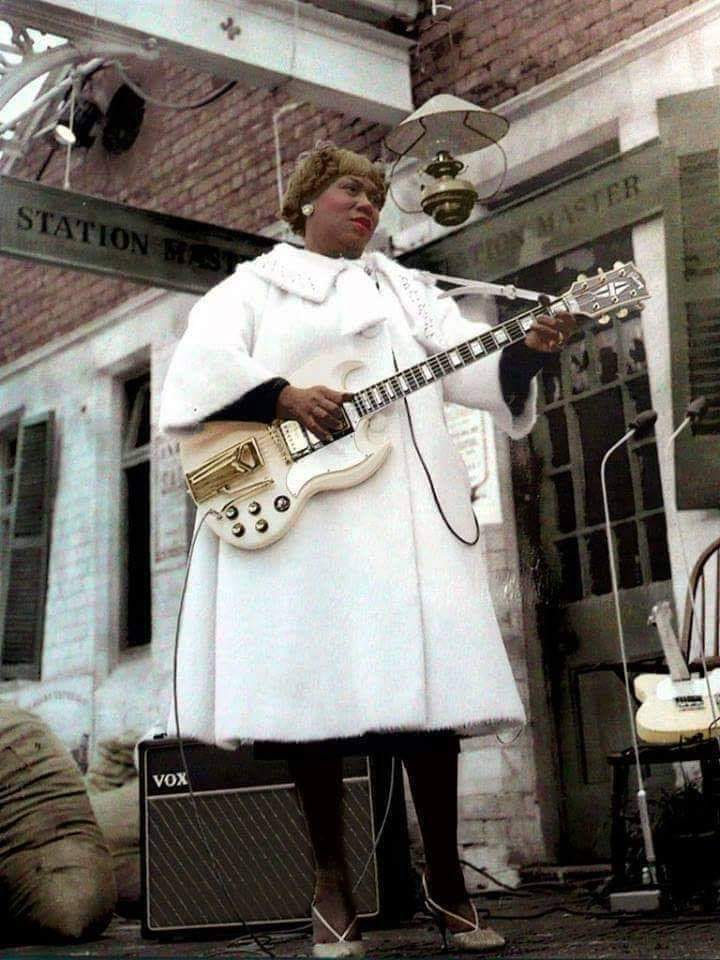
As part of the American Folk Blues Tour, Sister Rosetta Tharpe arrived in a horse-drawn carriage, in a huge white coat, in the rain, and proceeded to rock the crowd with “Didn’t It Rain.” The audience on the other side of the train tracks were transfixed and the excitement of her music was again spread worldwide.
She began her recording career in 1939 in New York City, and in her early 20s, she was the “girl singer” in the Lucky Millinder band, breaking away from her beloved gospel to sing secular hits like “I Want a Tall Skinny Papa,” “Rock Me,” and “Four or Five Times.”
She also recorded many of her early gospel gems solo, playing a National Triolian 14 Fret. She would soon revolutionise the electric guitar, pioneering the use of distortion and featuring uplifting guitar solos in most all of her songs.
Sister Rosetta Tharpe’s version of “Didn’t It Rain” was one of the show’s highlights
In this photo she is playing a Gibson SG, she also played a Les Paul, big archtops and more. She had a unique and wonderful guitar style to accompany her singing. One of the most loved and ebullient artists of all time!
Marie Knight
In 1946, Tharpe met singer Marie Knight, and after they recorded “Up Above My Head,” the two women teamed up and went on tour. The women worked together until 1950.
Rumours circulated for years that the women had a romantic relationship. Tharpe also had been married previously twice to men. She married a third time in 1951. But she might have been bisexual or lesbian.
In 2007, Gayle Wald wrote a biography about the trailblazing musician, “Shout, Sister, Shout!” Tharpe died in 1973 and didn’t leave any archives or written record about her life.
When Wald asked Knight about the rumours of an intimate relationship with Tharpe, Knight told her they were untrue.
Sexuality and identity
Wald also interviewed other sources who spoke about Tharpe’s attractions to men and women, but none of them would go on the record.
“Do I think Sister Rosetta Tharpe had attractions to and sexual relations with women? Yes,” Wald said. “But I don’t know if she used any words to identify herself.”
Wald said she wasn’t surprised that people didn’t go on the record about Tharpe’s sexuality. “In the gospel world, it was understood that people protected each other’s privacy. You didn’t want to ruin anyone’s career or life,” Wald said. “That way, people lived their lives as openly as they could.” “Sister Rosetta Tharpe lived with a certain amount of openness,” Wald said. “It was typical for people to be out, but there was no attempt to be public or for their private life to be a part of their public identity.”
Intergenerational Meetings with the Proud Trust
The Proud Trust have invited Out In The City members to these events:
Tea Lock-In with Bird & Blend – £11.55
Friday, 23 August – 6.30pm – 8.00pm
Bird & Blend Tea Co, 57 Church Street, Manchester M4 1PD
An extra special evening of tea tasting at Bird & Blend in partnership with The Proud Trust, includes tea mocktail on arrival, tea tasting note card and 9 teas to sample.
The Proud Place, 49-51 Sidney Street, Manchester M1 7HB
The Proud Place and National Trust Castlefield will be holding drop in sessions on the roof terrace. Learn some new skills, get your hands dirty and make some new friends! All tools and equipment will be provided – but please wear clothes which you don’t mind getting muddy. Free hot and cold drinks.
The Proud Place, 49-51 Sidney Street, Manchester M1 7HB
Do you love arts and crafts? We are inviting crafters of all experience levels to come join us. We’ll have a variety of art materials to hand as well as quiet space to craft in, so whether you want to try something new, meet fellow crafters or bring along your own project, then come along!
Are you LGBT+ over 50 years of age? If so, then you are warmly invited to Out In The City’sPride Party.
It’s at Cross Street Chapel, 29 Cross Street, Manchester M2 1NL from 2.00pm to 4.00pm on Thursday, 22 August.
There will be Entertainment – Frank n’ Flirter and our own boy band, Wolf, a Buffet and a Raffle.
2.00pm – Arrive
2.15pm – Buffet
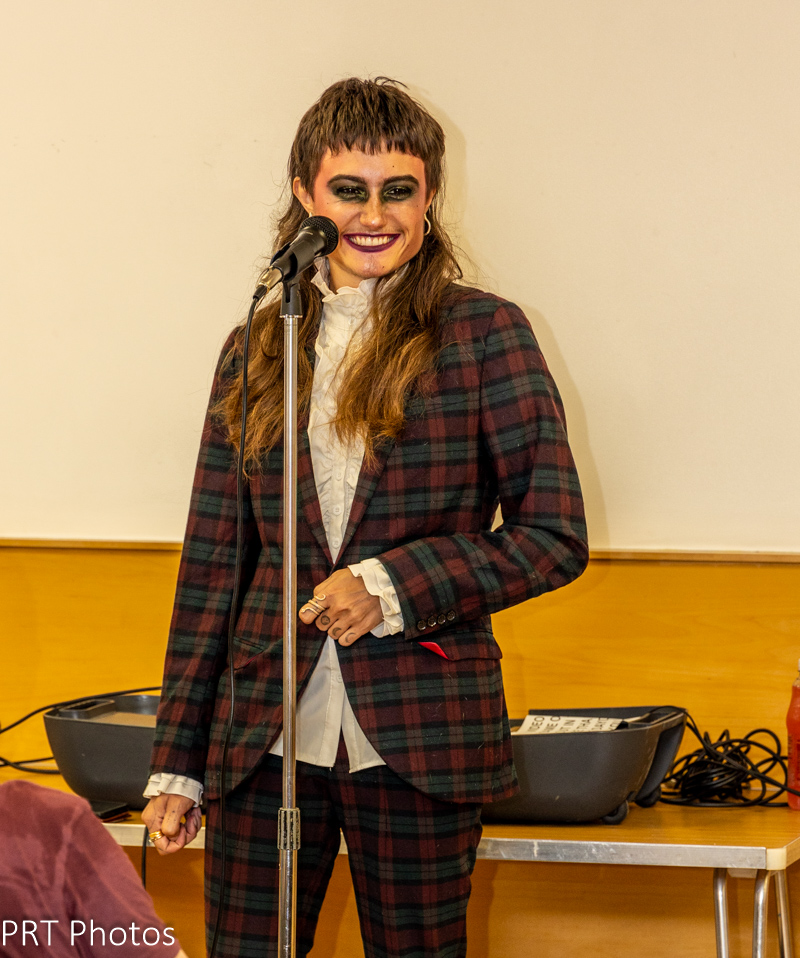
2.45pm – Frank n’ Flirter
3.10pm – Raffle
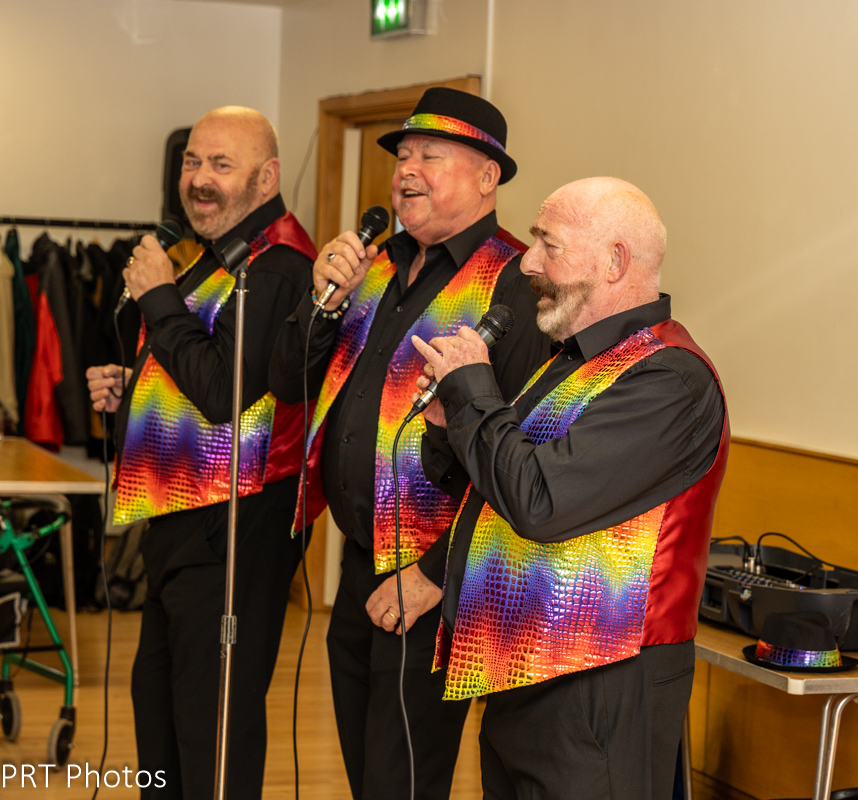
3.15pm – 4.00pm – Wolf
This is an event not to be missed – put the date in your diary now!!
The unsung activist who transformed LGBT+ rights in the UK
The history of LGBT+ rights in the United Kingdom is marked by the courageous efforts of individuals who dared to challenge the status quo.
Among these pioneers, one name stands out for its lasting impact on the legal and social landscape of the country: Allan Horsfall.
Working from Greater Manchester, he was a key figure in the campaign to decriminalise homosexuality in England. It could be argued that Allan Horsfall’s contributions laid the foundation for the modern LGBT+ rights movement. His life was defined by a relentless pursuit of equality, even when faced with significant personal and political risks.
Allan Horsfall (20 October 1927 – 27 August 2012)
Early life
Born in 1927 in the small Lancashire village of Laneshawbridge, near Colne, Allan Horsfall was raised by his grandparents in a traditional, conservative household. His early years were spent in the heart of rural England, on the edge of the Yorkshire Moors, far removed from the diverse cities where LGBT+ subcultures were beginning to take shape. This conservative upbringing, however, did not define Horsfall’s views.
Instead, it was his experiences during his service in the Royal Air Force (RAF) after World War II that began to shape his understanding of his own identity and the challenges faced by gay men in Britain.
During his three years in the RAF, Horsfall met other gay men, including his life partner, Harold Pollard (1908 – 1996), a primary school teacher. This relationship became a central part of Horsfall’s life, providing him with the emotional support needed to undertake the challenges ahead.
After leaving the RAF, Horsfall returned to Lancashire rather than seeking the anonymity of a city. He found work as a clerk for the National Coal Board, but his life in a small-town mining community was marked by the secretive and often repressive atmosphere surrounding homosexuality at the time. He later worked for the Salford education committee.
The Fight for Legal Reform
Horsfall’s political awakening came during the Suez Crisis in 1956, an event that radicalised many of his generation. He joined the Labour Party and soon became an active member, driven by a desire to address social injustices, including those faced by homosexuals. However, within the Labour Party, Horsfall encountered significant resistance. Many members believed that homosexuality was not an issue for the working class, reflecting the broader societal prejudice of the time.
Despite these challenges, Horsfall became involved with the London-based Homosexual Law Reform Society in 1958, a group dedicated to advocating for the implementation of the recommendations of the Wolfenden Report. Published in 1957, the report was a groundbreaking document that recommended the decriminalisation of homosexual acts between consenting adults in private. However, turning these recommendations into law was far from straightforward. Horsfall found himself increasingly frustrated with the London-centric focus of the Homosexual Law Reform Society and the lack of involvement from supporters outside the capital.
The North West Committee for Homosexual Law Reform
Undeterred, Horsfall took matters into his own hands. In 1964, he co-founded the North West Committee for Homosexual Law Reform, based out of his miner’s cottage in Atherton, Greater Manchester. They had their first public meeting in Church House, Manchester, on 7 October 1964.
Allan supported the Homosexual Law Reform Society (HLRS) from its inception in 1958, but was frustrated at the lack of involvement of supporters – never members – especially outside London. After several years spent overcoming deep reluctance within the London organisation, he got the blessing of General Secretary Antony Grey to start what was intended to be a compliant satellite, lobbying Northern MPs.
Allan’s decision to use his personal address and phone number, which in its time was an act of considerable bravery, was deliberate. There were several Labour MPs in industrial constituencies who opposed decriminalisation because ‘the miners would not stand for it.’ Allan Horsfall proved it was possible to run a Law Reform campaign from within a mining community without the sky falling in.
However, there was some personal cost in the reaction of the local gay community. He was shunned in the bars by people who feared he would bring the police down on them. His partner was warned that he should not be seen in public with Allan. They both ignored this.
This act of establishing the committee in a working-class, industrial area was both bold and dangerous. Horsfall used his own home address as the contact point for the organisation, a decision that exposed him and his partner to potential hostility and persecution. It was a move that demonstrated Horsfall’s deep commitment to the cause and his belief that gay men and lesbians should not have to conceal their identities to fight for their rights.
Decriminalisation and beyond
The North West Committee for Homosexual Law Reform, evolved into the Campaign for Homosexual Equality in 1971. At its height, CHE boasted over 130 local groups and more than 5,000 members. It was the most successful attempt in this country to create a mass-membership democratic LGBT organisation. If its legislative gains were small, it changed the lives of thousands of individuals through its groups, encouraging self-respect through “coming out”.
The tireless campaigning of Horsfall and others eventually bore fruit with the passing of the Sexual Offences Act in 1967, which decriminalised homosexual acts between consenting adults in private.
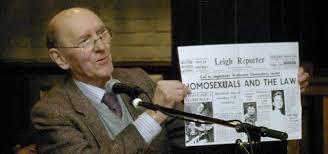
Allan Horsfall
This legal reform was a watershed moment in British history, but Horsfall understood that changing the law was just the beginning. The stigma and social prejudices that surrounded homosexuality were deeply entrenched, and much work remained to be done to achieve true equality.
Following the legal victory, Horsfall played a pivotal role in transforming the North West Committee for Homosexual Law Reform into the Campaign for Homosexual Equality (CHE) in 1971. Under Allan Horsfall’s leadership, CHE not only advocated for further legal reforms but also focused on building a sense of community and solidarity among LGBT individuals across the country.
Esquire Clubs
One of Horsfall’s most innovative ideas was the creation of Esquire Clubs, social spaces modelled on working men’s clubs that would provide LGBT+ individuals with a safe environment for socialising and cultural activities.
These clubs were envisioned as member-owned spaces that could foster a sense of belonging and self-respect. However, the social climate of the time made this vision difficult to realise. Many feared that joining such a club would effectively “out” them, and in several locations, local authorities refused to grant licences. Despite these setbacks, the idea of Esquire Clubs highlighted Horsfall’s understanding of the need for both legal and social change.
Legacy and Later Years
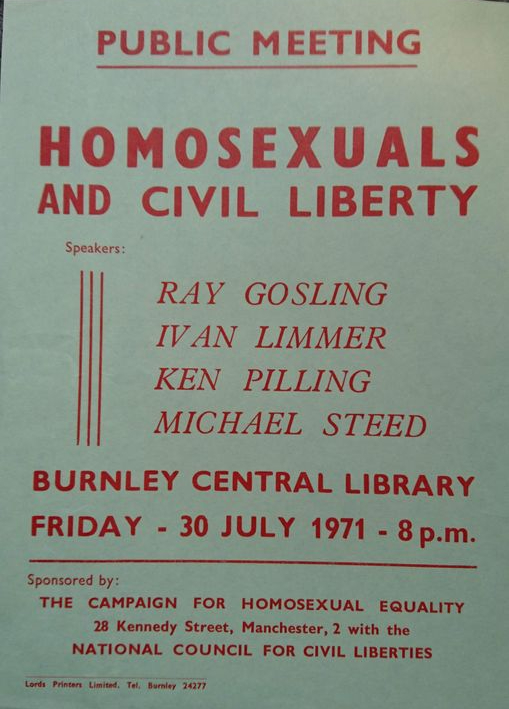
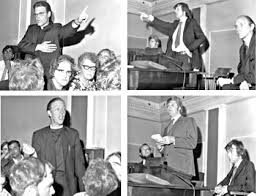
In Burnley in 1971, CHE, at Horsfall’s instigation set up a public meeting to confront the Christian alliance that opposed a local club. In a packed and heated gathering Allan invited all the homosexuals present to stand up. Over a hundred did so; it was one of the first mass coming-out demonstrations in the UK, certainly the first outside London. The skinheads who lined the wall (whom the police had deprived of their bovver boots and umbrellas as they arrived) were cowed. It was a symbolic coming-of-age moment.
Flyer for the landmark Burnley meeting 30 July 1971. Reproduced courtesy of Michael Steed
The Burnley Library meeting: top left Fr Neville (Roman Catholic); top right Ken Pilling, Ray Gosling, Allan Horsfall; bottom left Fr Cayton (Anglican); Bottom right Michael Steed, Ken Pilling, Ray Gosling
As the 1970s progressed, Horsfall’s health began to decline, following a severe heart attack in 1970. He gradually stepped back from the front lines of activism, though he remained involved in the movement.
In 1974, he was named President for Life of CHE, a testament to the respect and admiration he had earned within the LGBT community.
Even as he took a less active role, Horsfall continued to influence the direction of the movement through his advice and guidance. In his later years, Horsfall remained a vocal advocate for LGBT+ rights and other social causes.
Campaign for Nuclear Disarmament
He was an active member of his local Campaign for Nuclear Disarmament (CND) group and regularly contributed letters to newspapers such as The Guardian, The Independent as well as local papers.
Those who knew him during this period describe him as a gentleman, a man of quiet dignity and unwavering principles.
Allan Horsfall’s life was marked by both personal and public challenges, but his contributions to the LGBT+ rights movement in Britain are immeasurable.
His decision to live openly as a gay man in a small, conservative community, his dedication to legal reform, and his efforts to build a national LGBT+ organisation have left a lasting legacy.
In 2000, Allan Horsfall received The Pink Paper Award for his services to the gay community and was honoured with other campaigners, in 2004, at a ceremony at Manchester Town Hall.
He was a man of integrity, courage, and vision – a warm-hearted, generous, and much-loved humanitarian – and humanist – Horsfall was remembered with admiration and affection by those who knew him.
When Allan Horsfall passed away in 2012 at the age of 84, the LGBT+ community lost one of its founding fathers, a true pioneer whose work helped to lay the foundations for the freedoms that LGBT+ individuals enjoy in Britain today.
His story serves as a reminder of the progress that has been made, and of the work that remains to be done.
Rainbow Lottery Super Draw!
Please support Out In The City by buying a Rainbow Lottery ticket or two (or more!)
With each Rainbow Lottery ticket, you are not just entering to win exciting prizes, you are also supporting our mission to support older LGBT+ people.
It’s a vital part of our fundraising as we receive 50p for every £1 spent and you have the chance to win cash prizes each week from £25 for three numbers up to a jackpot of £25,000 for six numbers – while helping us to achieve more for the LGBT+ communities over 50 years.
On Saturday, 31 August, we’re thrilled to introduce our £2,000 Summer Holiday Bonanza – our BIGGEST travel prize EVER! With a whopping £2,000 to spend on the holiday of your dreams, you can keep the summer going even longer – or take the cash and spend it your way!
Your regular weekly tickets already enter you into the draw to win this scorching summer prize – but did you know you can now top-up your tickets, just for the Super Draw week!? And just imagine what you could do with this huge prize …
However, the choice is yours. You can take the £2,000 cash alternative!
If you already have tickets then you’re in with a chance to win big – but don’t forget, you can top-up your tickets just for the week of the Super Draw!
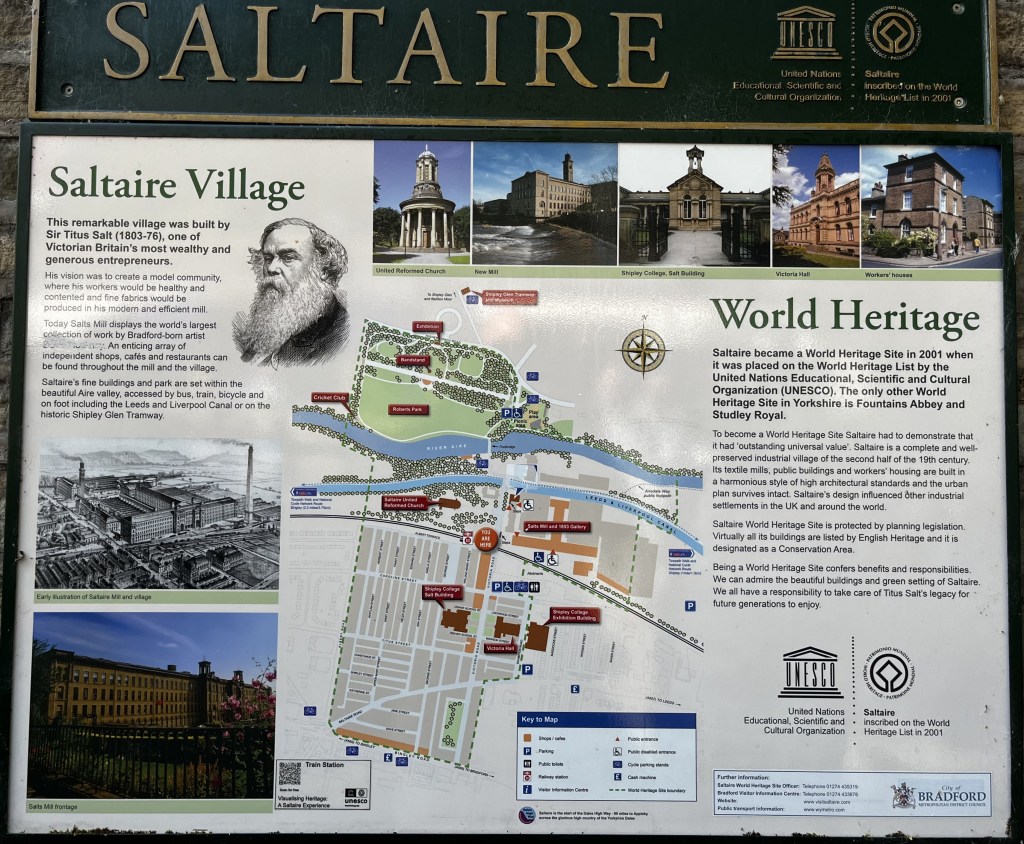
Saltaire is a Victorian model village near Shipley, West Yorkshire, situated between the River Aire, the railway and the Leeds and Liverpool Canal.
Saltaire takes its name from its founder, Sir Titus Salt, and the River Aire which runs through the village.
Salt’s Mill and the houses were built by Titus Salt between 1851 and 1871 to allow his workers to live in better conditions than the slums of Bradford. The mill ceased production in 1986, and was converted into a multifunctional location with an art gallery, restaurants and the headquarters of a technology company. It is a UNESCO World Heritage Site.
Salt built neat stone houses for his workers, washhouses with tap water, bathhouses, a hospital and an institute for recreation and education, with a library, a reading room, a concert hall, billiard room, science laboratory and a gymnasium. The village had a school for the children of the workers, almshouses, allotments, a park and a boathouse. Recreational initiatives were also encouraged such as the establishment of a drum and fife band for school age boys and a brass band.
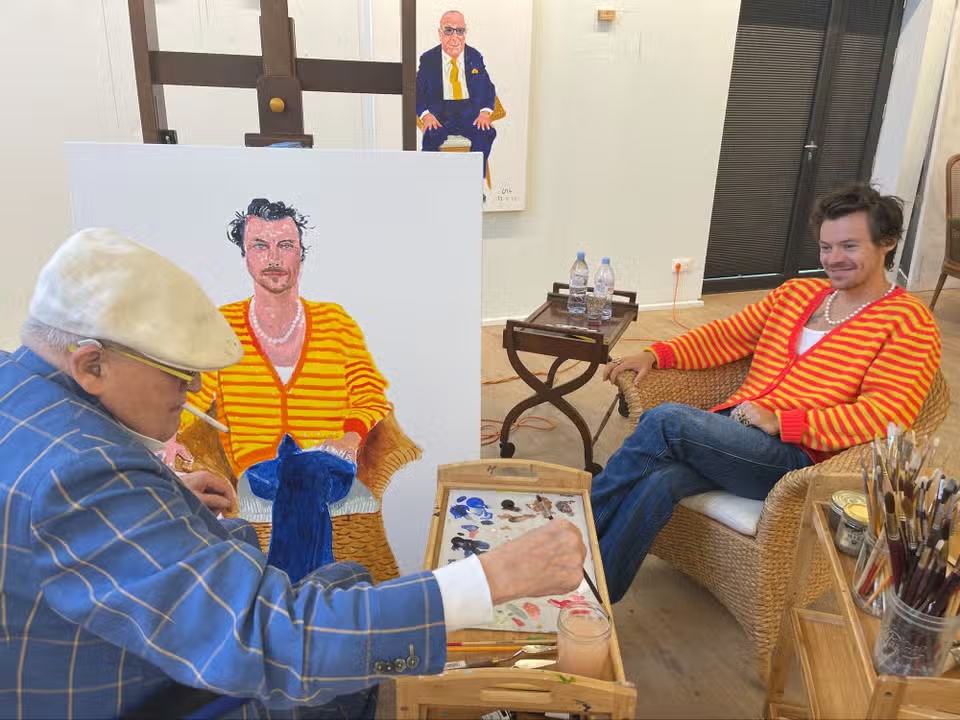
As you step inside Salt’s Mill, you are immediately greeted by its grandeur and architectural beauty. Salts Mill is home to one of the largest collections of David Hockney’s art.
There is so much to discover in Salt’s Mill and the village of Saltaire, but we just didn’t have the time to see everything.
David Hockney paints Harry Styles in his Normandy Studio, 1 June 2022Claire Mooney
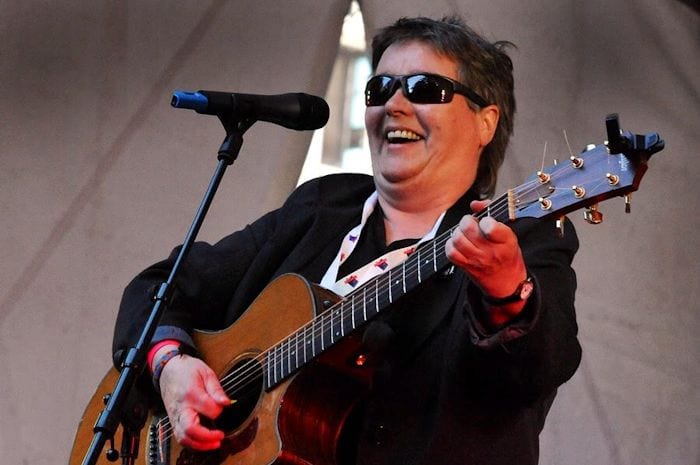
Claire Mooney
With sadness we have to inform you that Claire Mooney died on Monday, 12 August.
Her long and courageous battle against cancer ceased. Claire was a singer songwriter with numerous albums to her credit.
With Claire you expected lots of audience participation, community singing, audience dancing and lots of fun. She mixed the political with the playful and blended it altogether into a performance of serious fun. In September 2022 I attended “An Evening with Claire Mooney” in the Performance Space in Manchester Central Library. She soon had me up on stage! In October 2023 the radio station ALL fm 96.9 opened the Claire Mooney studio to recognise Claire as a presenter, musician, lesbian activist, humanitarian and role model for us all.
She touched many of our lives.
Kenneth Felts who Came Out at 90 Celebrates First Wedding Anniversary with Husband
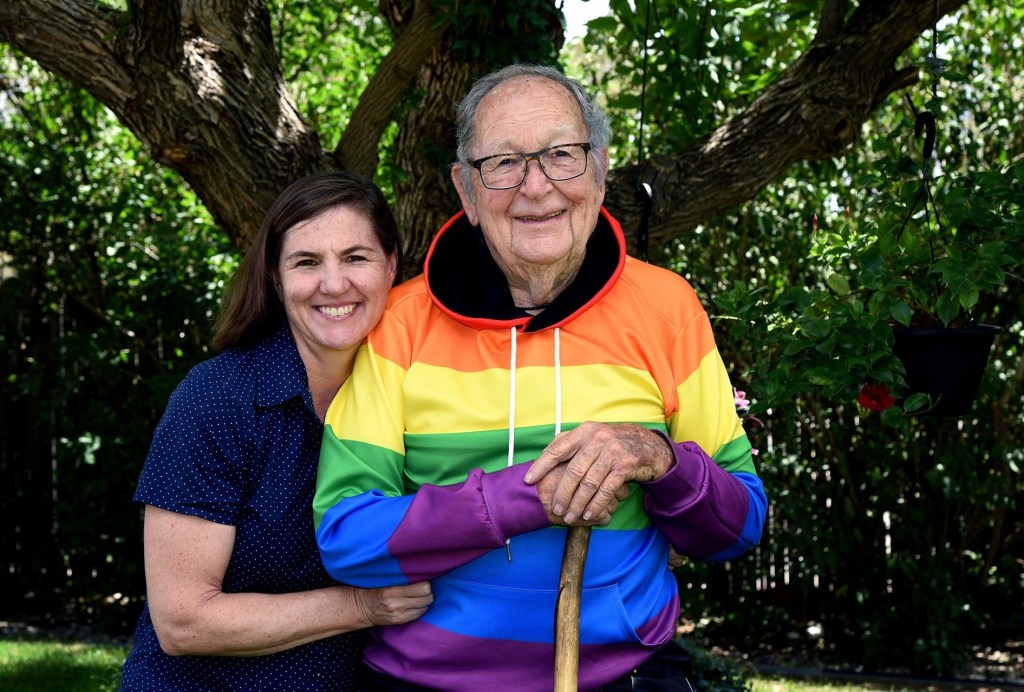
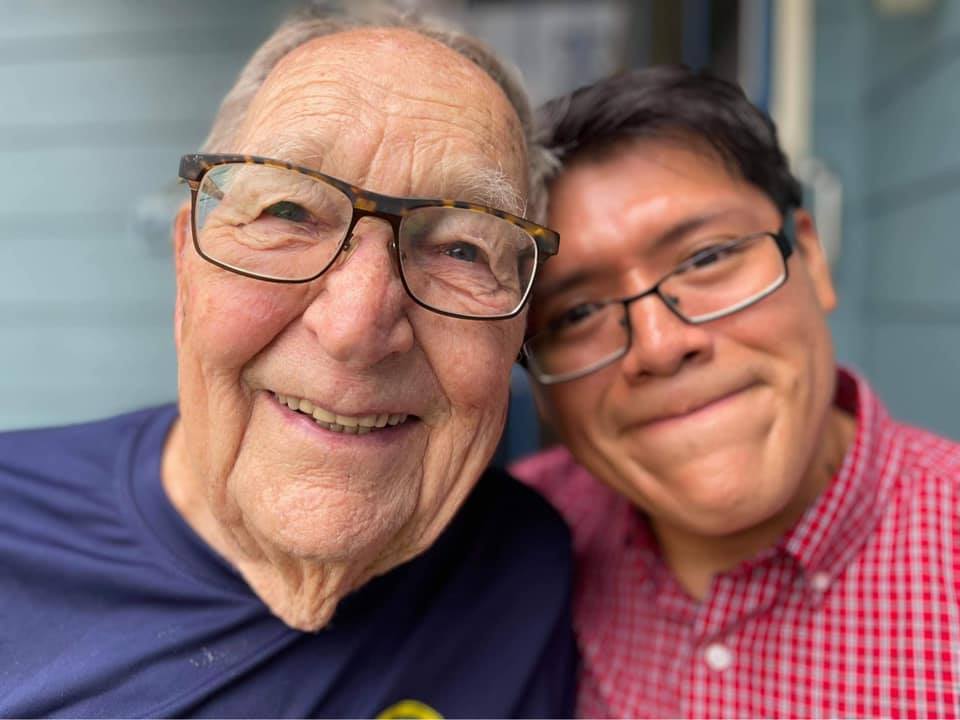
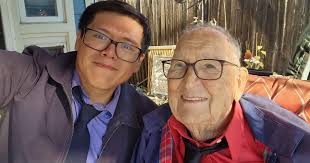
From left: Johnny Hau and Kenneth Felts. Photo courtesy: Kenneth W Felts
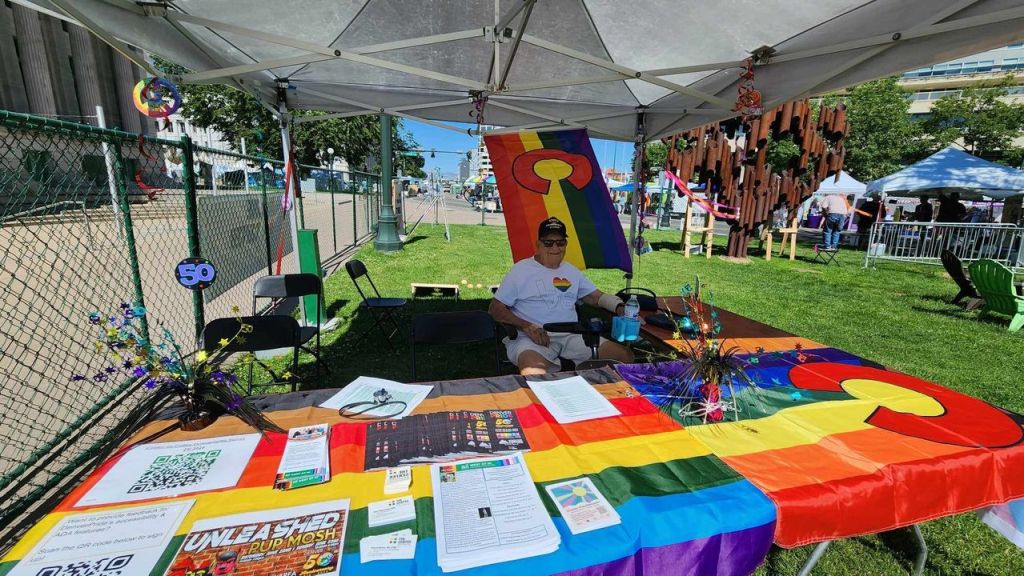
Kenneth Felts, now 94, and Johnny Hau found each other after Kenneth’s “coming out” story went viral. They are celebrating their first wedding anniversary.
“After meeting Johnny, everything has just bloomed,” Kenneth Felts, who announced he was gay in 2020, when he was 90 years old, said. “The freedom I have to speak out, go around, things like that – I’m a new person. I’m a different person.”
For their anniversary on Monday, 8 July, the couple had a “wonderful” time attending a local drag show at Hamburger Mary’s, according to Felts (who said he also got a lap dance from his husband onstage).
The previous day, they also celebrated with his daughter, Rebecca Mayes, and her family at their usual Sunday lunch.
“We gave them a gift card to go out to dinner together and got them an ice cream cake that we all had a slice of,” says Mayes.
From left: Johnny Hau and Kenneth Felts. Photo courtesy: Kenneth W Felts
For Felts, saying yes to spending the rest of his life with Johnny Hau, 35, was a journey that took decades.
In 2019, the retiree and Korean War veteran was diagnosed with Hodgkin’s lymphoma. He underwent chemotherapy and by 2020, due to the COVID-19 pandemic, he was forced to endure his sickness while isolated at his Arvada home.
Felts said that during this time, a friend convinced him to write a memoir. He started and got to a point where he mentioned his first love, Philip Jones.
During a visit one day, his daughter, who came out to her father as a lesbian after she graduated college, asked why he was crying. He replied, “Because I should never have left Philip.”
“I outed myself to my daughter,” he recalls now. “I had never intended to out myself to anybody, but I outed it to her … She took it very well. So I decided to put it on the net, on my Facebook, and instead of doing it to my friends, I did it to the public unknowingly.”
Soon, his story was being told across the globe, and one of the people who first heard about it was Hau.
“It took a lot of courage for him to come out, and I wasn’t really fully out also,” Hau, who works in I T, said. “I just felt like I wanted to talk to someone about this.”
So Hau reached out and the pair set up a blind date.
“We met on a Friday evening, and we had our masks on, of course, because of COVID,” Felts says. “We went up to the salad course, and then we were able to unmask. We talked, and I liked what I saw and I liked what I heard.”
Despite the decades-wide age difference, Hau says he felt “connected” to Felts. He said that it was a “real battle to be at peace” with his affinity for older partners, but the moment he met Felts, he found the two had a lot in common.
One of those commonalities was their faith.
“I was raised Catholic and a lot of this idea of how to not commit sin and stuff like that and that was really bothering me,” Hau says. “I saw that similarity with his story about him finding guilt when he was trying to be happy with Philip, and that really connected with me.”
The two would stay up talking the night they met and ultimately, as their relationship grew, Hau began to visit each weekend and on Tuesdays.
Then on 8 July 2023, the two shared a small backyard wedding. “It was a real close family affair there, and it was just a wonderful feeling, and especially to know that Johnny was going to be mine forever,” Felts says.
Now in remission, Felts said that, outside of his first marriage and Mayes’s birth, the last four years have probably been the best in his life.
Kenneth Felts. Photo courtesy: Kenneth W Felts
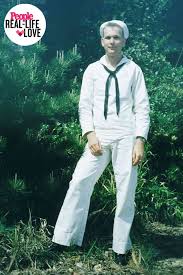
Born in Kansas in 1930, Felts says that he was raised in a “rather fundamental Christian family.” He completed two years of college and joined the Navy, serving in the Korean War from 1950 to 1954. He then graduated from college and started work as an insurance investigator in California.
Although he identified as straight at the time, he remembers that “one of the guys in the group came over to my desk” to help him with his forms. That man was Philip, and the pair started “meeting for coffee” and then it “wasn’t long before we were dating.”
The two kept their relationship a secret but grew closer, eventually living together. “Sitting in church one day, he was in the choir singing, and I was in the pews, and I was bombarded with guilt,” Felts says. “This basic Christian indoctrination that I’d had all my life really kicked in.”
He acknowledges that he ended things with Philip by “ghosting,” and he left California and moved back to Dodge City, in Kansas. Hiding his true identity, Felts got married in 1962 and become a father 10 years later. But he and his wife divorced in 1980.
Kenneth Felts. Photo courtesy: Kenneth W Felts
“I started looking for Philip again,” he says. He used the phone book and called every Philip Jones he could find, but was never able to track him down.
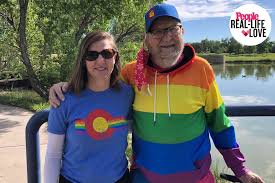
When Felts came out to his daughter – who lives a mile away from him – Mayes, a married mother of two, felt overwhelmed with “compassion”.
Mayes has always had a close relationship with Felts, who raised her from about the age of 11, and admits she wasn’t totally surprised by his admission.
Finally living his life freely, Felts published his memoir, My Handful of Stars: Coming Out at Age 90, in 2022 and enjoys creating art using organic and recycled materials – some of which has been on display at the Denver Art Museum.
From left: Rebecca Mayes and Kenneth Felts. Photo courtesy: Kenneth W Felts
Meanwhile, Mayes says that the family has lunch together at least once a week with her son, who is in college, and often joins them.
Felts says he’s living his life as if age “did not matter.”
“I just enjoy every day now knowing that Johnny is here and my family is here, and we get together,” he says. “I’m an old man, but I’m very happy to be an old man with all my support around me.”
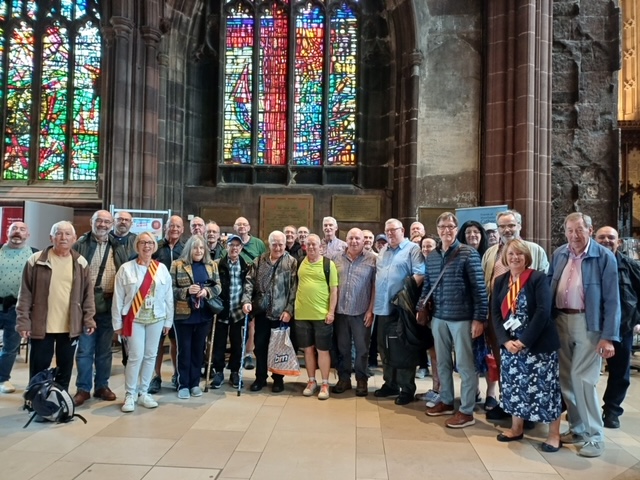
Manchester Cathedral, formally the Cathedral and Collegiate Church of St Mary, St Denys and St George is the seat of the Bishop of Manchester and the city’s parish church. It is on Victoria Street in Manchester city centre and is a Grade I listed building.
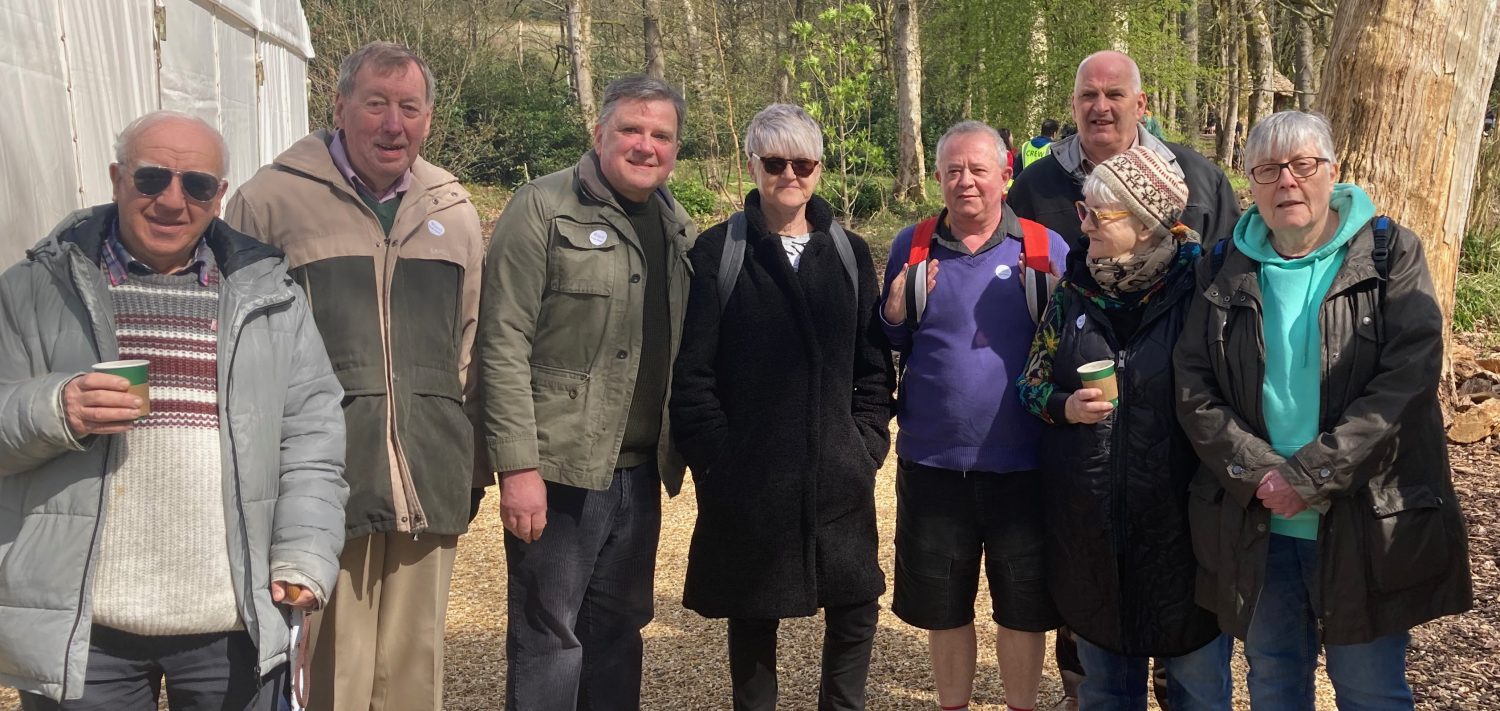
We visited the Cathedral last week and split into three groups, each with a very knowledgeable guide, who for one hour informed us about the history of the building.
It was a very interesting trip and some great photos can be seen here.
Free LGBT+ Manchester Walking Tours
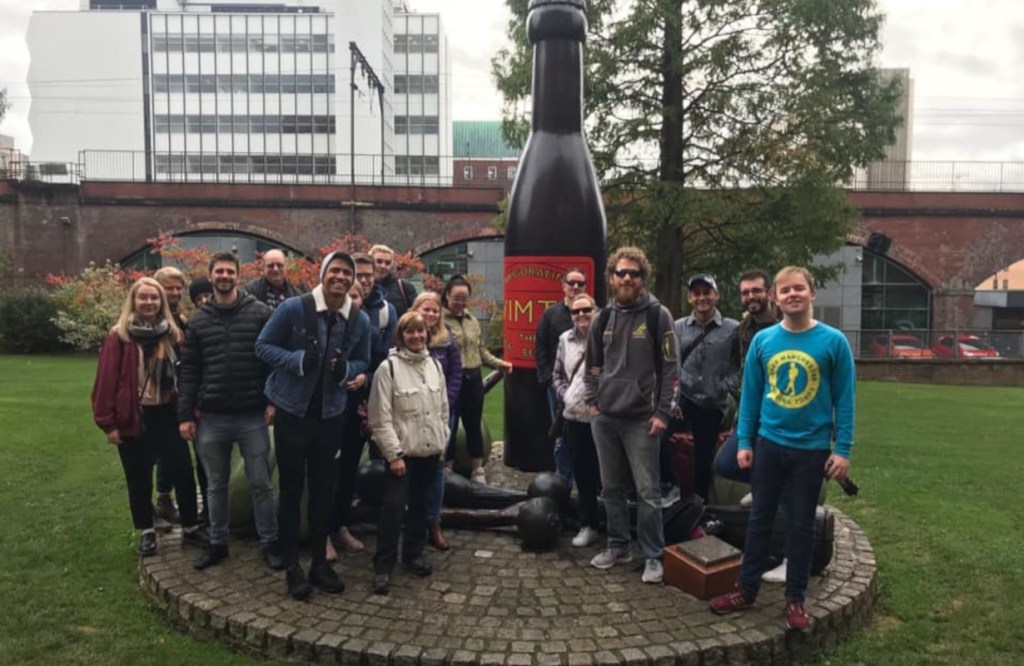
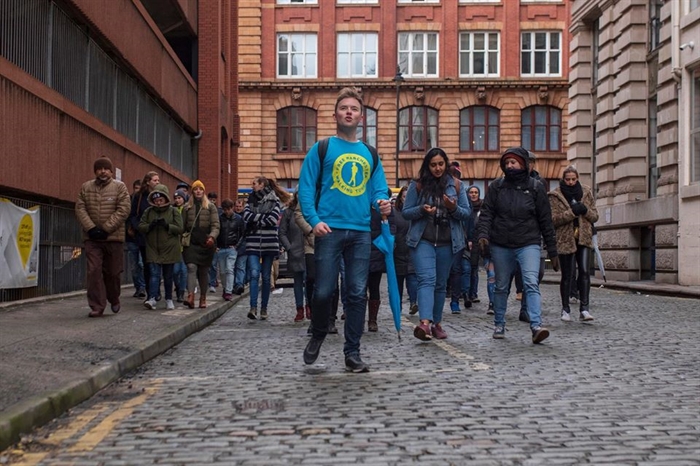
Explore Manchester’s world-famous Gay Village on Josh’s LGBT+ Manchester Walking Tour. It’s a journey through the iconic monuments, touching memorials, secret street art and legendary pubs to answer the question: How did Manchester become so bloody Queer?
Meeting point: Vimto Monument, Sackville Street, Manchester M1 3BU
Access info: The route is fully wheelchair accessible, and at the end there is an accessible toilet. Note, this is the only accessible toilet stop, as many of the venues along the route don’t have accessible toilets. This event is a sober space. There is no seating available (though there is often seating along the route.)
If you’d like to join one of these tours, simply email josh@fmwt.co.uk with the date you would like to come and mentioning Out In The City. Group sizes are capped at 35.
Pride in Ageing – Garden Party
On Saturday, 24 August we have the Manchester Pride Parade.
But on Sunday, 25 August there will be the Pride in Ageing – Garden Party. Come and relax in our urban oasis at the front of the Manchester Art Gallery, Mosley Street, Manchester M2 3JL.
12.00pm – Join volunteer gardeners as they tend the garden that they designed and created. There will be sketching materials available and a relaxing and energising programme of live music from Holly Marland and Teresa Lipinski who will share songs from around the world accompanied by Kora, a traditional West African harp.
12.15pm – Workshop for people who may not even believe they can sing! – Free – No ticket required
No previous experience required – just come along to the gallery atrium and enjoy learning simple harmony songs for enjoyment and wellbeing.
1.00pm – 3.00pm – Let’s Talk about Chemsex Listening Party – Free but book via Eventbrite here.
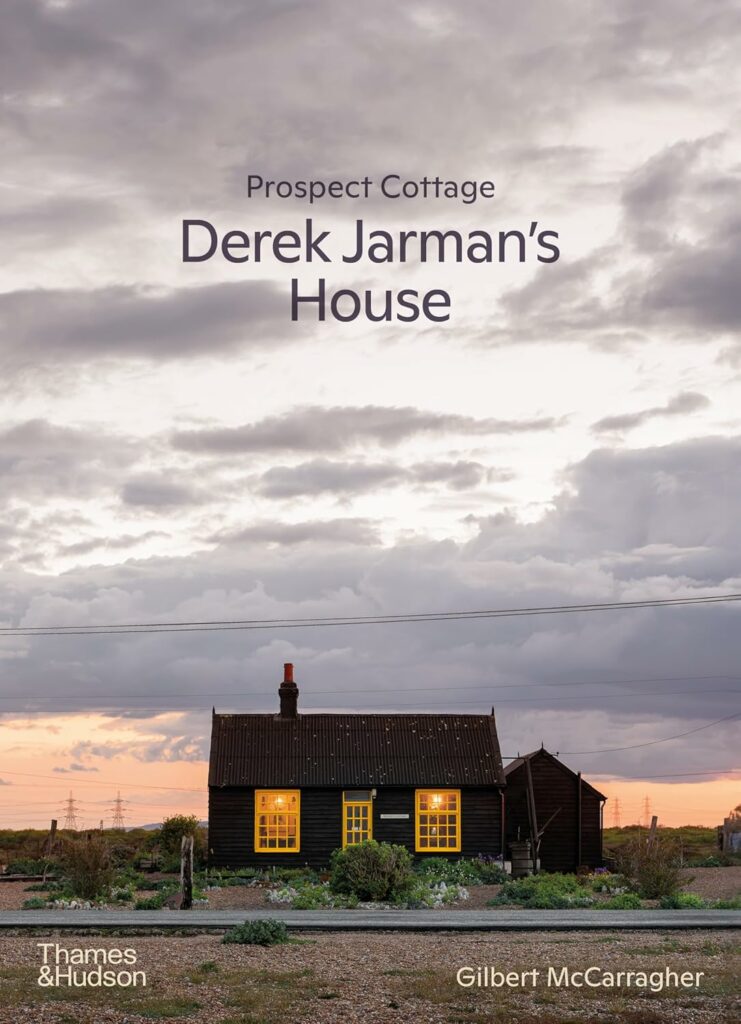
2.00pm – 3.30pm – Prospect Cottage: Derek Jarman’s House in-conversation – Free but book via Eventbrite here.
No Winter Fuel Payments for most pensioners
It seems strange to be writing about winter fuel payments in the summer when it will be 27 degrees (Celsius) today.
However the announcement on Monday 29 July 2024 by the new Chancellor of The Exchequer affects 12.6 million pensioners across the UK, the majority of these will no longer receive the winter fuel payments as of this year.
These payments are usually between £100 and £300 per household and are tax-free.
The only exception is people who receive pension credit. They will continue to receive the winter fuel payment and are also entitled to a warm home discount of £140, which is paid directly to the energy supplier.
There are 1.4 million older people receiving pension credit, however 800,000 older people who are entitled to pension credit do not claim it. 70,000 people in Greater Manchester currently claim pension credit and it is estimated that around 36,000 people do not currently claim pension credit.
Pension Credit is a form of financial support which ‘tops-up’ the income of people over State Pension age who fall below an income threshold of £218.15 for a single person and £332.95 for a couple.
Many of those eligible could also unlock additional benefits worth thousands a year such as the Warm Home Discount, a free TV licence, Council Tax Reduction and free NHS dental treatment.
Around 10.2 million pensioners will no longer receive the winter fuel payments. Age UK have estimated that this will push around 2 million pensioners into being cold this coming winter.
If you or an older relative could be entitled to pension credit then please check out one of the links below, which offer the alternatives of phoning or checking online. You will need the relevant details of what you or the person you are helping currently receives in income.
Good luck as this will affect many people you know, around one in six of all people in the UK now receive pensions.
Charities are warning the move risks putting more older people’s lives at risk this winter and are calling on the government to find ways to mitigate the damage.
Twenty-two charities have sent an open letter to the Chancellor, Rachel Reeves, calling on her to urgently review the change to the Winter Fuel Payment for older people.
If you want to voice your concerns about the proposals, we can suggest the following options:













 Out in the City