Age Without Limits Day … Walk a Day in our Shoes … Salford Pink Picnic … Bury LGBTQI+ History Walk … Straight Pride … David Hockney

News

Ageing Without Limits Day

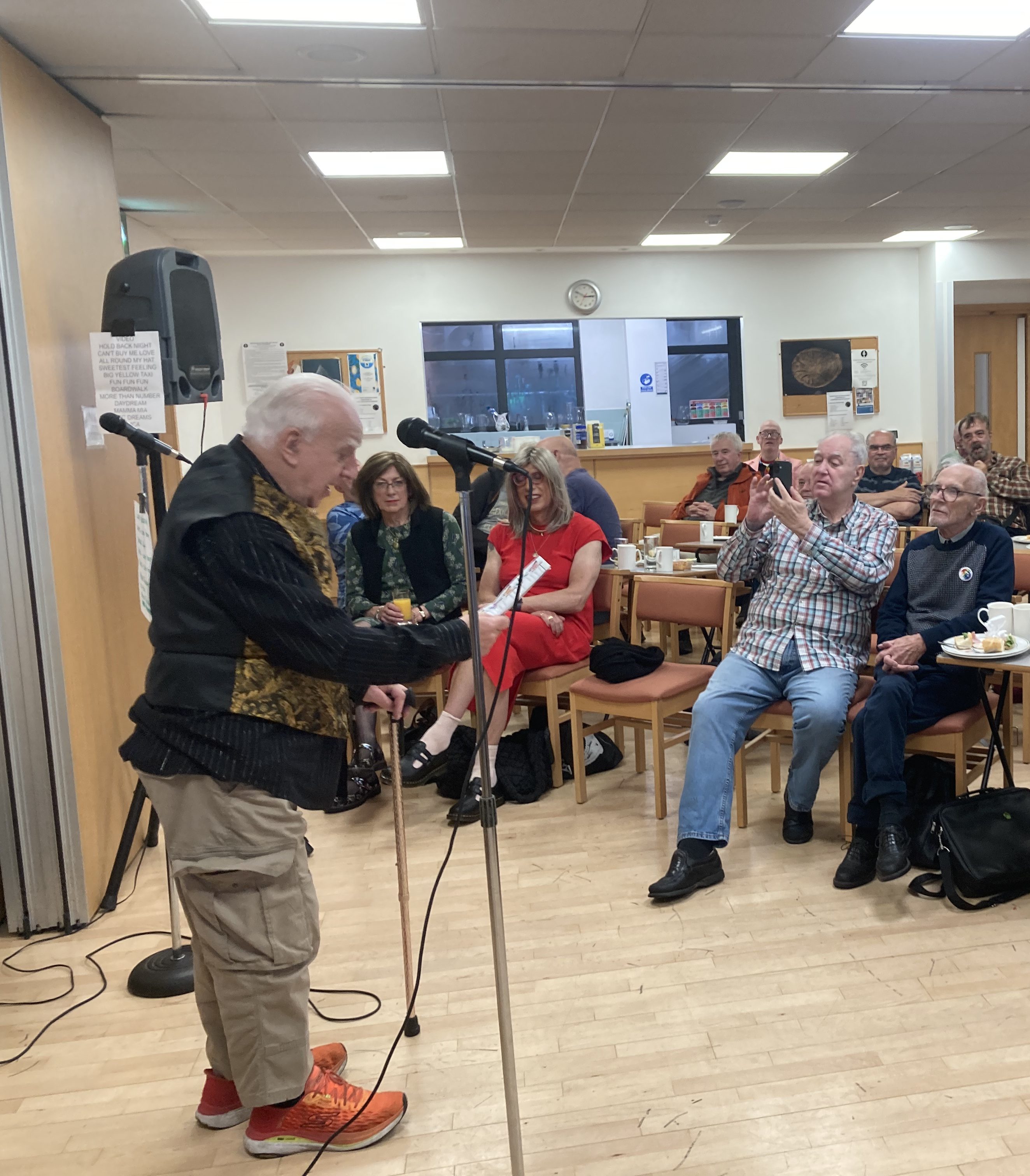
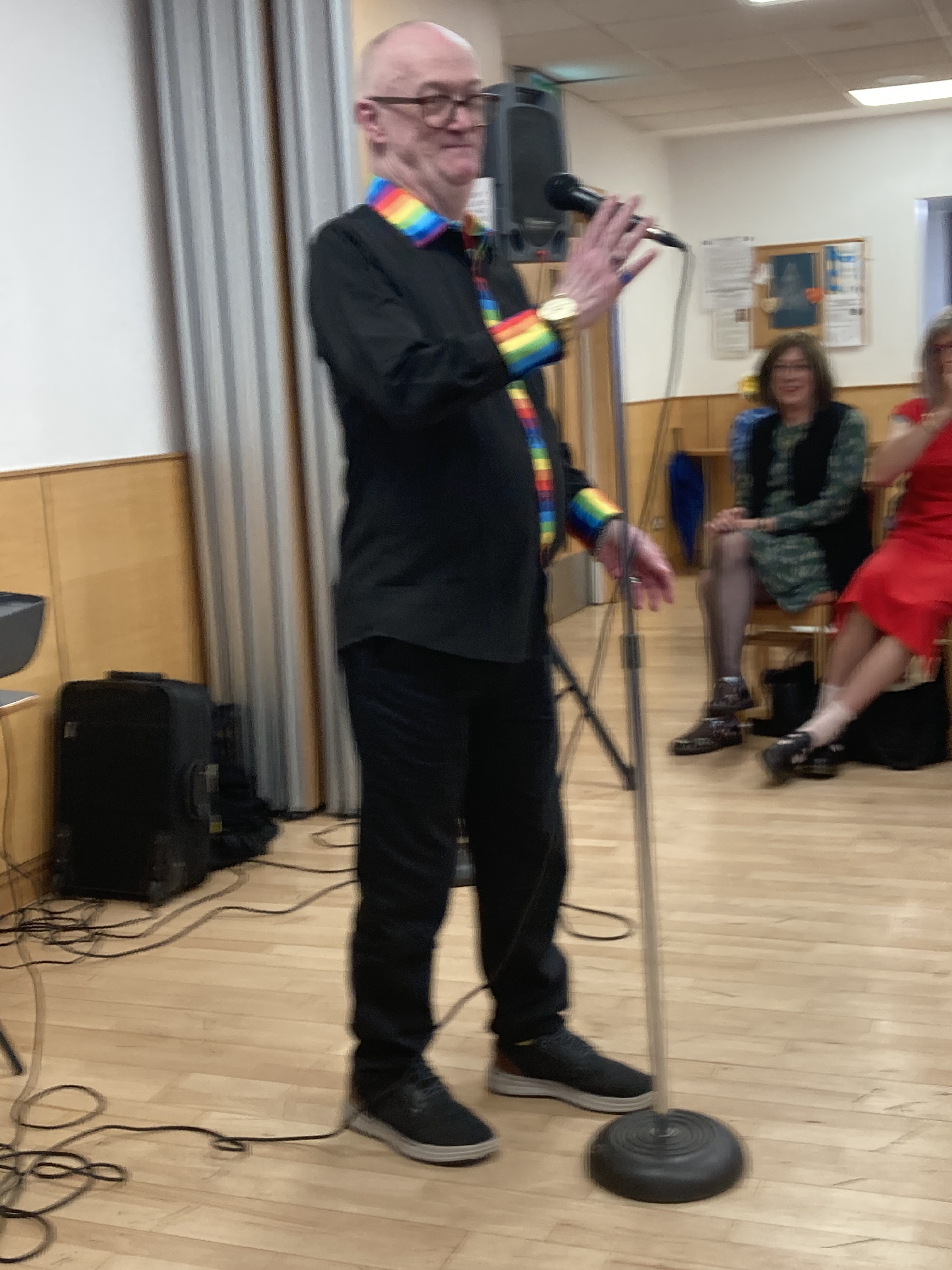
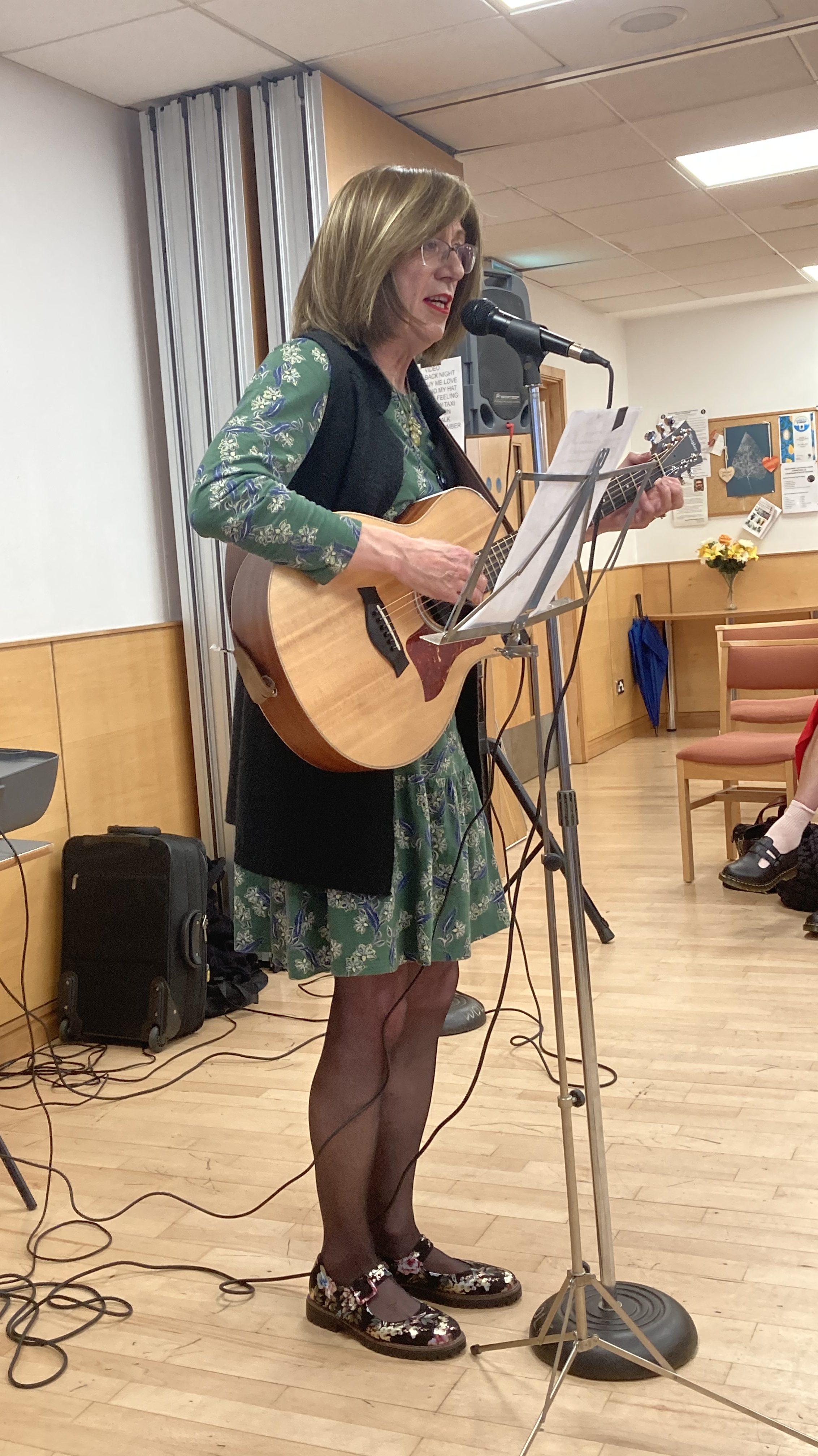
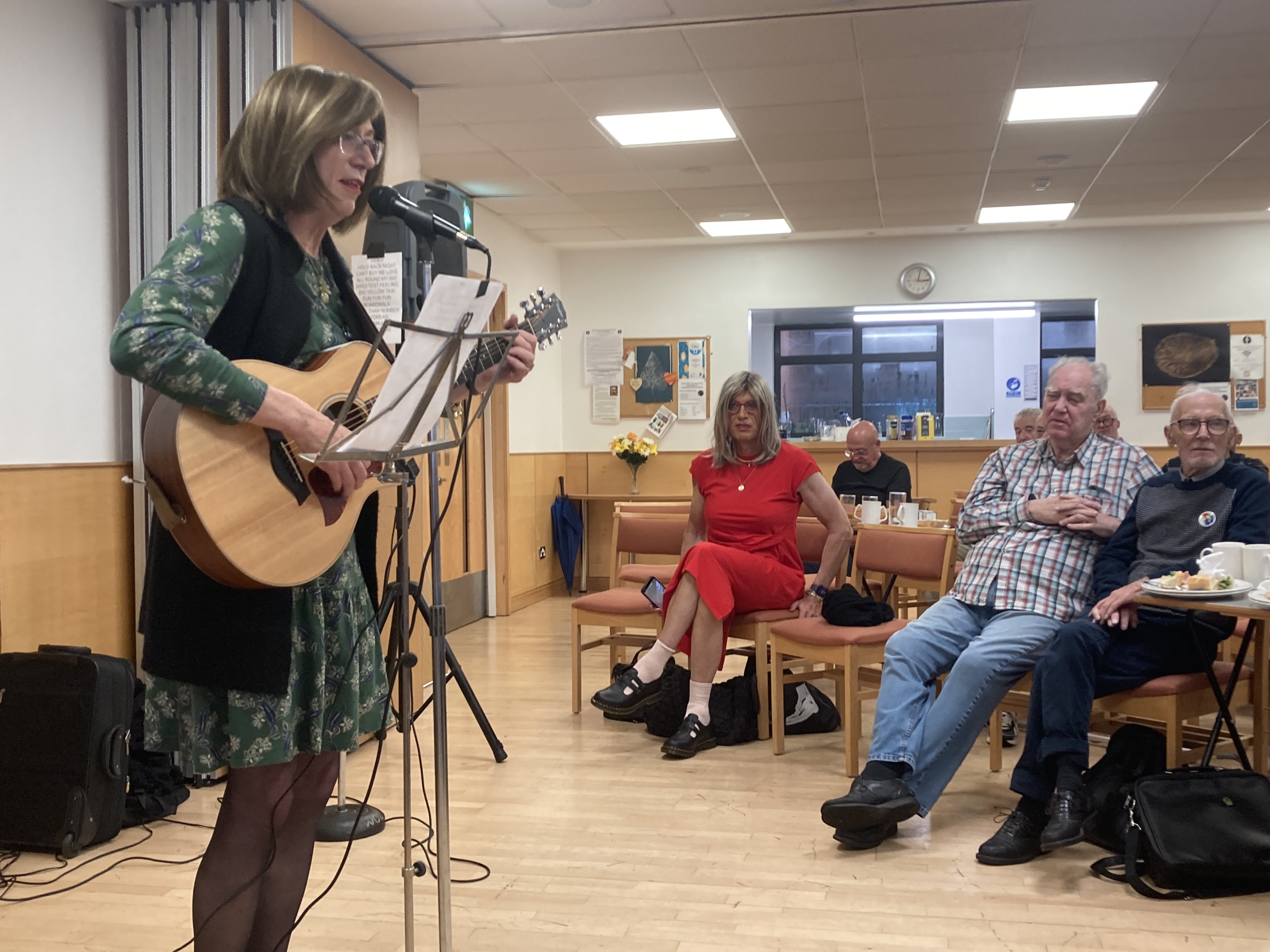
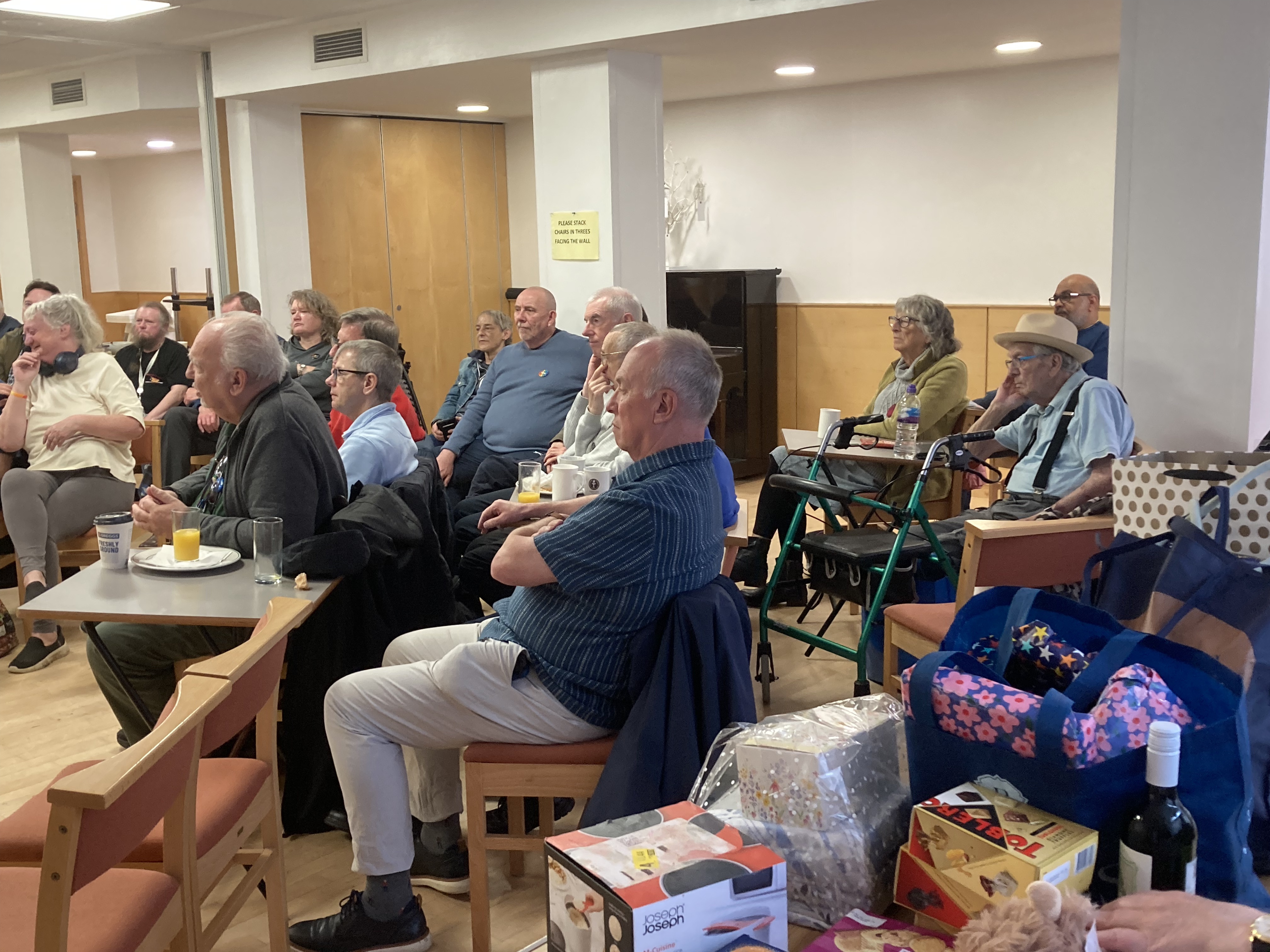
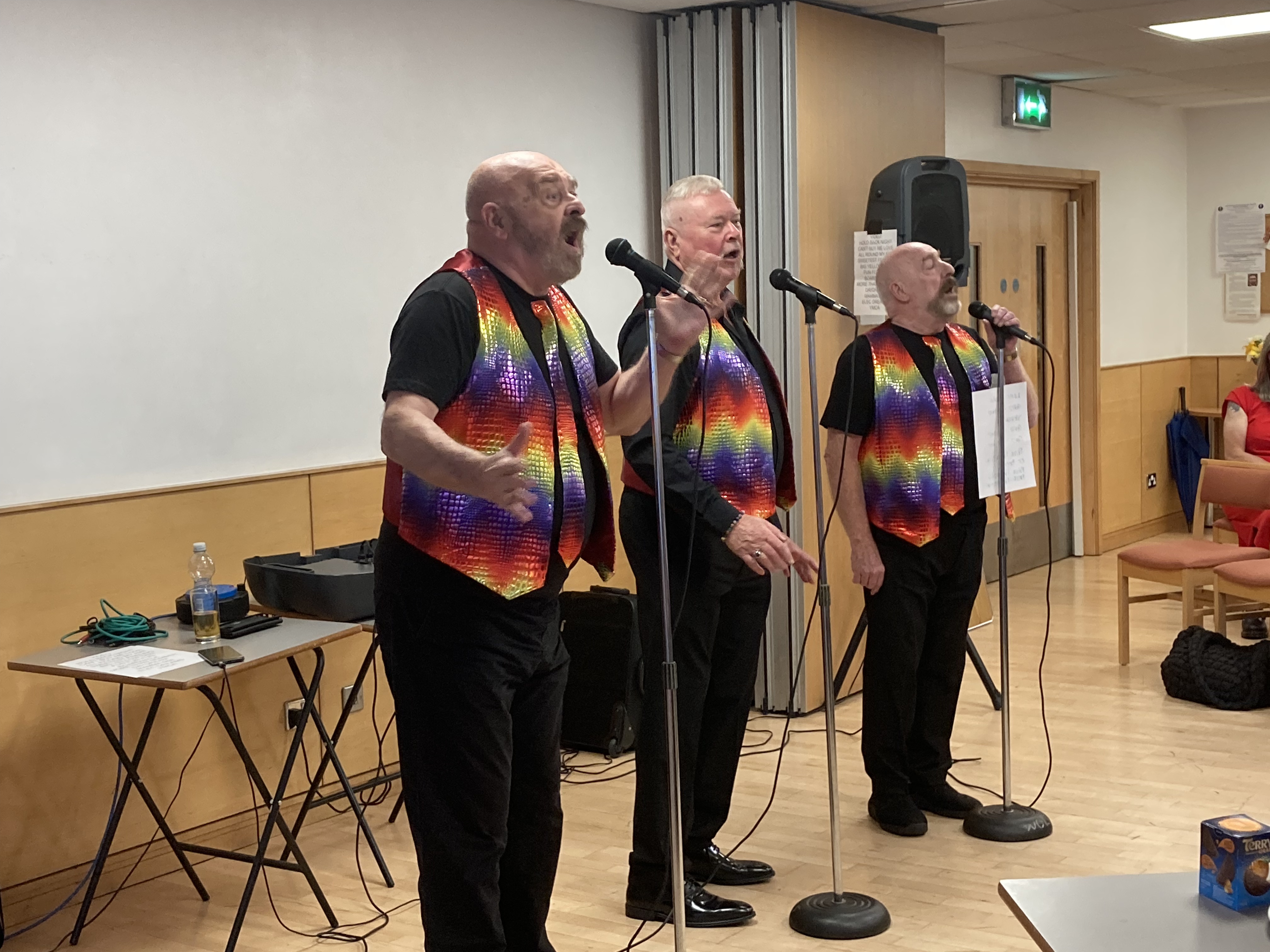
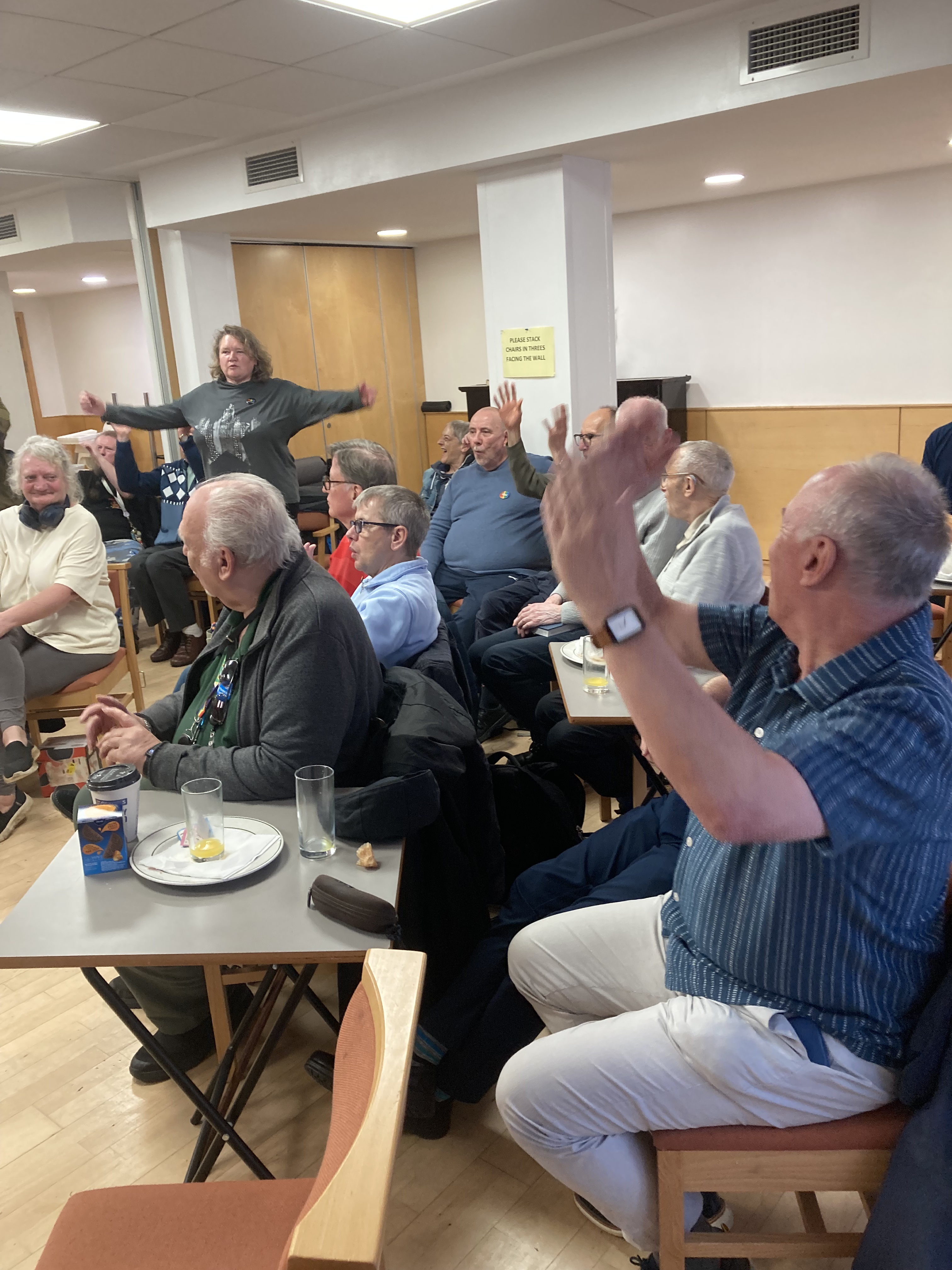
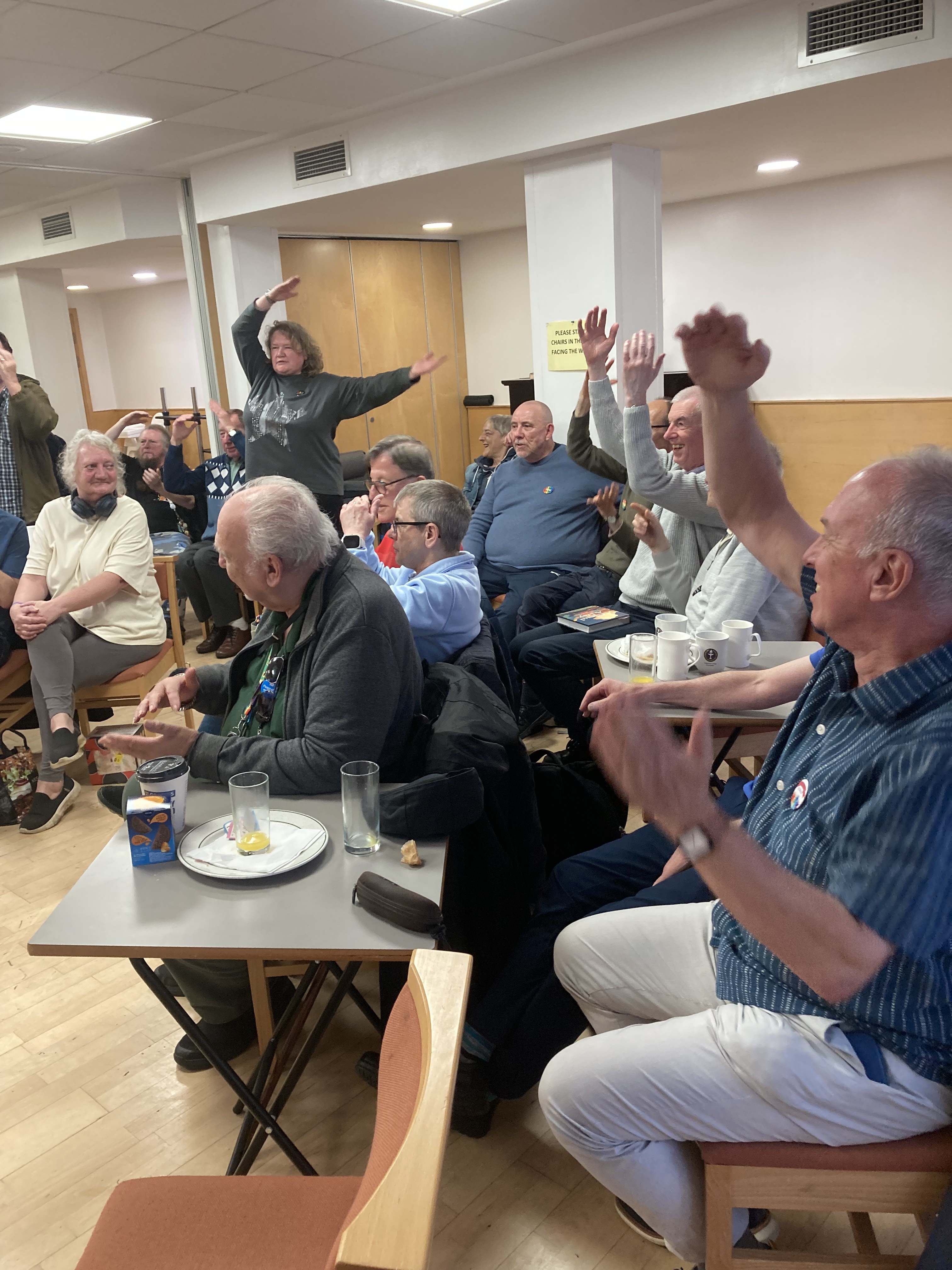
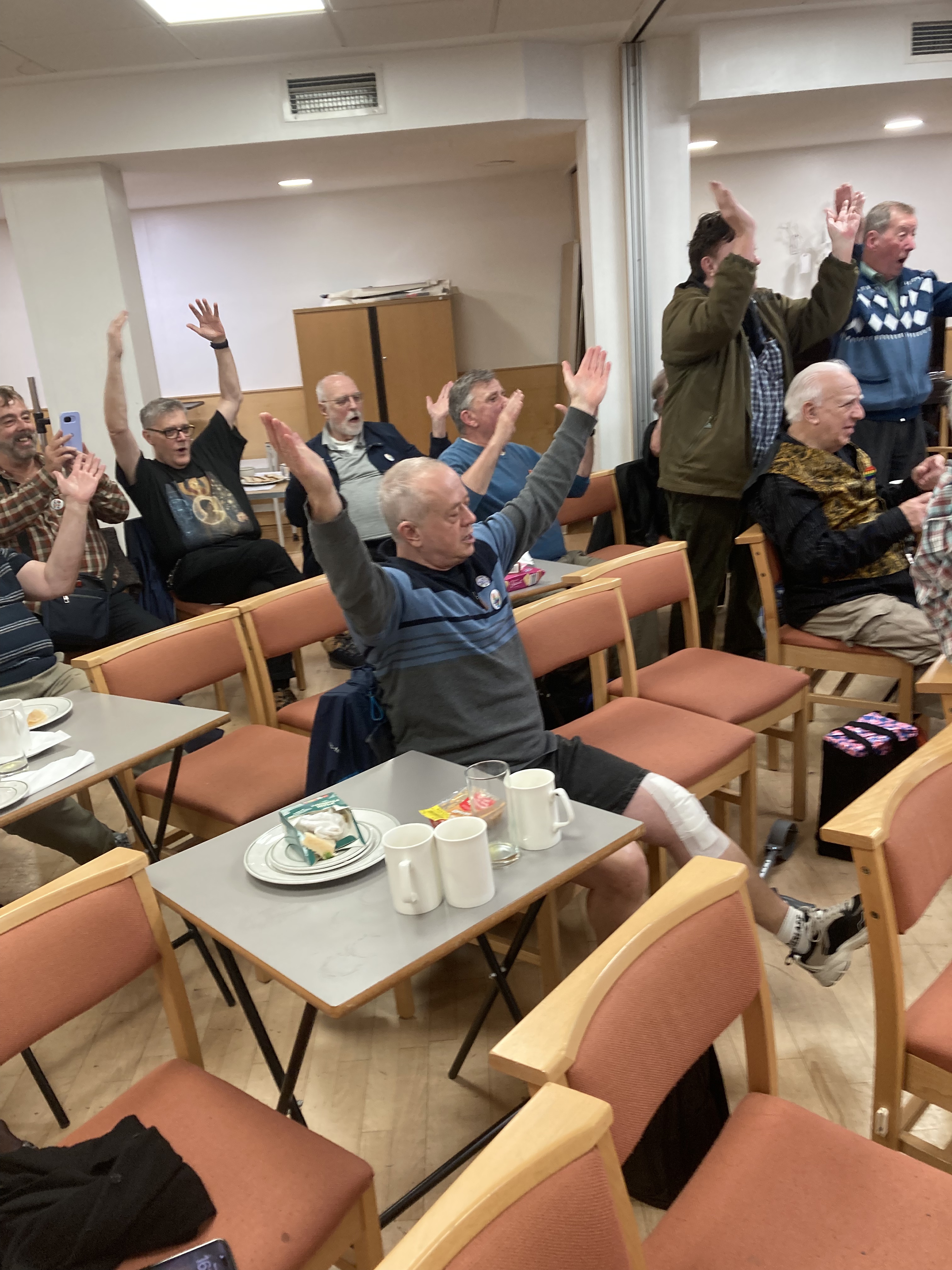
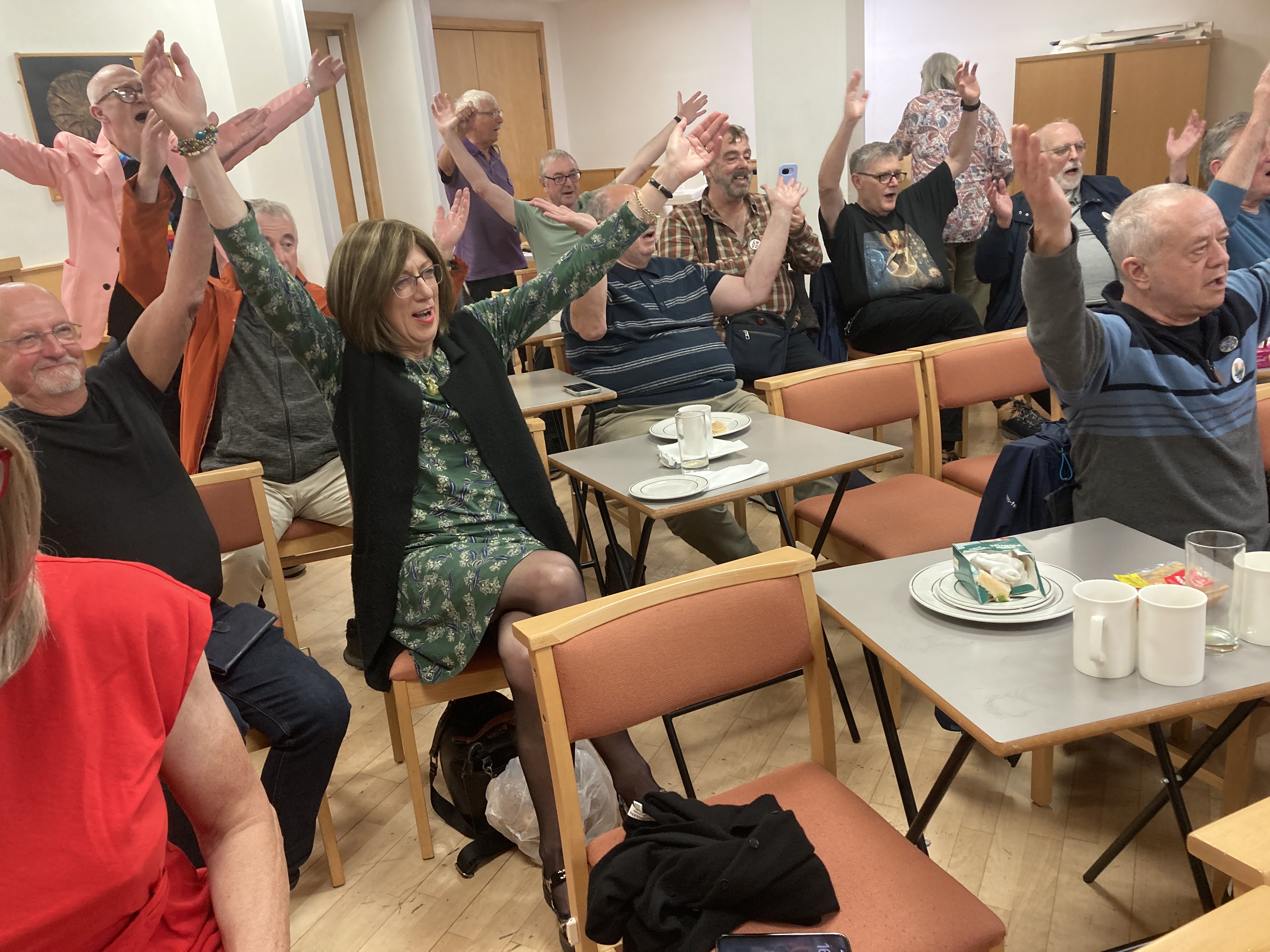
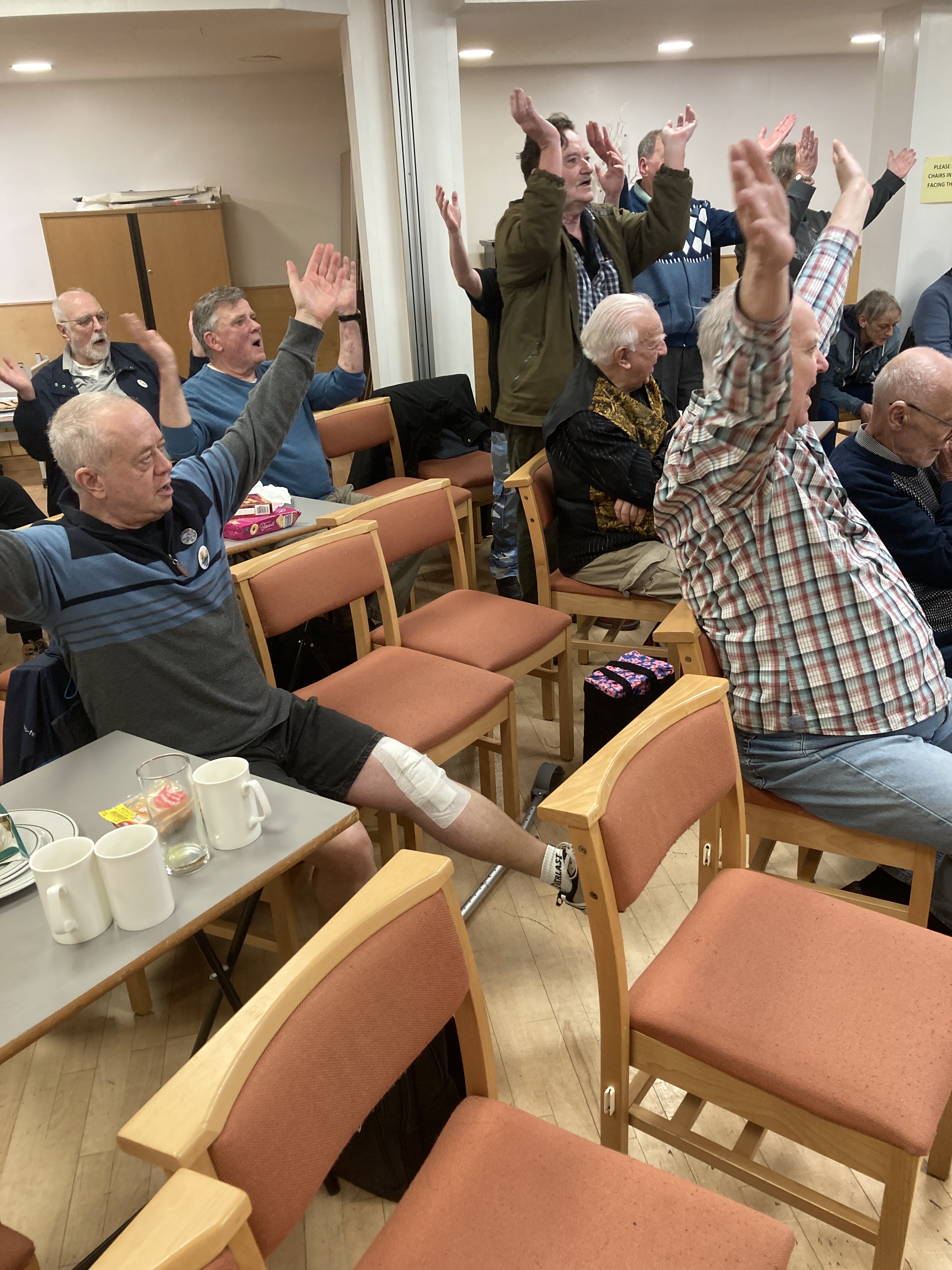
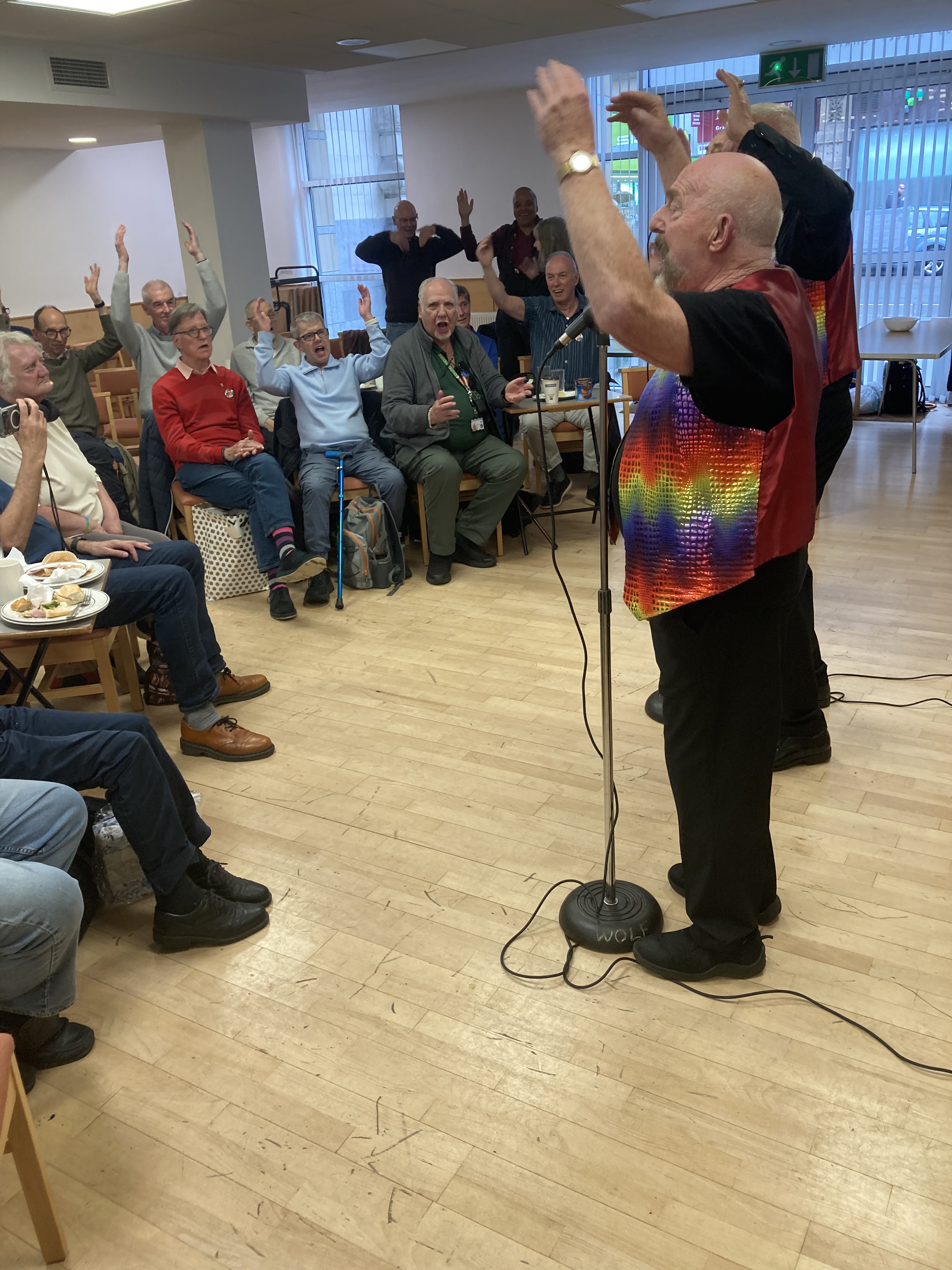
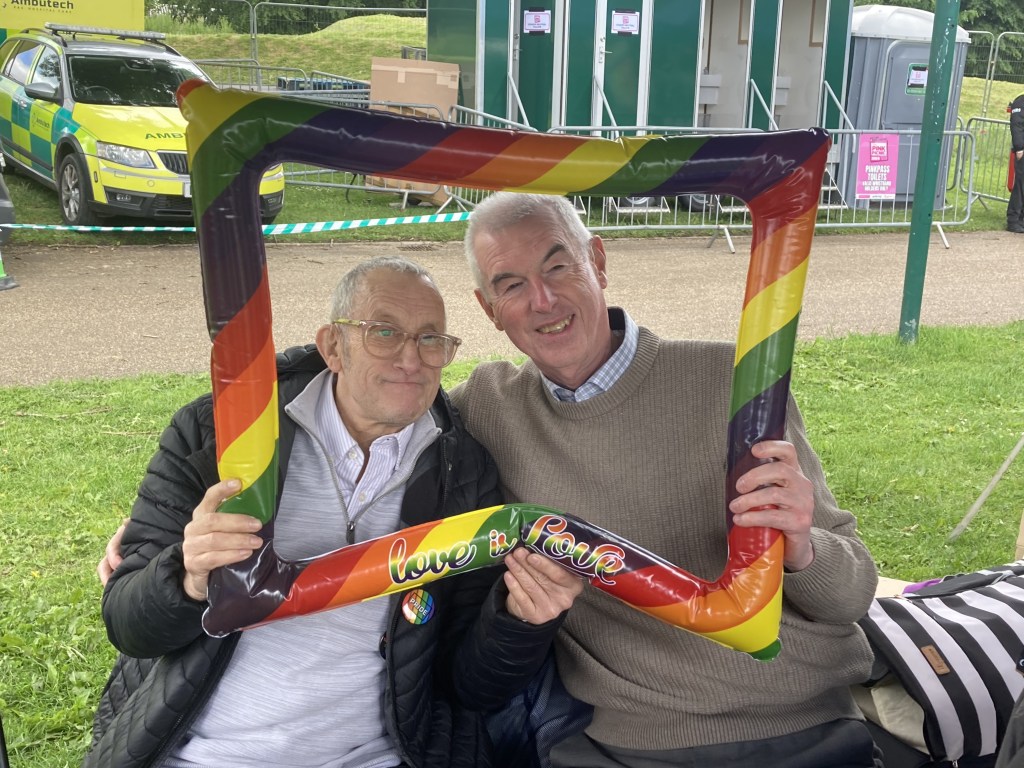
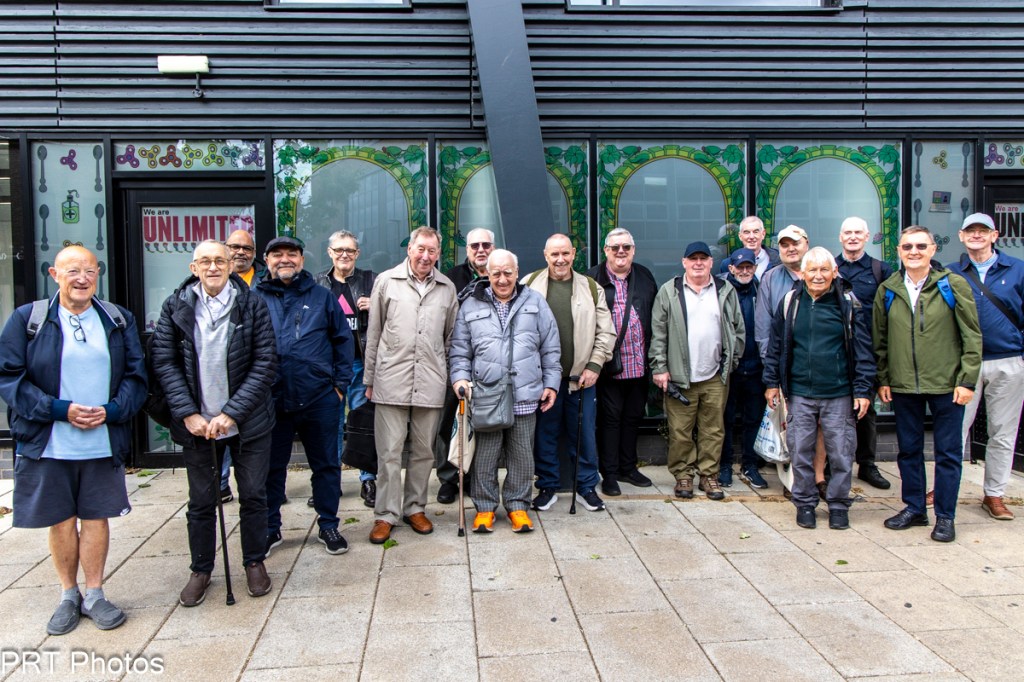
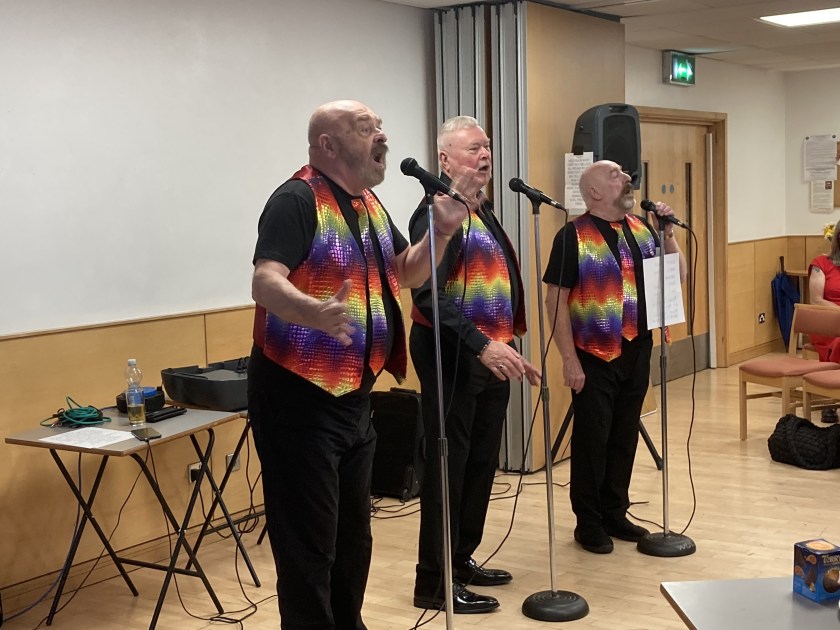
We organised a party for Ageing Without Limits Day with some great entertainment, a raffle and buffet to celebrate ageing and to challenge ageism.

Thanks to Wm Morrison Supermarkets Limited and all those who donated raffle prizes, Jim on reception, Andi, Ken, Norman and Peter for help in the kitchen, David for selling raffle tickets, and all the brilliant acts – Norman, Andi, Jennifer and Wolf.
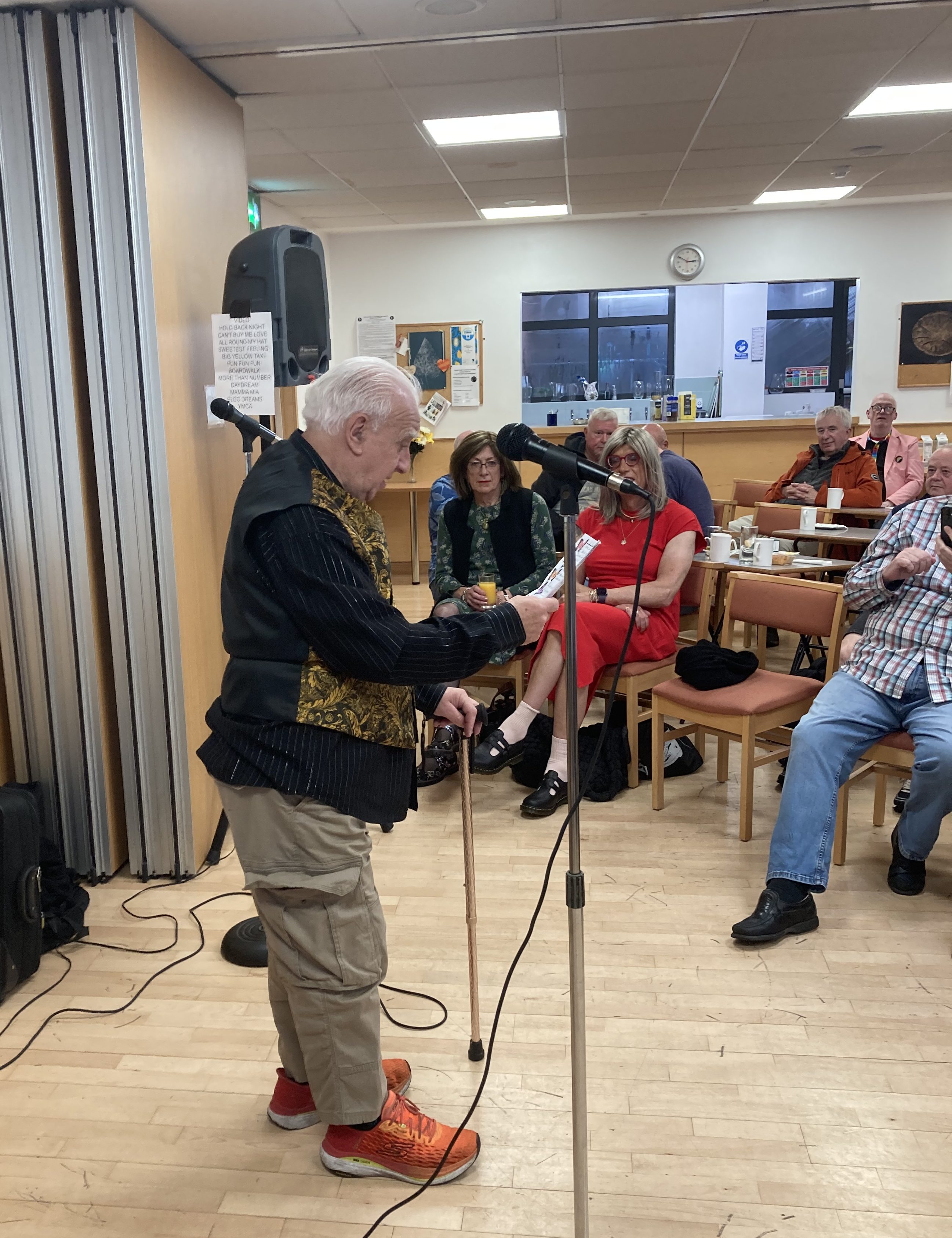
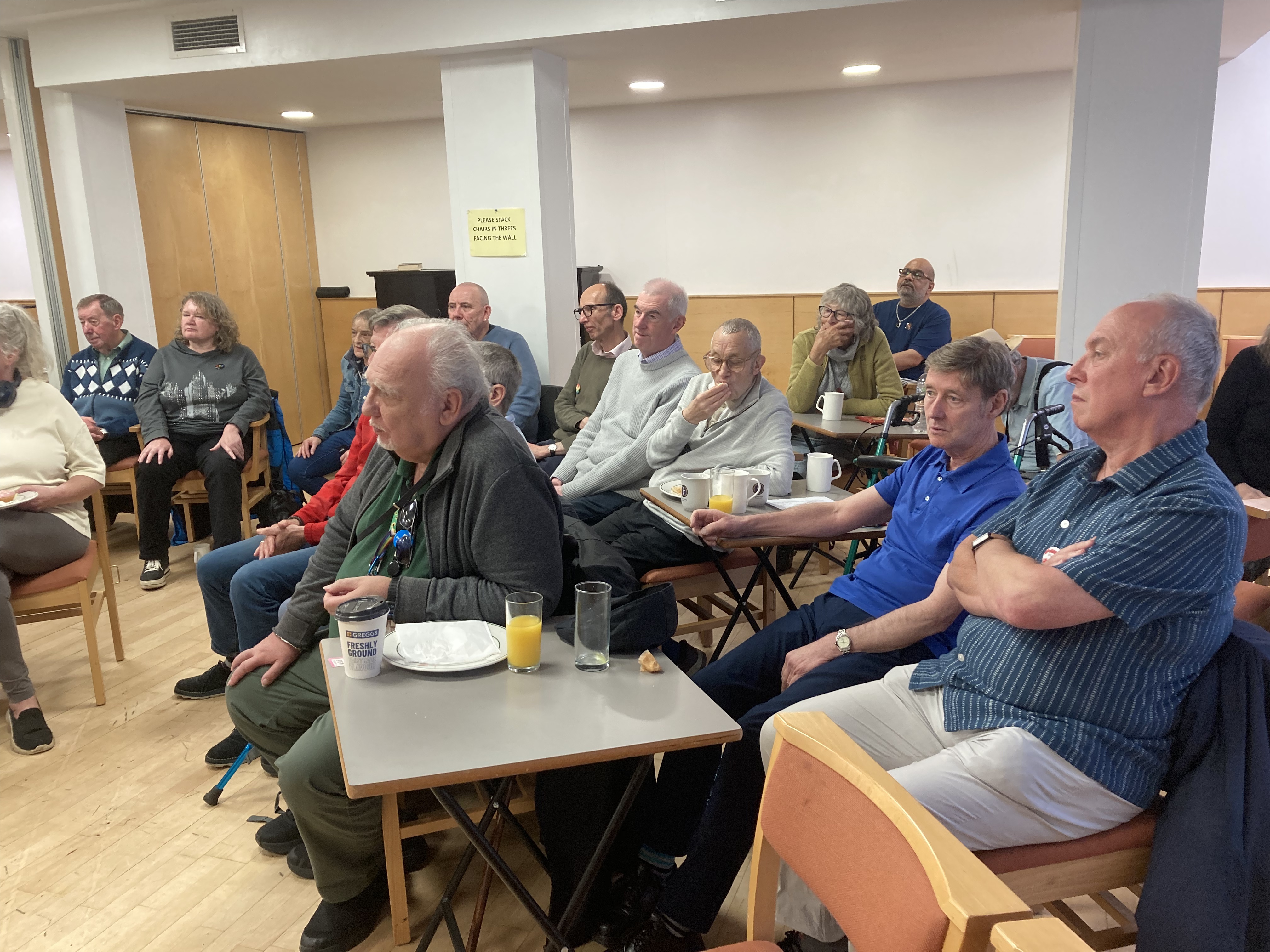
Tony read out a poem by Alyson Malach:

Walk a Day in Our Shoes

Before you post those words tonight,

Before you press “share” and start a fight,

Before you mock, deny, dismiss,

Or question who we say we is.

Remember this before you write:

We wake each day and live this life.

We are not topics to debate,

Not headlines built on fear and hate.

We are your neighbours down the street,

The people that you daily meet.

The worker serving at the till,

The nurse, the teacher, showing skill.

We are the customers you greet,

The service users you may meet.

The people buying what you sell,

The people wishing simply well.

Yet still some choose to mock our name,

To misgender us and cause us pain.

To question who we know we are,

Whilst judging us from near and far.

Walk just one day within our shoes,

And feel the things we did not choose.

The stares, the whispers, constant fear,

The sense we’re never welcome here.

Feel what it means to be denied,

To have your truth pushed to one side.

To hear your identity debated,

Dismissed, diminished and invalidated.

The trauma builds, the burden grows,

In ways the outside seldom knows.

Discrimination leaves its mark,

Long after comments leave the dark.

It affects our health, our peace of mind,

The confidence we struggle to find.

It impacts work, our daily life,

And fills ordinary days with strife.

Some lose hope beneath the strain,

Of carrying exclusion’s pain.

Because words are never “just a joke”

When they leave another person broke.

And to those posting hate online,

Remember there is often a line.

Freedom of speech is not a shield

When discrimination is revealed.

The measure of a decent society

Is not agreement or conformity.

It is whether people can belong,

Even when others think they’re wrong.

So see our humanity first.

Not politics at its worst.

Not culture wars or online noise,

But human beings with human joys.

Accept us for who we are.

The truth need not be travelled far.

For dignity is not a special right

It belongs to everyone in sight.

And when history asks what side you chose,

When faced with people different from your own,

Let your answer be both kind and true:

“I chose respect.

I chose humanity.

I chose to walk in their shoes.”
Salford Pink Picnic

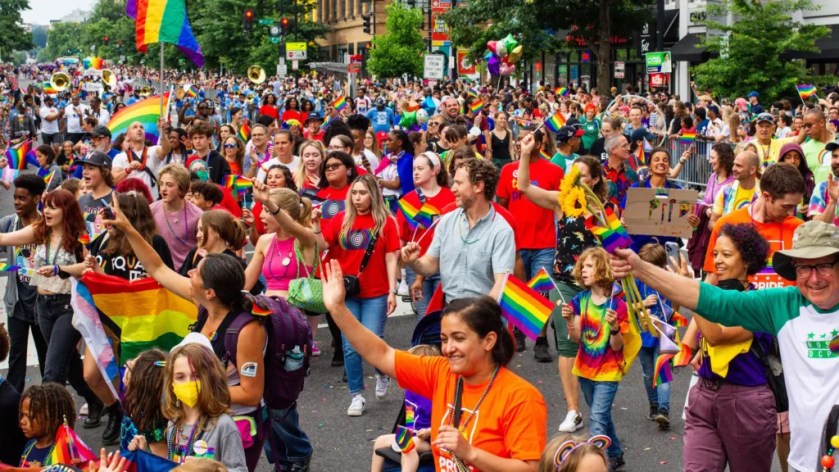
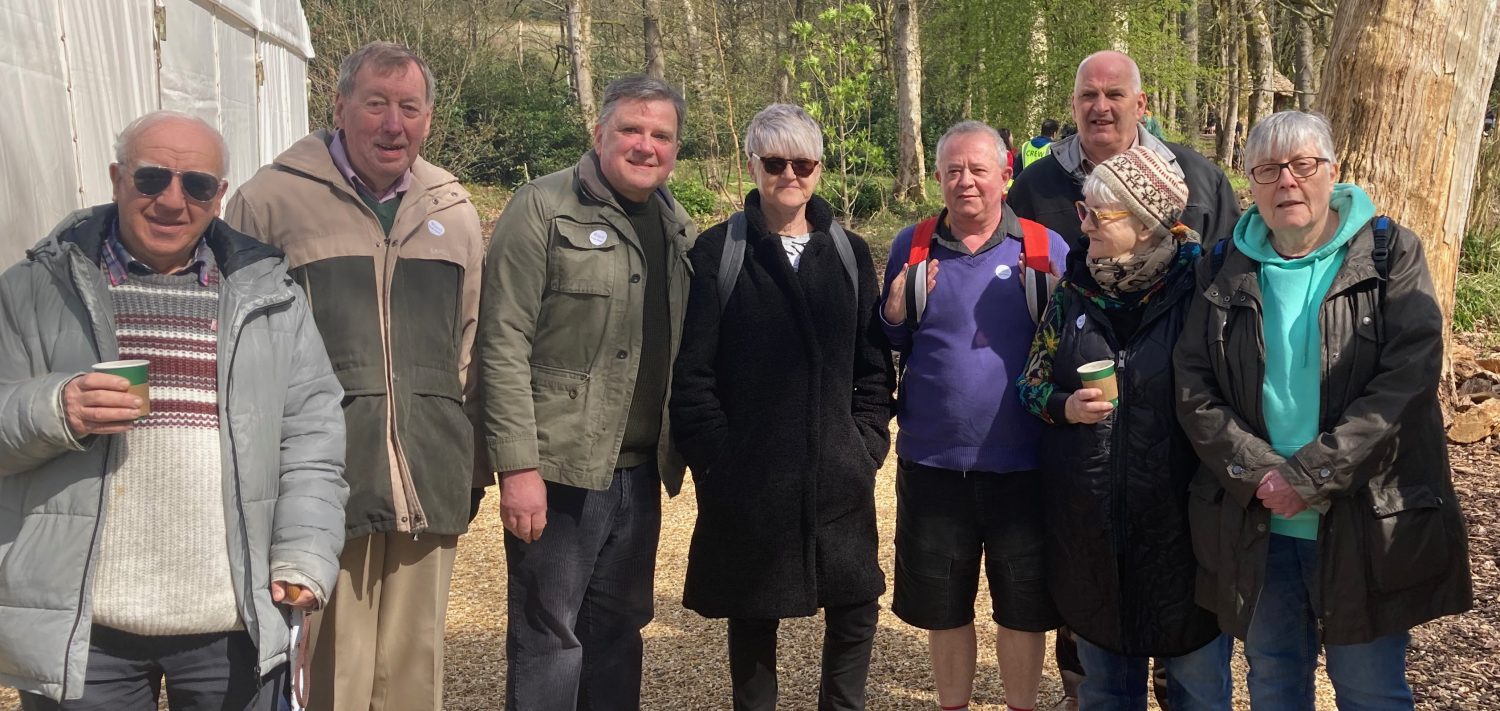
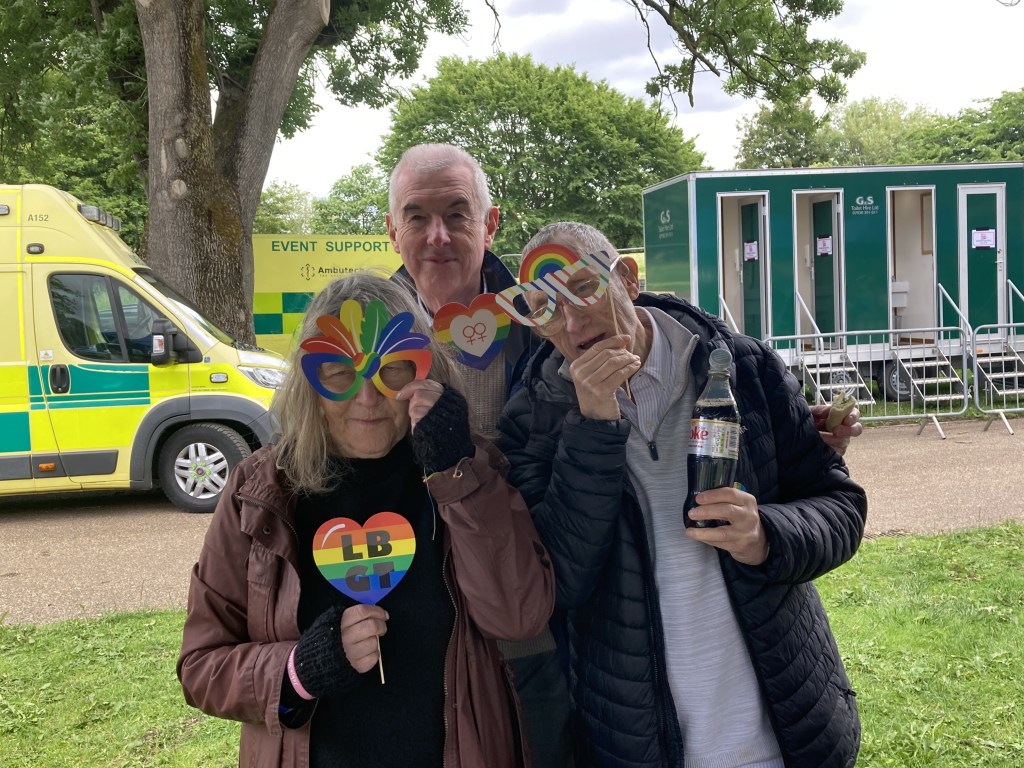
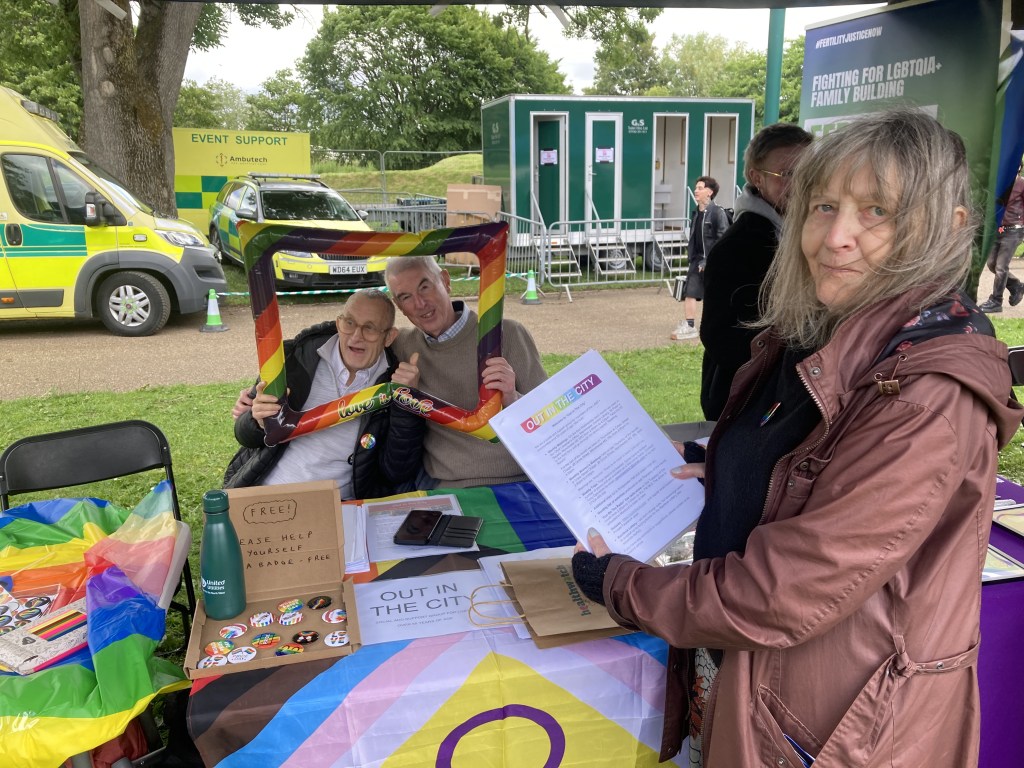
Thanks to AutoTrader for sponsoring a stand with Proud 2 B Parents at Salford Pride’s Pink Picnic. It was the 15th anniversary.
Bury LGBTQI+ History Walk

Saturday, 20 June – 2.00pm – 3.30pm

Meet at Victoria Wood Statue, Library Gardens, Manchester Road, Bury BL9 0DF

Discover Bury’s LGBTQI+ past and a great way to connect, share and celebrate together.

Tour is free – but donations welcome – no need to book.

Happy Straight Pride Month! Wait … let me double check my notes
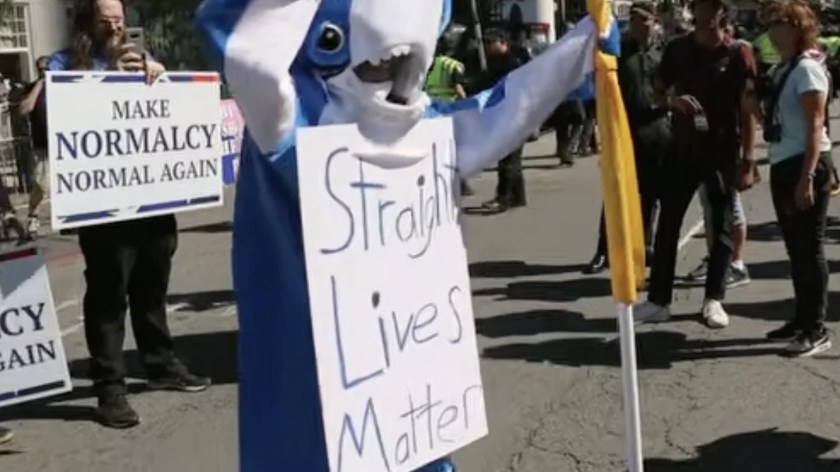
It’s finally that time of year, when we celebrate “Straight Pride!” Frankly, it’s about time. For centuries, heterosexual people have been oppressed, marginalised, and forced to live in the shadows of a ruthlessly queer-dominated world. It’s time we address this glaring inequality and finally celebrate the joy, the triumph and the beautifully beige aesthetic of being straight.

First, let’s brush up on our straight history. Even before the 1960s, heterosexual people were routinely targeted, harassed and arrested just for holding hands in public.

Hold on, my editor is whispering in my ear. Correction: That was actually homosexual people. My mistake! But I’m sure if we dig deep enough into the archives, we’ll find a time when straight people were persecuted for their orientation. No? Nothing in the database?

Well, no matter! Straight people should still be able to celebrate the brave act of being exactly what society expects them to be. What’s not to celebrate? Imagine the sheer courage it takes to embrace an attraction to the opposite sex without a single fear of societal retaliation. It’s not like heterosexuality has been the default setting since, well, the dawn of human civilisation. They deserve a parade and a flag!
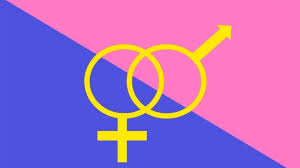
The big straight coming out

I’ll never forget the day my sister finally came out to our parents. Lord, what an emotional roller coaster. She had confided in me weeks prior, trembling as she asked if Mum and Dad would still love her. I kept reassuring her: “It’s going to be okay. They’re progressive. They’ll accept you.”

When the moment arrived, she sat on the couch, clutching a shredded tissue in her shaking hands, took a deep breath, and confessed that she was … straight. Mum immediately burst into tears. Dad gasped. But they both jumped up to embrace her, whispering, “No matter what the outside world thinks, you are our baby, and you are perfectly, statistically normal.” I was beaming with pride.

The fight for representation

It’s just exhausting seeing how lopsided our culture is in favour of the LGBT+ community. Those poor, sweet straights are practically invisible. You never see them in movies, and they are certainly never depicted as representing the “normal” way of living. When was the last time you saw a commercial featuring a man and a woman? Or a sitcom centred around a husband and wife? Almost never!

It’s completely unfair that straight people don’t have a designated month to look at a billboard and think, “Wow, it’s okay to be me.”

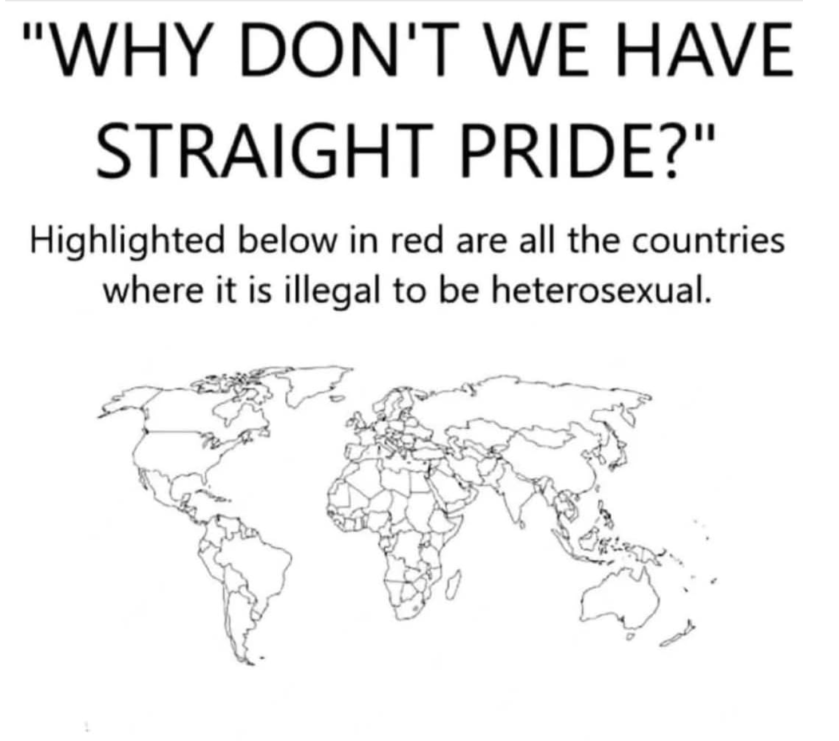
Consider the global crisis: Right now, there are nearly 70 countries where being heterosexual is literally illegal, and in several, it carries the death penalty!

Editor’s Note: Apologies again, I read the chart upside down. It is actually illegal to be homosexual in those countries. In fact, heterosexuality is legally protected and culturally enforced in 100% of the world.

But still! That doesn’t mean straight people feel like they have the entire weight of global law, religion, and history reinforcing their lifestyle. Right?
The legislative onslaught

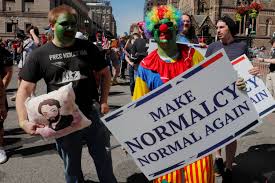
Let’s talk about the political climate. As we speak, there are over 500 anti-heterosexual bills moving through the US legislature. Over 500! These hetero-haters are doing everything in their power to deny basic rights, ban straight couples from adopting, dictate which bathrooms they can use and ensure that bakers don’t have to bake them a wedding cake. They’ve even passed “Don’t Say Straight” bills in schools!

Oops! I’m looking at the script again. It turns out I got it backward one more time. It’s actually the LGBT+ community facing those bills.

Look, at the end of the day, I just don’t think it’s fair. Yes, my research has revealed that heterosexuals are the overwhelming majority. And yes, science confirms that society is already built entirely around the heterosexual lifestyle. But if they don’t get a parade for successfully doing the bare minimum required to propagate the species, then what was this all for?
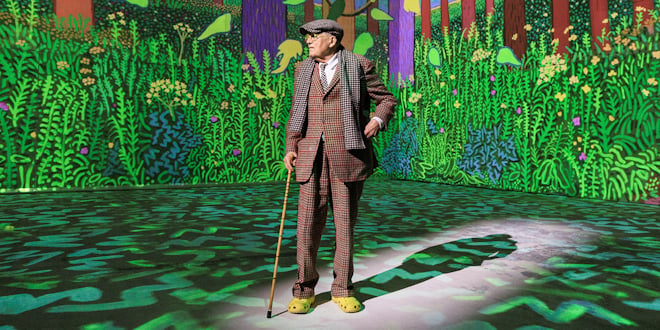
David Hockney

RIP David Hockney: The world-renowned artist died peacefully at home on Friday, 12 June. The artist captured everyday moments of gay life in an era where being gay was criminalised, as well as being known for his dynamic, colourful scenes.

We recently visited Salts Mill in Saltaire which features several large rooms given over to the works of David Hockney, and last year we visited Aviva Studios to experience an immersive exhibition with a unique personal commentary by David himself.
Age Without Limits Day … Only Connect … Tony Powell … Grindr: The Opera!

News

Pride in Ageing x Manchester Art Gallery

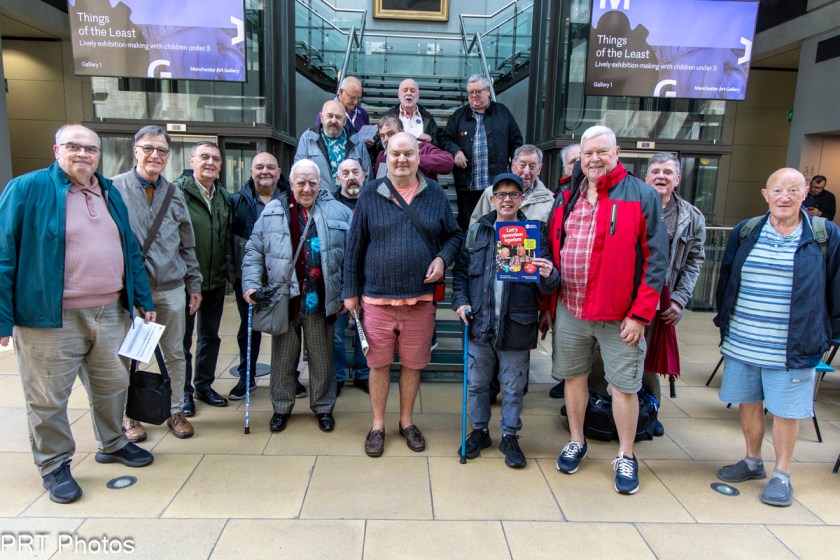
Age Without Limits Day Celebration – 10 June

We marked Age Without Limits Day by visiting Manchester Art Gallery’s WORN: the life within clothes exhibition, which showcases pieces of clothing that have lived fascinating and vibrant extended lives through mending, altering, customising and recycling.
We also experienced a 30-minute highlights tour of the exhibition and completed a short quiz on ageing.

More photos can be seen here.

Only Connect

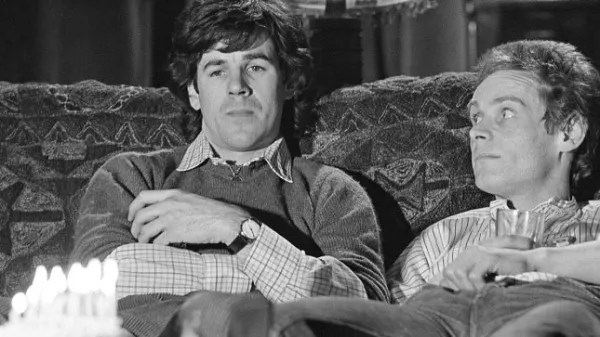
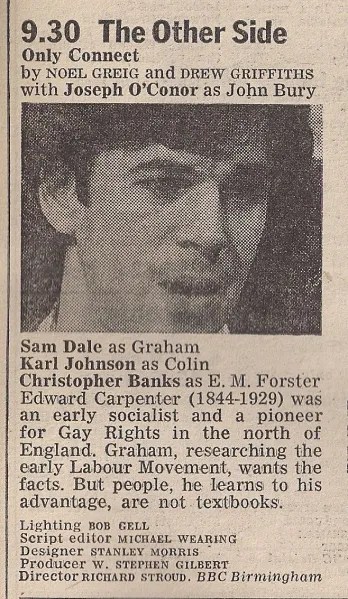
In 1979 W Stephen Gilbert, an openly gay drama producer at the BBC, commissioned Noel Greig and Drew Griffiths, from the radical theatre company Gay Sweatshop, to write an original drama for television. They had already been acclaimed for their stage work. The result was Only Connect, shown on BBC2 in a series called The Other Side.

It concerned a research student’s rediscovery of the forgotten figure of Edward Carpenter, a socialist pioneer and campaigner for gay rights. Keith Howes enthused in Gay News: “Credit should be bestowed upon all the people involved with Only Connect. It was a sensational work in the truest sense: changing our perceptions, stimulating our minds, stretching us. Although it was … completely accessible to non-gay people, it was ultimately ours. All we were required to do was to adapt to its pace and structure and watch it. I hope we haven’t seen the last of it.”

With Only Connect the BBC succeeded in producing a drama that portrayed the lives of gay men in a thoughtful and naturalistic way. However, in spite of Keith Howes’s hope that “we haven’t seen the last of it”, Only Connect remained buried, but is finally to get a repeat.

It will go out on BBC4 on Wednesday 17 June as part of Pride Month, accompanied by a new introduction.

John Bury, beautifully played by Joseph O’Conor is an older gay man, living in retirement in a mining town, who recalls a love affair he had in his youth with Edward Carpenter (1844-1929), the English writer and Utopian socialist.

Tony Powell, the secretly gay footballer

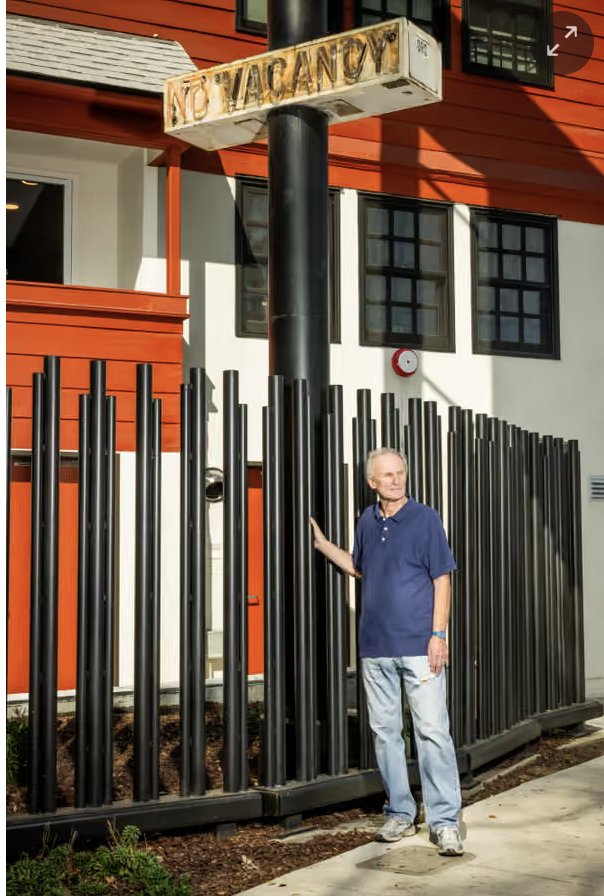
Tony Powell spent 25 years at the Holloway Motel – Photograph: Christie Hemm Klok / The Guardian

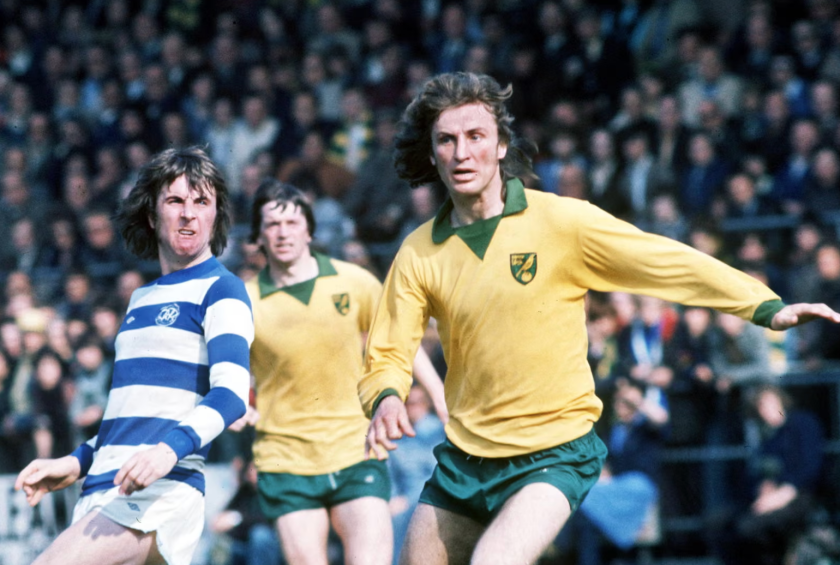
Tony Powell (born on 11 June 1947) was a secretly gay professional footballer for Bournemouth and Norwich in the 1970s. Powell is now 79 and lives in a very different world compared with when he was a husband, the father of two young daughters and Norwich’s player of the season in 1979.

Powell was forced to bury his true self for decades, At that time it was not a good idea to come out. Powell travelled to the US in the early 1980s to continue his career. He came out in a new country, abandoned his family in England and cut ties with them so they had no idea where he was for 35 years. He took that drastic decision because he was convinced his family would shun him if they learned the truth about his sexuality.

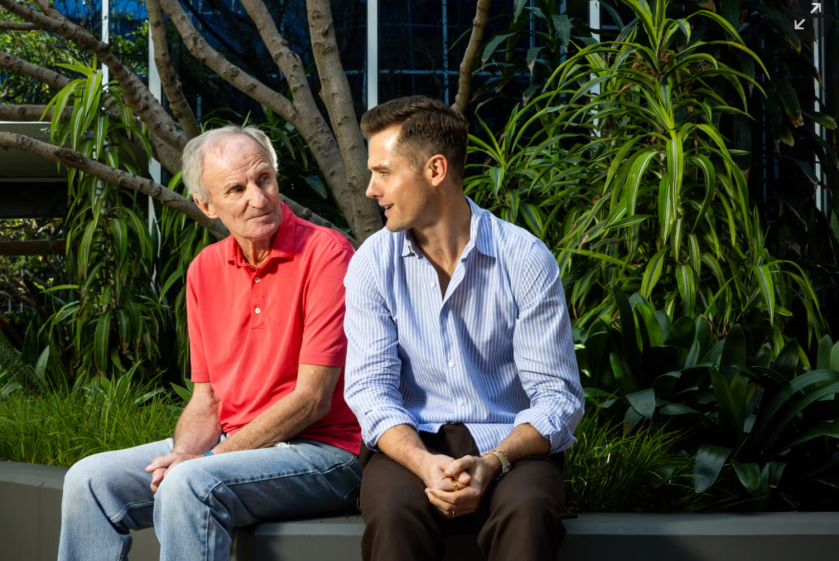
Tony Powell and Robbie Rogers are two rare male former professional footballers who have come out. 
Photograph: Christie Hemm Klok / The Guardian

Another professional footballer, Robbie Rogers, came out, feeling proud and loved by his family. He played for LA Galaxy. Most days he walked past the Holloway Motel on Santa Monica Boulevard in West Hollywood – without realising that another gay footballer lived in the dilapidated motel. Rogers has now helped to produce a moving and important feature-length documentary about Powell – The Last Guest at the Holloway Motel.

Tony Powell played 275 games for Norwich between 1974 and 1981. Photograph: Colorsport / Shutterstock

Rogers came out in public as he wanted to try and change football so young gay men could be themselves.

It’s been a little sad that other footballers haven’t been able to come out, and we can only hope things change for gay players in the future.

Grindr: The Opera!

Saturday, 22 August – 3.30pm – £35 tickets are reduced to £20 with Promo Code OITC20

53two, Arch 19, Watson Street, Manchester M3 4LP

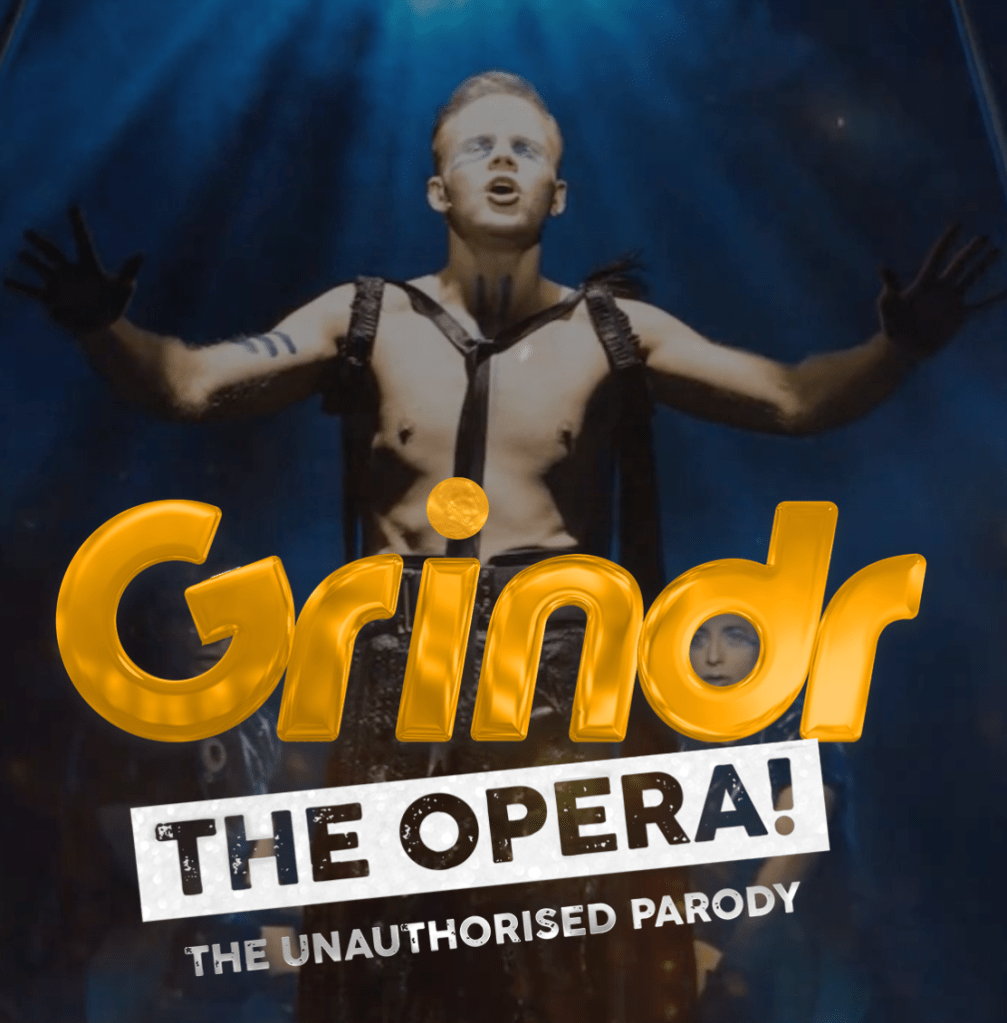
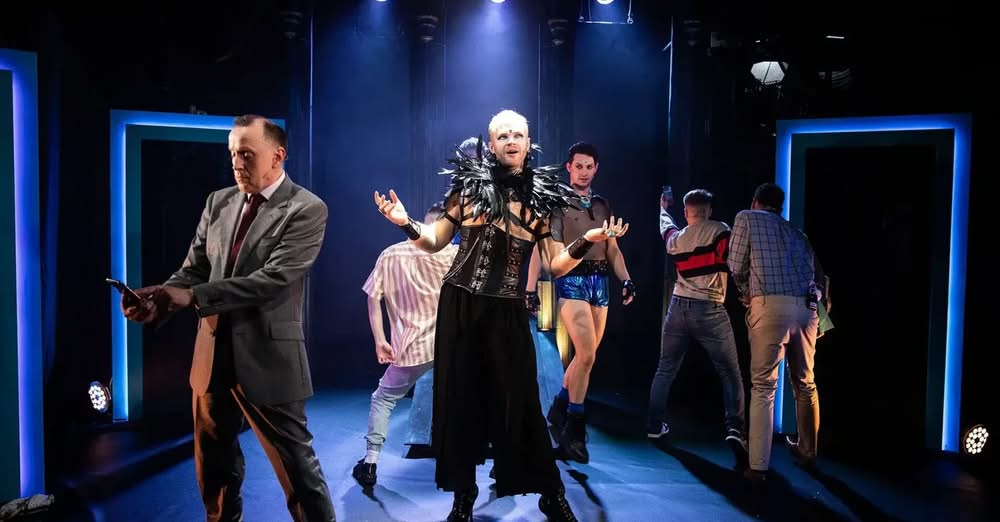
Grindr: The Opera! puts the most notorious gay hook-up app into the exaggerated world of opera. This musical parody takes you on a hilarious and thought-provoking journey through the world of gay dating, focusing on the greatest catalyst for the shift: GRINDR.

With catchy songs, witty dialogue, and colourful characters, this unique and ground-breaking production explores the impact of technology on human connection and the search for meaningful relationships.

Through the experiences of four gay men who use Grindr to connect with each other, Grindr: The Opera! offers a satirical commentary on modern gay culture.

Devon the romantic, Tom the cynic, Jack the twink and Don the daddy meet via the medium of the Grindr app, each seeking a different type of connection.

You’ll laugh, you’ll cry, and you’ll be challenged to think deeply about the ways in which technology is shaping our lives and relationships.

But above all, Grindr: The Opera! will make you feel alive. With its infectious energy, dynamic performances, and unforgettable characters, this production will leave you feeling inspired, entertained, and maybe even a little bit hopeful about the future of human connection.

Book here.

Please note the Promo Code should not be shared outside Out In The City

UK AIDS Memorial Quilt … 45 Years – 45 Million Dead … Age Without Limits Day … Loud and Proud … Joel Webbon … Survey

News

UK AIDS Memorial Quilt

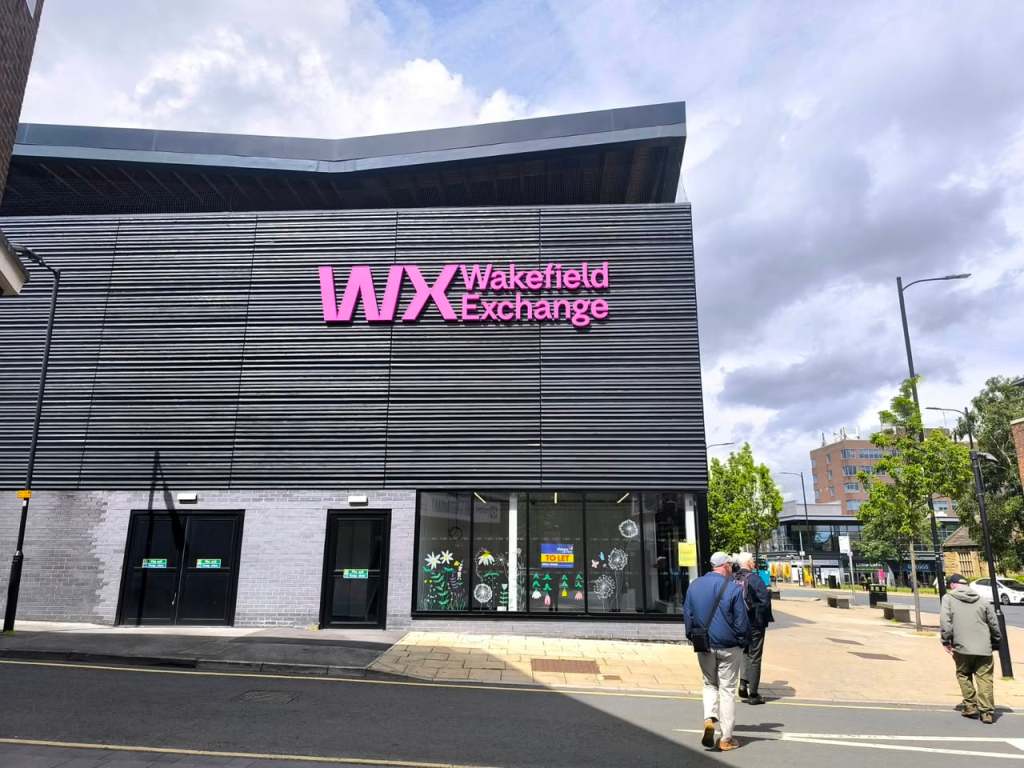
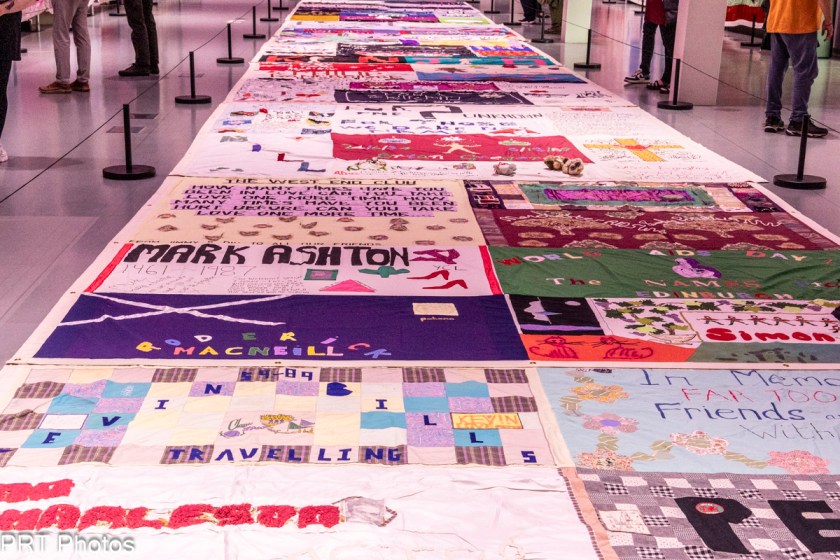
In partnership with UK AIDS Memorial Quilt Partnership, Wakefield is the first city to welcome the UK AIDS Memorial Quilt in its entirety, outside of London. The UK AIDS memorial Quilt consists of 43 quilts and 24 individual panels, representing more than 500 people lost to HIV and AIDS.

It is part of the world’s largest community art project, started in the USA in 1985 by activist Cleve Jones, commemorating friends, family and loved ones lost to AIDS.

Individual panels were stitched together to create larger quilts, which were then shown outdoors as a form of protest to raise awareness about HIV and AIDS.

Seven UK HIV support charities formed the UK AIDS Memorial Quilt Partnership in 2014 to conserve and display the quilt. Today it stands as an important reminder of those who were lost and of the fact that HIV and AIDS continue to affect people and communities today.

More photos can be seen here.

Forty five years since the first reported cases of HIV

On 5 June 1981, the Centers for Disease Control and Prevention (CDC) published a brief, clinical report in its Morbidity and Mortality Weekly Report about five young men – all “active homosexuals” – in Los Angeles who had developed pneumocystis pneumonia – a rare and deadly form of pneumonia.

The write-up, barely a page long, ran in between a report on dengue infections among US travellers and an assessment of measles cases. No one who read it could have known this was the opening chapter of the deadliest infectious disease epidemic since the 1918 flu – one that would kill an estimated 45 million people worldwide and reshape medicine, politics and culture in ways we’re still reckoning with.

The first UK cases were identified in December 1981. Then, the following year, Terry Higgins became one of the very first people to die in London in July 1982. The Terrence Higgins Trust was quickly established by his partner Rupert and friends to raise much needed awareness among affected communities, fund research to give hope and fight for the proper Government response required to stem the tide of lives lost.  

Initially known as GRIDS – or Gay Related Immune Deficiency Syndrome – the CDC first used the term AIDS (Acquired Immune Deficiency Syndrome) in autumn 1982. While primarily affecting gay men in the early days, the virus spread rapidly and began affecting some of the world’s most marginalised communities.

It wasn’t until 1986 that HIV (Human Immuno-Deficiency Virus) was used as the name for the virus. In 1987, the UK Government took important but overdue action and launched its Don’t Die of Ignorance campaign to raise awareness of HIV and its spread. But, in the process, the TV advert and leaflet that was delivered to every house in the country, frightened a generation of people and deeply entrenched information about AIDS that is now outdated in the UK. 

It took until 1996 – 15 years and millions of deaths after the CDC report – for effective treatment to be found to protect the immune systems of those who contracted HIV. This would go on to transform health outcomes for people with diagnosed HIV. But the preceding Government inaction, persecution and scaremongering in parts of the press (with reports of a ‘gay plague’) and the shame and stigma for affected communities, cast a long shadow that still impacts efforts to prevent HIV and destigmatise the virus today.

The story could have ended there: The virus had won while the world looked away. But it didn’t. What happened instead, through a combination of activist fury and scientific ingenuity is one of the great reversals in the history of medicine. It’s a narrative that provides hope not just that we might one day get to zero and eradicate HIV, but that the world can overcome what may seem like the most hopeless challenges. One of the biggest successes of modern medicine is transforming an HIV diagnosis from a virtual death sentence to a manageable long-term condition.

We now have highly effective ways of preventing, testing for and treating HIV. Access to those interventions is a privilege not afforded to many parts of the world still in 2026.

But HIV stigma and discrimination remain a huge barrier to further progress. Public perceptions – in the UK and internationally – have not kept pace with medical progress. Too few know that we can prevent HIV with a daily pill called PrEP, or that we can now say definitively that those taking effective HIV treatment can’t pass it on.

One of the best tools we have for tackling barriers to HIV testing and to improve the lives of those affected by HIV is through education. Through people living with HIV talking about their reality in 2026. Through sharing the facts about HIV. Through raising awareness of how much HIV has changed. Through tackling stigma and discrimination.

We’ve come far in the fight against HIV since the 1980s, but we still have a long way to go.

Thursday, 11 June – 2.00pm – 4.00pm – Age Without Limits Party

(with Wolf, Jennifer, Andi and Norman)

Cross Street Chapel, 29 Cross Street, Manchester M2 1NL

Buffet, raffle and great entertainment to celebrate ageing without limits and to challenge ageism.

Loud and Proud

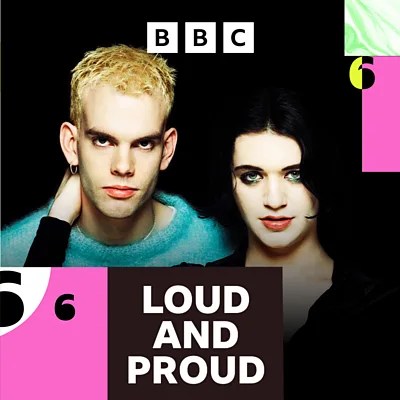
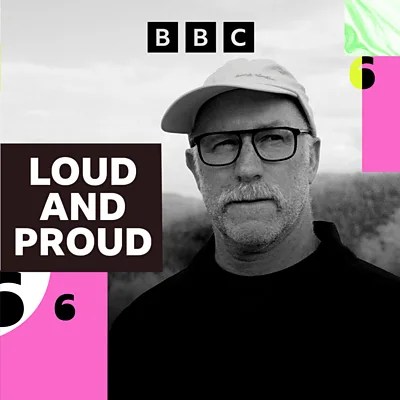
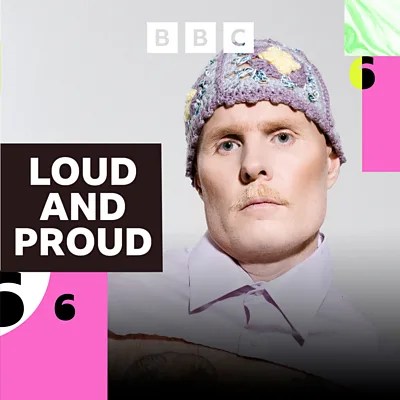
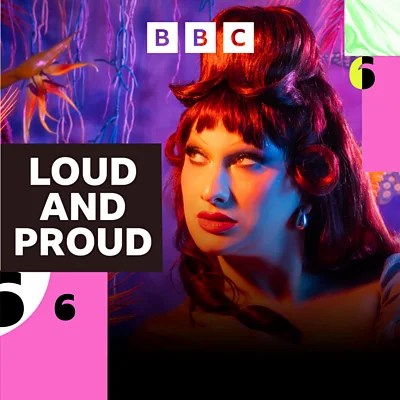
BBC Radio 6 Music have a series of mixes to celebrate LGBTQ+ voices – but they are only available until the end of June! Listen here

Loud and Proud Mix: Placebo

Loud and Proud Mix: Roddy Bottum

Loud and Proud Mix: Hercules and Love Affair

Loud and Proud Mix: Jinkx Monsoon

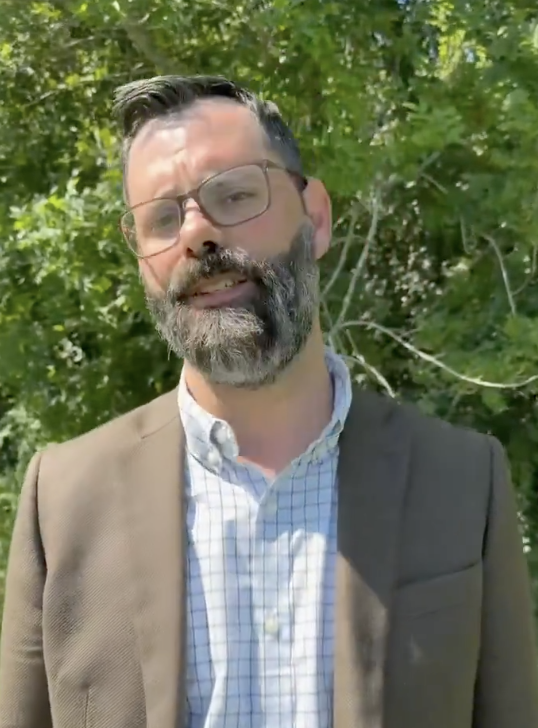
Pastor Joel Webbon

Joel Webbon

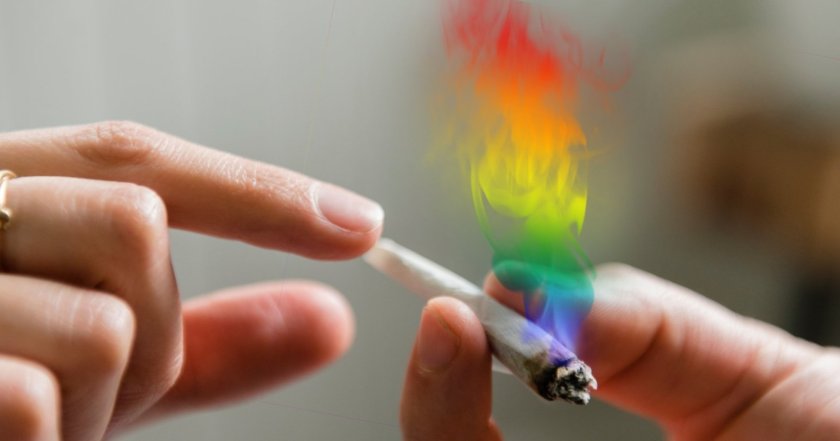
Joel Webbon, a US-based far-right Christian pastor, has sparked backlash after claiming that smoking marijuana makes men “gay”, urging Christian men to embrace tobacco and nicotine as a route back to “masculinity”.

Webbon links cannabis use to gender stereotypes and uses “gay” as a pejorative.

He says marijuana “makes you less masculine, more feminine, soft, gay, at least spiritually gay”, before arguing it leaves men unfocused and unambitious.

“Marijuana causes you not to focus, not to lock in, not to be ambitious. It makes you cloudy, fuzzy, lazy, unambitious.” Webbon also dismisses public health messaging around smoking, describing anti-smoking efforts as a conspiracy.

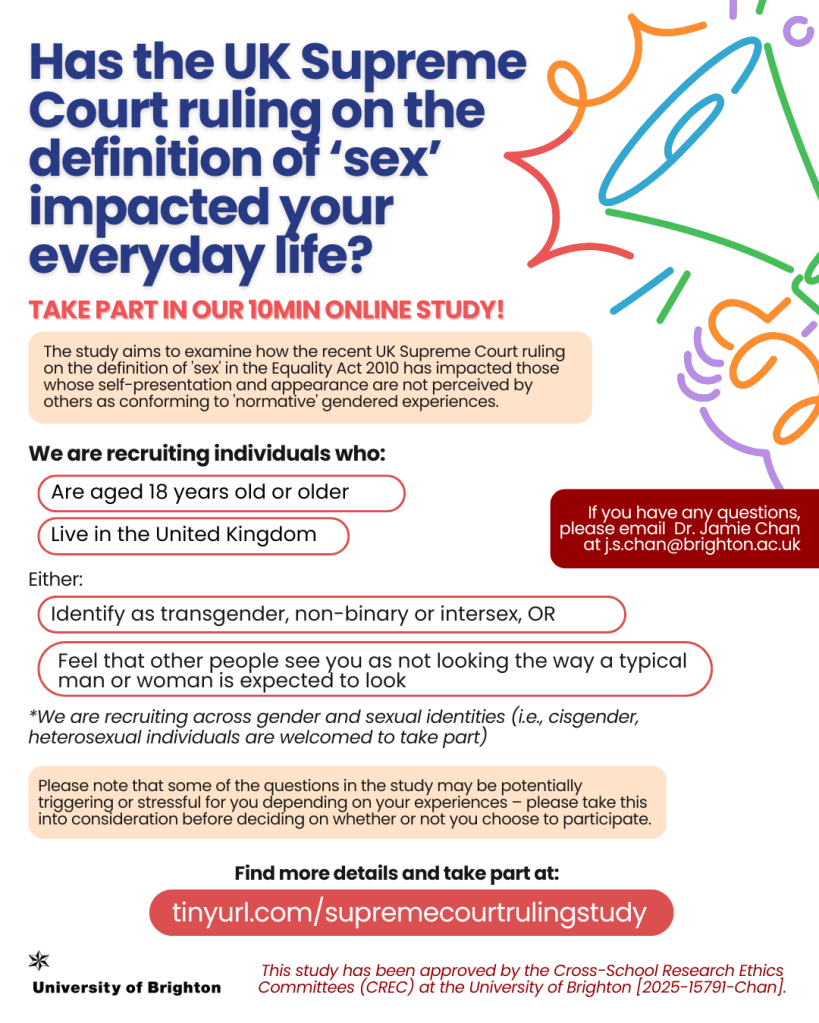
Research survey on UK Supreme Court ruling

A PhD student at the University of Bristol (Ambika Gupta, they/he) is conducting a research study that aims to provide evidence for how the UK Supreme Court ruling on the definition of “sex” in the Equality Act 2010 impacts people’s everyday lives, particularly those whose self-presentation might be perceived as falling outside the gender binary. 

They are recruiting individuals who:

  • Are aged 18 years old or older
  • Live in the UK
  • EITHER:
    • Identify as transgender, non-binary or intersex, OR
    • Consider themselves as having an appearance that other people view as not looking like a typical man or woman is expected to look.

They are recruiting across gender and sexual identities (ie cisgender, heterosexual individuals are welcomed to take part).

Please note that some of the questions in the study may be potentially triggering or stressful depending on people’s experiences – so, participants should take this into consideration before deciding on whether or not they choose to participate (which involves completing a 10 minute online anonymous survey).

Take the survey here.

Pride Events in 2026 … Mark Jennings … The Quakers … Lil Lesbian Nan

News
Parade Banners

Pride events in 2026

Traditionally, June is considered Pride month in honour of the Stonewall Uprising on 28 June 1969, which is argued by some to be the birth of the gay rights movement.

However, there are over 270 Prides taking place in the UK in 2026 starting in February and continuing until the end of November.

In the north west, we’ve already seen the Bury Pride Rainbow Train, Trafford Pride, Bolton Pride, Pride on the Range (Whalley Range) and Bury Pride.

Coming up is:

Blackpool Pride (6 June),

the Pink Picnic (Salford Pride) (13 June),

Warrington Pride (13 June),

Sparkle Weekend, Manchester (26-28 June),

Macclesfield Pride (4 July),

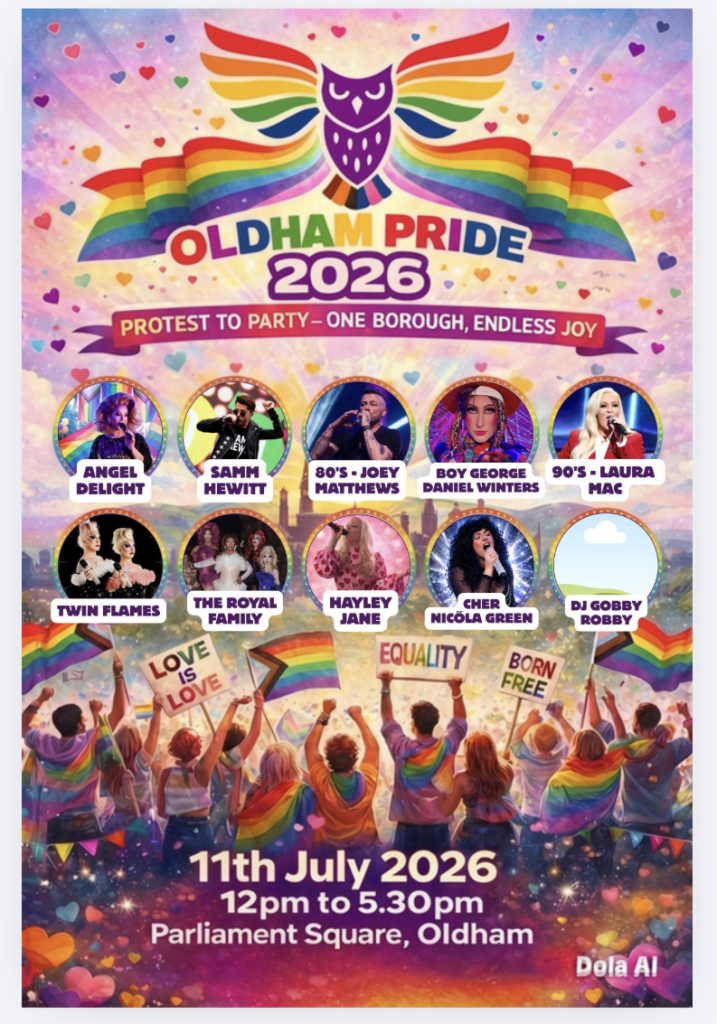
Oldham Pride (11 July),

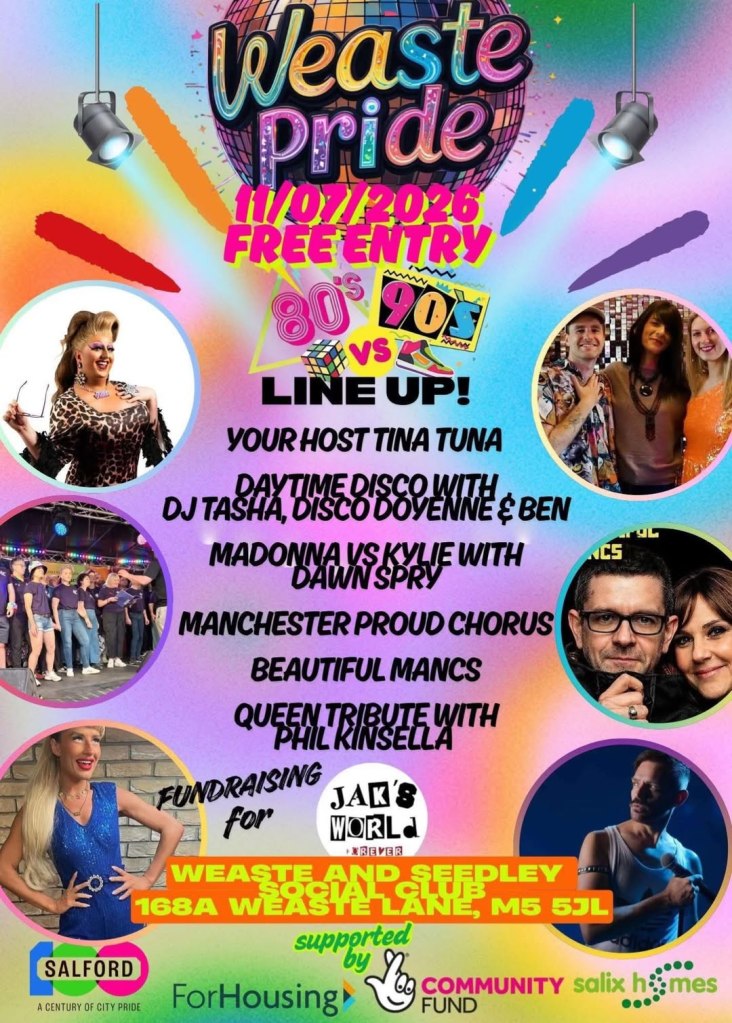
Weaste Pride (11 July),

Veteran’s Pride (24 July),

Liverpool Pride (25 July),

Stockport Pride (26 July).

From August onwards and a fully comprehensive list, please see here.

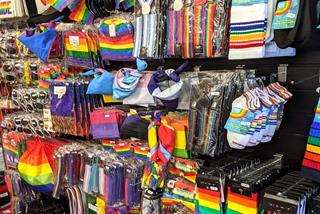
Gay Pride Shop, Manchester

Mark Jennings

Please don’t think me malicious, but I have no hesitation in naming and shaming Mark Jennings. Hopefully, the previous article on “Pride Events” might have made him quite ill. Pride flags are not the problem, but bigotry dressed up as victimhood is.

A man who claims to have a “phobia” of Pride flags just lost his second big case – after demanding tens of thousands of pounds because rainbow imagery at work supposedly violated his Christian rights.

Mark Jennings, a Roman Catholic and evangelical Christian and former social work student, has spent years trying to turn his discomfort with LGBTQ+ visibility into a legal weapon. First he sued NatWest after seeing a Pride display in a Kent bank branch, saying it triggered “severe psychological distress” and clashed with his Catholic beliefs.

He wanted the bank to stop promoting Pride in that branch and pay him £35,000 in damages. Courts in Scotland threw the case out, noting that his pleadings relied on bogus, AI‑generated legal “precedents” and failed to show any actual unlawful discrimination.

Jennings accepted a role as a work coach with the Department for Work and Pensions in June 2024, but reportedly began making a series of demands after receiving the job offer by phone.

Those requests included not being exposed to Pride imagery in the workplace and not hearing colleagues “using different pronouns” while at work. After the DWP refused to meet those conditions, Jennings turned down the role and later brought legal action.

Now, Jennings has lost again – this time at an employment tribunal. He claimed his employer discriminated against him because they refused to remove Pride flags and rainbow imagery from the office and asked staff to respect LGBTQ+ colleagues.

He argued he had a diagnosable “phobia” of Pride materials that should be treated as a disability, and that as a Christian he should not be forced to see or work around symbols that, in his view, promote “social values contrary to his faith.”

The tribunal wasn’t buying it. Judges accepted that Jennings has real mental health conditions – autism, borderline personality disorder, anxiety, PTSD – but found no medical evidence that “Pride phobia” is a recognised condition, and no legal basis for treating LGBTQ+ visibility as an attack on religion.

They ruled that employers are allowed to display Pride imagery and foster an inclusive environment, and that asking everyone to respect LGBTQ+ colleagues is not discrimination against Christians. In plain terms: your right to believe what you want does not include a right to erase queer people, or their flags, out of public view.

What’s striking is how familiar this pattern is. Around the world, we’re seeing a new kind of backlash where people try to turn equality itself into persecution – arguing that rainbow lanyards, pronoun badges, and Pride posters are “hostile” to them.

Jennings pushed that argument as far as it could go, twice, and independent courts have now told him no.

That matters beyond one bank and one office. It’s a clear signal from the legal system: inclusion isn’t discrimination, and LGBTQ+ visibility is not an assault on anyone’s faith.

To all bigots: Please leave LGBT+ people alone. To the NatWest and the DWP – thank you for flying the flag for the LGBT+ community.

63 years ago, the Quakers stood up for gay dignity

Like most Protestant denominations, Quakers hold differing views of homosexuality within their ranks. But no other mainstream Protestant religion has embraced LGBT+ identity like the Quakers, known officially as the Religious Society of Friends.

The clearest example is a text promulgated over seven years in meetings by a group of Quaker writers, psychiatrists, psychologists and teachers, assembled to consider issues surrounding homosexuality.

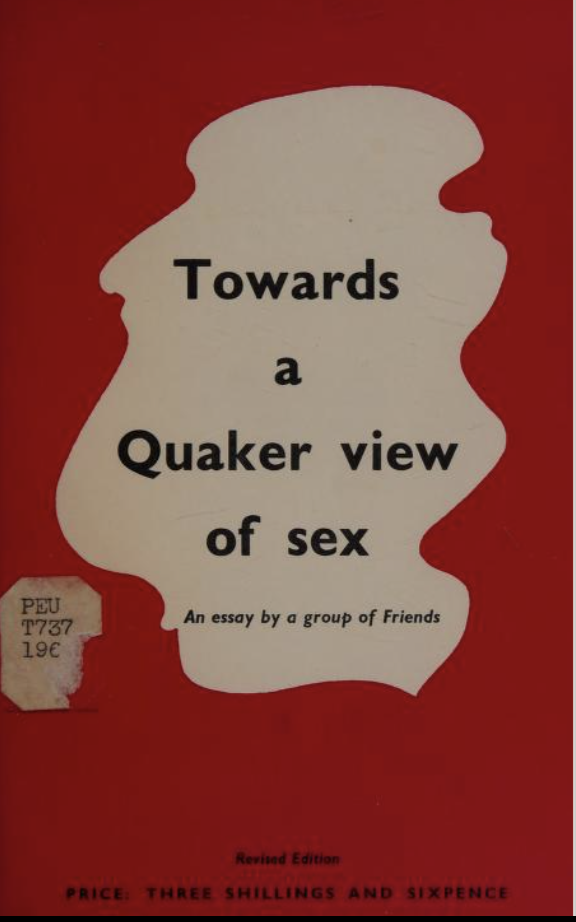
Published in 1963, “Towards a Quaker View of Sex” asserted, “An act which expresses true affection between two individuals and gives pleasure to them both, does not seem to us to be sinful by reason alone of the fact that it is homosexual.”

The book sparked fierce debate among Quaker communities, with one member from the Friends Temperance and Moral Union calling its findings “poison.” But the book also set the Quakers on a path to forward-thinking policy on LGBT+ rights, at a time when other Christian denominations remained adamantly opposed to homosexuality.

Since the publication of “Towards a Quaker View of Sex,” the Friends have shared a compassionate embrace with LGBT+ people in the movement for equal rights.

In 1973, a group of Quakers established the Friends Homosexual Fellowship to promote dialogue over the rights of gay people in the wider Quaker community. 

In 1987, a Friends community considered same-sex marriage for the first time, and at their Yearly Meeting in 2009, Quakers in Britain became the first religious organisation to formally recognize same-sex marriage.

in 2025, British Quakers rejected the country’s Supreme Court ruling that prevents trans people from using single-sex spaces.

Said one friend at the meeting held to address the issue, “This is what love requires of us.”

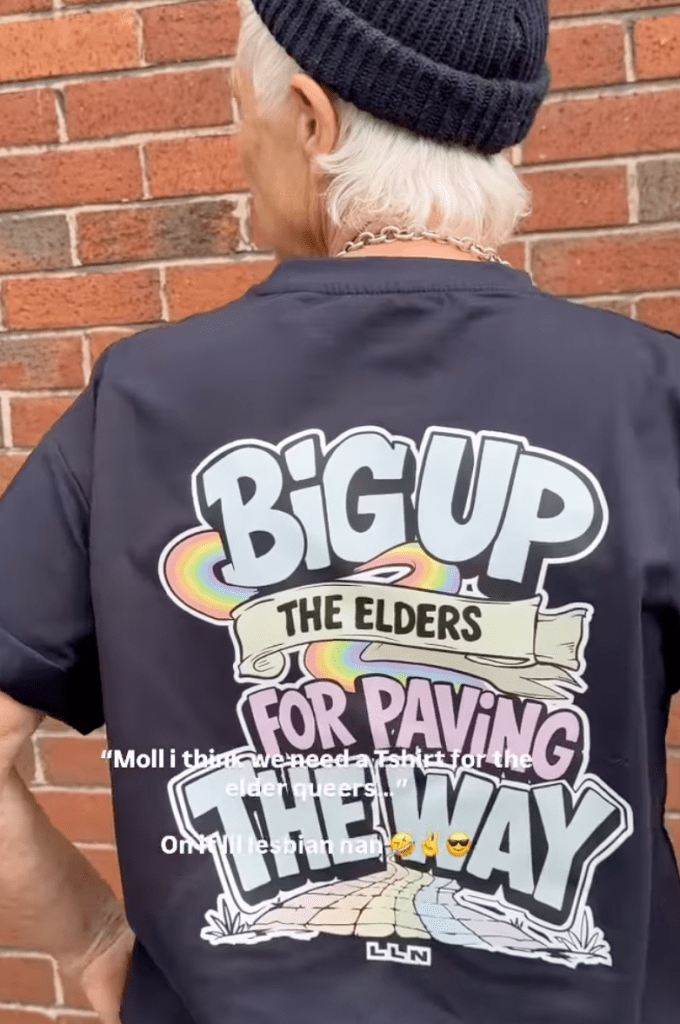
Lil Lesbian Nan

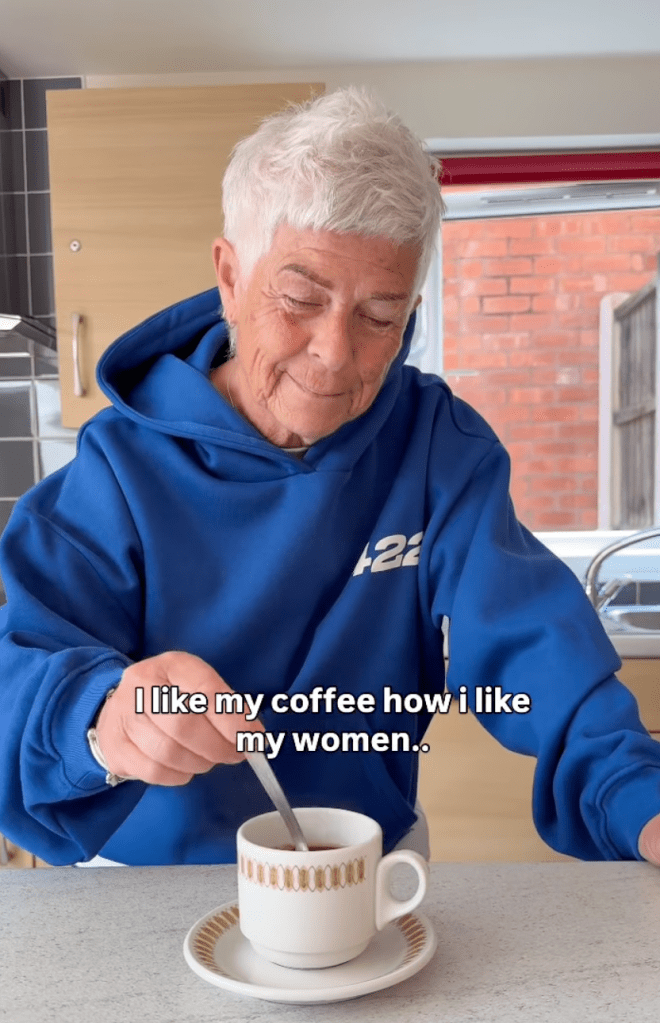
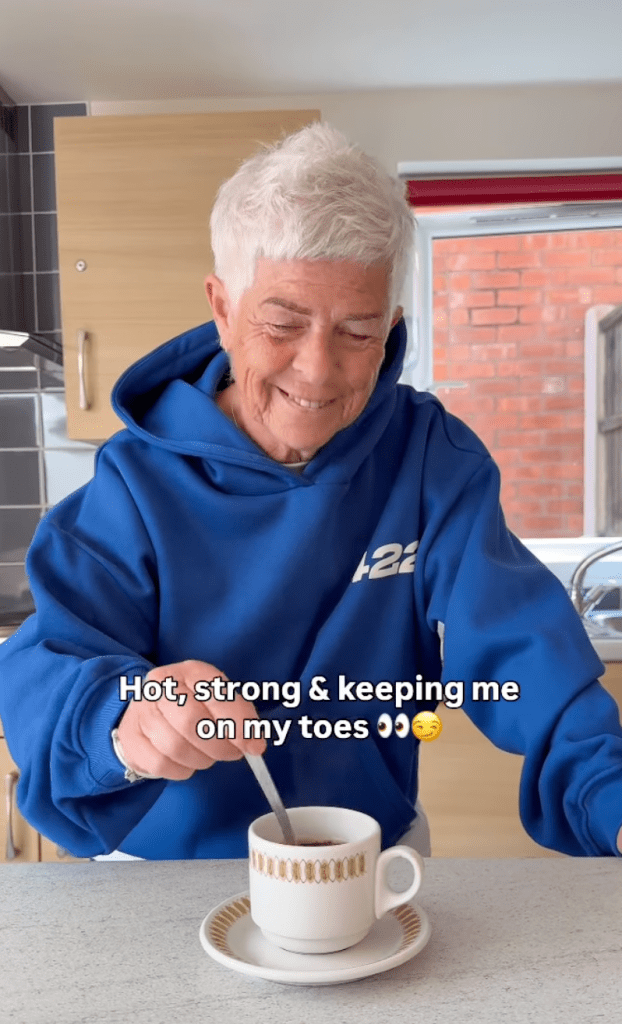
Her granddaughter made her do it! Now she has 177,000 followers on Instagram.

Salford Then and Now Exhibition … Vincent Price … Amnesty International … A Brief History of Lesbian Flags … Rainbow Lottery

News

Photographs chart 50 years of change across Salford for city’s centenary year

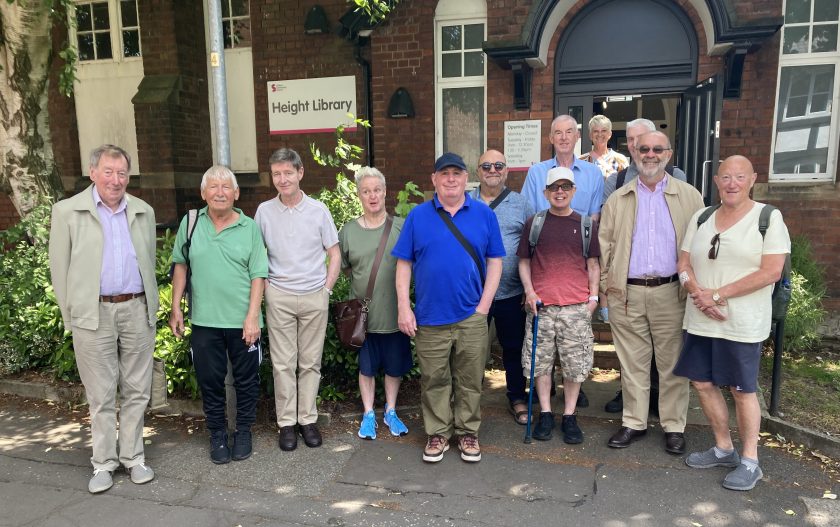
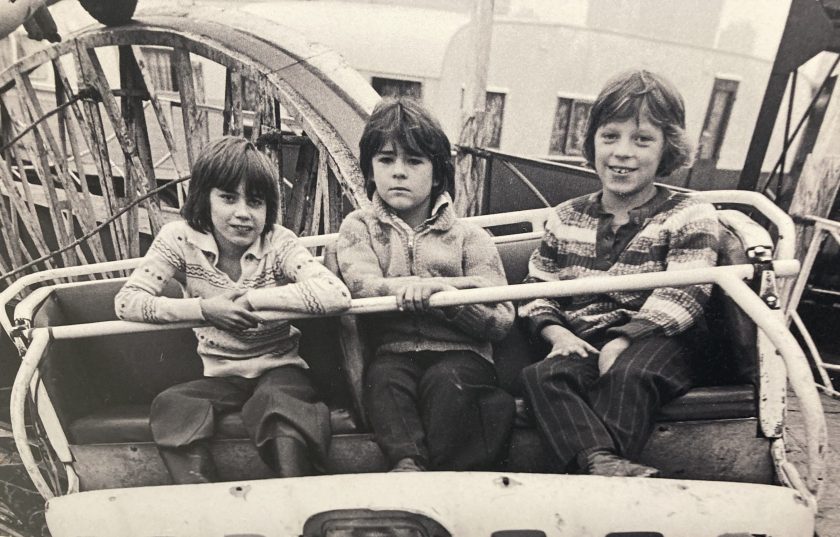
A new exhibition at Irlams o’th’ Height library is marking Salford’s centenary year by exploring how everyday life has evolved over the past five decades.

Steve Chapman and Phil Portus, in collaboration with A-level students Ella Fletcher and Reede Wallace, are exhibiting their work at Height Library, showcasing the evolution of Salford in the past 50 years.

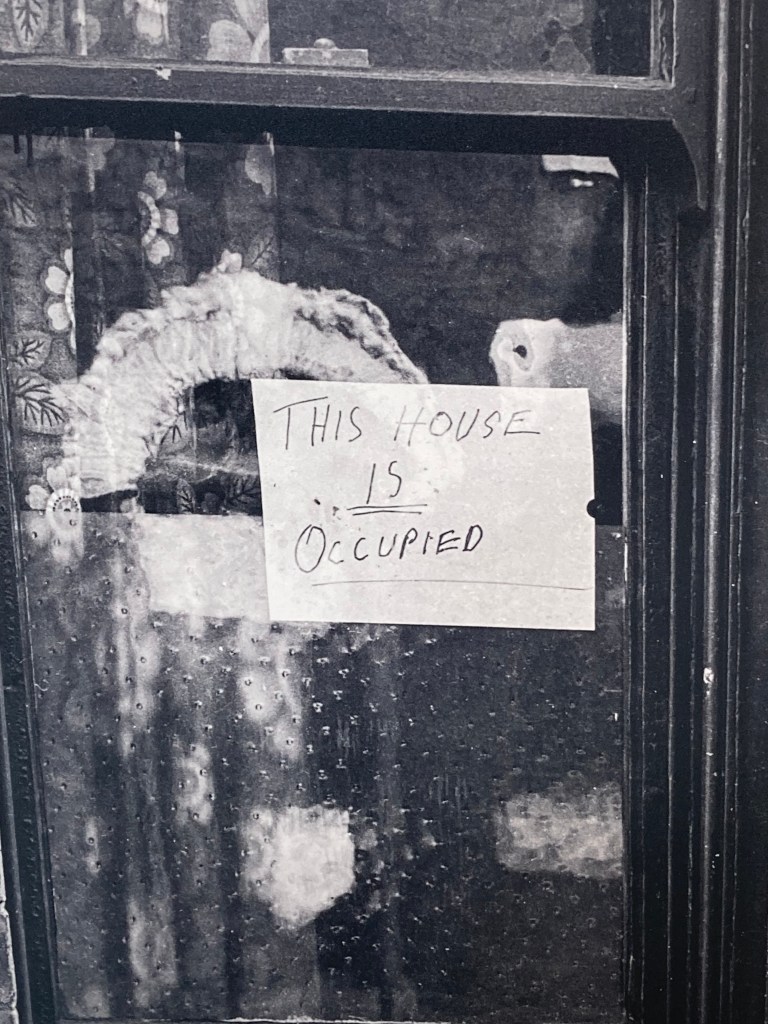
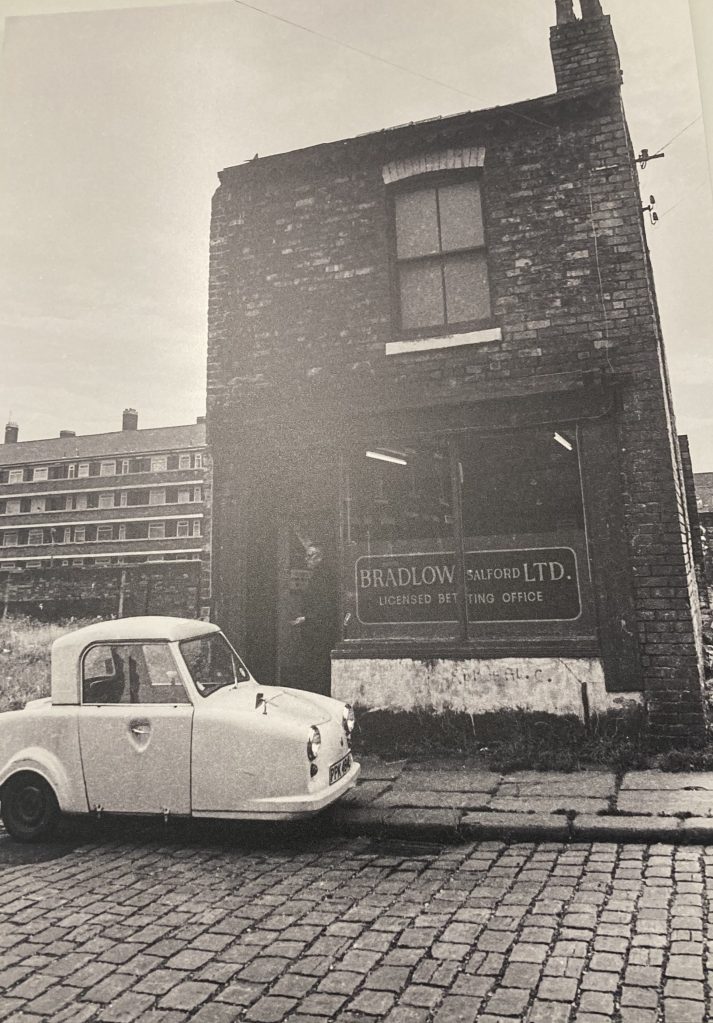
The historical photographs of Salford by Portus and Chapman illustrate the streets of the 100-year-old city during a time of upheaval in the late 1970s. The photographs in the exhibition are mainly focused on Langworthy, Weaste, Ordsall and Adelphi.

The work of Pendleton Sixth Form College students showcases their up-to-date images of Salford.

The exhibition wraps around the entrance and rear wall of the library and takes you through the daily life of Salfordians in the 1970s.

Portus and Chapman present images from elderly people enjoying Salford pubs, to young boys playing in the city’s old streets.

Phil and Steve have exhibited their work in Salford and Manchester in the past. But a lot of these works by the pair were unseen until their separate exhibitions in Cornerstone Langworthy Library in 2024 and 2025.

Many of the images can be recognised by Salford residents, particularly those who lived to see the evolution of the city over the past 50 years.

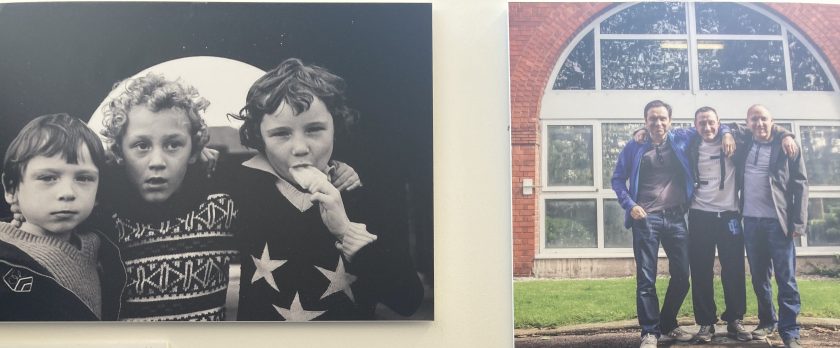
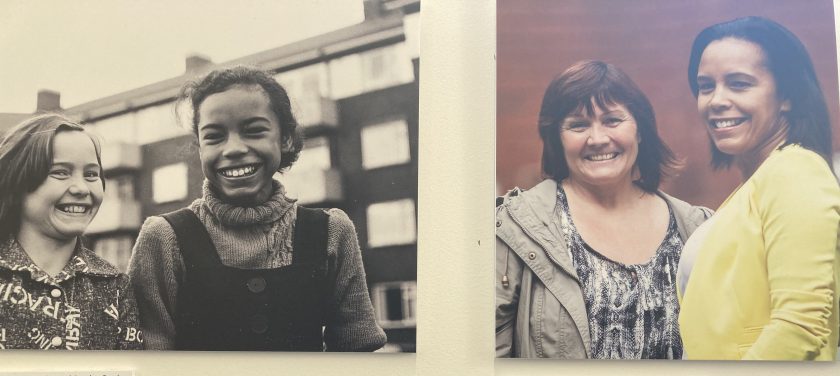
A great feature of the exhibition is the personal accounts of ‘Then & Now’, which compare people from the 1970s images, to more recent years in a side-by-side format.

Neil Williams (in the middle) grew up in Alexandra Grove, Salford and was 11 years old in the photograph. After high school he started dj-ing when he was 16 years old. Neil went on to work in the film industry and was involved in producing many films such as “The King’s Speech”. Now he runs a holiday business with his husband in south west France.

Three lads (then and now)
Michelle Darby and Sandra Opoku (then and now)

More photos can be seen here.

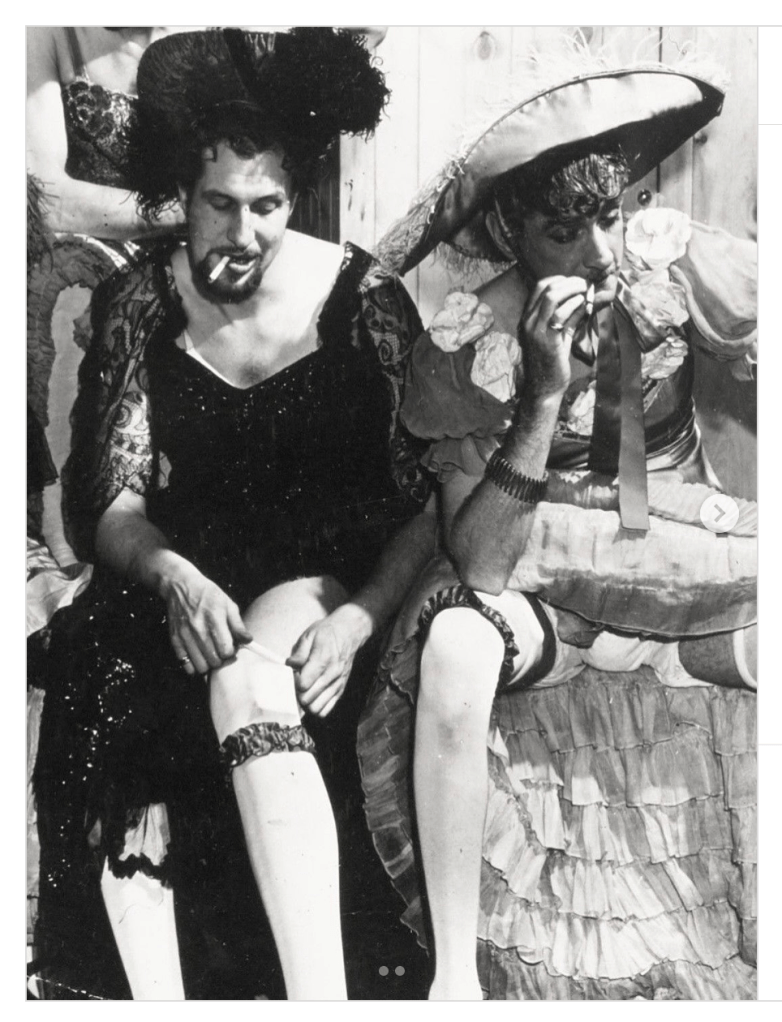
That time Vincent Price performed for the troops … in full drag

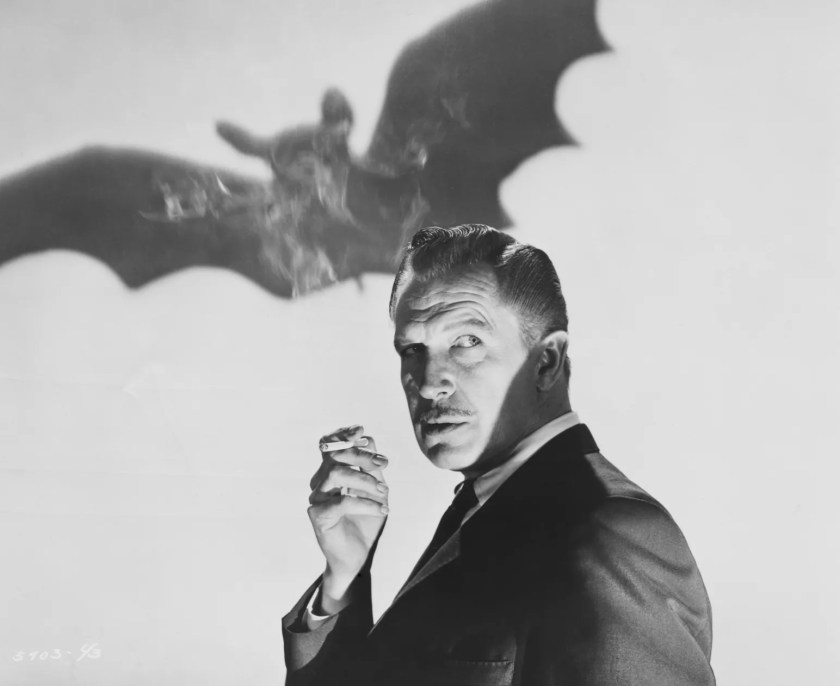
Vincent Price, the king of campy horror, was born on 27 May 1911.

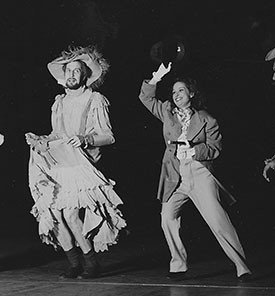
During the 40s, it was common for Hollywood stars to go all out for the army and navy, even flying overseas to perform stage shows for the soldiers. Vincent Price also showed up for the troops during WWII, before his horror career took off … and he did it in drag.

Price’s act was followed by a segment where Tallulah Bankhead, Gertrude Lawrence and others dressed up as men. Because in the past, drag wasn’t seen as an evil threat to gender values: it was seen as a fun time for everyone, including the guys fighting overseas.

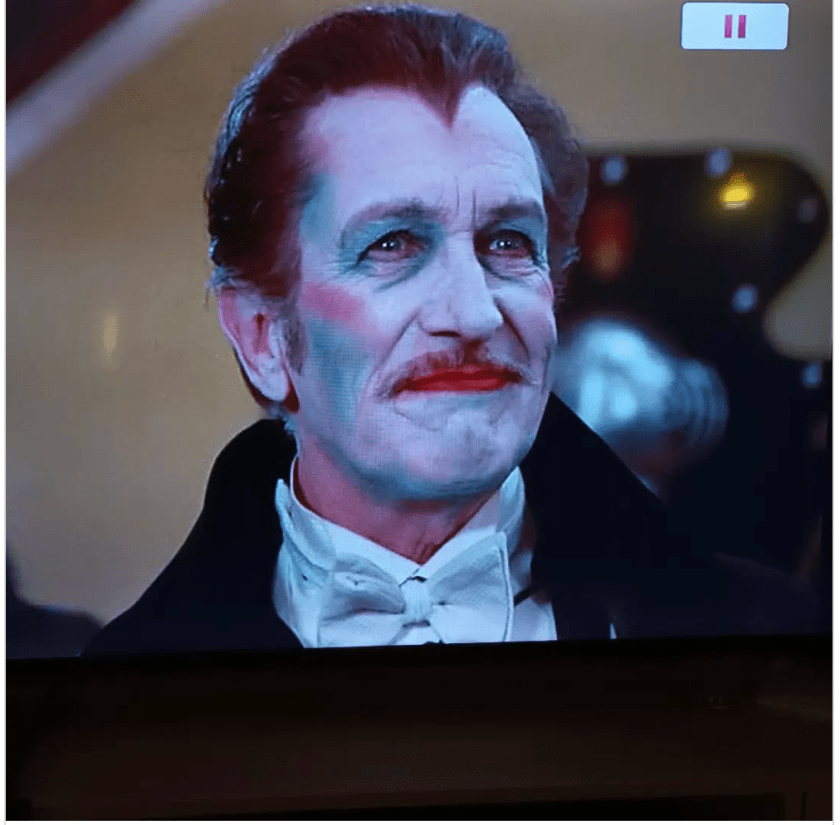
For an appearance in the 70s show “The Snoop Sisters,” Price rocked full vampire drag and wore the colours of the trans pride flag on his face – totally unintentionally, we’re sure.

Vincent Price’s daughter confirms her famous father was totally bisexual.

In her 1998 book Vincent Price: A Daughter’s Biography, Victoria Price explored the many facets of her famous father. While Victoria addressed the persistent rumours surrounding her father’s sexuality, she refrained from offering a definitive opinion on the matter.

She is well aware of America’s fixation with celebrity and the salacious, news-driven, “who had sex with who?” culture in which we live. But she also realises as a member of the lesbian, gay, bisexual and transgender community that there remains a deeply rooted yearning for history and heroes and a personal connection to the past.

“Since I didn’t hear it from his mouth, I think that everything I hear comes with a measure of hearsay, right?” she said.

“But I would like to say something here because I might as well,” she continued. “I am as close to certain as I can be that my dad had physically intimate relationships with men. I know for 100 percent fact that my dad was completely loving and supportive of LGBT people.”

Growing up in their Hollywood Hills mansion, Victoria recalls the constant presence of LGBT+ folks at family gatherings.

“Now, we lived across the street from Rock Hudson and we had a lot of gay friends growing up,” she recalled. “I mean, “Uncle Rupert and Uncle Frank” came to every dinner party and it was very clear that they were together. And while the word gay was never mentioned, it was very much the norm.

I remember at nine-years-old going to drop something off at Rock Hudson’s house – of course, I was super excited because I was a huge Rock Hudson fan,” she continued. “So this absolutely beautiful man came to the door and in my nine-year-old mind, I thought, oh, that’s – I don’t know if I had a word for it – but that’s his ‘Uncle Frank or Uncle Rupert’, right?”

Victoria recalls her father’s 1977 one-man-show where he played the openly gay Oscar Wilde to great acclaim and rebuffed the antigay Anita Bryant efforts of the day. In television interviews, Vincent Price said Wilde had already written a play about Ms Bryant: A Woman of No Importance.

She remembers her father as an early advocate who joined PFLAG as an honorary board member and was one of the first celebrities to do public service announcements quelling public fears of AIDS.

Amnesty International

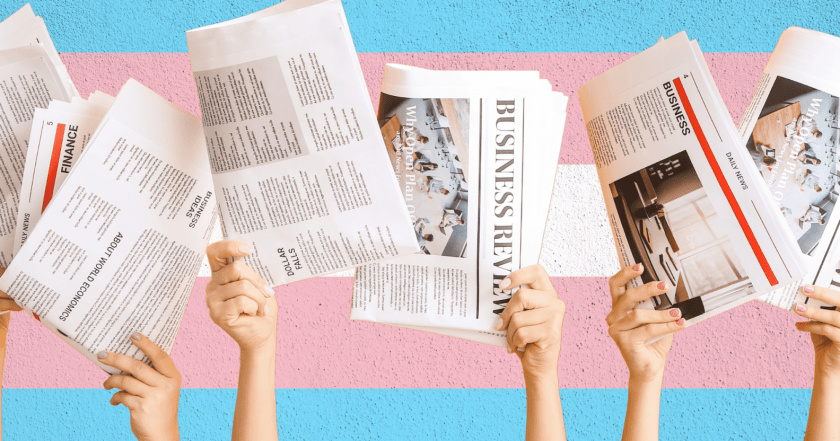
A major new report from Amnesty International has revealed the disproportionate scale of media coverage of trans people in the UK, despite trans communities representing just 0.5% of the population.

Analysing UK media coverage between January 2020 and April 2025, Amnesty found that four major UK news outlets produced almost 17,000 articles on trans-related issues, averaging 9 stories per day.

Researchers argue that the scale of reporting far outweighs both public interest and the actual influence trans people hold within British society.

Amnesty’s findings suggest that much of the coverage across the British press has been overwhelmingly negative, frequently framing trans people as controversial.

Researchers argue that this constant cycle of reporting has helped elevate debates around sex and gender into a defining political issue, despite evidence suggesting voters care far more about the cost of living, housing, and the NHS.

A Brief History of Lesbian Flags

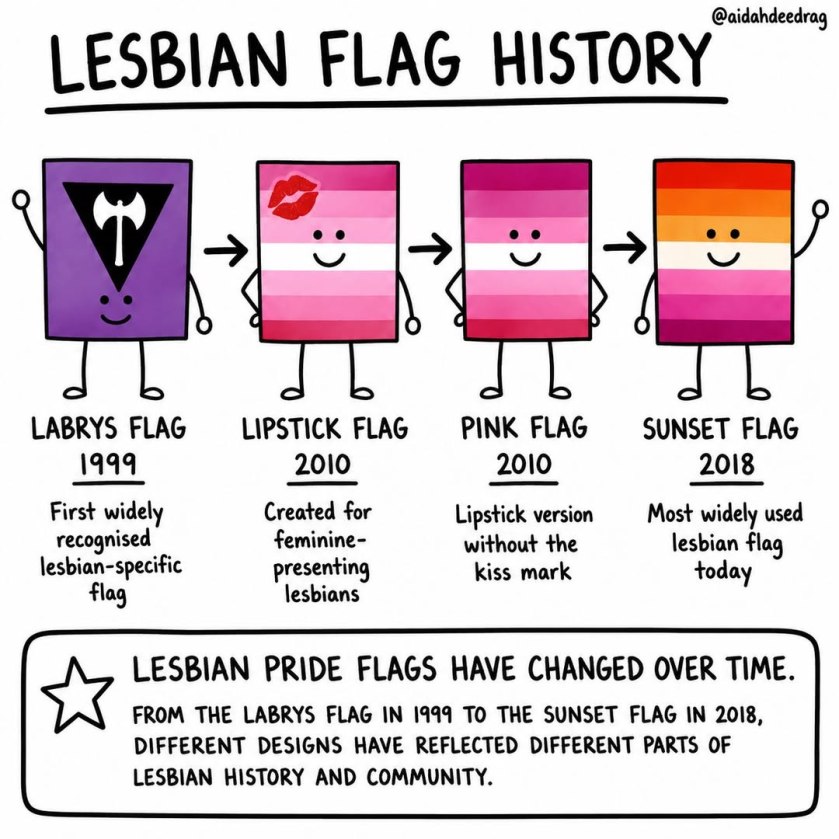
The lesbian community has used several different pride flags over the years. While the orange-pink flag is the most widely recognised today, it was preceded by other designs that reflected different ideas about lesbian identity, visibility, and community.

1999: Labrys Lesbian Flag

The Labrys Lesbian Flag was introduced in 1999. It features a white labrys (double-headed axe) inside a black triangle on a purple background. The labrys had become a symbol of lesbian strength and empowerment. The black triangle references a symbol later reclaimed by some lesbians. Purple has long been associated with lesbian culture.

2010: Lipstick Lesbian Flag

The Lipstick Lesbian Flag was designed for feminine-presenting lesbians. It features shades of pink and red and included a lipstick kiss mark. The design became popular online in the early 2010s.

2010: Pink Lesbian Flag

A variation of the Lipstick Lesbian Flag.

The lipstick mark was removed while keeping the pink striped design. It continued to be used by some lesbians throughout the 2010s.

2018: Orange-Pink Lesbian Flag

The orange-pink lesbian flag was designed to represent a broader range of lesbian identities and experiences. The original seven-stripe version assigned meanings to each stripe:

• Dark orange: Gender non-conformity

• Orange: Independence

• Light orange: Community

• White: Unique relationships to womanhood

• Pink: Serenity and peace

• Dusty pink: Love and sex

• Dark rose: Femininity

This design became the most widely used lesbian pride flag during the late 2010s and 2020s.

It’s Pride Season: Play the Rainbow Lottery and support Out In The City

The Rainbow Lottery is the UK’s first and only lottery supporting LGBT+ good causes.

Welcome to the Rainbow Lottery, the exciting weekly lottery that raises money for over 200 LGBT+ good causes totally, openly and exclusively.

The hope is to make a difference to good causes so they can carry on their vital work – which helps us all. Play the lottery, support the community – it’s fun, it’s simple and everybody wins!

How the lottery works:

  • £1 per ticket – that’s right, unlike many other lotteries, the lottery tickets are only £1 per week.
  • For every ticket you play, 80% goes to good causes and prizes.

£25,000 jackpot prize

  • Match all 6 numbers and you win the JACKPOT! There are also prizes of £2000, £250, £25 and 3 free tickets for following week.
  • Every month there is a Super Draw. May’s Super Draw is a £1,000 IKEA Gift card (or £1,000 cash alternative or plant 1,000 trees).

Buy tickets here.