
The Scandal that Shook the German Empire
Germany’s last emperor, a gilded porcelain vase and a general who had a heart attack in a pink tutu: The Eulenburg Affair shook the German Empire to its core and paved the way for the downfall of the monarchy.
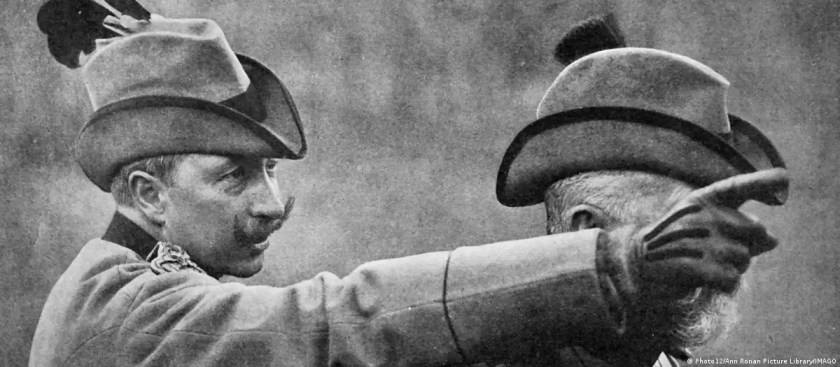
Image: Photo12 / Ann Ronan Picture Library / IMAGO
Embellished with a gilded iguana and a bouquet of fruits topped with a pineapple, an ostentatious piece of queer history was sold on 24 April 2026 for €300,000 (£260,000) at the Berlin branch of Germany’s Lempertz auction house. The just over 116-centimeter-tall porcelain vase is thought to have been made as a gift from Kaiser Wilhelm II, the last emperor of Germany, to his friend Prince Philipp of Eulenburg-Hertefeld.
Little known about today, the relationship between the Kaiser and the prince was at the centre of a scandal, the so-called Eulenburg Affair, that shook all of Europe to the core and transformed public opinion on the monarchy.
Wilhelm II ascended to the German throne in 1888. As Kaiser, Wilhelm had a reputation as a feckless, insecure and erratic leader obsessed with his own press coverage, who developed increasingly authoritarian tendencies.
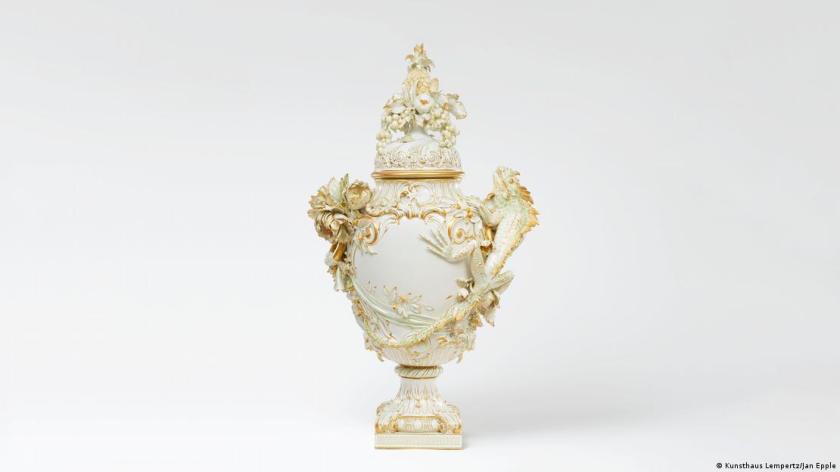
Image: Kunsthaus Lempertz / Jan Epple
Eulenburg was a diplomat who quickly rose to become the Kaiser’s most important extra-parliamentary advisor. He often hosted hunting and artistic retreats for a close circle of friends at Liebenberg castle, north of Berlin. As would later be revealed in court, members of that circle would refer to Eulenburg as “Phili” or “Philine” and Kaiser Wilhelm as “Liebchen” (“sweetheart”).
It also became clear that they cultivated a cult of neo-romantic male friendship, and their correspondence was filled with seemingly homoerotic attestations of friendship.
Scandalous plot to bring down the monarchy
The Liebenberg group of friends was despised by the Kaiser’s many critics who framed them as sycophants who abused their proximity to the Kaiser to influence policymaking.
Those critics included influential Berlin journalist Maximilian Harden, an ardent German nationalist. He was convinced that the German threat to go to war with France over Morocco during the First Moroccan Crisis (1905-06) had been brushed aside as a bluff by the French based on information leaked to the French ambassador at a Liebenberg hunting party.
Harden thought there needed to be a way to implement change and he was quite cynical in that he thought that the only option he had, as a journalist and publisher, was to scandalise these people with the aim of bringing them down.
On 17 November 1906, Harden published an article entitled “Prelude” in which he accused the Kaiser’s entourage of having “spun threads from invisible quarters, threads that make it difficult for the German Reich to breathe.” He singled out Eulenburg in particular as a corrupting influence. They “don’t dream of a world in flames, they are warm enough already,” wrote Harden in his widely read and very influential weekly journal Die Zukunft. “Warm” was common slang for homosexual at the time.
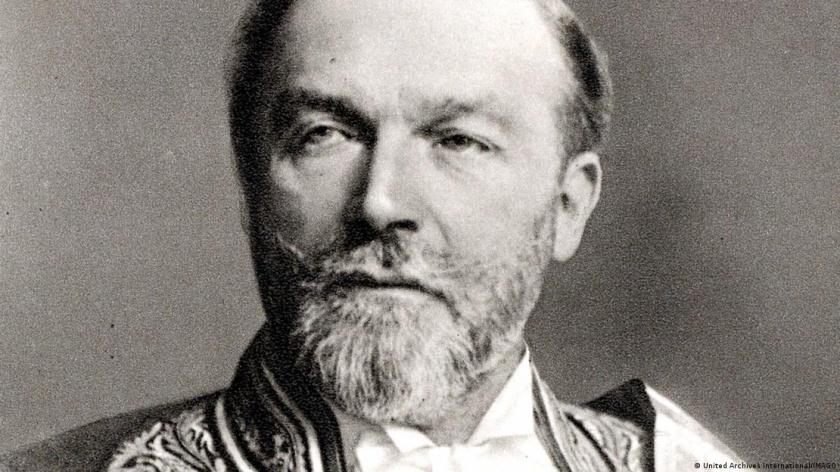
Image: United Archives International / IMAGO
Eulenburg promptly left Berlin for Switzerland, supposedly for “health reasons.” But he could not keep away for long and returned to Berlin in 1907, infuriating Harden.
What followed was a series of court martials and public trials that drew worldwide attention and resulted in a scandal with an impact comparable to the 1895 trial of Oscar Wilde in England for “gross indecency” and the Dreyfus affair, which began in 1894 and which came to symbolise injustice and antisemitism, in France.
The scandal divided German society. The German Empire, which was outwardly so pompous and ostentatious, inwardly was such a weak and unstable entity, with huge differences between north and south, east and west. The scandal cracked those divides wide open.
One of the most sensational trials of the Eulenburg affair involved General Kuno von Moltke, who would eventually resign from his role as city commandant, responsible for Berlin’s military security, and sue Harden for libel. In the Berlin courtroom, Harden said von Moltke, who was apparently known as “Tutu” among the Liebenberg circle, liked to wear rouge and “striking costumes” such as kimonos and long skirts at home.
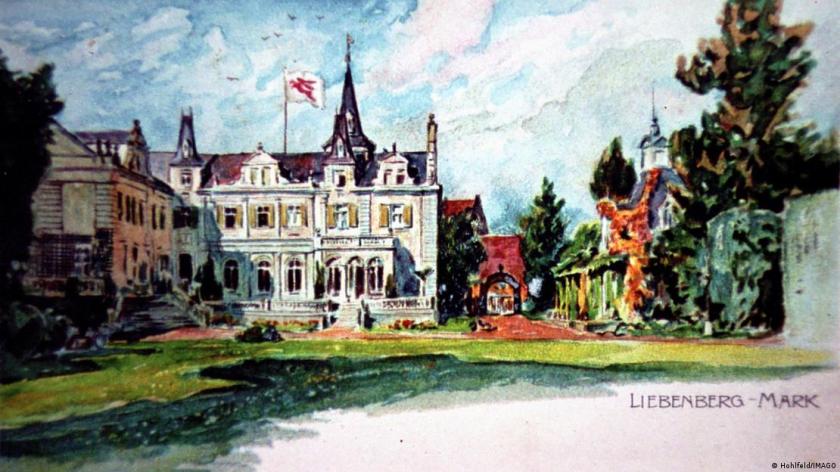
Image: Hohlfeld / IMAGO
During the trial von Moltke’s ex-wife, Lili von Elbe, sensationally blamed the commandant’s close friendship with Eulenburg for the failure of her marriage and claimed von Moltke refused to share a bed with her.
Harden also brought in sexologist Magnus Hirschfeld to give expert testimony on the issue of Moltke’s sexuality. In 1897, Hirschfeld had founded the Scientific-Humanitarian Committee in Berlin, the world’s first homosexual rights organisation. His assessment, based on his observations in the courtroom, was that von Moltke had a feminine side and displayed “unconscious homosexuality.” Harden was acquitted.
Hirschfeld’s theories about gender and sexuality, brought to wider public attention by the trial, were groundbreaking at the time. For him, sexual orientation was an innate, natural biological trait and not a lifestyle choice, an illness or a crime. In a sense it’s an early version of the ‘born this way’ concept, as various emancipatory movements have since asserted.
Important part of queer history
Long before its Weimar heyday, Berlin had already garnered a reputation as the party capital of Europe with a vibrant queer scene. At a time when sexual acts between men were criminalised under Paragraph 175 of the German Criminal Code, the city even had a special police unit – not to prevent homosexual activity, but to protect high-ranking members of society from potential blackmailers.
The Eulenburg Affair had unintended consequences for Berlin’s gay scene. It ultimately led to more homophobia, the pervasive idea of ‘degeneracy’ of homosexuals defined as effeminate men and debates about the tightening of Paragraph 175 – which the Nazis decades later in 1935 implemented – and ultimately on gay men’s freedom to live their sexuality.
Homosexuality also became associated with a lack of patriotism and even treason. In 1908, the New Yorker Staatszeitung, an important voice for Germans in the US, even recommended a “bright and cheery little war” to rid Germany of homosexuality.
In a grim foreshadowing of Nazi Germany, the press also spewed antisemitic invective against Harden, his lawyer Max Bernstein and Hirschfeld. “We cannot allow this German man [von Moltke] to be dragged through the mud by Jewish fellows,” raged German daily newspaper Die Staatsbürgerzeitung.
The scandal destroyed Eulenburg’s reputation and he was later the subject of a defamation case brought by Harden. During that trial, an elderly fisherman and a petty criminal testified to having had sexual relations with the prince in their youth. After he collapsed in court in 1909, Eulenburg was regularly found by court physicians to be too ill to stand trial. He was shunned by friends until his death in 1921.
The Liebenberg circle of friends continued to gather around Kaiser Wilhelm II, who was never far from a scandal.
During a hunting dinner at Donaueschingen palace in 1908, a Prussian general, Dietrich Graf von Hülsen-Haeseler, the head of the Kaiser’s military cabinet, dropped dead of a heart attack while waltzing. By some accounts, he was dressed in the hostess’ ballgown and a hat adorned with peacock feathers, by others, in a pink tutu and a crown of roses.
The incident caused the Kaiser, who was already under pressure after the publication of very undiplomatic comments about the British, to suffer a nervous breakdown.
He was ultimately sidelined by the military during World War I and abdicated the throne in 1918. The last emperor of Germany, he died in exile in the Netherlands in 1941.

European Parliament backs EU-wide conversion therapy ban
On 29 April the European Parliament voted in favour of banning so-called conversion therapy across the European Union.
Conversion therapy is a broad term which refers to several practices (eg talk therapy, physical abuse or aversion therapy) that attempt to change a person’s sexual orientation or gender identity.
ACT (Against Conversion Therapy) LGBT launched a campaign in 2024 in support of the ban through the EU’s European Citizens Initiative framework. More than 1.2 million people ultimately signed it.
The proposed ban had the support of 405 MEPs. The European Commission, the EU’s main executive body that can introduce the legislation, is expected to formally respond by 18 May.
Seven EU countries – Belgium, Cyprus, France, Malta, Norway, Portugal and Spain – have banned conversion therapy outright.
In 2022 Greece banned the practice for minors. In 2020 German lawmakers passed a law that prohibits conversion therapy for minors and for adults who have not consented to undergoing the widely discredited practice.
The UK failed to bring forward a ban ahead of the end of the Parliamentary session as promised in the Kings Speech.
Pride in Trafford (12 – 17 May 2026)
Pride in Trafford explores and celebrates both identity and LGBTQ+ life in Trafford. The work aims to challenge and entertain, taking a queer art focus over a more traditional pride format.
The inaugural Pride in Trafford took place in 2019, with a strong commitment to diversity, telling stories and celebrating artists many of which are often under-represented and has since grown and developed into an important festival for Trafford and Greater Manchester attracting over 4,000 people annually.
The festival has become a driver for the creation of new work by LGBTQ+ artists and has supported artists such as Sam Danson’s BI-TOPIA, Hunter King’s A Northern Tr*nny Hootenanny and Holly Redford-Jones’ I Was Dancing in the Lesbian Bar, Violet Blonde and Cheddar Gorgeous.
For a day-by-day list of events, see here.
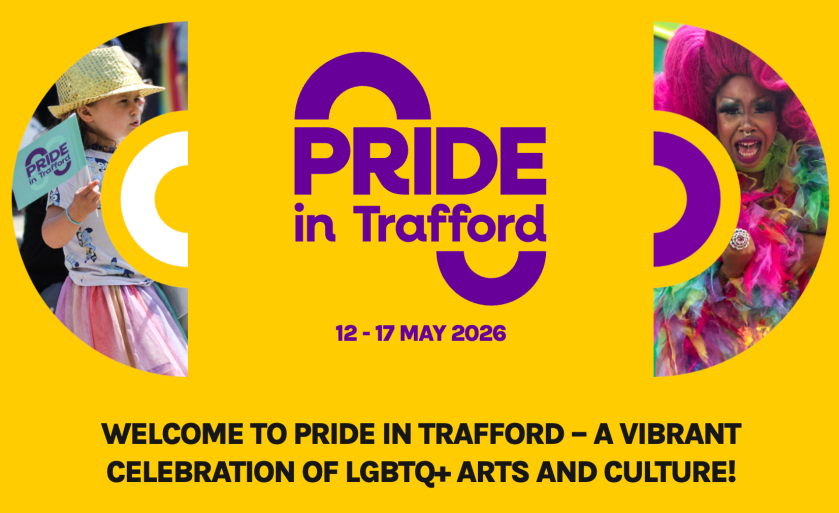
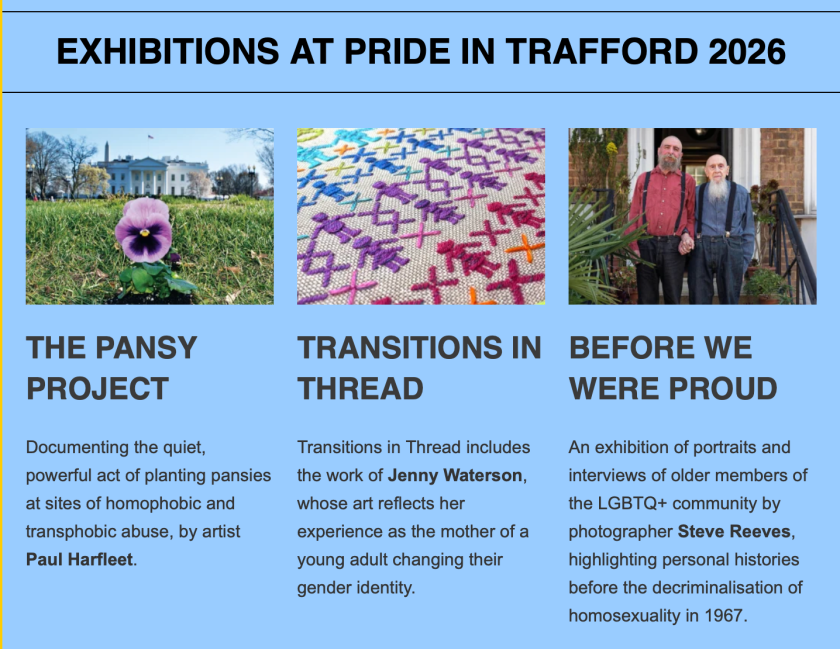
Out In The City will be visiting three exhibitions on Wednesday, 13 May. If you want to join us, please contact us here.
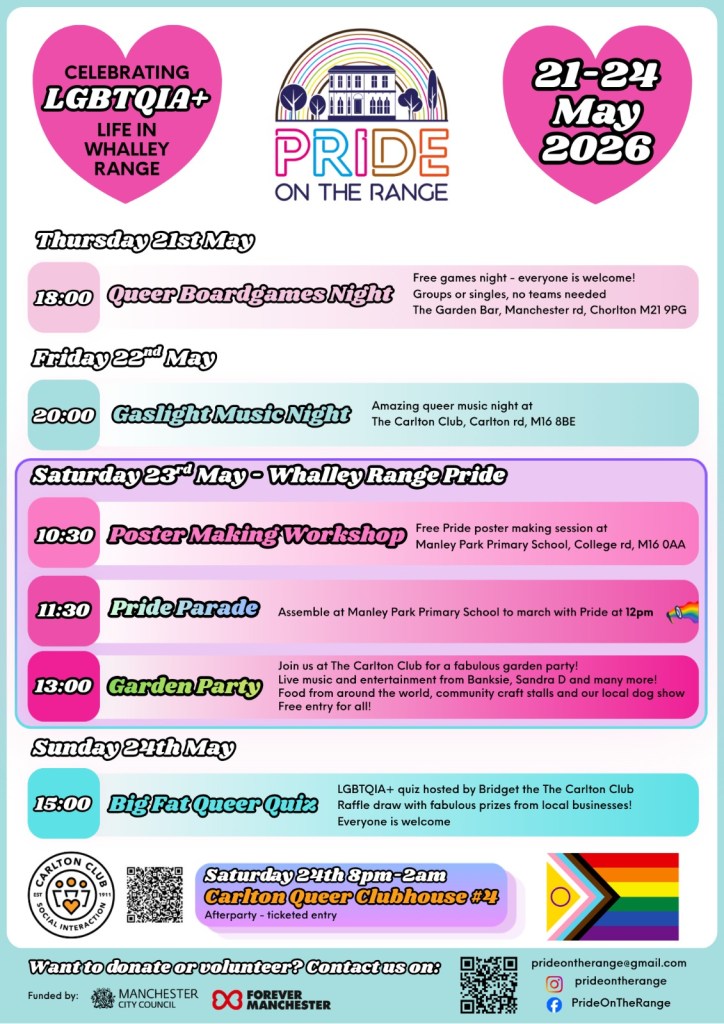
Pride on the Range (Whalley Range Pride) (21 – 24 May 2026)
Out On The Radio

Tuesday, 5 May – 2.00pm – 3.00pm – Out On The Radio
Show 6 on 96.9fm
Live and available on Mixcloud to listen again.
Norman and Tony are chatting and playing tunes.
 Out in the City