
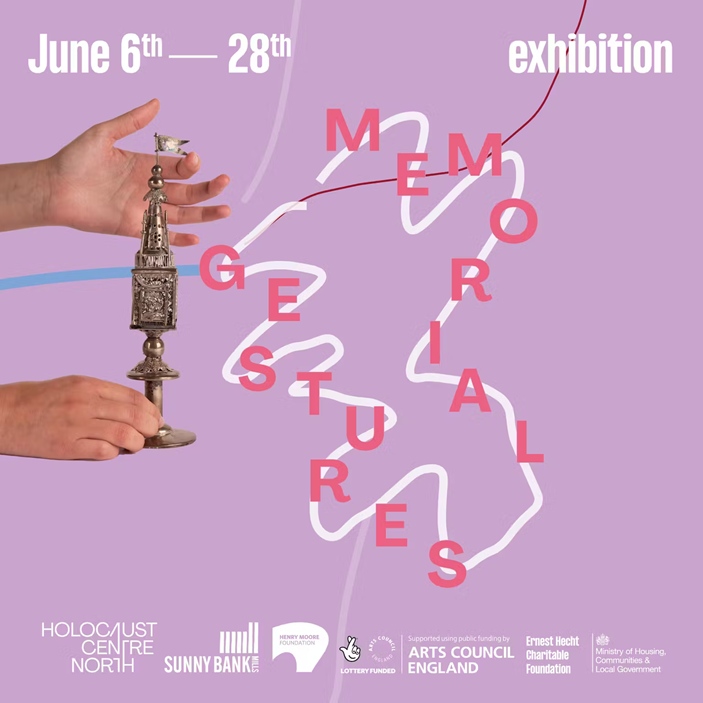
Holocaust Centre North Exhibition: “Memorial Gestures”
A group of us travelled to New Pudsey, with some difficulty due to delayed trains and cancelled taxis. But it was a very worthwhile day, although an exhausting one.
We had a lovely lunch at the Mill Café – most of us sat outside due to the warm weather, before making our way to the historic 1912 Mill.
The exhibition – “Memorial Gestures” – is the culmination of three years of a unique artist residency programme. In this time, 14 artists, writers, and translators have been invited into the Holocaust Centre North Archive to engage with the growing collection of personal papers and historical material.
Through textiles, video, ceramics, installation, drawing, photography, print, found objects and written word, these artists explore themes of migration, trauma, memory, hope, resilience and survival. Their work reflects a deeply personal engagement with history, forming a dialogue between past and present – one that gains resonance in today’s climate of rising antisemitism, authoritarianism and displacement.
Each artist brings a distinct voice and lens, shaped by their own identities, histories, and lived experiences. Exhibited together for the first time, their work invites a collective conversation not just among themselves, but with you, the audience.
One artist concentrates on the issue of gay men:
Paragraph 175 (Text by Matt J Smith)
Paragraph 175 was the legal code in Germany that persecuted same sex desire.
Gay men were assigned pink triangle badges within the camps.


Sachsenhausen camp was known for housing a disproportionately high number of gay men during the Holocaust. It had a subcamp called Klinkerwerk which made bricks.
The work conditions were lethal. Only partial records remain, including a list of 231 names of pink triangle prisoners who died there.
There are few records of pink triangle prisoners. Shame stopped many families reuniting with their pink triangle relatives. Seen as criminals, many pink triangle prisoners were sent directly from camp to prison when freed by the Allies to complete their sentence.

The photograph above shows 175 small clay brick tiles, each the size of an inmate’s number badge. On each tile I wrote the name of one of the 231 pink triangle men in pencil. Each man deserves to be remembered. When the tiles were fired, the graphite disappeared, and the record of their life also vanished.
Paragraph 175 was the law before the Nazis came to power. However, in 1935 they changed its remit so that more men could be targeted. Men could now be imprisoned for five years for a quick kiss or a touch that lingered too long. By 1944 no physical contact needed to have taken place, with just the intention of homosexual behaviour being enough to lead to incarceration.
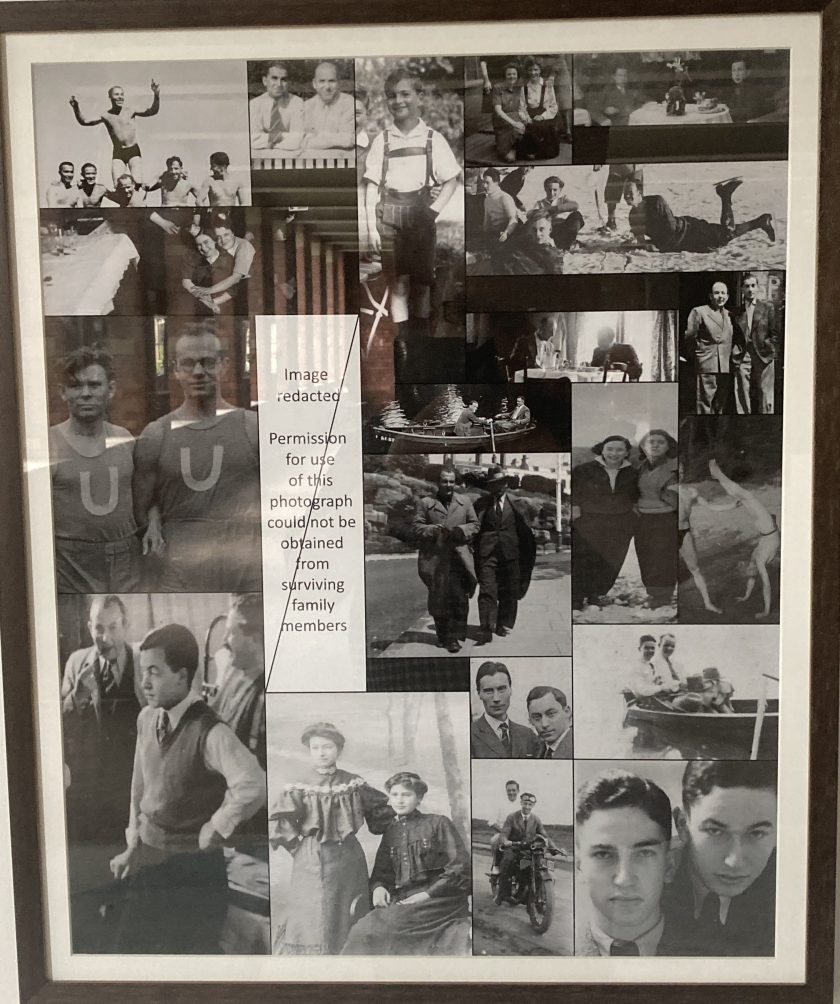
The photographs in the panel are all from the Holocaust Centre North Archive. While there is no suggestion that the individuals pictured here were gay, their gestures could be read – or misread – as expressions of same sex desire. I was interested in how even entirely innocent behaviour could be seen as suspicious, and how the persecution of one group could influence the behaviour of all. The images actually depict groups of friends, colleagues, brothers, sisters or cousins.
Unlike the pink triangle prisoners recorded on the tiles, the memory of the people in these images is carefully looked after by family members and the Archive. Permissions needed to be sought to use the images, and we were unable to clear permission for one of the chosen images. Its intended location is left blank.
Some pink triangle prisoners were offered potential early release from the camp if they agreed to castration.
The 1935 iteration of Paragraph 175 remained in the West German criminal code until 1994.
More photos can be seen here.

Barry Manilow was ‘insulted’ by public reaction when he came out as gay at 73 in 2017
Barry Manilow (born 17 June 1943) was finally ready to take a chance when he officially came out in 2017.
After decades of keeping his sexuality private, the music legend, then 73, opened up about being gay in a People magazine cover story.
But Manilow was surprised at the reaction to his revelation – or lack thereof.

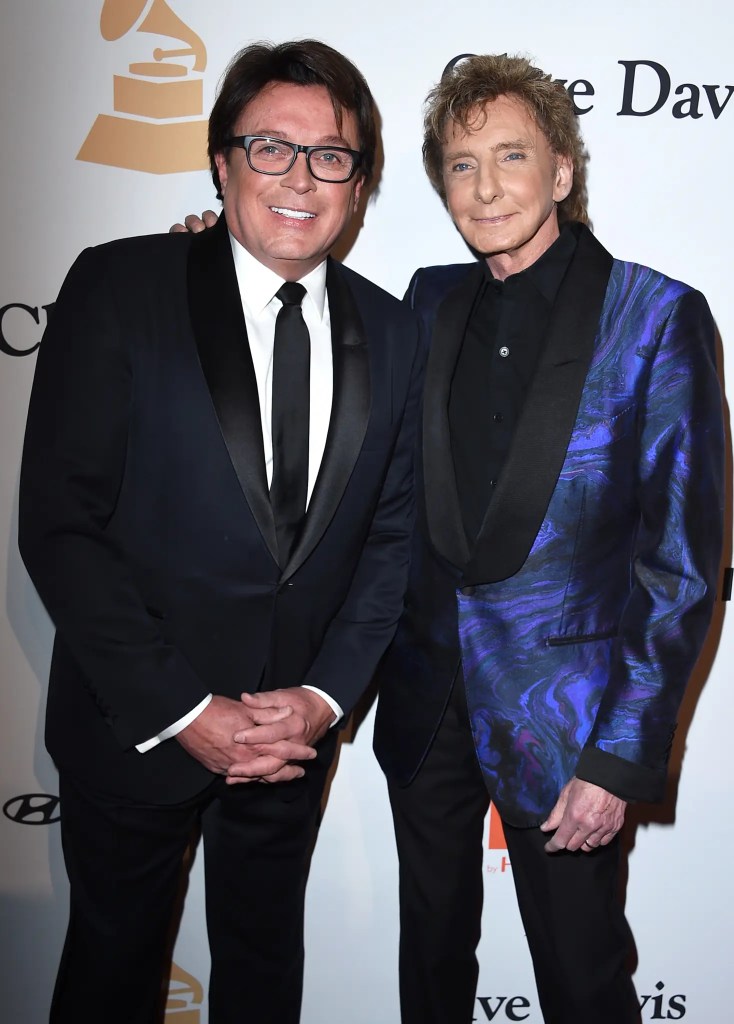
“You know, it was a non-event,” the Brooklyn-born singer, 82 tomorrow, said. “I was kind of insulted. I thought it was gonna be a big deal. Oh my God, it was nothing,” he continued. “Nobody said anything about it.”
However, Manilow chalks it up to his fans not really being surprised.
“At that point, they all knew immediately,” he said. “They liked my music, they liked me. And they were happy that I had somebody to come home to.”
That somebody is Garry Kief, Manilow’s husband and manager. In the 2017 People magazine story, the “Can’t Smile Without You” crooner revealed that the couple secretly got married in 2014 after being together since 1978.
“We’d been together for so long and then, you know, we were able to get married, and it was no big deal,” he said.
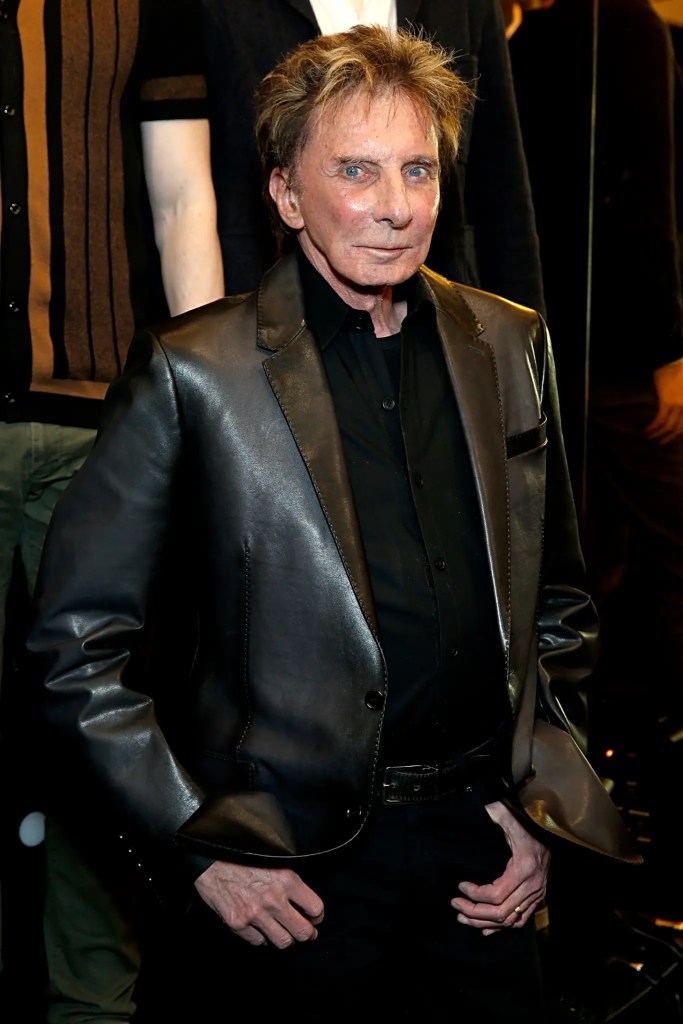
But Manilow admits that sharing this love story would’ve been a much bigger deal when he was topping the charts with hits such as “Mandy,” “I Write the Songs” and “Looks Like We Made It” in the ’70s.
“You couldn’t come out back then. I didn’t want to. I didn’t care about it,” he said. “All my friends knew. And I think as the years went on, all of my fans knew. But you just didn’t talk about stuff like that back then.”
But Manilow is happy that things have changed for today’s generation of pop stars to come out.
“Well, you can do that now,” he said. “When I started off, you couldn’t. It would ruin your career. You couldn’t even say the word ‘gay.’ ”

It makes it all the more impressive that Manilow and his husband have been together for 47 years.
“You know, Garry’s got his own career, and I’ve got my own career, and we respect each other. It’s a great relationship.”
That kind of longevity extends to Manilow’s six-decade career. After getting his start doing jingles and accompanying artists such as Bette Midler on piano, he made his self-titled debut in 1973.

And, although Manilow is launching a farewell arena tour, he’ll still perform at his Radio City and Las Vegas residencies.
200-year-old condom ‘in mint condition’ says museum
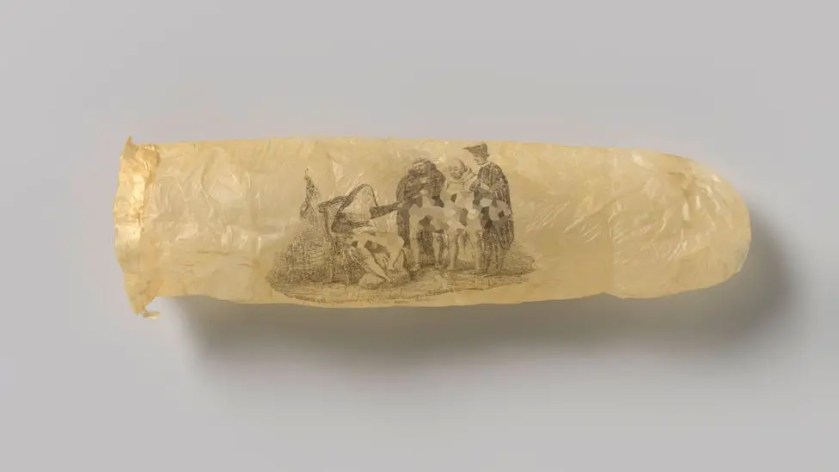
The sheath is dated to about 1830, the museum says
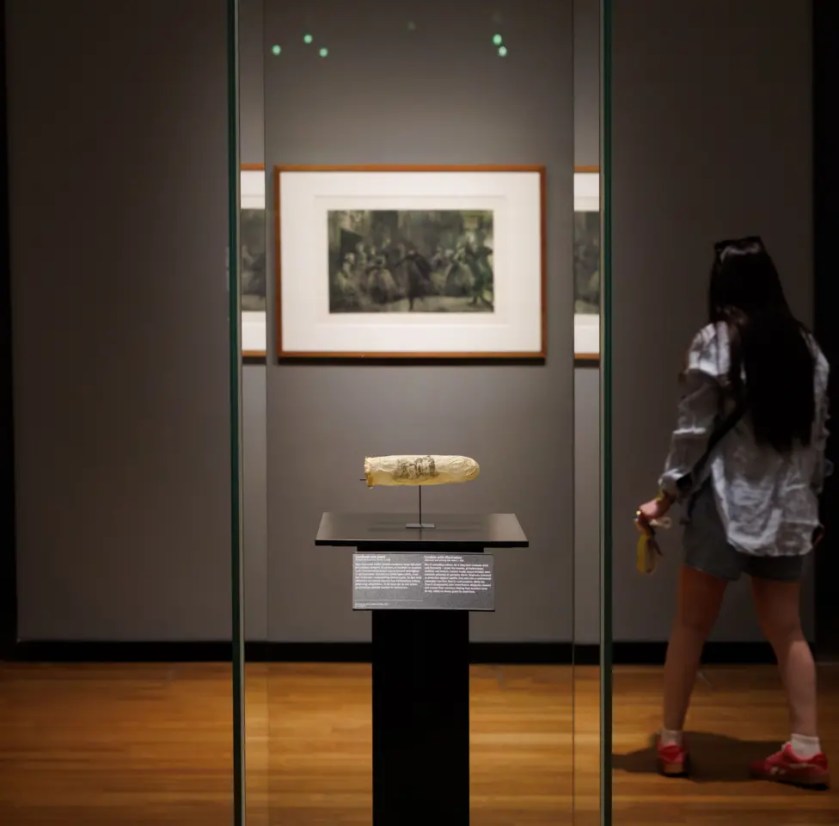
An almost 200-year-old condom – in “mint condition” – has just gone on display at an exhibition at the Rijksmuseum in Amsterdam.
It is thought to be made of a sheep’s appendix and features an explicit print representing a nun and three clergymen.
The rare artefact dates back to 1830 and was purchased by the museum at an auction last year. The condom is part of an exhibition on 19th Century prostitution and sexuality. Prints, drawings and photographs also form part of the display.
Rijksmuseum curator Joyce Zelen confirmed that after obtaining the item, they inspected it with UV light and ascertained that it had not been used.
Since it was put on display the museum has been packed with people – young and old – and the “response has been amazing”, she added.
Ms Zelen explained the condom is believed to have been a “luxury souvenir” from a fancy brothel in France, and that only two such objects are known to have survived to the present day.
The museum said the unusual item “embodies both the lighter and darker sides of sexual health, in an era when the quest for sensual pleasure was fraught with fears of unwanted pregnancy and sexually transmitted diseases – especially syphilis”.
The explicit print on this specific object shows the nun sitting in front of the three men with her dress up and her legs apart pointing her finger at the clergymen, all of whom are standing in front of her holding up their habits.
The condom also bears the inscription “Voilà mon choix”, meaning “There is my choice”.
It will be on display until the end of November.
AIDS Quilt on Display
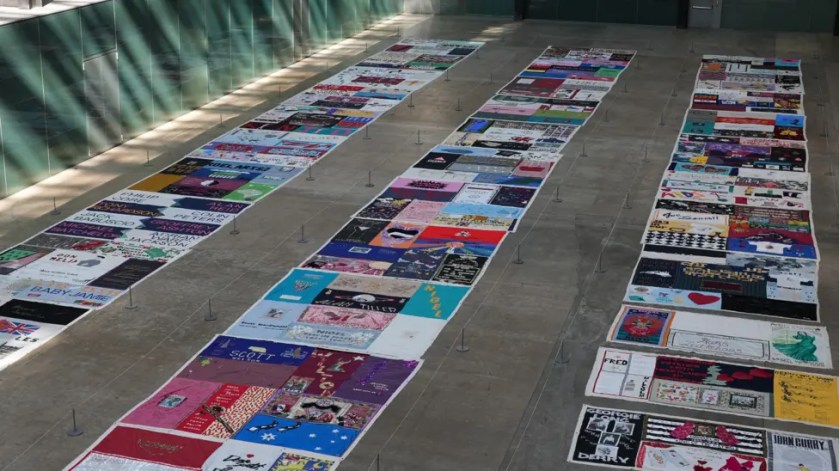
Brave and beautiful people are being remembered as part of the UK Aids Memorial Quilt, a patchwork creation of 42 quilts and 23 textile panels representing 384 people who lost their lives to HIV/AIDS in the UK, made by the people who loved them.
The huge quilt will be on display in the Tate Modern’s Turbine Hall in London between 12 and 16 June. Although different parts of it have been on display before, the showing at the Tate will be the largest public display of the quilt in its entirety since it was created in 1994.
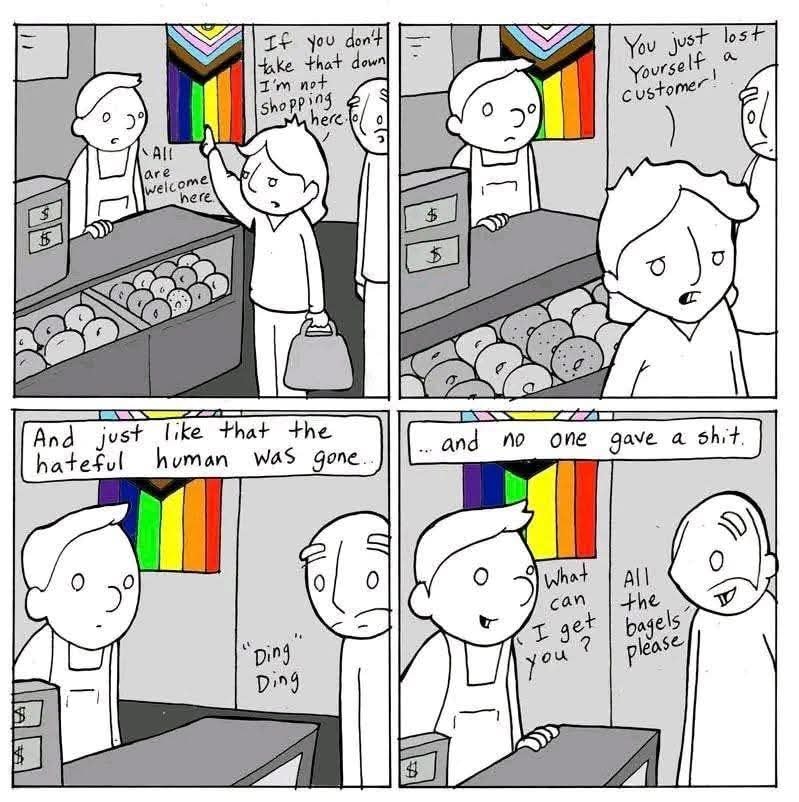
All Are Welcome Here
 Out in the City
Did anybody else get this item on their newsfeed, with the simple truncated heading “…Barry Manilow 200 years old…”? It did make I grin!
LikeLike
Ha ha! It wasn’t intentional.
LikeLike