“Gay Shame”
In this LGB-minus-T “sex realist” book Gareth Roberts says accepting trans people is “Gay Shame”.
Review by Tucker Lieberman, originally published in Prism & Pen

Gay Shame: The Rise of Gender Ideology and the New Homophobia was released on 25 April 2024 by Forum, which publishes other anti-trans books too.
Another ‘spiked’ Writer Has an Anti-Trans Book
This time, it’s the London-based Gareth Roberts.
Doctor Who fans may recognise him as a writer for that show, although due to 2017 tweets that disrespected several trans women, he was dropped from a 2019 Doctor Who anthology. He also wrote for the soap opera Emmerdale and writes for the Spectator and UnHerd. In his new book, he brings up the soap opera Coronation Street, for which he also wrote.

Roberts is gay. He prefers the word “homosexual” as he perceives it to de-emphasise identities (which are cultural) and re-centre genitalia (which are biological). He’s cis, though the word appears only three times in his book, and only in quotations of others’ words; once, he appends a Latin “sic” to show he doesn’t like the term. He’s not trans, that’s all I mean.
Scan the headlines of his spiked columns over the past couple years (To hell with Pride Month / Your sexuality doesn’t make you special / Joan of Arc was not ‘nonbinary’ / No, Jesus was not trans / There’s nothing ‘homophobic’ about the word ‘homosexual’ / Meet the mean boys of trans activism) for a sense of how he feels about being gay and about other people being trans.


In his sparse endnotes and his recommended reading are some names I recognise, including: MP Rosie Duffield, Hadley Freeman, Suzanne Moore, Sonia Sodha, Abigail Shrier, Hannah Barnes, Helen Staniland, and Kellie-Jay Keen. Also, Jonathan Haidt, who always seems to come up in these contexts. In the acknowledgments, he lists Helen Joyce, Kathleen Stock, and Graham Linehan. Of course, he counts J K Rowling among “the most reasonable and rational people.”
He mentions Judith Butler only to say they’ve “elevated bullshit to something higher than an art form.”
Roberts defines “genderism” as “the ideology that advocates the misty concept of gender identity” over “the reality and importance of sex.” What some call “gender identity” is, to him, “the mysterious sexed soul of a person.” His position, which he calls “sex realism” (preferring that term to “gender-critical”), rejects any such thing as “gender identity.”
What’s his tone? His glossary ends with: “Woman: An adult human female. So there.” He acknowledges that everyone resists some gender stereotypes, and wants to let queer people know we’re not special: “Declaring yourself ‘non-binary’ is like demanding to be recognised as noteworthy because you’ve got a bumhole.”
Roberts refuses to engage the academic work or even the mere existence of trans people; he briefly name-drops only a couple prominent trans women, while the only trans man he names is a deceased murderer. Meanwhile, gay trans men, he assures his readers (stage whispering in the presence of this one who’s a gay trans man), are “very little discussed” and “much less known.”
In short, this is an ordinary “sex-realist” book: deliberately insulting, repetitive, and hanging on very few facts about anything. One thing I’d like to note about Gay Shame, though, is the timeline he’s more or less borrowed from the other “sex-realist” writers. To learn why the “sex-realist” narrative is shallow and false, take a look at this illustrative timeline.
Why the Timelines of “Sex Realists” Interest Me
“Sex realists,” also known as “gender criticals,” like Roberts, generally believe that trans identities are delusional and that trans people‘s genders are fake. A major problem for their position is that trans people exist and live alongside everyone else in ways that are demonstrably coherent.
The way the sex realists bridge this narratively is by claiming that transsexuals were once an infinitesimally small and medically pathologised segment of the population – hidden from view, kept within safe parameters, and leading lives of no importance – until one day c. 2012–2015 when large numbers of people suddenly became inappropriately trans, posing a threat to humanity. The pre-2012 history tends to be exaggerated into the idea that no one had ever heard of trans people, which in turn is fallaciously reduced to therefore, trans people did not exist.
This timeline always fascinates me for three reasons:
- I transitioned in the late 1990s. I have memories of doing so and of the many other trans people I met at that time. Is the sex-realist claim that no trans people existed in any interesting or meaningful way until I was 15 years post-transition? That’s plainly false. They aren’t merely disputing a fact or two; they’re committing outright historical denialism of my life.
- Any narrative that says trans people didn’t exist before 2012 is going to trip over the fact that we did. The narrative will work hard to minimise our existence or to contextualise it away. Then, it will struggle to account for the spontaneous generation of trans people post-2012. Furthermore, if trans people are understood to be fake, the narrative will struggle to explain how everyone else is able to perceive us and talk about us. In general terms, this is the problem of writing history and criticism on a subject you believe is inauthentic or nonexistent.
- These days, more people are transitioning at younger ages, yes. The “sex-realist” narrative anticipates that most of these children and young adults will change their minds and profoundly lament their choices. The “sex realists” are banking on many making noise for the anti-trans side when they turn 18. A few years ago, “sex realists” set up a deadline for this. Unfortunately for them, it’s coming due right about now and it’s not proving their point. The thousands of angry, regretful young transitioners they prophesied for the mid-2020s have yet to materialise.
The ‘Genderism’ Timeline, According to Gareth Roberts
Here’s the timeline Roberts presents.
1970s and 1980s
Once, there was “playful, productive gender-bending of the 1970s and ’80s.” There was “gay low culture,” which he found more interesting than “gay high culture,” with its “ring of truth,” as long as it was not put “on a pedestal.” He liked comedic drag, a “fun” sort of “disguising” and “gender-bending, etc.” that assumes it’s impossible to change sex, but he wants nothing to do with glamorous drag that’s more “trans” and appeals to a feminine ideal that, in his opinion, isn’t based in reality.
1988
Roberts claims that the UK’s anti-gay law Section 28, though it was “a bad thing” that no gay men supported, wasn’t that big a deal. After it passed in 1988, “nothing happened.” It was law for 16 years and “was never used. Not once.” Gay culture and politics thrived, so it had no “chilling effect.” “Section 28 barely registered at all,” he says, though he quickly undermines his own position with this anecdote: In 1995, another columnist for Doctor Who Magazine “mentioned his boyfriend” in print, and fellow contributors fretted that “this will get us banned from WHSmith!”
2004
Then, “in the noughties in the UK,” he says, “transsexuals were doing very well.” He gives just two examples, both from television: “Nadia (Almada) won Big Brother in 2004; Hayley was a firm Coronation Street favourite.” Nadia is a trans woman who appeared on one season of a reality show; Hayley is fictional.
Regarding the latter, Roberts is mostly eager to remind us that he wrote for the British soap opera Coronation Street, where he had “a small hand in creating” the long-term character of Hayley Cropper, a trans woman who married the character Roy Cropper and was on-air 1998–2014.
Anyway, the UK 2004 Gender Recognition Act seemed reasonable at the time, according to Roberts, maybe for him while he was writing a nice trans woman for television, but in retrospect he says it “was like a bomb left behind by a fleeing army of occupation, timed to go off many years later releasing a shrapnel cloud of unintended consequences.” Where the public once felt “goodwill” to “transsexuals,” “the rise of genderism has undone” it. (Of course he doesn’t acknowledge his own role in undoing it.)
2007
At a London nightclub in 2007, he briefly felt as though being gay had become normal, “just like having blue eyes or ginger hair,” but:
“How naïve I was in The Yard back in 2007: to think that everything was OK because gay men walked hand-in-hand through the city streets … At best this was the lightning flash-brief period of homosexuality being acceptable before the gender bomb went off.”
He’s blaming the existence and inclusion of trans people for the perpetuation of homophobia. He laments that homosexuality has been defined out of existence insofar as it is reinterpreted to mean “sexually attracted to the same ‘gender’, not sex.” Many gay men were happy to embrace the “TQ+,” he speculates, “because it gave them an out from homosexuality. Another place to hide. Another closet.”
2011
He believes that nonbinary identity “was literally invented on Tumblr in 2011.”
2012
He questions the inclusion of Marsha P Johnson as an important part of the 1969 Stonewall riot. He pinpoints 2012 as the beginning of all trans political history: “If ‘transgender’ activists were so key, and so very constant a presence, in the fight for gay and lesbian rights, why did they never pipe up about ‘trans rights’ until about 2012?”
2013
“Speak to anyone in the gay world before 2013 about there being more than two sexes and they would’ve laughed in your face,” he assures us.
Nonetheless, “one day in the early 2010s,” he says, he began adding the T to LGBT, as he’d noticed “everyone else seems to be doing that now.” As he did so, he thought of a trans person: not a real one, but his own fictional “lovely Hayley Cropper of Coronation Street,” one of the “old-fashioned unmanned transsexuals.”
Let’s pause here so I can give just one example for a more complete, accurate picture:
In 1990, the Gender Identity Project formed at the New York City Lesbian and Gay Community Services Center. There’s a print ad for it in a newsletter called “FTM” in September 1998. Incidentally, that’s the month I started college, post-transition. I remember this newsletter. This is the kind of language I personally remember seeing.
In 2001, the New York City organisation officially changed its name to The Lesbian, Gay, Bisexual & Transgender Community Center. It did this not because bi and trans people materialised out of nowhere but rather because they’d always been part of the community.

Given this example among countless others we might find, it’s plain that queer organisations did not discover the word “transgender” in the “early 2010s,” regardless of what Roberts would like to recall.
2014
And, in Roberts’s narrative, “every gay institution fell for genderism at roughly the same time, 2014/2015.” Genderism also caused the fall of the British gay press “in about 2014,” he says, though his memory of “rough paper, often typeset eccentrically” suggests to me that the rise of internet may have had more to do with the gay press’s disappearance. There is, of course, Pink News, but it “fell to genderism,” so to him, it doesn’t count.
Today there are just men who claim to “know what it ‘feels like’ to be a woman,” which is “openly insulting male behaviour,” since they “can only imagine” womanhood. He sees “the rise of genderism in the 2010s” as enabled by social media, as in his view “it’s very hard to imagine an idea such as ‘trans women are women’ surviving contact with, and spreading through, the ‘meat space’ of tangible reality.”
2015
“We,” he says, referring to gay “sex-realists” like himself, “only noticed gender in 2015.” Since then, the UK has become “a society reordered so as not to hurt the feelings of a tiny minority of the delusional.”
His narrative seems to be crumbling. If he didn’t notice gender until 2015, after fictional Hayley Cropper’s fictional funeral had aired, I suspect the hand he had in Hayley was a very small hand indeed.
The New Homophobia
Roberts, like his spiked colleague Brendan O’Neill, uses his book to applaud a group called the LGB Alliance. Their premise is that being trans inherently threatens the concept of sexual orientation; they believe the latter is properly about genitalia and is based on a binary at which trans people’s very existence supposedly chips away, even when we’re not saying or doing anything to intentionally chip it away.
Fearing that the existence of the T could cause the LGB to reassess what sexual orientation is and how they’d like to identify themselves, they say the ‘T’ is “homophobic” and must be stripped from the acronym.
To describe this general dynamic, Roberts uses the term “new homophobia” in his book’s subtitle. I recognise the term from a two-year-old Newsweek article by Ben Appel, another spiked contributor. Nowhere in Roberts’s book does he credit his colleague for coining or promoting the anti-trans use of this term, a lapse I find curious, though it’s not my relationship to manage, nor is it my anti-trans ball to keep in fair play.
I find myself strangely attracted to the details of anti-trans narratives that deliberately erase my existence, but it’s OK for me, and for all of us, to let that deflated ball hit the floor. We cannot make it make sense.

Open Community Dinner and Choir Performance
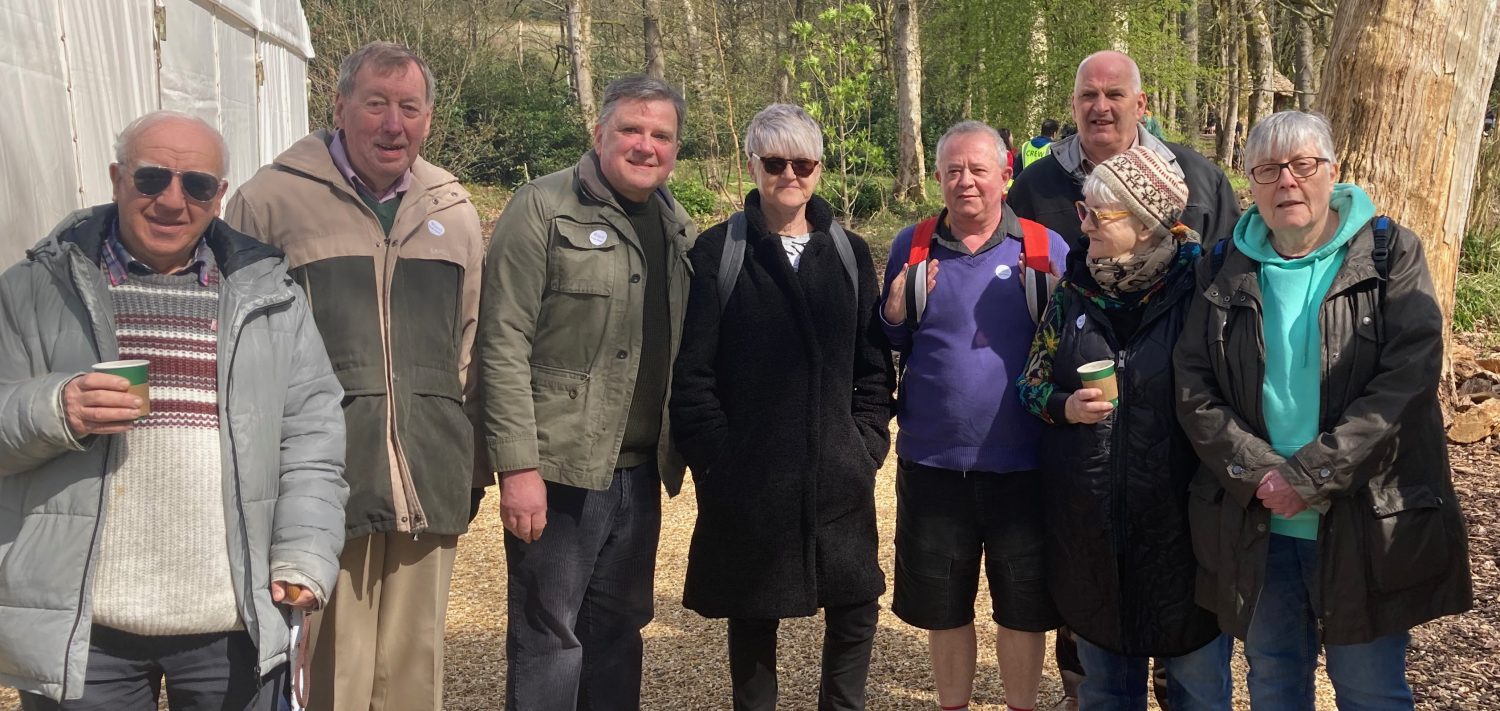
Twelve of us from Out In The City joined the Proud Trust for a free community dinner to kick off Manchester’s Pride Month.
There was a range of delicious veggie and vegan hot and cold food supplied by Oak Street Kitchen including cauliflower korma, tofu pad thai, and roast vegetable lasagne.

After dinner there was a special performance from Lesbian Boy Band Choir which included songs by boy bands McFly and Busted.
There was a brilliant atmosphere and we all had a great time.


Pride In Ageing: A Celebration of Five Years

By Pauline Smith
Launched by Sir Ian McKellen and the LGBT Foundation in June 2019, the Pride in Ageing programme was set up to address concerns that too many lesbian, gay, bisexual and trans people over the age of 50 are living in isolation and facing discrimination as a direct result of their sexual orientation or gender identity.
They celebrate five years of Pride in Ageing
5 years ago Pride in Ageing was launched
On Radio Manchester at 10.10am
5 June 2019
By Lawrie, Lucia and Pauline
Later at Barclays in Albert Square
Sir Ian McKellen was the keynote speaker
Talking about inclusivity, tolerance and support

Here we are 5 Years later
Celebrating our Lustrum
As the Romans called it
In a marriage the 5th anniversary
Is represented by wood or silver

For us in June 2024
Our celebration is one of reflection
A time to look back
At what we have achieved
In the last 5 years

The differences and programmes
that Pride in Ageing has created
Thanks to the sponsorship of Barclays
with several successful fund raising dinners
And the videos in which many of us volunteers
have appeared to promote
Pride in Ageing’s activities

Pride in Ageing has set up
A permanent archive
of older LGBTQ+ people’s
stories about their lives
at Manchester Central Library

The Rainbow Buddy programme
designed to help lonely and vulnerable
people of all ages
who are part of the LGBTQ+ community

The Derek Jarman Pocket Park
at Manchester Art Gallery
created a living garden
out of an area of concrete
and weeds

Showing the love and nurturing skills
of the volunteers who created it
and maintain it
with advice and support from the RHS
A lasting living memorial

The Box of Me project
An idea created by 3 of our volunteers
Mindy, Pam and Pauline
To help older LGBTQ+ers
Plan the last part of our journey

Giving empathy and sympathy
to show older LGBTQ+ers
the steps to having a will
power of attorney, funeral plan
And how to celebrate

With St Ann’s Hospice support
and Pride in Ageing volunteers
this programme has been rolled out
to groups of older LGBTQ+ people
across Greater Manchester

The Skills for Care project
A co-operation between Strathclyde University
Pride in Ageing and Skills for Care
has created a programme to train
health and care professionals on
how to look after older LGBTQ+ people
In care homes, hospices and hospitals
with dignity and respect

This programme is being implemented across
England and has been adopted
by Brighton and Hove health care authority
And its still a new idea
with training manuals and videos

And of course there are ongoing programmes
which will come to fruition in the near future
the joint project between PIA and the Proud Trust
with young teenage and older LGBTQ+ers
working together on a cabaret evening in 2023
photography and plays in 2024

Lastly the Whalley Range Housing Project
Creating a safe environment
for older LGBTQ+ers
to live in their own units
with joint facilities for the site

There will be other projects in the future
Lawrie and the volunteers are creative
And all work together as a team

On the 17 March 2024
Sir Ian McKellen spent time
with us volunteers as
We chatted with Pride and Joy

And started the celebrations for
5 Years of Pride in Ageing


Well as a Trans women .. Queer married to a woman according to this writer of Gay Shame I don’t exist. I am not the person I say I am even though three psychiatrists tell me I am who I say I am. They agreed that I was suitable for the transition operation which I had successfully. The court agreed with these professionals and issued me with a Gender Recognition Certificate and new Birth Certificate…but according to this writer I am not the person I say I am. His whole proposition is a nonsense however that doesn’t matter but what does matter it the long report you give here about his ideas and false historical content. To say I am upset that a group of older LGBTQ can give this such publicity and the review of the Book.. Gay Shame ..in such detail is a mystery to me. Unless the group support this approach. Which of course I have long thought was the case.
Helen
Helen, the book review is by Tucker Lieberman – a trans man. Out In The City is an inclusive group and we reprinted his review (with permission) to show that the book is hateful, boring and low quality.
Thank you Tony. The problem at this time is the Trans community are being used for political reasons. The Conservatives thought it was a vote winner and supported Gender critical writers and personalities. As a simple soul I thought this may have finished with a return if a Labour government. But no Wes Streeting a gay man and minister of Health is delivering the same message…trans men are women and trans women are men. No trans women can’t use female toilets..no trans women and men will be put in their birth sex wards in hospital….well this is a fact if I have to use a male toilet what do I do sit on the urinal?….what about trans men that have completed their operations with a constructed penis…OMG let them piss in the women’s toilet sink….my point Tony is the Trans community at this time require a lot of support. One would think we are monsters Labour.. Conservative are the same .. thankfully we have support but not amongst many in the LGBTQ community which is too sad for words…if it wasn’t for strong trans women like Pauline Smith I don’t know where we would be….look at the critical comments on a female intersex boxer competing in the Olympics…this stuff is emotional nonsense.. anyway take care.. peace and love Helen.
Thank you Tony and Norman, you do a fantastic job for all you do for the older gay men and women like myself at 73 years old and yes it does get lonely at times but attending the events you organise and Cross Street Chapel meetings have been a big help for me Kindest regards Anne
Hi there Tony, looking forward to meeting you and others for the Pride Party at Cross Street Chapel,it’s Brian and Fred here! Cheers.