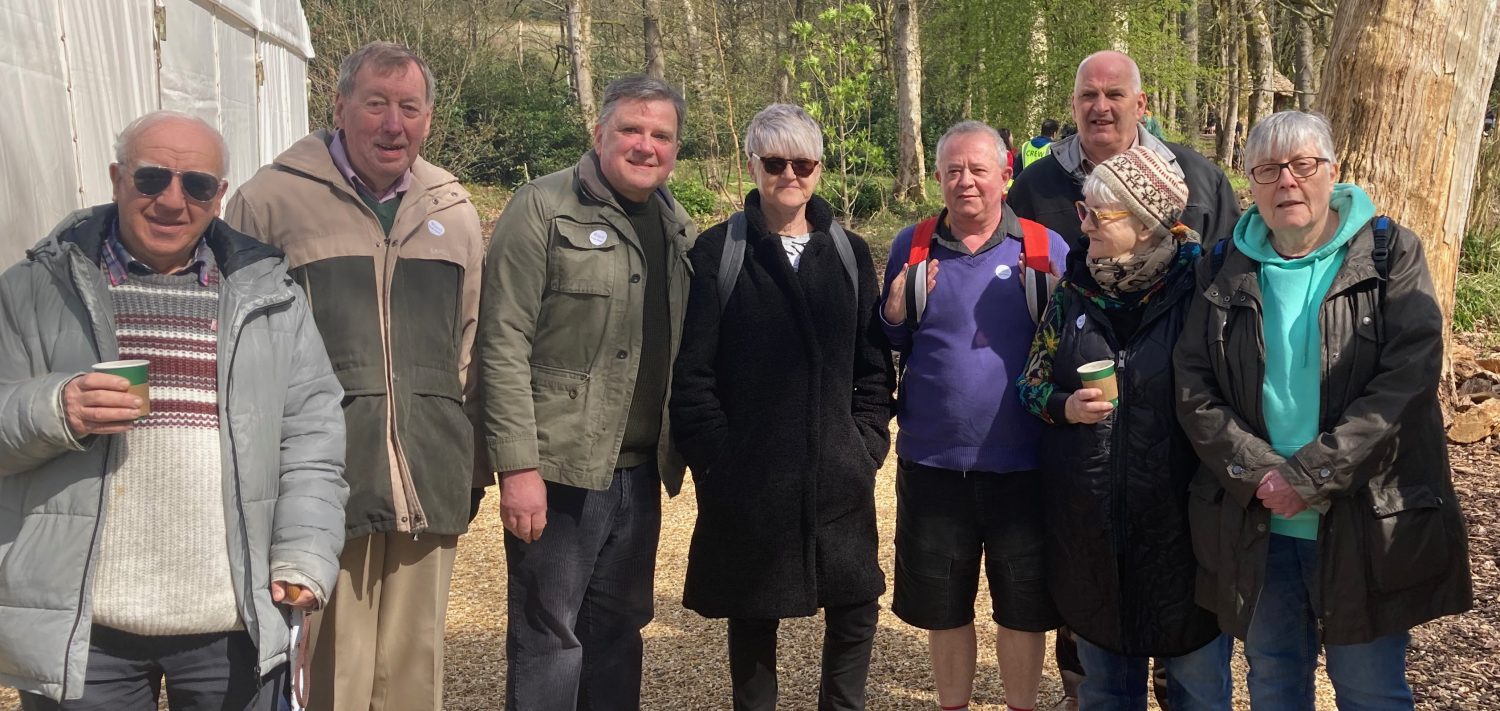

Bridgewater Hall
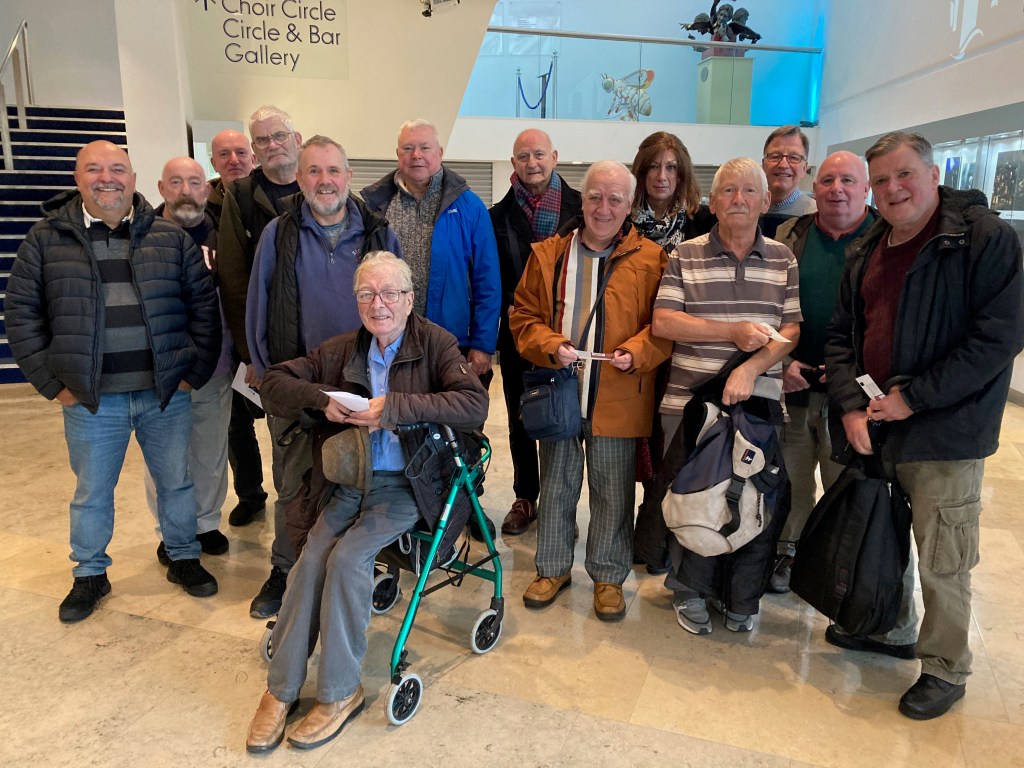
We’re delighted to advise that The Bridgewater Hall offered us 12 FREE tickets to various performances from the International Concert Series, BBC Philharmonic and Manchester Mid-day Concerts Society.
This week we heard the Manchester Chamber Choir with a varied programme including Benjamin Britten and William Byrd. The Choir was formed in 2002 and has become one of the UK’s most versatile and accomplished vocal ensembles. They regularly work with the BBC Philharmonic but have also broadcast a BBC2 Special with the Pet Shop Boys!

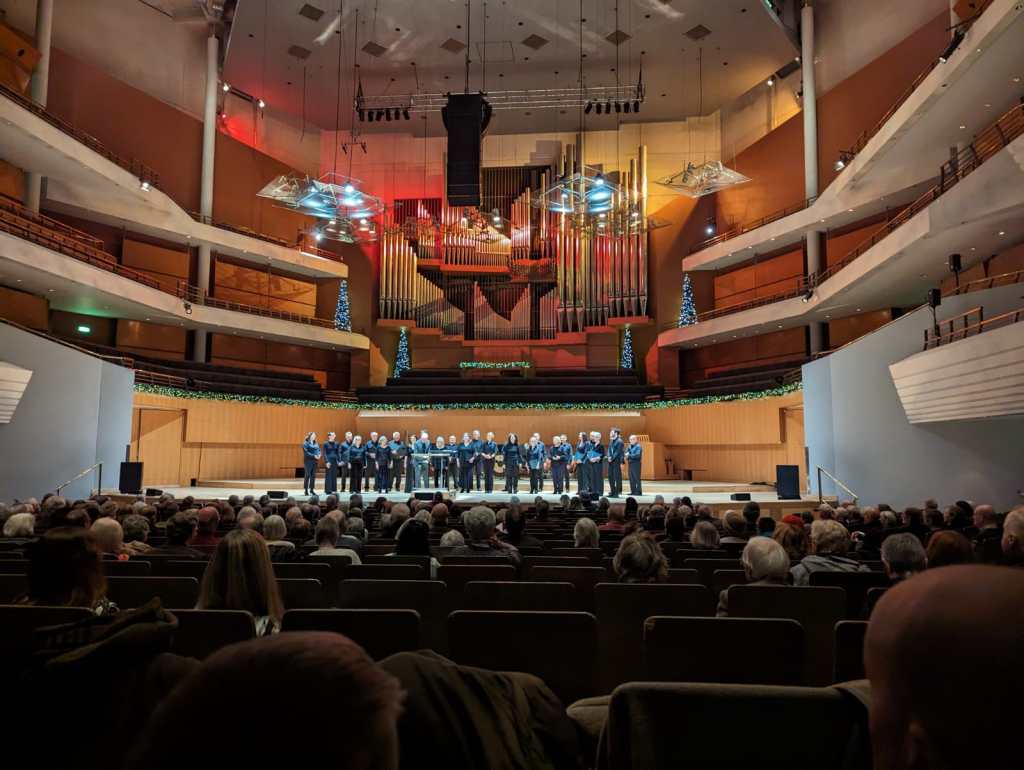

We really appreciate the support of Bridgewater Hall. Altogether 38 different people have enjoyed 13 concerts this season.
The first concert in 2024 (12 January at 1.10pm) is fully booked up, but we have tickets for the concert on the same day – Friday, 12 January at 7.30pm. This is an International Concert Series featuring pieces by Chopin, Schumann and Liszt.
More concerts can be found on our Next Outings page and you can book tickets here.
10 Iconic Lesbian Couples Through Herstory
Wherever and whenever LGBT+ people have lived, they have loved.
Whether they found romance in ancient Egypt or a 1920s salon, the history of lesbian women and their lovers is rich with devotion, betrayal, and activism. Throughout history, lesbian couples have fallen in and out of love and experienced joy and heartbreak, just like anyone else.
For anyone who can’t get enough of vintage love stories, here are ten same-sex couples who have defined lesbian romance over the centuries.
Ethel Collins Dunham and Martha May Eliot
Martha May Eliot and Ethel Collins Dunham, two doctors who got their medical degrees together from Johns Hopkins, met while they were students at Bryn Mawr College. They decided to attend medical school together in 1914 and forever stay by each other’s side.
Though they were both active in fighting for women’s right to vote, their ambitions to medicine separated them until they were both invited to the brand-new paediatrics department at Yale .
Both pioneers in their own right, they changed the role of women in children’s medicine forever. During the Great Depression, Eliot was an architect of the New Deal’s programmes regarding maternal and child health, and later she was named chief of the Children’s Bureau, a federal health agency, by President Truman. Dunham focused on caring for premature babies and newborns, establishing the national standards for how hospitals care for babies. She became one of the first female professors at Yale’s School of Medicine, while her partner was the first female member of the American Paediatric Society and the first woman to become president of the American Public Health Association.
In 1957 the American Paediatric Society awarded Dunham its highest honour, the John Howland Award. She was the first woman to receive the honour. Eliot was the second.
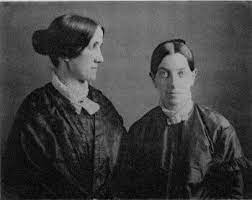
Sallie Holley and Caroline Putnam
These lifelong companions met at Oberlin College and became agents of the American Anti-Slavery Society as soon as they graduated. The couple travelled on the abolitionist lecture circuit alongside Sojourner Truth fighting for black people to be freed.
After the Civil War and emancipation, the two split to pursue their calling for justice. Holley gave talks in the North raising money to educate freed slaves, while Putnam went to Virginia to teach them. She ended up founding the Holley School, named after her partner.
Holley joined Putnam in Lottsburg, Va., where they taught together at the school year-round. Dedicated to encouraging and enabling black men to vote when they as women still could not, they died having left the school to an all-black board of trustees who kept it open for decades.
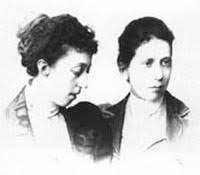
Edith Anna Somerville and Violet Florence Martin
Throughout the late 19th century, Irish novelist Edith Somerville wrote in collaboration with “Martin Ross,” who in reality was her second cousin, Violet Martin. Publishing 14 stories and novels, the two achieved success under the pseudonym “Somerville and Ross.”
While the exact nature of their relationship is a subject of debate, they lived together like a married couple in Drishane, County Cork, and later in her life Edith became a close companion of lesbian composer Ethel Smyth.
After Violet died, Edith continued to write under their shared pen name, convinced that the two could communicate through spiritualist séances.

Queen Kristina of Sweden & Countess Ebba Sparre
Queen Christina, who ruled Sweden in the 17th century, marched to the beat of her drum since she was a tot. Her father, King Gustav II Adolph, lost his life in battle when she was only 6 years old, but his fondness for his daughter followed her throughout her life after he requested she be raised not as a princess, but a prince.
Adhering to the fallen king’s wishes, the court educated and treated Christina like a boy. She dressed androgynously and even when she took the throne at 18, she refused to marry or become a mother. As a monarch, she established the first Swedish newspaper and country-wide school ordinance, but as a woman, she found love in her lady-in-waiting Countess Ebba Sparre.
The queen wrote often about the countess’s beauty, nicknaming her Belle and referring to her as a bedfellow. “It was actually quite normal for women to have intimate relationships at the time, because all the men were at war. So I think it was tolerated, but it wasn’t recognised as a lesbian relationship,” said Mika Kaurismaki, who directed the 2015 film The Girl King on Queen Christina’s life.
“I do not intend to give you reasons, [I am] simply not suited to marriage,” Christina told her officials. She went on to behead nobles who accused her of being a “jezebel,” losing much of her popularity. In 1654, the queen announced her plans to abdicate. Having thrown away her throne, she fled Sweden for Denmark, dressed as a man and taking most of the country’s treasures in her luggage. As she sought new homes in Italy and France, Christina continued to exchange passionate letters with her former lady-in-waiting, telling Sparre she would always love her.
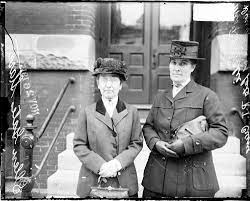
Jane Addams & Ellen Starr
The two lesbians behind Chicago’s Hull House, which provided social services and innovative educational programmes to recently arrived immigrants, first met in 1877 at Rockford Female Seminary. Though Starr was forced to leave school due to financial problems, their romance endured.
Starr joined Addams on a tour of Europe in 1888, where they observed the English settlement movement in London. Determined to bring the same resources to Chicago, they cofounded the now-500-house-strong charity. The original Hull House included a kindergarten, a day nursery, an infant care centre, and a centre for continuing education for adults.
The ladies lived together and were partners in advocacy and life. Starr joined the Catholic Church in 1920, when she felt it was seriously teaching social justice, though the church would go on to fight her when she campaigned against child labour. “Let’s love each other through thick and thin and work out a salvation,” Addams wrote to Starr.

Gabriela Mistral & Doris Dana
The first Latin American author to receive a Nobel Prize in Literature, Chile’s Gabriela Mistral was known for her lyrical love poetry. But she should also be known for her complicated bond with Doris Dana, who married or not stood by her in sickness and health.
Dana, who was born into a wealthy New York family, lost all her family money in the Wall Street crash of 1929. She met Mistral in 1946, an event only she remembered. Two years later, they began writing letters, one of which was an invitation for Dana to join the acclaimed poet at her Santa Barbara, California, home. After that they travelled the world, visiting Mexico and Italy, until Mistral fell gravely ill.
When Mistral was suffering from pancreatic cancer, Dana moved them to Long Island, where she cared for her life partner until her final days. After that, Dana remained the executor of the poet’s works and guarded them closely, refusing to let them be published in Chile. She even declined an invitation from President Ricardo Lagos Escobar.
Committed to the richness of Mistral’s work, Dana published a final volume of her poetry, Poema de Chile, after the poet’s death in 1957.
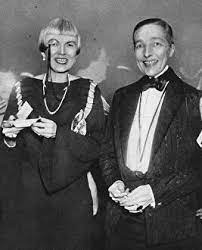
Marguerite Radclyffe Hall & Una Troubridge
Hall, a prominent lesbian writer, fell for the sculptor Troubridge in the most reckless of ways.
In 1907, the writer met Mabel Batten, a married singer with adult children and grandkids, in a spa in Germany. Despite a 30-year age gap, the two fell in love, setting up house after Batten’s husband died. Batten gave Hall the nickname John, which she kept even after their relationship went up in flames.
The cause of fire? Batten’s cousin Una Troubridge, whom Hall met in 1915. Batten died a year later and Hall ran to her cousin. The two began living together in London.
Though the two were involved until death, Hall had affairs with a number of other women, including Russian Evguenia Souline. However, their matching dachshunds remained faithful.
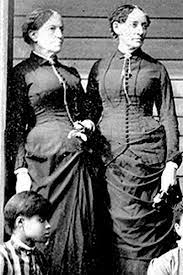
Harriet E Giles & Sophia B Packard
Few know that Spelman, the historically black college for women, was founded by a lesbian. Sophia B Packard met Harriet E Giles while teaching at Connecticut Literary Institution in Suffield. Later the two moved to the South intent on opening a school for African-American women and girls in Georgia. With only $100 from a Massachusetts church and a promise of support from the Woman’s American Baptist Home Mission Society, the couple opened a school in the basement of Friendship Baptist Church.
There they were not just teachers but held prayer meetings and sewing lessons. Impressed by Packard’s vision, John D Rockefeller made a down payment for a permanent site for the school in 1884, naming it Spelman in honour of his wife and her parents.
Packard went on to become the treasurer and Giles worked as the president of the college until she died in 1909. The two are buried together.
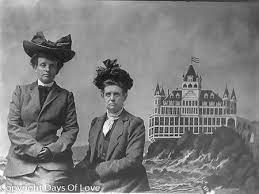
Fannie Johnston & Mattie Edwards Hewitt
Born in 1864, Fannie Johnston received her first camera from George Eastman, the founder of Kodak. With it she shot portraits of those closest to her and the era’s most famous people, including Mark Twain, Susan B Anthony, and Alice Roosevelt.
Surrounded by impactful people, Johnston met the woman who would impact her the most, Mattie Edwards Hewitt, the wife of another photographer. With her own passion for art, Hewitt worked in her husband Arthur’s darkroom. Immediately she was enamoured of Johnston’s acclaimed work, and mutual admiration evolved into a deep, dangerous romance.
“Ever since you told me that I was indeed worthwhile, I have felt like another woman, and now if I have been able to make you truly care for me, well, I am very very happy over it. You do not know the wealth of tenderness there is in my heart for you, and shall I tell you why I have needed you so much and seemed so longing for love and affection?” Hewitt wrote in one of the many love letters exchanged between the women. “When I married that nice little man, I thought of course I should get all the love my heart had yearned for, but somehow he has always seemed too busy to stop long enough for such nonsense, as he calls it.”
In 1909, Hewitt divorced Arthur and moved to New York, where she and Johnston worked and lived together. They opened a joint photography studio and spent their lives in harmony.
“Ah I love you, love you better than ever you know … Yes my dear we will turn over a new leaf and stand together in time of weakness,” Hewitt declared.

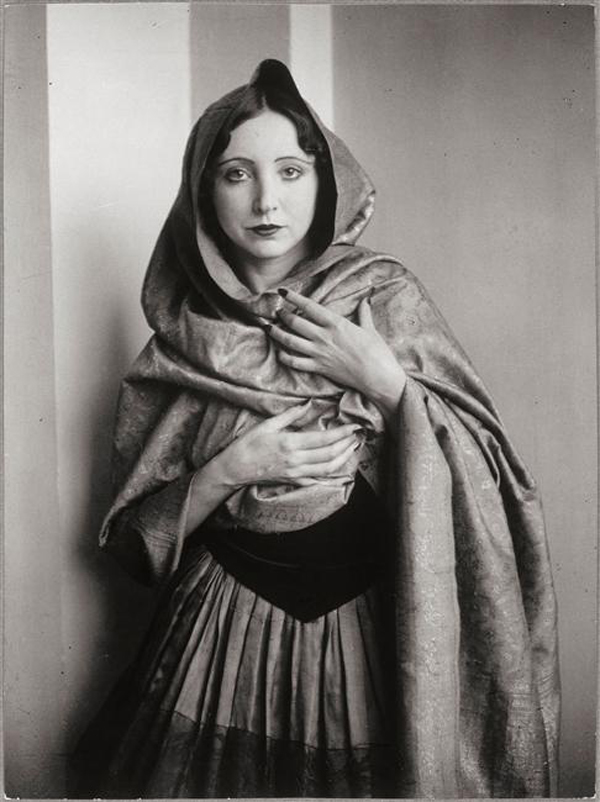
June Miller & Anaïs Nin
Though June was best known for being married to American writer Henry Miller, some believe her true love was French-American scribe Anais Nin, who found fame writing novels, essays and non-fiction.
In 1931, while visiting Henry in Paris, Miller met his colleague Nin, who quickly saw her as a muse. Throughout their flirtation (that Nin claimed was not sexual), Nin used June as inspiration for a number of her characters. Descriptions of their relationship in Miller’s diary makes it hard to imagine their relationship wasn’t sexual; Nin seemed fixated to the point of obsession with June.
Henry & June – a 1986 book culled from Nin’s unedited diaries, and published after Nin’s death – again stoked talk of the women’s affair. A 1990 movie, starring Maria de Medeiros as Nin and Uma Thurman as June, brought more attention to their relationship.
After their encounters in the 1930s, Nin would eventually reunite with her husband and live out her final years in Los Angeles. June was in and out of psychiatric wards during the 1950s, where she received electric shock treatments. During one, she fell off the table, breaking several bones. She never fully recovered.


A Festive Celebration of the LGBT+ Community – Monday, 18 December 7.00pm – 9.00pm
Manchester Cathedral – FREE – just a few tickets left – apply here
The Proud Trust, akt, LGBT Foundation, George House Trust and Manchester Pride are coming together for a festive gathering of Greater Manchester’s LGBT+ community at Manchester Cathedral – a space for celebration and inclusion.
We are stronger when everyone is included, and this event will be a celebration of all within our wonderfully diverse LGBT+ community.
Please join us for a joyful evening of Carols and readings. This is a free event, with donations made on the evening supporting The Proud Trust, akt, LGBT Foundation and George House Trust charities, who work hard to keep our community safe and strong.

Out In The City Party
Out In The City Party on Thursday, 14 December from 2.00pm to 4.00pm at Cross Street Chapel. Buffet! Entertainment! Not to be missed!
Please let us know if you are coming for catering purposes (vegetarian and gluten free will be catered for).
RSVP here.




 Out in the City
Tony, your emails are always educational. I was particularly interested in the article about famous lesbian couples, of whom I admit most were unknown by me.
LikeLike