

Beautiful Thing review
Members of Out In The City attended the matinee of the play “Beautiful Thing” on 4 November. I haven’t seen the play yet as I was performing as part of the Community Company. We were waiting in the Green Room until our appearance at the end of the play.
Let’s not forget the play was written at a time when the age of consent for gay men was 21, Section 28 had yet to be repealed, and Aids was a threat that loomed large in people’s minds.
Here is the review from Pink News:
Hilarious and heartwarming revival uplifts gay Black love

The 30th anniversary revival of Jonathan Harvey’s 90s coming-of-age classic, Beautiful Thing, is a tenderly portrayed triumph.
On a council estate in south London, there are three houses filled with closely held secrets, lost hopes and wistful dreams. At one end of this row of homes – simply but elegantly captured on a walkway – Ste (Raphael Akuwudike), a football-loving teen living in an abusive household, finds sanctuary next door.
It’s here that we meet the hilariously sassy Sandra (Shvorne Marks), a fiercely protective mother who is never short of a witty remark. Her latest lover Tony (Trieve Blackwood-Cambridge), a desperately devoted middle-class artist, struggles in the face of Sandra’s fiery temper and ambition.
Then there is Leah (Scarlett Rayner), a constant presence at the end of the road since her expulsion from school, who harbours an intense obsession with singer Mama Cass and an ever-dwindling hopes to return to the education system.
At the centre of them all is Sandra’s son Jamie (Rilwan Abiola Owokoniran), a shy boy who prefers The Sound of Music to the football field and who happily welcomes a troubled Ste when he comes knocking. Against this lively backdrop, we watch Ste and Jamie slowly fall in love.

Forced to share a bed on evenings when Ste is seeking refuge from his father, Akuwudike and Owokoniran craft an exquisite chemistry that leaves you rooting for their love to flourish.
Their dynamic delicately balances the tenderness of first love with the terrifying reality of being a gay Black boy in the 90s – captured best as Jamie lovingly tends to Ste’s bruises in the quiet of the night. Despite the challenges that face them, their bravery to choose love over fear is the warmth at the heart of the play.
Jonathan Harvey’s story, interpreted here by director Anthony Simpson-Pike, offers a much-needed portrayal of gay Black love defined by hope rather than trauma. The play’s most powerful moments are found in its most positive ones, from Sandra’s tear jerking acceptance of the boys’ relationship to Ste and Jamie’s gorgeously romantic final dance.
Weighty scenes are perfectly punctuated with moments of humour, such as when the street is sent into a mad scramble to sober-up a high Leah in the middle of the night, or through well-timed one liners scattered throughout.
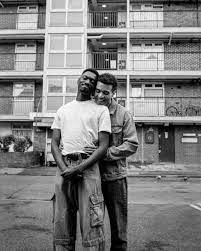
In particular, Marks offers a standout performance, leaving the audience in fits of laughter and misty-eyed from one moment to the next.
One thing is for sure, Beautiful Thing remains not only a timely commentary on the struggles for working-class gay teens, but also a feel good triumph that leaves audience grinning as the lights go down.
With their joyful energy, the revival cast brilliantly pays homage to this eclectic cast of characters first unleashed on the world by Harvey three decades ago.
Beautiful Thing runs at HOME in Manchester until 11 November.
‘I had a panic the night my mum came to see it’: Jonathan Harvey on writing Beautiful Thing
Jonathan Harvey, playwright:
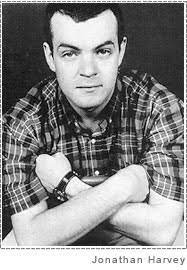
“I wrote Beautiful Thing quickly in the summer of 1992. It came from the heart. The age of consent debate was going on – back then, gay men had to be 21 to have sex. The rhetoric used in parliament was so archaic, with words like “buggery” and “sodomy”. I wanted to write a play about two boys falling in love, and give it a happy ending.
During the Aids crisis, it was unusual for a gay character to still be alive at the end of a drama. Class was important, too. Gay characters in Merchant Ivory films went punting, but if you were working class on screen, you would end up becoming a rent boy and selling your arse for 20 Woodbine cigarettes. My own experience, however, was that tolerance and acceptance were not just the privilege of the upper and middle classes.
I’d already had some plays staged but was still teaching, working near the Thamesmead estate in London where the play is set. My agent had just got rid of me, saying I wasn’t taking my writing seriously. That gave me a kick up the arse. I spent the first two weeks of the summer holidays writing Beautiful Thing in longhand, the second two typing it up and the last fortnight sending it out. By the end of the summer, I had a new agent – Alan Radcliffe, the father of Daniel, who played Harry Potter. I left my teaching job at Christmas.

All the new writing venues turned the play down, except the Bush in London. Dominic Dromgoole, who ran the theatre, told me: “It’s a really weird ending.” I said: “What, the dance?” He said: “What dance?” It turned out the agent’s assistant had sent it out to everybody with the last 40 pages missing. Dominic said: “I thought you were just being elliptical.”
They got Hettie Macdonald in as director, which was important because it needed some fine-tuning. It was on stage by the end of July 1993. People said we had the graveyard slot – all the reviewers were up in Edinburgh – but it sold out. The Bush was this tiny space above a pub: it seated 80 and was quite claustrophobic. But the play is about people living on top of each other, so when the two boys, Jamie and Ste, were in bed talking, you really felt as if you were in there with them. I had a feeling it was good, but to see the rapturous response was like drinking your first glass of champagne: it was effervescent. Philip Glenister was laugh-out-loud funny as Tony, the boyfriend of Jamie’s mum Sandra, played by Patricia Kerrigan. Patricia was scary but warm and full of heart. I had a panic the night my mum came to see it. She is nothing like Sandra but there are conversations I had with her that are in the play. After she saw the film version, she said: “Please don’t stop writing about the little people.” That really moved me. The play helped me find my theatrical voice. It was the first time I had been honest in my writing and it gave me the confidence to keep going.”

Bridgewater Hall

We were invited to a Community Members Day Focus Group at the Bridgewater Hall on 2 November.
The focus group was an opportunity to introduce the Department, and reflect on the previous Community Members Day in May 2022. It was also an opportunity to talk more about the scheme, and what we would like to get out of it.
A commitment was made that the Community Members Scheme would continue beyond May 2024.
Frank ‘Foo Foo Lammar’ – 20 year anniversary since his death
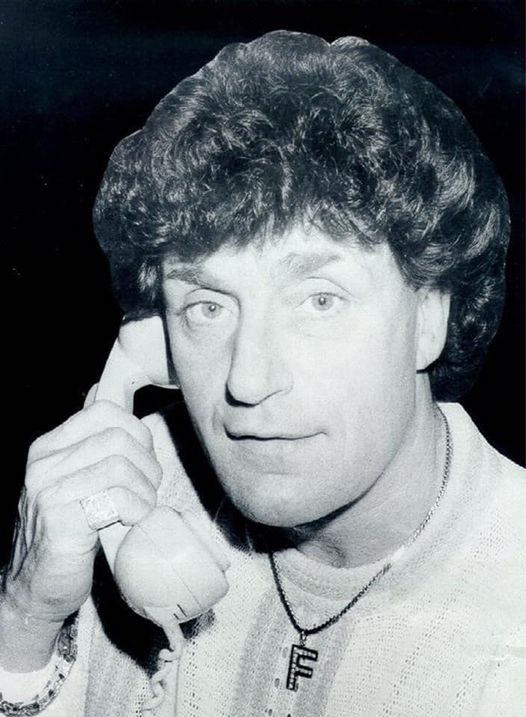
Born Francis Joseph Pearson in 1938, young Frank Pearson was an amateur boxer raised in a tough part of East Manchester. He was the son of a rag and bone merchant in the days when the term ‘gay’ meant happy.
He left school at 15 with no qualifications and got a job working at a paper-recycling centre. Whist working in this male environment he picked up a lot of industrial style banter, which would later serve him well as an entertainer. He enjoyed watching the glamour of Hollywood films and his favourite screen actress was Hedy Lammar. Frank created ‘Foo Foo Lammar’
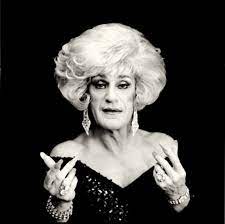
In the evenings he started singing around the pubs of Ancoats, in Manchester. The story goes that his tough dad heard a rumour that his son was dressed in a frock signing in the Ancoats Arms. His dad stormed into the pub, went berserk and threw a bar stool at him whilst singing on the small stage. This was Frank’s first brush with dealing with rowdiness and tough crowds. As an amateur boxer he was able to stand up for himself on quite a few occasions. People quickly learned not to under estimate this tough guy in a dress!
In the 1960’s, drag was becoming popular in the northern clubs. The success of Danny La Rue had paved the way for other acts to break through. Comedians such as Larry Grayson long before his TV fame did half his act in drag and the second half in a suit. Before long, the name Foo Foo Lammar was established and in much demand throughout Manchester during the glorious days of cabaret entertainment. Entertainers could work seven nights a week year round.

In 1971 Frank opened his first club in Manchester named ‘The Picador’ at Shudehill in Manchester with “Connie the Queer” on the door. Due to its popularity he then opened ‘The Celebrity Club’. This same venue on Dale Street later became the infamous ‘Foo Foo’s Palace’ in the heart of the city of Manchester. Foo Foo’s Palace became ‘the in’ place. Coach parties would arrive in droves to visit this legendary plush cabaret palace. It became an entertainment institution – a popular venue for stag and hen nights out. It was also a regular haunt for the cast members of Coronation Street and Manchester United football players.
Foo Foo Lammar was of course a glamorous stage persona in expensive outfits. The offstage life and character of Frank was equally as colourful. He was a stylish man of presence who oozed that special star quality. He was a well known recognisable figure throughout Manchester and a respected and successful businessman. Following the success of the TV Show ‘Queer as Folk’ in 1999 which popularised Manchester’s Gay Village, Frank purchased several properties in ‘The Village’ around Canal Street, venues such as Napoleons and Cruz 101 night club. In equal measure he was generous with his time and money. Throughout his life in show business he helped raised millions of pounds for various charities. He was an ambassador most notably for The Royal Children’s Hospital in Manchester – a place he held dear to his heart.
Around 2001 Frank was diagnosed with cancer and suffered a battle until his death on 7 November 2003 aged 65. His funeral was a sad yet colourful day in the social history of Manchester. People lined the streets to pay their respects to mark the passing of their legend.

Frank ‘Foo Foo Lammar’ was true to his Manchester roots and became a self-made millionaire. He is remembered as perhaps the most popular female impersonator in the North Of England. His career spanned nearly 50 years.
Lammar was said to be “a familiar sight in his native city dressed in shiny suits and dripping in gaudy jewellery.” He owned a number of Rolls-Royce cars with the licence plate FOO 1, and enjoyed giving lifts to locals. He was “devoted” to his mother Leah, taking her shopping every day and having tea at the bungalow he had bought for her in Moston. I remember seeing him and his mother in the Arndale Centre. He loved life and was admired by all walks of life. In return Frank loved the attention he received from people. It’s a great pity he did not live long enough to have been awarded Royal recognition for his services to entertainment and charity. He certainly deserved it.


 Out in the City
A really interesting post. Thanks
LikeLike