Fleetwood is a coastal town with fish processing still a major economic activity. But the town’s most significant employer is Lofthouse of Fleetwood, manufacturer of the lozenge Fisherman’s Friend which is exported around the world.
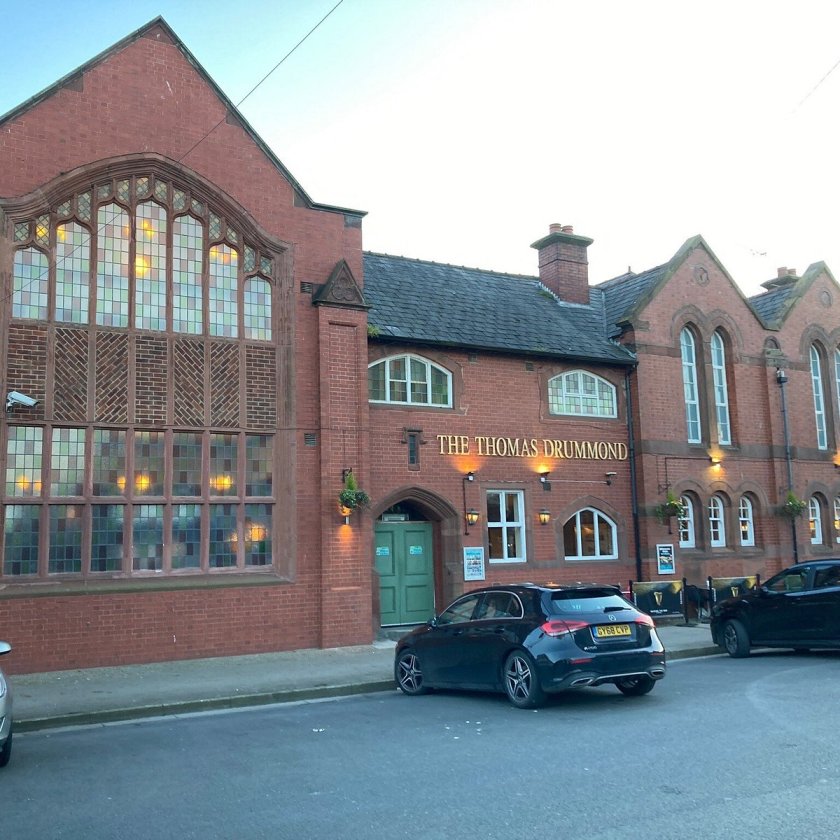
A small group of us met at 10.30am at Piccadilly Train Station and took the 11.02am train to Blackpool North. We arrived around 12.35pm just in time for a 25 minute wait for the next tram to Fleetwood. Unfortunately due to work on the tracks the last three stops were closed, so we got off at Fisherman’s Walk and carried on foot to The Thomas Drummond – a Wetherspoon’s pub that was formerly a church. We had a lovely meal, but then it was time to return home!
We never did see Fleetwood Museum famous for it’s maritime heritage.
Scotland could be first country in world to end HIV transmission, say leading charities
Scotland is in prime position to be the first country to end new HIV cases, according to leading HIV charities, but urgent action by the next Scottish Government is crucial to achieving the goal of getting there by 2030.
The Scottish Government committed in 2020 to ending new HIV cases by 2030, which would be the first time the onward transmission of any virus had been stopped without a vaccine or cure.
However, there are still an estimated 400 people in Scotland living with undiagnosed HIV, and up to 1,400 people who have been diagnosed but are no longer accessing life-saving care.
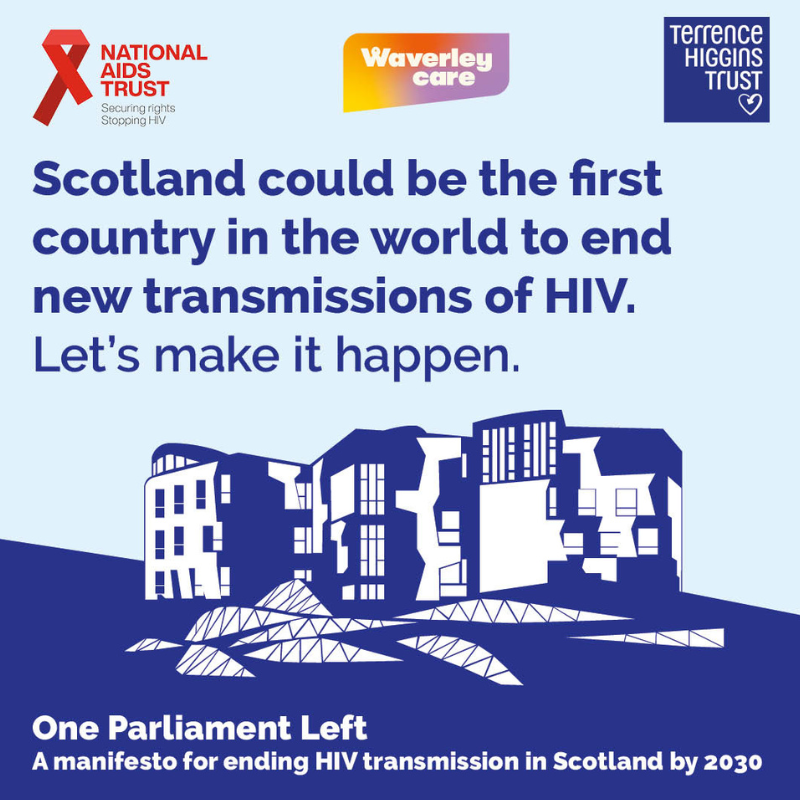
Terrence Higgins Trust, Waverley Care and National AIDS Trust have published a manifesto for ending new HIV transmissions in Scotland and are urging all political parties to commit to action ahead of the May election.
Medical advances mean that a person living with HIV and on treatment can live a long and healthy life and cannot pass HIV on to others. This progress – combined with the availability of the HIV prevention drug PrEP and rapid HIV testing – means Scotland has all the tools needed to reach its 2030 goal.
The charities are calling on the next Scottish Government to make sure these tools reach everyone who needs them – including through a national online HIV prevention service, providing at-home test kits and access to PrEP, a National HIV Testing Week and a programme to re-engage those who have been diagnosed but are not accessing HIV care.
Section 28 Justice Coalition
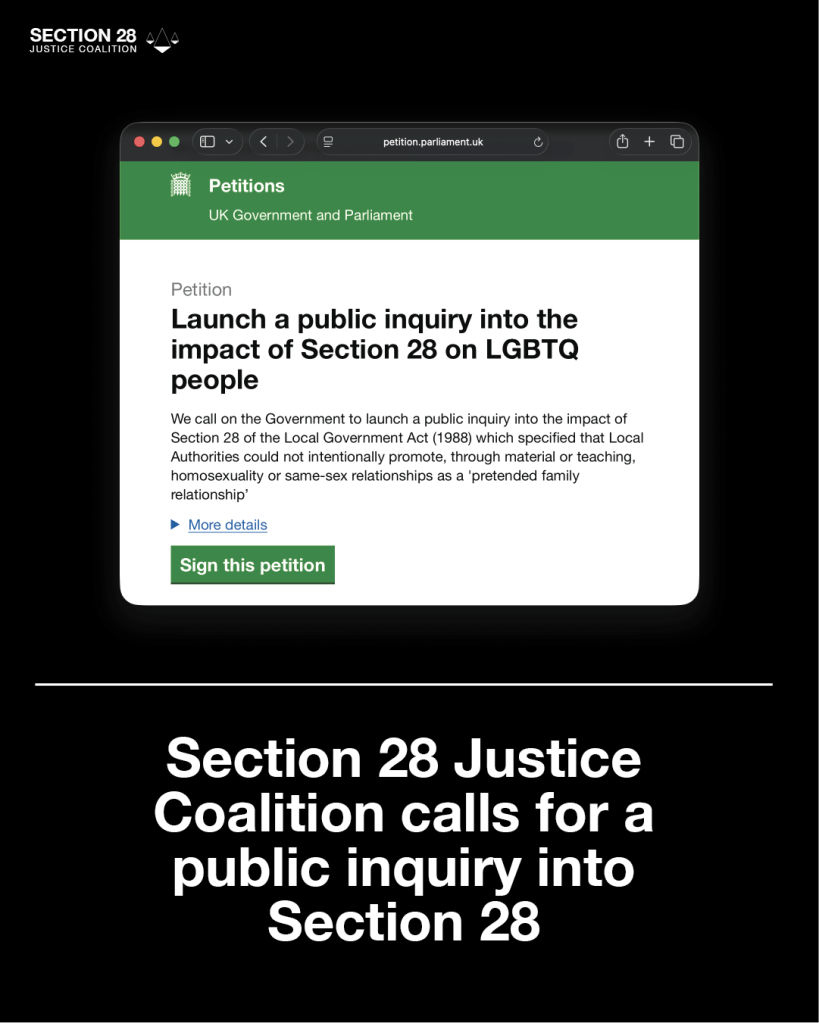
We have been contacted by a new group, the Section 28 Justice Coalition. They want to get a proper acknowledgement of the harms caused to LGBTQ+ people by Section 28 and stop censorship of LGBTQ+ issues, whether enforced by social pressure or by law.
We’re witnessing increasing censorship laws, similar to Section 28 take hold internationally, and in the UK a more quiet form of censorship, enabled by social pressure, leading to book bans, pressure on libraries and schools, de-funding LGBTQ+ activities and an increase in protest of community and arts based events.
Reflecting on Section 28 and the damage this law caused enables us to show how censorship laws don’t work, they actively harm people.
They have launched a petition, calling for a public inquiry into the impact of Section 28 on LGBTQ+ people to get justice for those who lived through it and to give recommendations on how to stop anything like it ever happening again.
Their ‘Dear Section 28’ project is compiling an archive of personal experiences through letters addressed directly to the law and featuring a film called ‘Don’t say gay’ which will be released later this year.
How you can support them
As they have just launched and are trying to get recognition for their campaign, they wanted to ask if you would consider supporting them in any way you can:
Creative agency Noodl are looking to hear from people from a range of communities and backgrounds who have an active interest in nature, history, art or culture and would be open to sharing their perspectives on how British cultural institutions and nature locations (beaches, woodlands, etc) can better connect with people living in towns and cities.
They’re currently recruiting for people to do a questionnaire over the next week and they’re paying £25 to those who take part, first come first served, plus you’ll be added to their network where they provide paid opportunities to participate in future creative projects.
If this sounds like you, click the link below to find out more and register your interest.
After close consultation with the city’s LGBTQ+ community, Manchester Village Pride CIC has announced the theme for the return of the iconic Pride parade: ‘No Place Like Home’.
Adopting a key line from The Wizard of Oz, the theme offers the opportunity for community groups to celebrate a homecoming and safe landing for Pride in the city after recent uncertainties, as well as a chance to honour the city of Manchester itself as a welcoming and safe place for all.
The parade will take place on Saturday, 29 August and will work its way through the city via a route – still to be determined – that will conclude in the Village; the place where Pride began in Manchester four decades ago.
Announcing the theme, Carl Austin-Behan, one of the founding board members and spokesperson for Manchester Village Pride CIC, said: “The parade is one of the most important and iconic events during Pride Weekend in Manchester. It’s a time for the community to come together with people from all walks of life to celebrate, listen, and show visibility for LGBTQ+ life in Manchester and beyond.
‘No Place Like Home’ is a very apt theme for this year, allowing us to pay tribute to Pride’s roots in the Village; the home of our amazing community and everything that Manchester Village Pride stands for – from our LGBTQ+ businesses and charities to performers and patrons. I can’t wait to see how the community responds and interprets the theme, as I think there is so much to go on!
The parade is one of the cornerstone elements of the weekend, alongside the poignant Candlelit Vigil, that we want as many people as possible to attend.
Both elements are, and always will be, free to attend; however, we do ask that those who would like to enjoy the wider celebrations – including the party and performances in the Village – purchase a weekend wristband or individual day pass to ensure that funding goes towards safe event delivery, as well as supporting LGBTQ+ charities, grassroots organisations, and vital community services.
With it being our first Manchester Village Pride event under transparent management, we also need to be clear with people that we need them to make their commitment as early as possible by purchasing their wristband or day passes. This will ensure that we can lock in LGBTQ+ talent and make sure event planning is smoothly and fairly financed – the success of Manchester Village Pride is in the community’s hands, and now is the time to show up!”
This year’s parade would not be able go ahead without the unwavering support from Manchester City Council. Cllr Bev Craig, Leader of Manchester City Council, said:“Pride is such an important event for our city, and after concerns over its future, it’s great that it’s firmly back on the calendar.
The phrase ‘No Place Like Home’ has added resonance this year after the event was saved for the city by Manchester Village Pride CIC and its supporters, including the Council. We are proud to have played our part, including funding the popular parade element that people know and love.
Pride is more than just an annual boost for our city’s hospitality sector, as significant as this. It’s a celebration of Manchester’s LGBTQ+ community; an event which has been part of the fabric of the city for more than 40 years.”
Manchester Village Pride CIC has opened applications for those who are interested in taking part in the parade on the day. In support of the local community, free entry will be offered to all LGBTQ+ charities and grassroots groups, whilst commercial entries will be required to pay an entry fee to help subsidise the costs for community entries.
Parade applications
Applications to take part in the parade can be made via Jotform.
Wristbands and day passes
Manchester Village Pride wristbands and passes are now on sale at via Skiddle.
Master Jotform:
This covers –
Volunteering
Artist
Career tickets
Parade application
Sponsorship
Community lane – markets and expo
Photographer
Festival jobs
Media/press
Drink/bar concessions
Services
Other
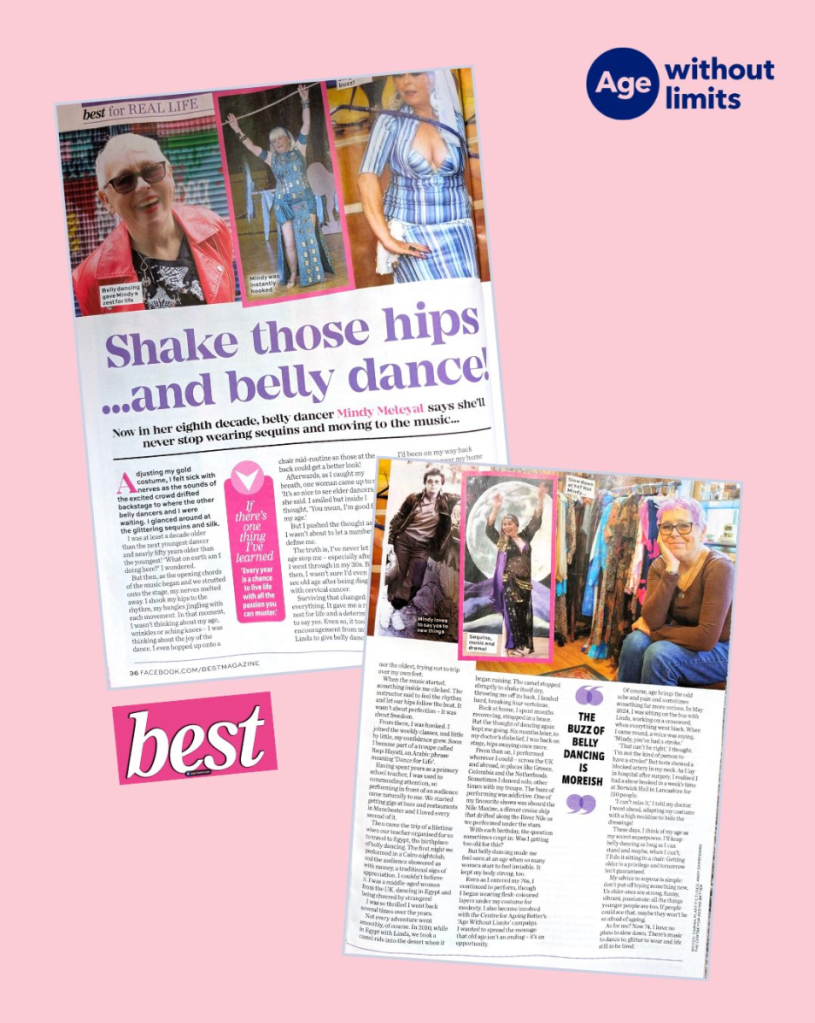
Shake those hips … and belly dance!
Now in her eighth decade, belly dancer Mindy Meleyal says she’ll never stop wearing sequins and moving to the music …
Adjusting my gold costume, I felt sick with nerves as the sounds of the excited crowd drifted backstage to where the other belly dancers and I were waiting. I glanced around at the glittering sequins and silk.
I was at least a decade older than the next youngest dancer and nearly fifty years older than the youngest! “What on earth am I doing here?” I wondered.
But then, as the opening chords of the music began and we strutted onto the stage, my nerves melted away: I shook my hips to the rhythm, my bangles jingling with each movement. In that moment, I wasn’t thinking about my age, wrinkles or aching knees – I was thinking about the joy of the dance. I even hopped up onto a chair mid-routine so those at the back could get a better look!
Afterwards, as I caught my breath, one woman came up to me. “It’s so nice to see elder dancers”, she said. I smiled but inside I thought, “You mean, I’m good for my age.”
But I pushed the thought aside. I wasn’t about to let a number define me.
The truth is, I’ve never let age stop me – especially after what I went through in my 30s. Back then, I wasn’t sure l’d even see old age after being diagnosed with cervical cancer.
Surviving that changed everything. It gave me a zest for life and a determination to say yes. Even so, it took encouragement from my partner Linda to give belly dancing a chance.
Eagle Street College, Bolton
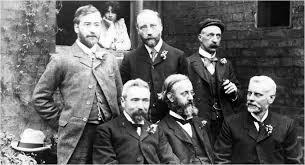
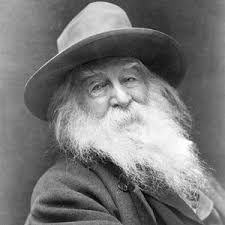
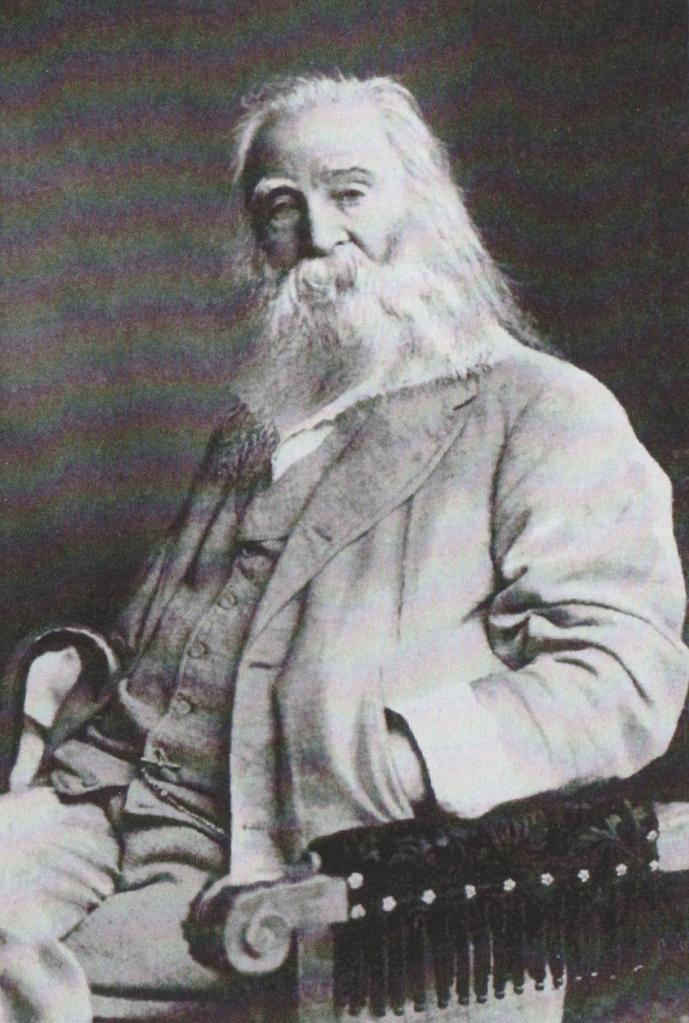
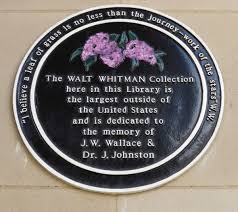
Among the birthday greetings Whitman received in 1887 were an unexpected gift of money and an expression of admiration from two Englishmen who were completely unknown to him. They were J W Wallace and Dr John Johnston, both of Bolton, a cotton manufacturing town not far from Manchester in the Lancashire district of northern England. Wallace and Johnston were the leaders of a small band of Whitmanites who met weekly at Wallace’s home on Eagle Street. So earnest were their discussions at these gatherings that Johnston dubbed the group the “Eagle Street College.” Whitman acknowledged the gift warmly, which was repeated in succeeding years, and in 1890 met Johnston for the first time when the doctor arrived at Mickle Street in Camden.
The following year Wallace made the same journey. While in America, both men also visited various friends and associates of Whitman, meetings which they recounted in a jointly written volume published in 1917.
The story of the “College” itself, however, ranges beyond these brief contacts, for in the closing years of his life Whitman wrote a steady stream of messages, sometimes on a daily basis, to this unlikely group of admirers. These were not literary critics or scholars, in the usual sense, but bank clerks, clergymen, manufacturers, assistant architects (including Wallace), and, of course, the physician, Dr Johnston. Originally their meetings ranged freely over many subjects, but three or four were already students of Whitman, so gradually the poet became the principal subject of their papers, readings and discussions.
Once the direct contact had been made with Whitman through Johnston’s visit, it never lessened, having been intensified by Wallace’s stay in Camden. The ties between the poet and the Bolton group were made deeper by the gifts of books, magazines, and photographs that flowed between England and America, including Whitman’s gift of the stuffed canary which in life had brought him much pleasure and which he made the subject of a poem, “My Canary Bird” (1888). Others were also brought into the relationship — John Burroughs; R M Bucke, who visited Bolton; and Horace Traubel, who became one of Wallace’s most constant correspondents and remained so until Traubel’s death. In England the “College” contacts included Edward Carpenter and John Addington Symonds.
Despite the literary luster of Carpenter and Symonds, it was the working-class status of the collegians themselves that appealed to Whitman, and in them he believed he had found the audience for which he aimed. Later the circle of friends became part of the English socialist movement, but while Whitman was alive their ideal was democracy, by which they meant the elimination of the class system in England and the improvement of the conditions of workers. Therein lay Whitman’s great appeal for them, for they understood him to be the divinely inspired prophet of world democracy.
The “Eagle Street College” did not disband or lose its direction after Whitman’s death, but continued to work toward the high objectives its members believed Whitman had set. Virginia Woolf once paid respect to their long devotion to Whitman, and the “College” so inspired their townsmen that the Bolton Library maintains the collegians’ books, correspondence, and manuscripts in its local history collection. Included among the artifacts is the stuffed canary still in its original case.
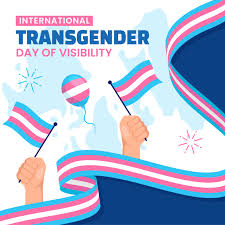
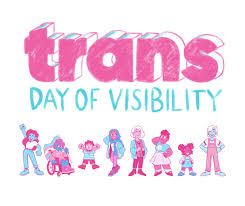
Transgender Day of Visibility 2026: What It Is & How to Celebrate
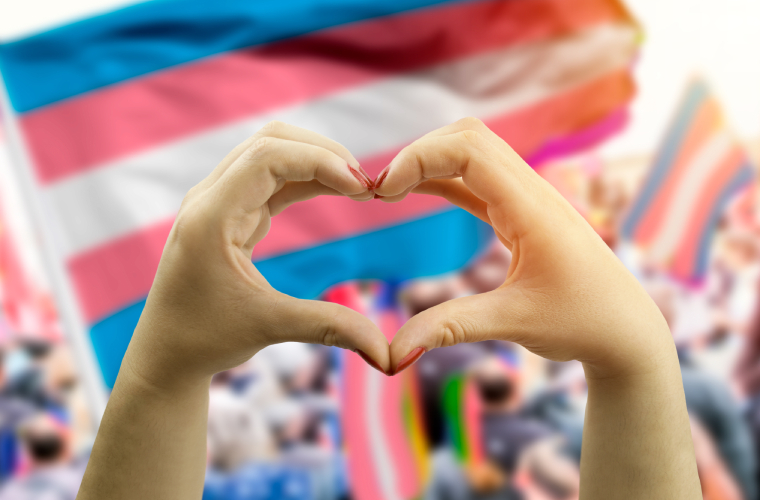
Transgender Day of Visibility (TDOV) is an annual event dedicated to celebrating transgender people and raising awareness of the discrimination they face worldwide. Unlike Transgender Awareness Week, which focuses on education and advocacy leading up to Transgender Day of Remembrance, TDOV is a day dedicated to celebrating and uplifting the visibility and achievements of transgender individuals.
Observed on the 31 March, TDOV was founded in 2009 by transgender activist Rachel Crandall to counteract the negative narratives often associated with transgender lives. This day provides an opportunity to acknowledge trans achievements, educate society and advocate for equal rights.
Why is Transgender Day of Visibility Important?
Despite growing representation and legal advancements, transgender people still face significant challenges. Recent statistics indicate that hate crimes against transgender individuals in England and Wales have seen a significant increase over the past five years. In the year ending March 2024, police recorded 4,780 hate crimes against transgender people, which, despite being a 2% decrease from the previous year, reflects a substantial long-term upward trend.
A recent YouGov poll (2024) has highlighted increasing anti-trans sentiment in the UK. The research showed growing scepticism towards trans rights, even among traditionally progressive demographics such as young people and women. Key findings include:
Support for legally changing gender has declined among women from 44% in 2022 to 37% in 2023, while opposition rose from 32% to 42%.
Among 18-24-year-olds, support for legal gender change dropped by 7 percentage points, now at 50%.
The percentage of people who believe individuals should not be able to socially identify as a different gender increased by 8 points to 25%.
57% of respondents said trans healthcare treatments should not be provided by the NHS, a rise from previous years.
This shift in public opinion mirrors anti-trans rhetoric increasingly present in political and media discourse. The UK government has maintained a commitment to modernising the Gender Recognition Act, but reports suggest continued barriers to progressive reform.
By celebrating TDOV, individuals and organisations can help foster understanding, reduce stigma and promote inclusivity for transgender people in workplaces, schools and communities.
How to Celebrate Transgender Day of Visibility
Whether you are a business, an educator, or an individual, there are many ways to mark TDOV and show solidarity with the transgender community. Here are some meaningful ways to celebrate:
Educate Yourself and Others
Understanding transgender issues is crucial in building an inclusive society. Read books, watch documentaries and follow trans activists on social media to learn more about their experiences. Recommended reads include:
What It Feels Like For a Girl – Paris Lees
What’s the T? – Juno Dawson
The Queer Allies Bible – NV Gay
Amplify Trans Voices
Support transgender content creators, activists and artists by sharing their work on social media. Consider following influencers such as Matt Ellison, Dylan Holloway, and Fox and Owl Fisher, who advocate for trans rights and visibility.
Encourage trans individuals to share their stories, whether through blogs, panel discussions or media features. Personal narratives help to humanise experiences and foster empathy.
Support Trans-Led Organisations
Donating to charities and organisations that support trans rights can make a meaningful difference.
According to The LGBT Foundation, nearly half (48%) of transgender people in the UK have attempted suicide at some point in their lives. Supporting mental health and advocacy groups can be life-saving.
Advocate for Inclusive Policies
For businesses and educational institutions, TDOV presents an ideal opportunity to review and enhance policies on diversity and inclusion. Key steps include introducing gender-neutral facilities, updating workplace policies to ensure comprehensive protections for trans individuals and adopting inclusive language.
Workplaces can also foster a culture of acceptance and respect by inviting transgender speakers to lead workshops or share their experiences. This not only raises awareness but also encourages meaningful dialogue.
Use Correct Pronouns and Names
A simple yet powerful act of allyship is respecting people’s chosen names and pronouns. If unsure, ask politely or include pronouns in email signatures and social media profiles to normalise their usage.
Attend or Organise TDOV Events
Many LGBT+ organisations host events such as panel discussions, art exhibitions and community gatherings. Taking part in these events is a meaningful way to show support and gain insight from trans perspectives.
If you’re in a workplace setting, consider organising a trans awareness workshop led by an expert. This can help improve team understanding and contribute to a more inclusive work environment.
Show Your Support Publicly
If you are a business or influencer, take a stand in support of transgender visibility by making a public statement. Update your social media banners, share valuable resources and celebrate the achievements of trans employees to demonstrate a genuine commitment to diversity and inclusion.
Engage with Policy Changes
Advocate for policies supporting trans rights, such as easier access to legal gender recognition and healthcare. Writing to local MPs, signing petitions and attending protests can amplify the call for equality.
Transgender Day of Visibility is not just a celebration – it is a call to action. While visibility is important, it must be accompanied by systemic change to improve the lives of transgender individuals worldwide.
With growing anti-trans sentiment, the role of allies, educators and policymakers is more crucial than ever. By taking the time to learn, amplify voices and advocate for inclusivity, we can help create a society where transgender people are not just visible, but valued and respected.
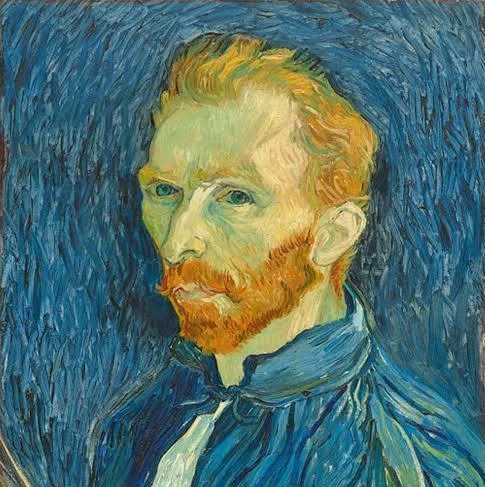
Vincent van Gogh (30 March 1853 – 29 July 1890)
While there’s so much we’ll never understand about Vincent van Gogh’s life, I was interested to learn that medical biographers believe he experimented with “hypersexuality, hyposexuality, bisexuality and homosexuality” in his adult years.
Van Gogh and Gauguin lived together in Arles, France for a two month period. Historians speculate the two artists had a physical and emotional relationship, which would explain their frequent and fiery arguments – including the one that led van Gogh to cut his ear off and Gauguin to leave Arles for good.
“Everything considered, I am obliged to return to Paris,” Gauguin wrote in a letter to van Gogh’s brother Theo. “Vincent and I simply cannot live together without trouble, due to the incompatibility of our characters, and we both need tranquillity to work.” Sounds a little gay to me!
While the two never reunited, they communicated via letters until van Gogh’s passing.
The artist later reflected on Gauguin’s painting as “indeed me, extremely tired and charged with electricity as I was then.” And weeks before his death, he wrote to Gauguin: “I’ve thought about you every day.”
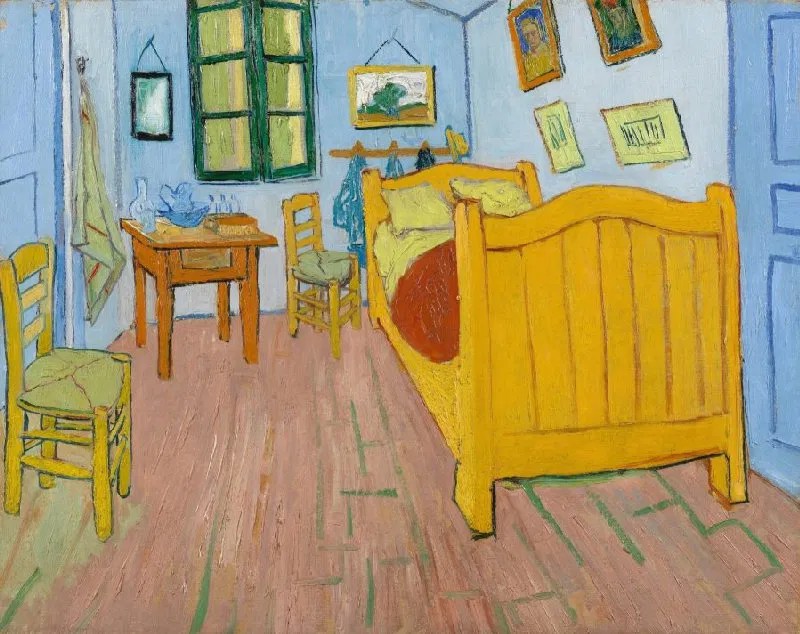
Maybe more happened in the infamous bedroom – painted during van Gogh’s stay in Arles – than we’ll truly ever know.
The Olympics ended sex testing – it’s back
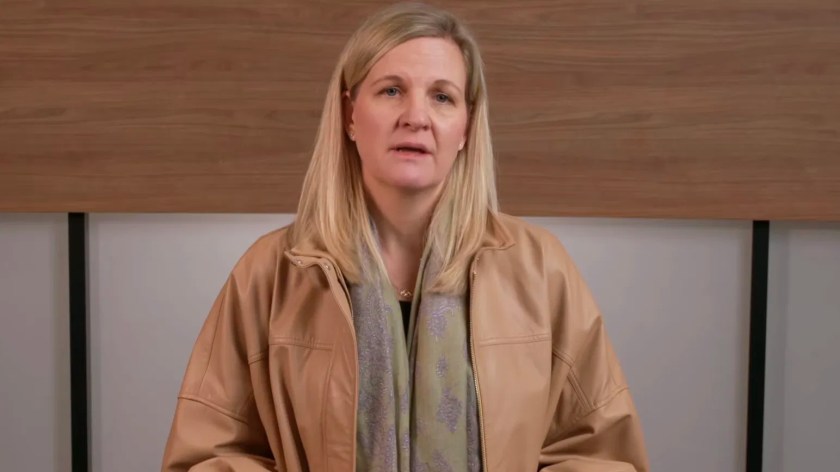
The International Olympic Committee (IOC) has announced that, from the Los Angeles games in 2028, all women will be subject to a gender verification ‘sex test’ that will ban trans women from all Olympic events. Men will not be subject to sex testing.
IOC President: Kirsty Coventry
The IOC has announced it will restart ‘sex testing’, a practice its own internal report said was scientifically flawed, discriminatory, and a cause of emotional trauma when it ended the practice 30 years ago.
To be eligible for female categories in the Los Angeles Olympics in 2028, women will be “determined on the basis of a one‑time SRY gene screening.”
The SRY gene is found on the Y chromosome, associated with the male sex. However, with rare exceptions, athletes with an SRY-positive screen will not be able to take part in female category Olympic events.
The move has been condemned by over 100 human rights groups, who say the guidelines are “a blunt and discriminatory response that is not supported by science and violates international human rights law”.
The effect of this change will be to police women’s gender presentation even further and write a blank cheque for right-wing media and pundits to pursue patriarchal, discriminatory rhetoric unchecked.
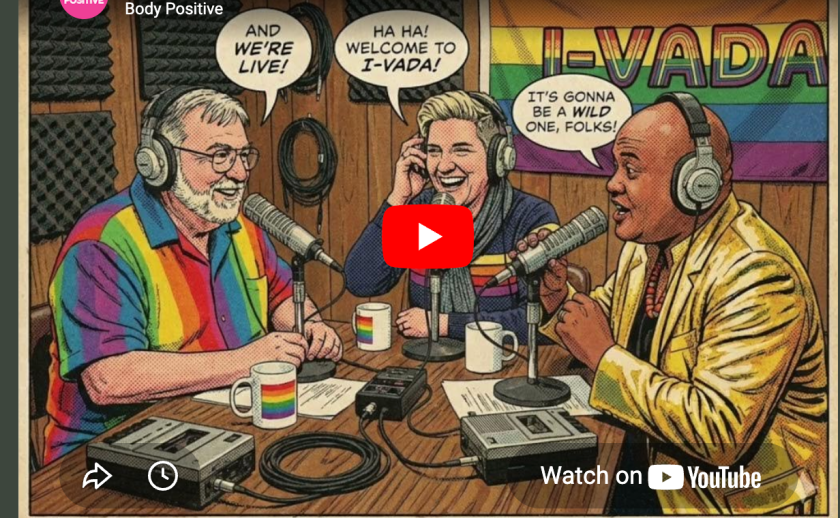
I-Vada – An LGBTQ+ History Podcast
Hosted by Jonathan Mayor, Sally Probert-Hill and the fantabulosah Colin Avery, i~vada brings the rich, rebellious and often forgotten history of LGBTQ+ culture to your perfectly-formed ears via the magic of the podcast.
With sharp insight, warmth, and a touch of mischief, the hosts explore the people, politics and stories that have shaped queer life across generations. From hidden histories to headline moments, each episode shines a light on the past to better understand our present.
Section 28 – The Law That Tried to Silence Us
In this episode of I-Vada, we dive into one of the most controversial pieces of legislation in recent British history: Section 28.
We cast our minds back to Thatcher’s Britain to explore how a few lines of law created a decade-long climate of fear for the LGBTQ+ community.
From the infamous ‘pretended family relationships’ clause to the protests that shook Manchester, we look at the personal toll of state-sanctioned homophobia and the community that rose to fight it.
In this Episode:
The Roots of the Law: We discuss how Section 28 of the Local Government Act 1988 prohibited local authorities from ‘promoting’ homosexuality, effectively silencing teachers and youth workers.
The ‘Red Herring’ Book: The story behind Jenny Lives with Eric and Martin, the Danish children’s book that became a focal point for moral panic despite hardly being used in schools.
Manchester Fights Back: Insights from oral historian Jamie Starr and activist Tony Openshaw on the massive 20,000-strong protest in Albert Square.
Working from the Inside: Paul Fairweather shares his experience as a Gay Men’s Officer for Manchester City Council, navigating legal minefields to continue supporting the community.
A Culture of Fear: Personal reflections on the 1980s “gay plague” headlines, the panic surrounding the AIDS crisis, and the internalised shame many still carry today.
Art as Activism: Choreographer Gary Clark discusses his performance piece, Detention, which explores the trauma and rage of growing up under Section 28.
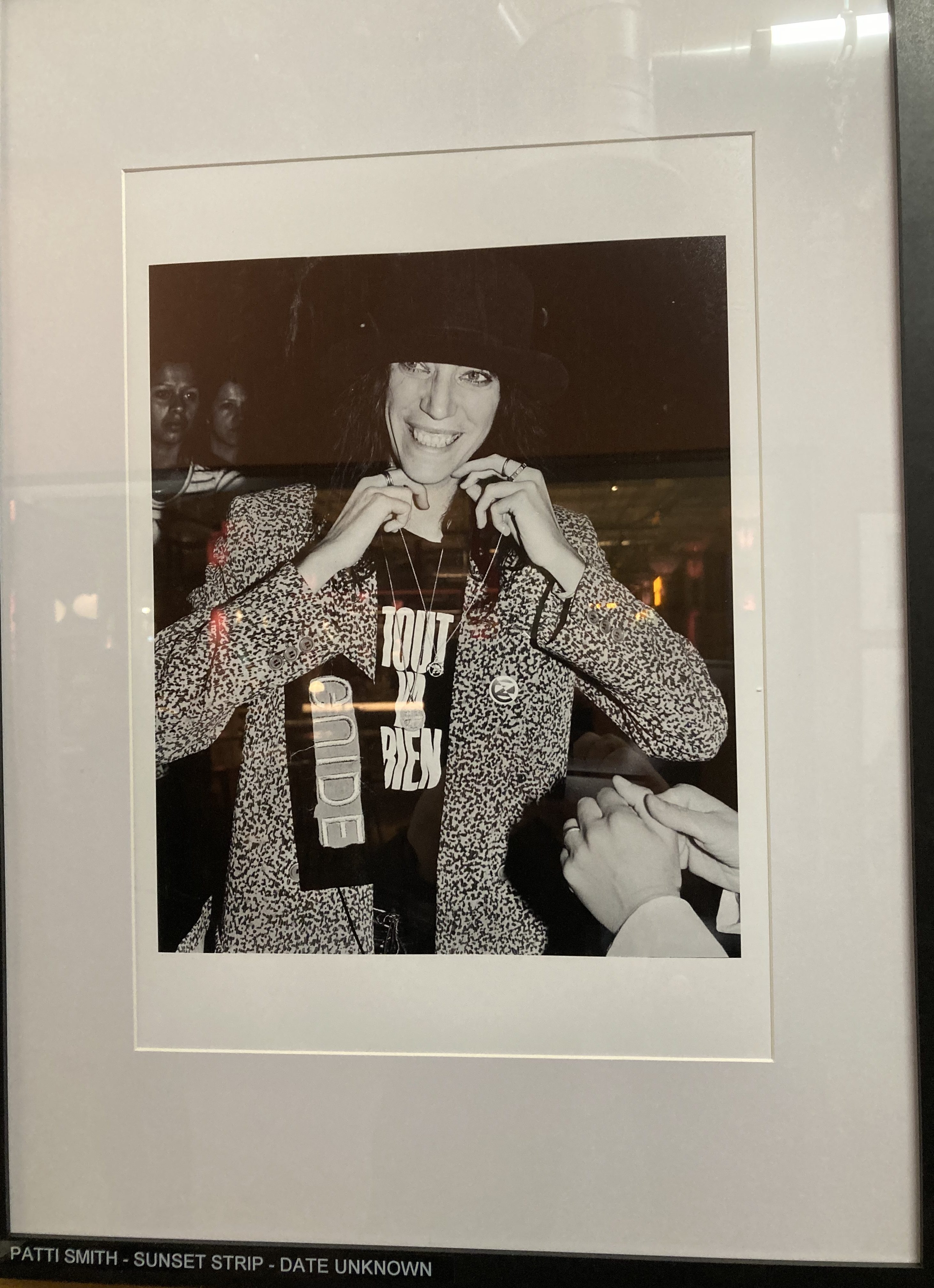
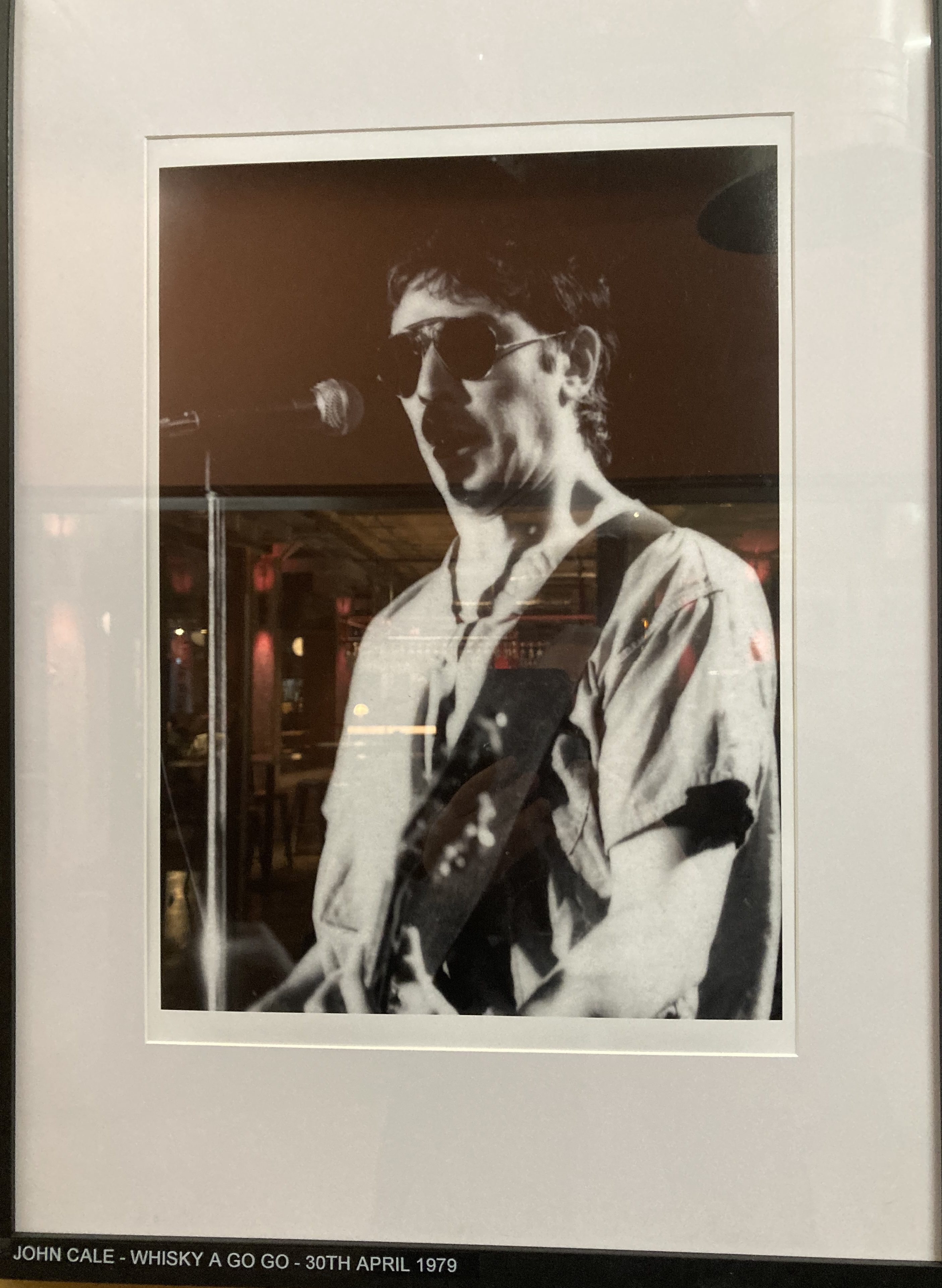
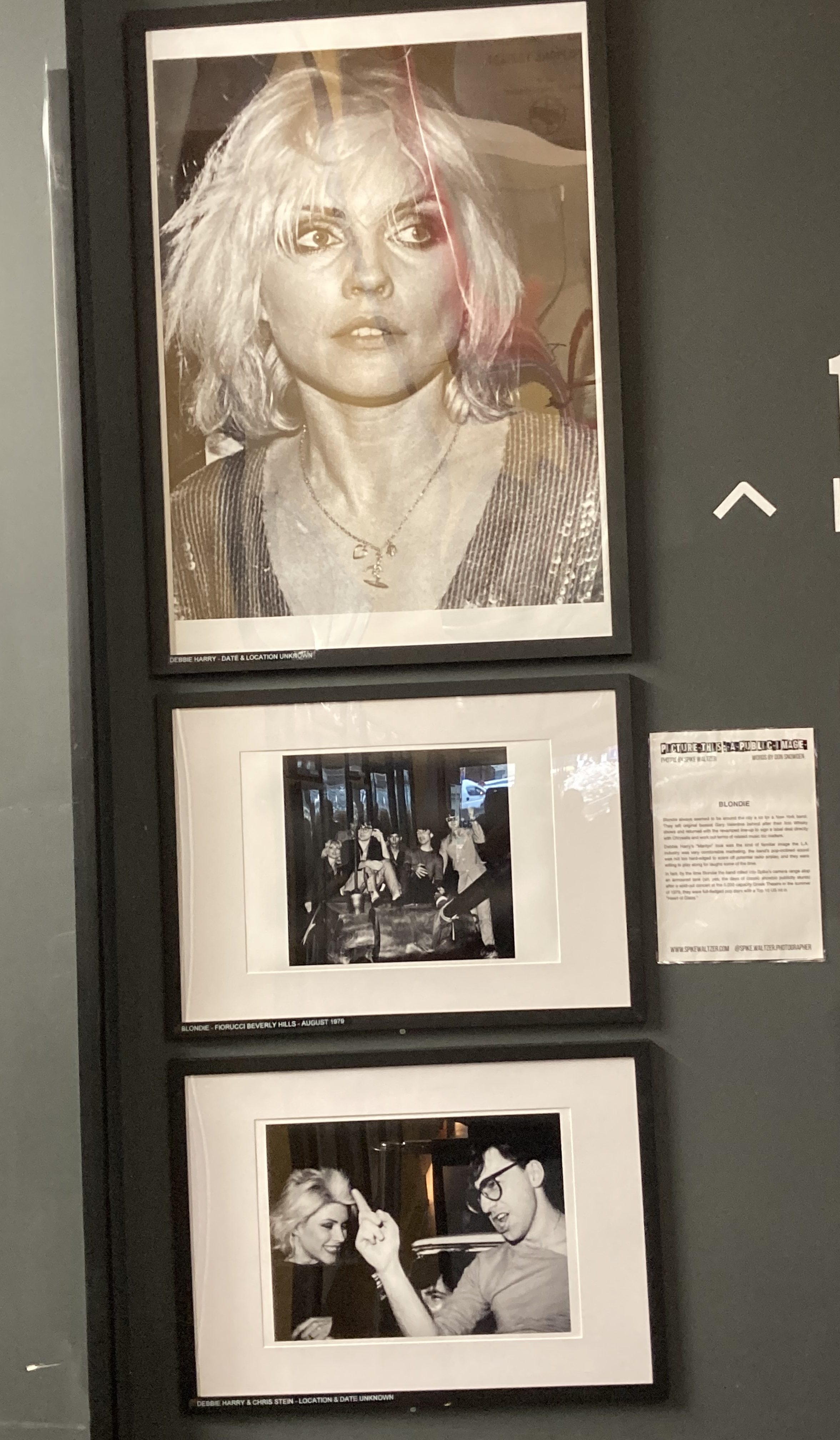
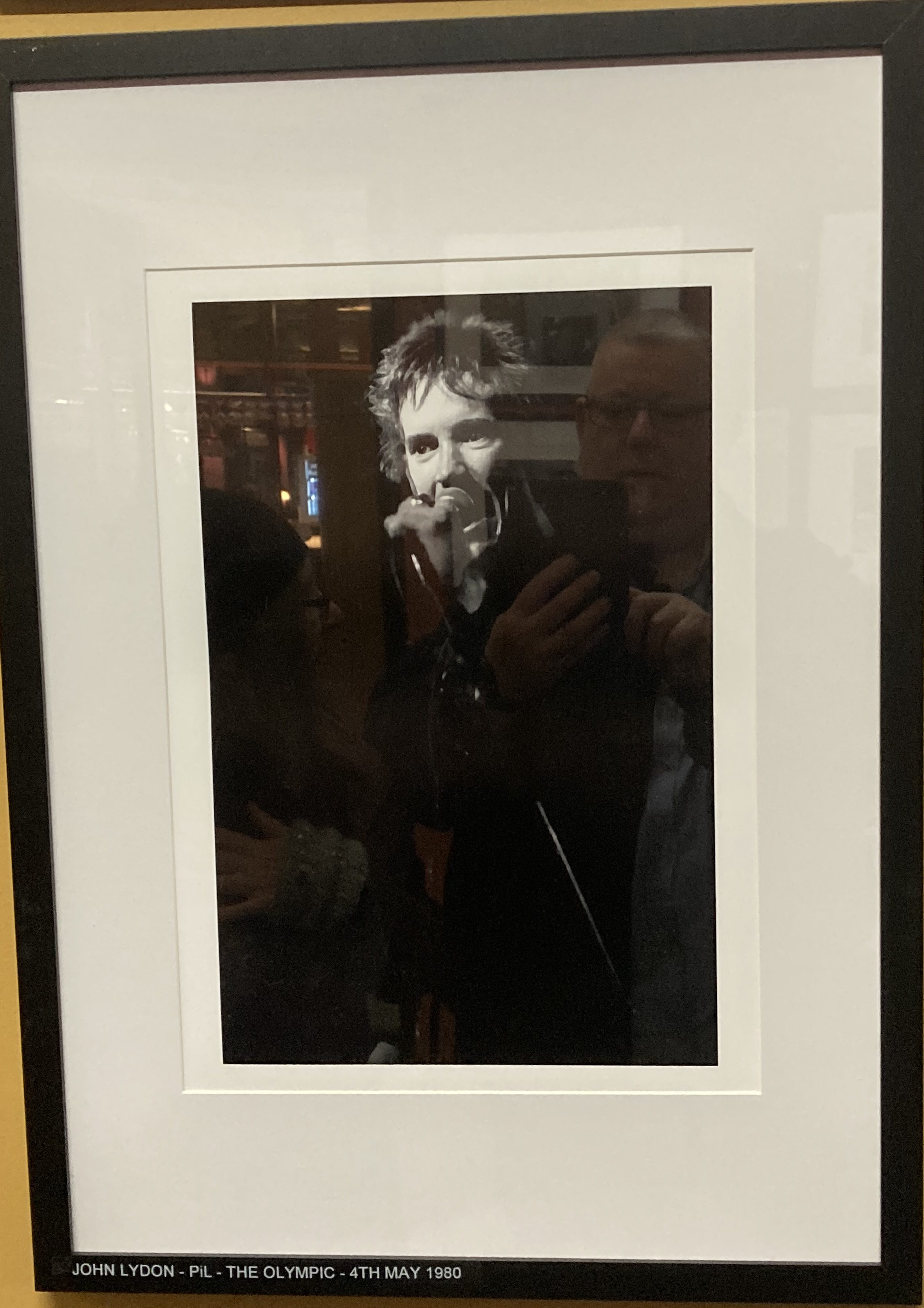
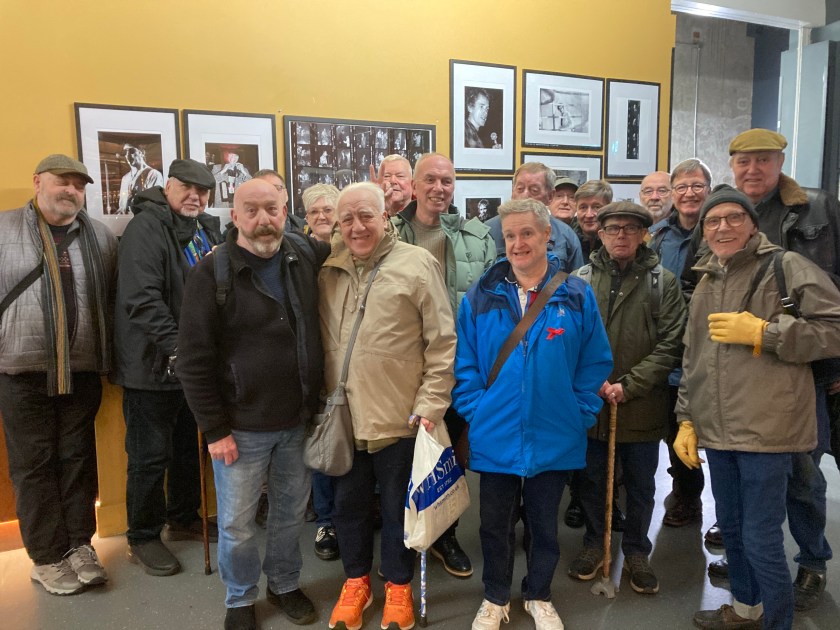
This week Out In The City members visited the New Century Hall to view a new photography exhibition: “Picture This: A Public Image” – a collection of previously unseen photographs from 1978 -1980.
The images were the individuals and groups from the Ska, Punk and New Wave era and included The Clash, Sex Pistols, Madness, Blondie and Patti Smith.
(Patti Smith at Sunset Strip, John Cale at Whisky A Go Go (30 April 1979), Blondie and John Lydon)
The New Century Hall has hosted iconic acts ranging from legends like Jimi Hendrix, The Rolling Stones, The Kinks, The Hollies, The Bee Gees and Tina Turner to Madchester bands like The Stone Roses and Happy Mondays.
The building has now been fully restored and is still a concert hall, but includes a food hall with independent food traders.
It was in 1944, while stationed at Bletchley Park in hushed secrecy, that Alan Turing first spoke of “building a brain”.
The man who brought Turing to Manchester in 1948 was called Max Newman. Newman was a mathematician who had taught Turing at Cambridge, then worked alongside him at Bletchley Park, and was now in Manchester where he had been given £30,000 by the government to build a computer.
While at Cambridge, Newman had posed his students a philosophical question about the limits of mathematics as a field. Turing (and this sort of behaviour was typical of Turing) produced in response a paper where he imagines a machine that works like a brain. It’s the first evidence we have of a theme that runs through Turing’s life – his fascination with the idea that a machine might be taught to think.
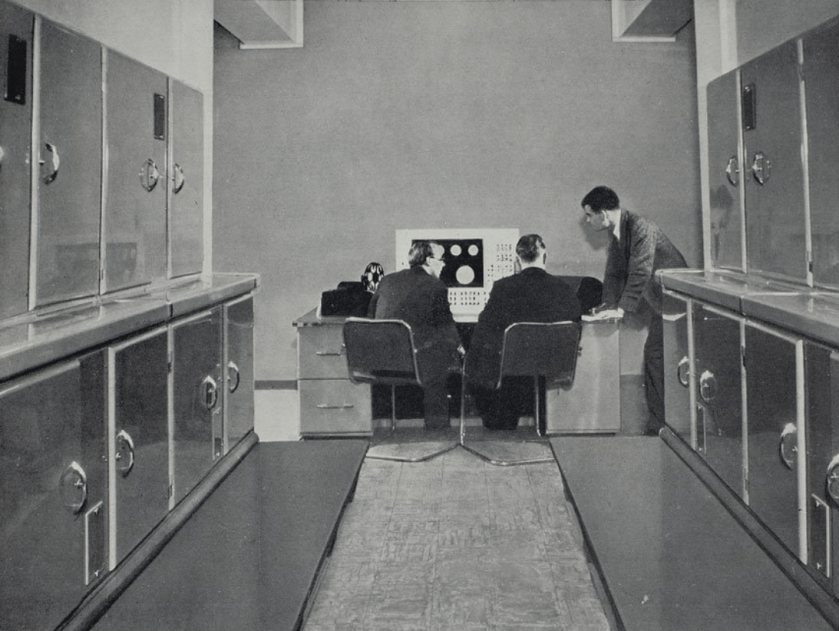
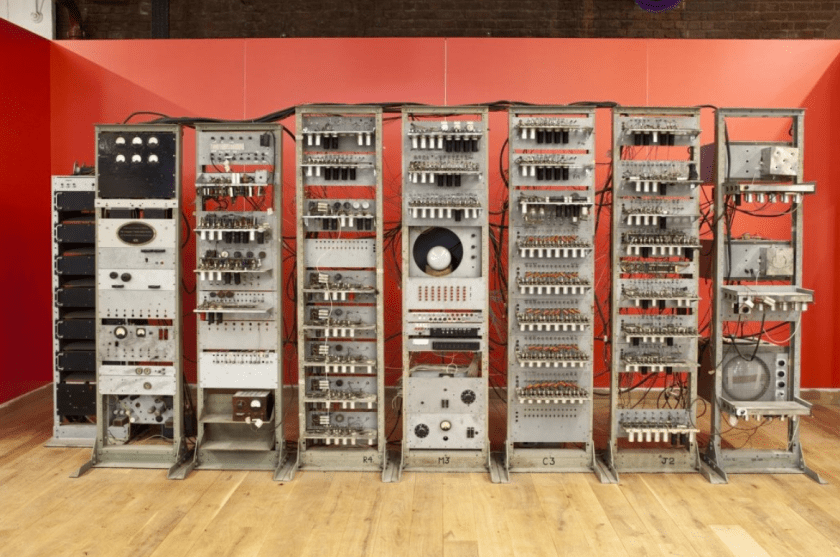
The other notable thing happening in Manchester at that time was that three men – Frederic C Williams, Tom Kilburn and Geoff Tootill – were in the process of “having a baby”. The Manchester Baby was the world’s first-ever “stored programme” computer. The Baby was freakishly large. It filled the entire laboratory room: a dusty, dirty room in the old Victoria University of Manchester on Cooper Street. The Baby was also largely what made Manchester attractive to Turing: a testbed for his ideas.
Replica of the Manchester Baby at the Museum of Science and Industry
Turing and Newman had a shared interest in the idea of a machine acting as a brain. Turing was more open about this, Newman less so (the latter weighed up the practical consideration of accessing grant funding, while the former did as he pleased) but a shared interest it was. In October 1949 the trailblazing female philosophy professor Dorothy Emmet hosted a seminar at the university, The Mind and the Computing Machine, which we can label, retrospectively, the first public intellectual debate on what came to be known as Artificial Intelligence (AI).
Also in 1951 an essay by Turing appeared in the philosophical journal Mind, with the opening line: “I propose to consider a question, can machines think?” A Manchester Guardian piece in 1951 talked about how Turing had “come to the conclusion that eventually digital computers would be able to do something akin to “thinking” and also discussed the possibilities of educating a ‘child-machine.’”
Free concerts at Manchester Cathedral
Take time out and enjoy free music in the beautiful surroundings of Manchester Cathedral – you might even discover the UK’s next big talent!
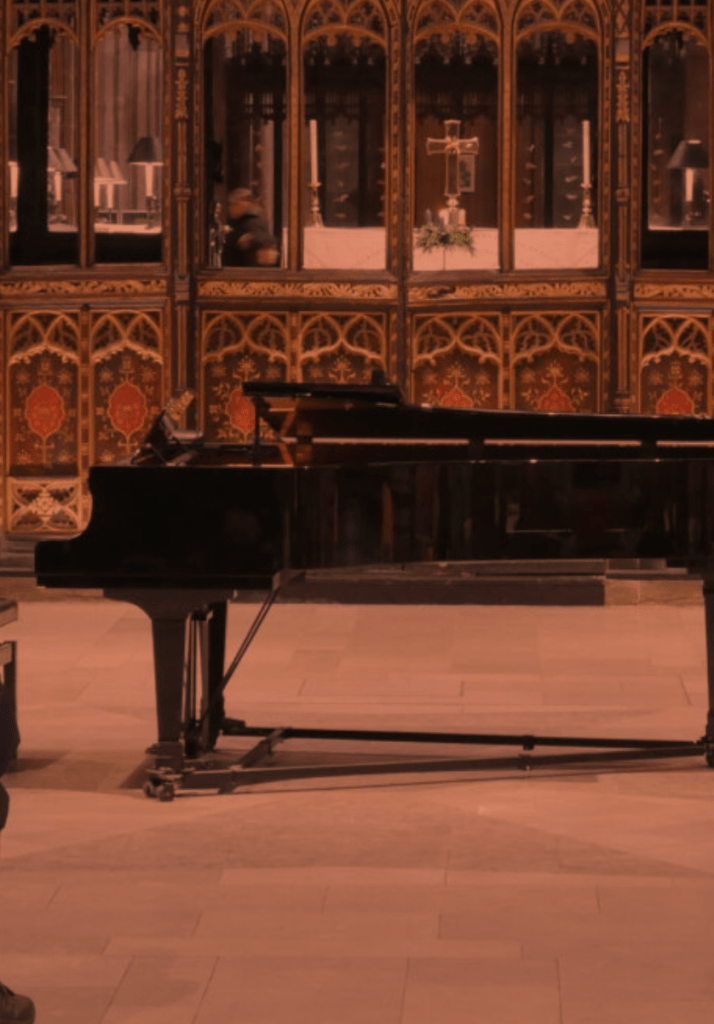
The cathedral, part of Manchester’s Medieval Quarter, has announced a new series of lunchtime recitals by students from Chetham’s School of Music. There are piano recitals and a programme called ‘Music for a While,’ which showcases the talent of individuals as they perform with accompanists. The music choices vary so there’s always something new to discover.
We believe that the true wonder of music is that it can bring people together and have a profound effect on quality of life. We aim to make music more accessible to more people so everyone can experience this, and the students are at the heart of this mission.
Concerts are free and no booking is required – just turn up, sit back and enjoy. You’ll also be supporting the next generation of musicians as they hone their skills.
Upcoming events: 20 April, midday – Piano Lunchtime Concert 18 May, midday – Piano Lunchtime Concert 11 June, midday – Music for a While
Rainbow Lottery
It’s time to put your feet up with a cuppa while the robots take care of your gardening and spring cleaning! One of our supporters could win this amazing Home Robot Bundle in our March Super Draw – and make spring cleaning a breeze!
You could be taking home a Roomba 405 Plus combo vacuum and mop for carpets and hard floors, and a Lawnmaster Ocumow to keep the garden under control – all while you focus on the important things! Of course there’s always the £1,000 cash alternative too – or our winner can choose to go green, and plant 1,000 trees!
Play the Rainbow Lottery and support Out In The City
The Rainbow Lottery is the UK’s first and only lottery supporting LGBT+ good causes.
Welcome to the Rainbow Lottery, the exciting weekly lottery that raises money for over 200 LGBT+ good causes totally, openly and exclusively.
The hope is to make a difference to good causes so they can carry on their vital work – which helps us all. Play the lottery, support the community – it’s fun, it’s simple and everybody wins!
How the lottery works:
£1 per ticket – that’s right, unlike many other lotteries, the lottery tickets are only £1 per week.
For every ticket you play, 80% goes to good causes and prizes.
£25,000 jackpot prize
Match all 6 numbers and you win the JACKPOT! There are also prizes of £2000, £250, £25 and 3 free tickets for following week.
Every month there is a Super Draw. March’s Super Draw is a Home Robot Bundle (or £1,000 cash alternative or plant 1,000 trees).
Lost BBC documentary on homosexuality brought back to life nearly 70 years on
A new short film from Loughborough University tells the story of a remarkable BBC radio documentary about homosexuality, broadcast nearly seven decades ago at a time when the subject was almost entirely absent from public life.
The Homosexual Condition aired on the BBC Home Service in July 1957, when male homosexuality was still illegal in Britain. The programme featured doctors, legal experts and a former prisoner discussing the causes of homosexuality, possible “treatments” and whether the law should be changed.
It was broadcast just weeks before the publication of the landmark Wolfenden Report, which recommended decriminalising homosexual acts between consenting adults, a recommendation that would not become law for another decade.
The transcripts were rediscovered in the BBC archives by Marcus Collins, Professor of Modern History at Loughborough University, whose research forms the basis of the new film.
Collins said the discovery offered a striking glimpse into a very different world. “What counted as a ‘liberal’ position in the 1950s was often the belief that homosexuality could be cured, rather than punished,” he said.
The film explores how the BBC navigated such a controversial subject at the time, and how profoundly attitudes to sexuality, science and the law have shifted since. Homosexuality was partially decriminalised in Britain in 1967, ten years after the broadcast.
Keith Haring: A New Retrospective of his Early Work 1980-1983 at the Brant Foundation, New York
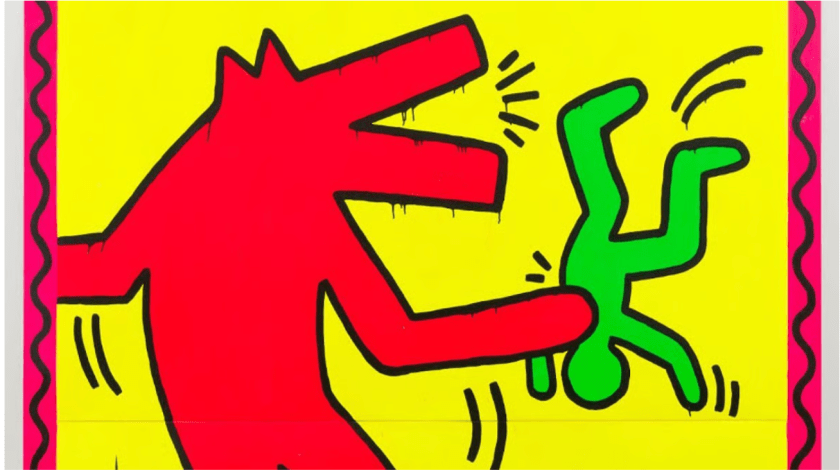
Keith Haring early painting featuring bold red and green figures in his signature graphic style Photo: Courtesy of Keith Haring
We still find it tough to believe that it’s 36 years since the world lost Keith Haring. Aged just 31, Haring died of AIDS related complications at the height of the epidemic. At his memorial service on 4 May 1990, at the Cathedral of St John the Divine in New York City, there were over 1,000 people in attendance. He will always remain the quintessential New York queer artist of the time, quite rightly, his whole body of work is just as powerful and memorable today as it ever was.
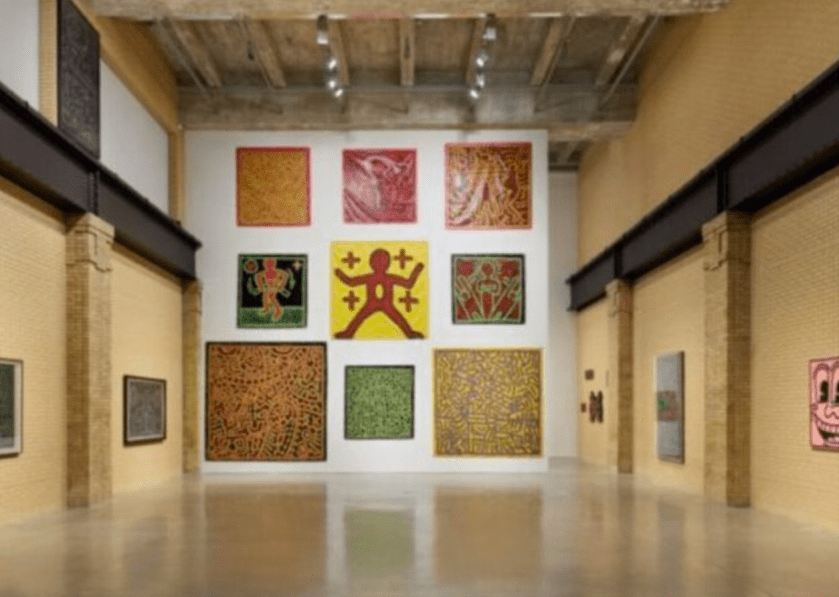
Now, the Brant Foundation in New York has mounted a new retrospective revisiting Haring’s formative years of 1980 – 1983, and the exhibition traces his meteoric rise from the subways of New York to international fame. Opening to the public on 11 March 2026, the exhibition will be on view at the Foundation’s East Village space in the bustling downtown neighbourhood where a young Haring began his career.
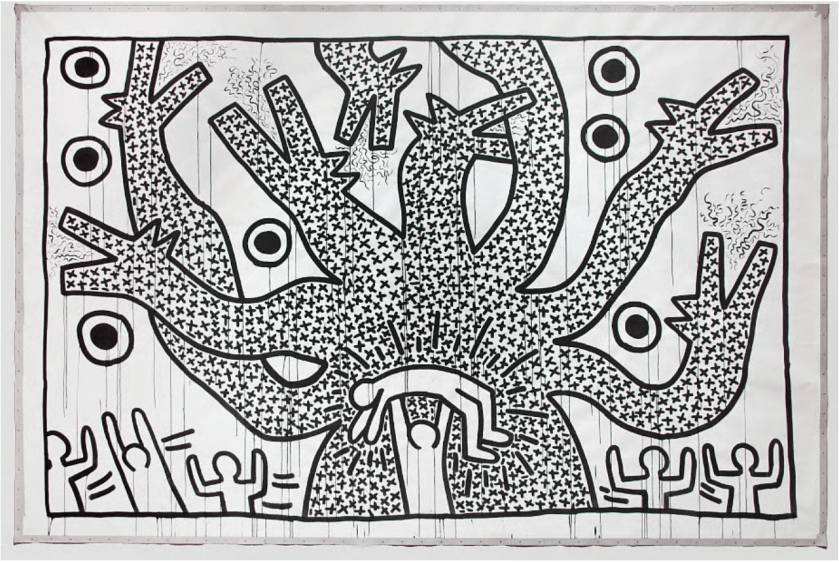
Keith Haring large-scale mural-style composition with radiating figures and signature graphic symbols Photo: Courtesy of Keith Haring
Haring took inspiration from the everyday urban spaces he inhabited. From his spontaneous, early-career chalk drawings in subway stations to his vibrant, pop-inspired works that addressed social issues ranging from the AIDS epidemic to the drug crisis, Haring shepherded a body of work that was both visually dynamic and socially engaged.
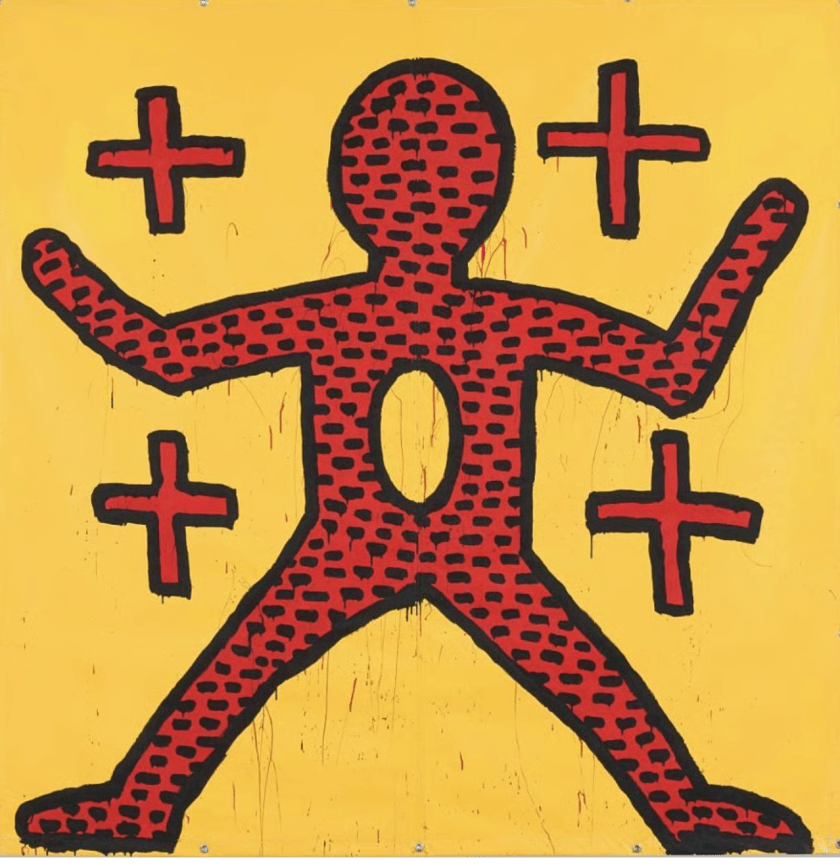
Keith Haring “Crack Is Wack” style figure with a red patterned body against a yellow field Photo: Courtesy of Keith Haring
The Brant Foundation’s founder, Peter M Brant said:
“Haring was a champion for important causes of his time, particularly the AIDS crisis. He used his art to support his tireless activism and he was an advocate for change, inspiring millions with his distinct style.”
Original Pride flag to come to Cork as first stop of world tour
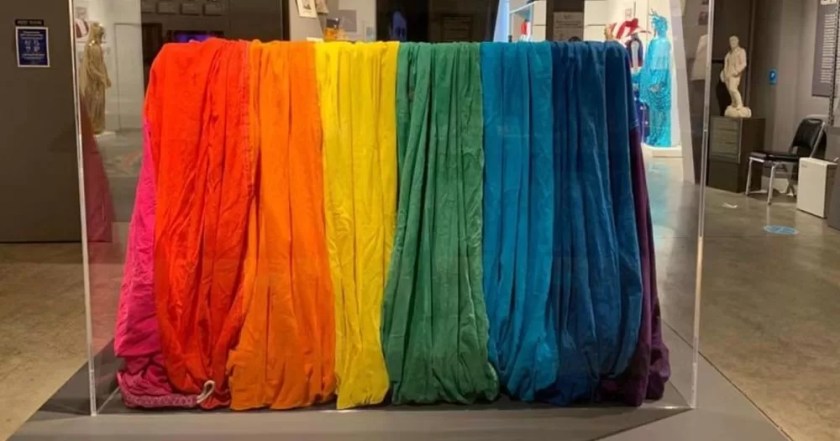
Original Pride Flag / Image: Andrew Shaffer via The Art Newspaper
The original Pride flag, which usually resides in San Francisco, is going on a world tour, and Cork is its first stop.
Cork may seem like a surprising stop on the world tour, certainly for the first stop, but San Francisco and Cork are actually sister cities. Twinning and sister cities aim to celebrate culture and build communities through international links.
Cllr John Maher, local representative of the Labour Party for Cork City North East, visited San Francisco and the flag in 2024. He is another reason for Cork being selected as the inaugural stop on tour. “I made the comment a bit flippantly, to be honest, when we met the curator of the museum where the flag is held. He had said that they were thinking of sending the flag on tour, and I just said ‘make sure Cork is first’.
The original Pride flag was designed in 1978 by LGBT+ rights activist Gilbert Baker. It is usually on display in the GLBT Historical Society in the Castro district of San Francisco. Baker was popular for his drag costumes and political banners. Harvey Milk encouraged Baker to create a symbol of Pride for the LGBT+ community, and Baker decided on a flag as a way to come out and attain visibility.
The dyed cotton muslin flag is a fragment of one of the two original eight-stripe rainbow flags raised at the San Francisco Gay Freedom Day Parade on 25 June 1978.
The original flag boasted eight colours, two more than the now-standard six-colour Pride flag. Pink and turquoise were cut by 1979 due to production issues and aesthetic choices, and indigo was replaced by blue. Baker made a mile-long version of the flag for the 25th anniversary of the Stonewall riots in 1994.
Cleve Jones, a friend of Baker, said, “I told him he’d better patent it, and he said, ‘No, it’s my gift to the world.’” Many flag versions have been created since, with the Progress flag and Intersex-inclusive ones being popular additions in recent years.
Cork LGBT Archive is to launch a permanent exhibition this year, and the original Pride flag is expected to be on display beside the exhibition in autumn, in the Cork Public Museum.




 Out in the City