WHO put the day in World AIDS Day?

News

World AIDS Day, designated on 1 December every year since 1988, is an international day dedicated to raising awareness of the AIDS pandemic caused by the spread of HIV infection and mourning those who have died of the disease.

In 2016, a campaign was started to rename World AIDS Day to World HIV Day, putting the emphasis on social justice issues and the advancement of treatments.

Today, medical advances have come on leaps and bounds, and ending HIV transmission in the UK is finally within sight.

The first step is understanding … Human Immunodeficiency Virus (HIV) is a virus which causes damage to the immune system. Your immune system protects you from illnesses and infections. Early diagnosis and starting treatment means someone with HIV can stay well and live a normal lifespan.

Undetectable = Untransmissable (U = U)

The viral load is the amount of HIV in the body. It is measured by a blood test in copies/ml and can range from over 1,000,000/ml (very high) to fewer than 20/ml (undetectable).

An undetectable viral load does not mean there is no HIV present or that it has been cured – HIV is still there but at levels too low for the laboratory test to pick up.

If someone is on effective HIV treatment and has an undetectable viral load it has been scientifically proved that they cannot pass on HIV.

The red ribbon is the universal symbol of awareness and support for people living with HIV. Wearing a ribbon is a great way to raise awareness on and during the run up to World AIDS Day.

The answer to the question in the title is actually in the question itself: The World Health Organisation (WHO) chose 1 December to mark World AIDS Day.


Pride in Caring – Celebrating Older LGBT+ People

News

Trips & Adventures – 29 November 2019

We attended an event “Pride in Caring – Celebrating Older LGBT+ People” from 10.00am to 2.00pm at the Elizabethan Suite in Bury Town Hall.

It was a day of celebrating older LGBT people with stalls, exhibitions, a workshop and a free lunch.

The day started with a couple of speeches from a Bury councillor and a gay man, in a relationship for 37 years, whose partner is quite frail and needs a lot of support. We then had a wander around the various stalls chatting to the staff.

There was an interesting workshop. Sadly, half of all LGBT people over 55 feel that their sexual orientation or gender identity has or will have a negative impact on getting older. As older LGBT people we have grown up in a world hostile to our identities, and the impact of discrimination is felt as we age. We may experience an increased reliance on services, isolation from family and community, and a need to renegotiate our identities within the wider LGBT communities.

We often experience specific health inequalities and care needs. Sexual orientation and age are not often discussed together, but sexual orientation is an important characteristic that is part of an individual’s identity throughout their life.

We also had a very nice buffet lunch and had time to chat in a relaxed atmosphere.

Gladstone Pottery Museum

News

Trips & Adventures – 22 November 2018

Stoke-on-Trent is the home of the pottery industry in England and is made up of six towns: Hanley, Burslem, Fenton, Longton, Stoke-upon-Trent, and Tunstall, each having its own town hall.

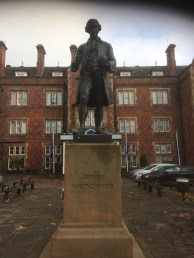
We were welcomed to Stoke-on-Trent by Josiah Wedgwood, whose statue stands outside the train station. He was the English potter, most associated with the neoclassic style, who established the Wedgwood pottery factory.

We decided to take a taxi to The Gladstone Pottery Museum as it was situated a few miles away in Longton.

The factory opened as a museum in 1974, the buildings having been saved from demolition in 1970 when the pottery closed (some ten years after its bottle ovens were last fired). In the 1990’s ownership passed to Stoke-on-Trent City Council. The museum has shown its commitment to industrial heritage by functioning as a working pottery, and is typical of those once common in the North Staffordshire area of England from the time of the industrial revolution in the 18th century to the mid 20th century.

The museum was fascinating and we learnt a lot about saggar making, throwing, jiggering, jolleying, casting, dipping, glost placing and firing the clay. There were demonstrations of throwing the pot and flower making.

Saggars were used to support the pottery and protect it from smoke in the kiln. Each lasted about 40 firings so the saggar maker needed to replace them continuously. Saggars were made by a team, a skilled saggar maker, a frame filler and a saggar maker’s bottom knocker.

Lots of children worked in the pottery but life expectancy at the time was only 46 as people suffered with heat from the ovens and from lead poisoning.

We visited the doctor’s house as well as the tile gallery and an exhibition “Flushed With Pride” which was the story of the toilet.

The exhibition had quite a lot of “toilet humour”. We found out that the Latin word for bee is “apis” and that it’s a myth that Thomas Crapper invented the toilet! There were toilets on display for standing, sitting and squatting as well as a Japanese toilet with a heated seat.

All in all, another fabulous day out.


Transgender Day of Remembrance – 20th November 2018

News

Transgender Day of Remembrance (TDOR) is an annual observance on 20th November that honours the memory of those whose lives were lost in acts of anti-transgender violence.

Additionally, during the week of 12th to 19th November, people and organisations around the country participate in Transgender Awareness Week to help raise the visibility of transgender people and address the issues trans people face.

What is the Transgender Day of Remembrance?

The Transgender Day of Remembrance (TDOR) was started in 1999 by transgender advocate Gwendolyn Ann Smith as a vigil to honour the memory of Rita Hester, a transgender woman who was killed in 1998. The vigil commemorated all the transgender people lost to violence since Rita Hester’s death, and began an important tradition that has become the annual Transgender Day of Remembrance.

“The Transgender Day of Remembrance seeks to highlight the losses we face due to anti-transgender bigotry and violence. I am no stranger to the need to fight for our rights, and the right to simply exist is first and foremost. With so many seeking to erase transgender people — sometimes in the most brutal ways possible — it is vitally important that those we lose are remembered, and that we continue to fight for justice.”
– Transgender Day of Remembrance founder, Gwendolyn Ann Smith

We are remembering the 310 people we have lost from 20 November 2017 to 19 November 2018 originating from the following countries:

Argentina (8), Bangladesh (1), Brazil (144), Bolivia (2), Chile (1), Colombia (14), Dominican Republic (1), Ecuador (1), El Salvador (6), France (2), Fiji (1), Guatemala (4), Honduras (1), India (7), Italy (3), Mexico (61), New Zealand (1), Pakistan (7), Paraguay (2), Peru (2), Philippines (1), South Africa (2), Spain (1), Trinidad and Tobago (1), Turkey (7), United Kingdom (1), United States of America (23) and Venezuela (5).

Culture Club at Manchester Evening News Arena

News

Trips & Adventures – 18 November 2018

Thanks to Unique X who offered Out In The City a VIP experience at the Manchester Evening News Arena to see Culture Club, one of the most influential groups of the 1980’s.

In the UK they amassed twelve Top 40 hit singles between 1982 and 1999, including the number ones “Do You Really Want To Hurt Me” and “Karma Chameleon”, the latter being the biggest selling single of 1983. The highlights included the encores “Let’s Dance” by David Bowie and “Get It On” by T-Rex and my personal favourite “Everything I Own”.

The support acts were Tom Bailey (from the Thompson Twins) and Belinda Carlisle. Tom Bailey had an all female backing group and Belinda Carlisle had an all male backing group, but they were both really good. We all had a great night out.