Manchester Pride Parade Theme Announced
After close consultation with the city’s LGBTQ+ community, Manchester Village Pride CIC has announced the theme for the return of the iconic Pride parade: ‘No Place Like Home’.
Adopting a key line from The Wizard of Oz, the theme offers the opportunity for community groups to celebrate a homecoming and safe landing for Pride in the city after recent uncertainties, as well as a chance to honour the city of Manchester itself as a welcoming and safe place for all.
The parade will take place on Saturday, 29 August and will work its way through the city via a route – still to be determined – that will conclude in the Village; the place where Pride began in Manchester four decades ago.
Announcing the theme, Carl Austin-Behan, one of the founding board members and spokesperson for Manchester Village Pride CIC, said: “The parade is one of the most important and iconic events during Pride Weekend in Manchester. It’s a time for the community to come together with people from all walks of life to celebrate, listen, and show visibility for LGBTQ+ life in Manchester and beyond.
‘No Place Like Home’ is a very apt theme for this year, allowing us to pay tribute to Pride’s roots in the Village; the home of our amazing community and everything that Manchester Village Pride stands for – from our LGBTQ+ businesses and charities to performers and patrons. I can’t wait to see how the community responds and interprets the theme, as I think there is so much to go on!
The parade is one of the cornerstone elements of the weekend, alongside the poignant Candlelit Vigil, that we want as many people as possible to attend.
Both elements are, and always will be, free to attend; however, we do ask that those who would like to enjoy the wider celebrations – including the party and performances in the Village – purchase a weekend wristband or individual day pass to ensure that funding goes towards safe event delivery, as well as supporting LGBTQ+ charities, grassroots organisations, and vital community services.
With it being our first Manchester Village Pride event under transparent management, we also need to be clear with people that we need them to make their commitment as early as possible by purchasing their wristband or day passes. This will ensure that we can lock in LGBTQ+ talent and make sure event planning is smoothly and fairly financed – the success of Manchester Village Pride is in the community’s hands, and now is the time to show up!”
This year’s parade would not be able go ahead without the unwavering support from Manchester City Council. Cllr Bev Craig, Leader of Manchester City Council, said: “Pride is such an important event for our city, and after concerns over its future, it’s great that it’s firmly back on the calendar.
The phrase ‘No Place Like Home’ has added resonance this year after the event was saved for the city by Manchester Village Pride CIC and its supporters, including the Council. We are proud to have played our part, including funding the popular parade element that people know and love.
Pride is more than just an annual boost for our city’s hospitality sector, as significant as this. It’s a celebration of Manchester’s LGBTQ+ community; an event which has been part of the fabric of the city for more than 40 years.”
Manchester Village Pride CIC has opened applications for those who are interested in taking part in the parade on the day. In support of the local community, free entry will be offered to all LGBTQ+ charities and grassroots groups, whilst commercial entries will be required to pay an entry fee to help subsidise the costs for community entries.
Parade applications
Applications to take part in the parade can be made via Jotform.
Wristbands and day passes
Manchester Village Pride wristbands and passes are now on sale at via Skiddle.
Master Jotform:
This covers –
- Volunteering
- Artist
- Career tickets
- Parade application
- Sponsorship
- Community lane – markets and expo
- Photographer
- Festival jobs
- Media/press
- Drink/bar concessions
- Services
- Other

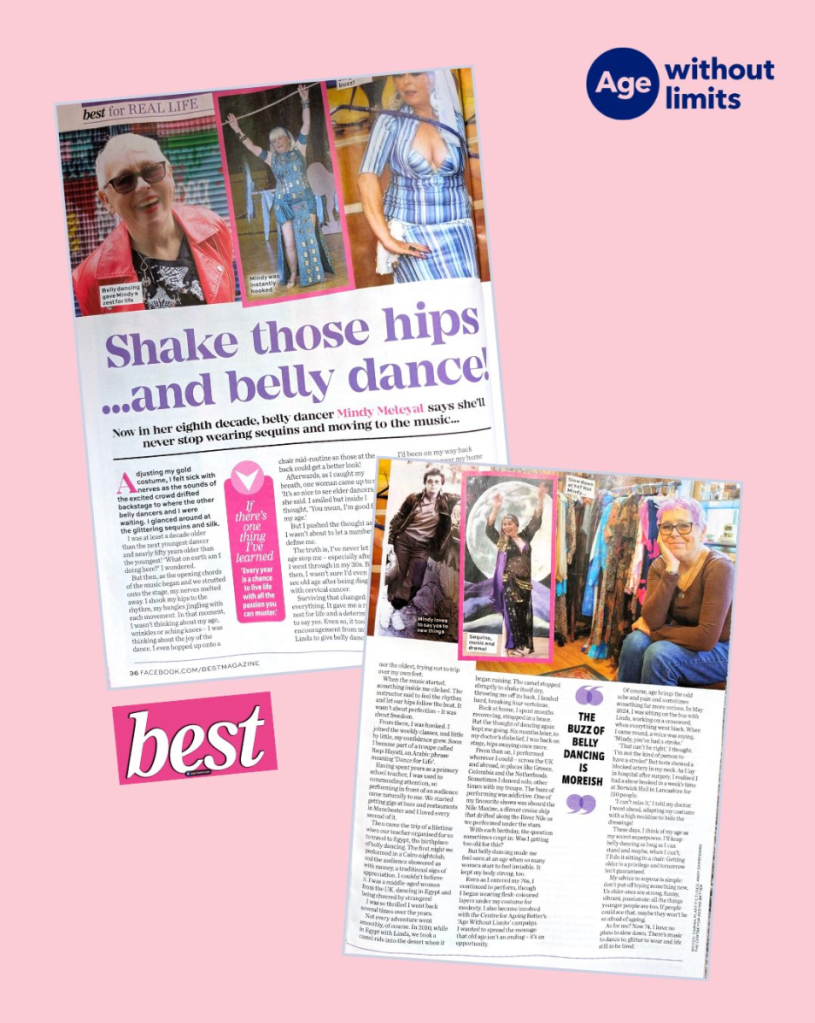
Shake those hips … and belly dance!
Now in her eighth decade, belly dancer Mindy Meleyal says she’ll never stop wearing sequins and moving to the music …
Adjusting my gold costume, I felt sick with nerves as the sounds of the excited crowd drifted backstage to where the other belly dancers and I were waiting. I glanced around at the glittering sequins and silk.
I was at least a decade older than the next youngest dancer and nearly fifty years older than the youngest! “What on earth am I doing here?” I wondered.
But then, as the opening chords of the music began and we strutted onto the stage, my nerves melted away: I shook my hips to the rhythm, my bangles jingling with each movement. In that moment, I wasn’t thinking about my age, wrinkles or aching knees – I was thinking about the joy of the dance. I even hopped up onto a chair mid-routine so those at the back could get a better look!
Afterwards, as I caught my breath, one woman came up to me. “It’s so nice to see elder dancers”, she said. I smiled but inside I thought, “You mean, I’m good for my age.”
But I pushed the thought aside. I wasn’t about to let a number define me.
The truth is, I’ve never let age stop me – especially after what I went through in my 30s. Back then, I wasn’t sure l’d even see old age after being diagnosed with cervical cancer.
Surviving that changed everything. It gave me a zest for life and a determination to say yes. Even so, it took encouragement from my partner Linda to give belly dancing a chance.
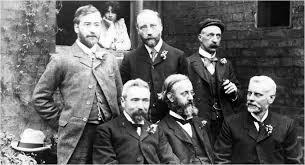
Eagle Street College, Bolton
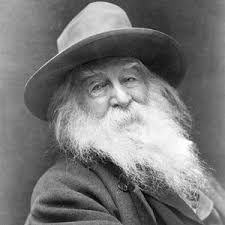
Among the birthday greetings Whitman received in 1887 were an unexpected gift of money and an expression of admiration from two Englishmen who were completely unknown to him. They were J W Wallace and Dr John Johnston, both of Bolton, a cotton manufacturing town not far from Manchester in the Lancashire district of northern England. Wallace and Johnston were the leaders of a small band of Whitmanites who met weekly at Wallace’s home on Eagle Street. So earnest were their discussions at these gatherings that Johnston dubbed the group the “Eagle Street College.” Whitman acknowledged the gift warmly, which was repeated in succeeding years, and in 1890 met Johnston for the first time when the doctor arrived at Mickle Street in Camden.
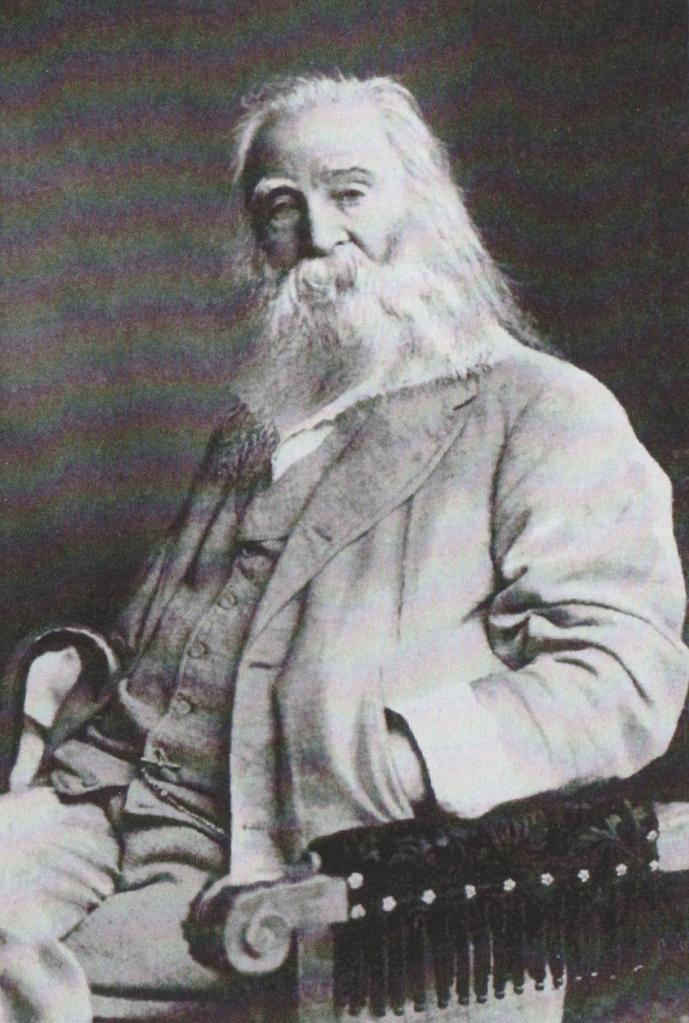
The following year Wallace made the same journey. While in America, both men also visited various friends and associates of Whitman, meetings which they recounted in a jointly written volume published in 1917.
The story of the “College” itself, however, ranges beyond these brief contacts, for in the closing years of his life Whitman wrote a steady stream of messages, sometimes on a daily basis, to this unlikely group of admirers. These were not literary critics or scholars, in the usual sense, but bank clerks, clergymen, manufacturers, assistant architects (including Wallace), and, of course, the physician, Dr Johnston. Originally their meetings ranged freely over many subjects, but three or four were already students of Whitman, so gradually the poet became the principal subject of their papers, readings and discussions.
Once the direct contact had been made with Whitman through Johnston’s visit, it never lessened, having been intensified by Wallace’s stay in Camden. The ties between the poet and the Bolton group were made deeper by the gifts of books, magazines, and photographs that flowed between England and America, including Whitman’s gift of the stuffed canary which in life had brought him much pleasure and which he made the subject of a poem, “My Canary Bird” (1888). Others were also brought into the relationship — John Burroughs; R M Bucke, who visited Bolton; and Horace Traubel, who became one of Wallace’s most constant correspondents and remained so until Traubel’s death. In England the “College” contacts included Edward Carpenter and John Addington Symonds.
Despite the literary luster of Carpenter and Symonds, it was the working-class status of the collegians themselves that appealed to Whitman, and in them he believed he had found the audience for which he aimed. Later the circle of friends became part of the English socialist movement, but while Whitman was alive their ideal was democracy, by which they meant the elimination of the class system in England and the improvement of the conditions of workers. Therein lay Whitman’s great appeal for them, for they understood him to be the divinely inspired prophet of world democracy.
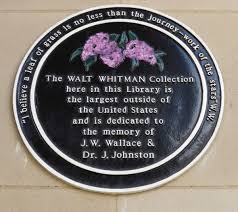
The “Eagle Street College” did not disband or lose its direction after Whitman’s death, but continued to work toward the high objectives its members believed Whitman had set. Virginia Woolf once paid respect to their long devotion to Whitman, and the “College” so inspired their townsmen that the Bolton Library maintains the collegians’ books, correspondence, and manuscripts in its local history collection. Included among the artifacts is the stuffed canary still in its original case.
 Out in the City