

Belfast City Hall unveils stunning Pride themed stained glass window
A vibrant Pride themed stained glass window has been unveiled at Belfast City Hall in a powerful celebration of the city’s LGBTQ+ community. Installed on the ground floor of the historic building, the artwork represents a significant addition to the ongoing transformation of the City Hall into a shared and inclusive space for all.
Announcing the installation on Instagram on Thursday, 22 May, Belfast City Hall wrote: “Check out our latest colourful addition to the City Hall, a new stained glass window marking the contribution of our city’s LGBTQ+ community.”
The post went on to highlight that the design is “packed with visual nods to the community’s development over the years, including significant moments and various campaigns for equality.”


The window was officially unveiled by Lord Mayor of Belfast, Councillor Micky Murray, the city’s first openly gay mayor. He was joined by Cara McCann, Director of HERe NI, a leading organisation advocating for queer women in Northern Ireland.
The new stained glass stands as a tribute to Belfast’s history, resilience, activism, and the achievements of the LGBTQ+ community in the city and beyond ensuring that their stories and struggles are not only remembered, but celebrated in the heart of the city.

New robotic technology brings hope to men with prostate problems

Difficulty peeing, a frequent need to go to the toilet and trouble emptying their bladder – those are just some of the problems living with an enlarged prostate can bring men.
Just ask David Fleming, from east Belfast, who has been living with one for a number of years and was one of about 1,000 men on a waiting list for bladder outlet surgery.
If left untreated, an enlarged prostate can lead to more severe symptoms such as acute urinary retention and infections – which is why getting that waiting list down is so important.
Fortunately a new treatment – or more specifically, a new robotic technology – is offering hope that those men can be treated sooner rather than later.
Mr Fleming himself was delighted to be one of the first to undergo aquablation therapy at the Ulster Hospital.
The treatment, the first of its kind across the island of Ireland, is a minimally-invasive procedure that uses a heat-free waterjet to remove excess prostate tissue, which Mr Fleming said will make a big difference to his life.

The 64-year-old’s condition, also known as benign prostatic hyperplasia (BPH), worsened early this year and his difficulties peeing led to a catheter being fitted.
But this new treatment will “sort the prostate out so that the flow will be good in the future”.
Mr Fleming said his condition was being managed by medication until December but then it “took on a life of its own”.
“I would have been waking every hour at night, every hour and a half, so I really wasn’t getting much sleep and was really quite tired,” he said.
Now, the procedure should solve the issue, ensure the catheter is removed and give him “a good quality of life in relation to what I’ve had previously”.
Mr Fleming hopes, come his 65th birthday in September, he will be “a new man”.
How does aquablation therapy work?
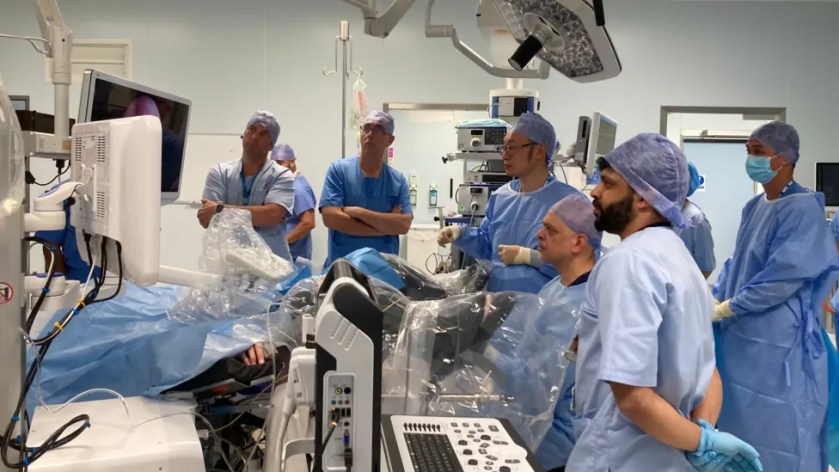
While there are several benign prostate treatments available, this treatment particularly helps men experiencing urinary problems due to an enlarged prostate.
Until now, men with a very enlarged prostate had to travel to England for treatment or have more complex or invasive surgery in Northern Ireland.
But this robotic technology eliminates the need for invasive prostate surgery.
It uses image-guided, high-velocity water jets to precisely remove excess prostate tissue.
Real-time ultrasound imaging helps the surgeon map and direct the water jet with accuracy, avoiding damage to nearby nerves and structures responsible for sexual function and continence.
Unlike traditional procedures, no heat is involved, significantly lowering the risk of complications.
The South Eastern Health Trust said this technology reduces the likelihood of side effects such as erectile dysfunction, incontinence and bleeding that may require transfusion.
It also offers a shorter recovery time, shorter hospital stays and lower retreatment rates, improving outcomes for patients.
Reports from elsewhere in the world

Recently released is the 2025 Long Term Care Equality Index by Human Rights Campaign Foundation and SAGE (an advocacy service for older LGBTQ+ people in the US) covering LGBTQ+ residential care and senior housing. You can read the report here.
SAGE and the National Resource Center have produced a report on LGBT Aging. See the report here.
Meanwhile, researchers in Australia have published a study synthesising a number of pieces of research into LGBTQ+ older people in care settings. The report features direct quotes from LGBTQ+ with lived experience of care settings.

Also recently published is an article in Yahoo! News covering some existing and upcoming LGBTQ+ retirement communities in Sweden, France and Spain. See “Scared of being pushed back in the closet”

The Alzheimers Society have spoken to Neil Cutler, who cared for his late partner, John, after his dementia diagnosis. The piece covers the impact of decades of homophobia on John and the prejudice he experienced while accessing care. See “The impact of decades of homophobia on a person’s experience of dementia”
Finally, there’s a new documentary – “Late to the Party: Coming Out Later in Life” – being released in the US to coincide with Pride Month. This article covers the show and mentions a few of the stories featured (which includes Kenneth Felts, who came out at age 90.)
Birthdays






 Out in the City