Manchester Gay Switchboard
Fifty years ago, on 2 January 1975 a telephone rang for the first time. It was a helpline – the Manchester Gay Switchboard – and was situated on the stairway in a rented Longsight flat.
Terry Waller, a local activist, with friends had discreetly handed out leaflets advertising the service at gigs and student nights. It’s difficult to envision a time before the internet, with information now available at our fingertips, but things were just not spoken about. There were no role models on television and no sex education in schools. Library books on the subject of homosexuality were hidden on the reserve book shelf. Some of us felt we were different, but we didn’t have the words.
The phone line served a very important service – a chance to speak to other lesbian and gay people to get information and advice.
There have been name changes and relocations over the years, but to date it’s estimated that more than 250,000 people have rung up, registering more than 3.7 million minutes worth of advice and support.
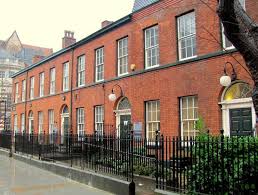
I volunteered for the service in the late 70’s when it was situated at 178 Waterloo Place – a basement belonging to the university. I had “come out” to my parents at age 16, but they encouraged me to believe that it was “just a phase”, so I told them that I was volunteering for Samaritans!
The helplines included “Lesbian Link”, “Friend” and the “TV/TS service”. Nowadays we say “Transgender”, but the acronym stood for “Transvestite/Transexual”. Bob Crossman was our first paid worker, and later he became the first openly gay Mayor in the UK, serving as Mayor of Islington from 1986-1987.
Sometimes people rang up who were suicidal, but other times it was for information such as locations of gay pubs. The service is continuing 50 years later and is still necessary.
February is LGBT+ History Month
In 2025 we are celebrating 20 years of UK LGBT+ History Month, organised by Schools OUT, and this year the theme is: Activism and Social Change.
Schools OUT was delighted to launch the UK LGBT+ History Month 2025 theme from Conway Hall in London – a place steeped in history from the conference of doctors that led to the founding of the NHS, to speakers such as George Orwell.
A list of LGBT History Month events in Manchester include:
- Community Café / Digital Café at LGBT Foundation;
- Lights, Camera, Pride! – free film at Manchester Central Library;
- The Big Gay Pub Quiz Takeover at Contact Theatre;
- Queer AF Comedy Night at Contact Theatre;
- Alan Turing’s Manchester – Lunchtime lecture at House of Books;
- LGBT+ History Month archive exploration & guided gallery tour at People’s History Museum;
- Queer as Cupid Cabaret at Contact Theatre;
- LipService presents Funny Stuff at Bury Met;
- Shadowed Dreamer at 53two; and
- LOUD Cabaret at Bury Met.
More details can be found on https://outinthecity.org/next-outings/ and https://lgbt.foundation/

Daughters of Bilitis
Founding
Del Martin and Phyllis Lyon, two women fresh with degrees in journalism, met in Seattle in the early 1950s. Martin and Lyon quickly became romantically involved, and moved together to San Francisco in 1953. Despite the rising prevalence of gay and lesbian bars in the North Beach neighbourhood, Martin and Lyon found themselves feeling isolated, without a community of other lesbians. “It wasn’t like we had a community. It was like there were places to go for entertainment and there was a certain ambiance, but there was not the sense of community that we have developed since.”

When Martin and Lyon were invited by a friend of a friend to join a small, secret lesbian social club, they jumped at the opportunity. The first social meeting of eight lesbians took place in 1955, and out of this meeting the Daughters of Bilitis (DOB) was born. The group named itself after the poetry collection Songs of Bilitis by Pierre Louys, a work that depicts a fictional lesbian woman who lived alongside Sappho in Ancient Greece.
Rise and Politicisation
The 1950s was a time permeated by fear for gay people in the United States. When the DOB was founded, it served as an outlet for lesbian women to congregate socially and safely. However, as the social club gained popularity in the San Francisco area, it quickly began to turn its focus toward more political interests in the homophile movement. In the first issue of their publication, The Ladder, members of the DOB wrote, “with discussion came broader purposes and the club was formed with a much wider scope than that originally envisioned.”
The homophile movement began with the inception of the Mattachine Society, a group founded in Los Angeles in 1951 by homosexual men intending to spread awareness and educate the public on matters of homosexuality. The DOB mirrored the Mattachine Society and its homophile principles in many ways: both groups were founded with social intent, turning later towards the political; both groups urged their constituents to participate in psychological studies and to work to actively educate the masses against the stereotype of homosexuals as “sick”; both groups worked to combat the fear that permeated the community during the 1950s due to widespread bigotry, frequent police raids on gay and lesbian bars, etc; and both groups emphasised the concept of “fitting in” to the larger heteronormative community rather than embracing difference in sexuality and gender. However, the DOB focused their efforts primarily on the causes of women and lesbians, and at times members resented their representation as “auxiliary” to the Mattachine Society.
By 1960, the DOB had spread throughout the United States, and the organisation’s first national convention, publicised by the DOB as “Ten Days in August,” took place at the Wickham Hotel in San Francisco, and was deemed a success by members of the organisation.
The Ladder
As the DOB began to gain traction, they decided to begin publishing a small newsletter for members of the organisation. The first issue of The Ladder was published in October 1956. The first issue had the express intent of attracting new members, and included a copy of the DOB’s statement of purpose.
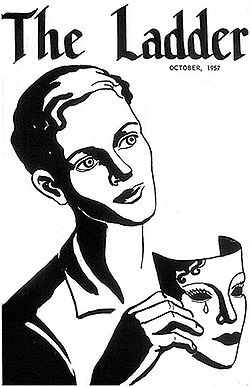
October 1957 issue of The Ladder
Subsequent issues of The Ladder contained various articles, interviews, group event calendars, advertising, group bowling outings and even pieces of short fiction and poetry written by members of the DOB and other contributors.
The Ladder was generally met with praise. Its popular “Readers Respond” section, in which readers could send messages to the editor and have them published in the following month’s issue, included numerous praises and expressions of gratitude sung by readers. One such grateful reader was “L H N” a playwright from New York, who wrote in the May 1957 issue to say,
“I’m glad as heck you exist … Women, like other oppressed groups of one kind of another, have particularly had to pay a price for the intellectual impoverishment that the second class status imposed on us for centuries created and sustained. Thus, I feel that The Ladder is a fine, elementary step in a rewarding direction.”
L H N was Lorraine Hansberry Nemiroff, whose play A Raisin in the Sun made its debut on Broadway two years after her message was published in “Readers Respond”. Hundreds of other women across the United States echoed Nemiroff’s eager readership, until The Ladder ceased publication in 1972.
Demise
By the mid-1960s, the political culture around homosexuality and protest was changing; the homophile movement and its call for assimilation gave way to the activism and celebration of identity of the pride movement. A new generation of lesbians was taking power in the Daughters of Bilitis, with Shirley Willer taking over as the first national president elected from outside of San Francisco in 1966. The rise of the feminist movement throughout the United States also caused tension among group members, who began to split ideologically between emphasising gay rights and women’s rights. When Barbara Gittings took over as editor of The Ladder, some members of the DOB criticised Gittings for her active incorporation of gay male contributors to The Ladder, feeling she was beginning to stray from The Ladder’s intents as a magazine with specific lesbian interest. Gittings was controversially removed from her position as editor in August 1966, and, along with other members of the DOB, began working with more general gay rights groups; some former DOB members helped to found the Homophile Action League in 1968. Around this time, Martin and Lyon began working closely with feminist activist group National Organisation for Woman (NOW), turning their attention away from the DOB. The DOB leadership attempted another national convention in Denver in 1968, with a turnout of less than 30.
In 1970, the national mailing list for The Ladder was stolen from the DOB’s San Francisco office by Rita Laporte. Laporte, a former member of the DOB, began publishing issues of The Ladder with a new team, without support of the DOB. Many members of the DOB felt scandalised by Laporte’s actions, and rejected her explicit focus on gender over sexuality when she wrote in The Ladder’s August / September 1970 issue, “With this issue, The Ladder, now in its 14th year, is no longer a minority publication. It stands squarely with all women, that majority of human beings that has known oppression longer than anyone.”
Due to controversies in leadership and direction, The Ladder published its last issue in 1972. Though it had officially split from the DOB in 1970 after Laporte’s theft, the demise of The Ladder signified the end of the DOB for many women in the group. Some chapters continued meeting occasionally, but the close of the original San Francisco chapter in 1978 marked the DOB’s formal demise.
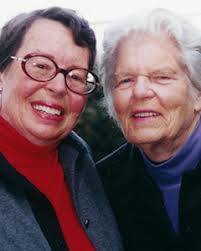
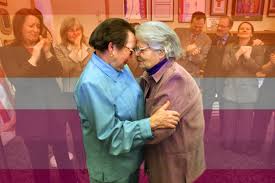
Martin and Lyon remained active figures in both the women’s rights and gay rights movements, and made the news for an historic moment in 2004 as the first homosexual couple to be offered a marriage certificate in San Francisco.
Mayor Gavin Newsom of San Francisco presiding at the nuptials of Del Martin and Phyllis Lyon, long-time partners and lesbian activists, who after more than 50 years together could finally say, “We’re married.” Sadly, Del passed away just over two months later on 27 August 2008.
How we met: ‘Ben told me he now identified as a trans man. I had been waiting for it to happen’
Anna, 51, and Ben, 55, met at a friend’s birthday brunch in 1993. After she split from her girlfriend, Anna begged one of Ben’s friends to set them up. They now have three children and live in Oakland, California.
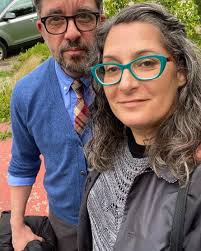
In late 1993, Anna was invited to her girlfriend’s birthday brunch in San Francisco, where they were both living. “We were dating casually at the time,” she says. “We went for a crepe party with a big group of people at her place.” She remembers spotting Ben straight away, who at that time identified as a woman.
“I saw Ben wearing glasses and thought they were adorable,” she says. “I remember thinking we’d be together one day.” They chatted briefly, but Ben didn’t show much interest.
“Anna was dating a good friend of mine,” he says. “And I was living in Long Beach, finishing my graduate school studies in pathology.” After the brunch party, they went their separate ways and he didn’t expect to see her again.
In spring 1994, Ben moved to Sacramento in northern California. By then, Anna and her girlfriend had split up. “I was still thinking about Ben and begged one of his friends to set us up,” she remembers, laughing. He was reluctant at first because of Anna’s previous relationship with his friend, whose birthday brunch it had been. However, he says: “She was fine with it, so I decided to go and see her.”
They met in San Francisco a few weeks later and spent the day walking around the city visiting craft markets, before sharing some tacos. “It was a super sweet date,” says Ben. “She was really cute. I was really happy to be with her.”
The following week they met again for a cinema date. “It was a scary movie, so good for snuggling,” says Ben. Afterwards they kissed for the first time.
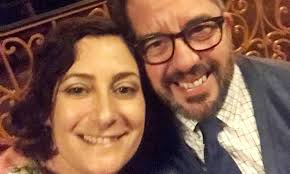
They dated until Ben moved to San Francisco in early 1995. “I’d never thought about having a long-term relationship before Ben, but we were so happy together,” says Anna. Things became more serious and the couple moved into a shared house in 1996, before holding a special ceremony the following year. “We made up our wedding, which is what gay people did back then as same-sex marriage wasn’t actually legal,” she says.
In 2001, their first child was born, followed by twins in 2002. “Rather than going to a sperm bank, we decided to ask a trusted friend, Tex, to be a donor,” says Anna. The family moved into a house in Oakland with Tex in 2004. “He has a separate flat but we’re all really close. He is an uncle to the kids,” she says. Later that year, Ben and Anna attempted to formalise their relationship, after the mayor of San Francisco, Gavin Newsom, now governor of California, announced plans to legalise same-sex marriage in the city. “We queued for hours but our paperwork was rejected two months later.” Within a month of the announcement, 4,000 same-sex couples tied the knot in San Francisco but then the California Supreme Court ruled all the marriages invalid. “[Mayor Newsom] didn’t actually have the power to make that change,” says Anna.
Two years later, Ben told Anna that he no longer identified as a gay woman, but as a transgender man. “The process was more of an evolution than a line drawn in the sand,” he says. “My gender presentation had not changed, but I made the decision to have hormones and surgery so that my body could match that. My transition isn’t a binary one, but it’s a shift in how I feel and how I’m seen in the world.”
For Anna, this wasn’t a surprise. “I was waiting for it to happen. Everyone we knew was very accepting of different gender expression, so it wasn’t foreign to me at all. I wanted him to feel comfortable.” In 2014, they were finally able to marry legally, surrounded by friends and family. “We also have a wedding celebration every year, on the anniversary of the one that was disallowed,” says Anna.
After nearly 30 years together, she still appreciates the way her partner keeps her grounded. “I have ADHD, so my brain can be everywhere. He is very fair and always honest. He doesn’t always do the easy thing but he does the right thing. He’s a great artist and an amazing parent.”
Ben appreciates Anna’s creativity. “She knows what’s in her heart and she is never afraid to share,” he says. “She always shows up, and I love how she sees the world differently to me. It helps me see things I’d never notice.”

 Out in the City