
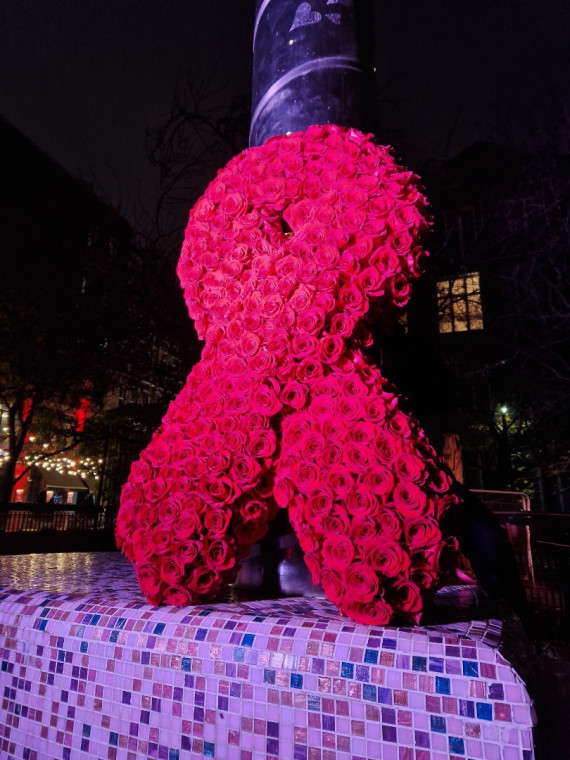
World AIDS Day
World AIDS Day is a global initiative to raise awareness about HIV/AIDS and show international solidarity. It’s a time to:
- Remember those who have died from AIDS-related illnesses;
- Honour the 39 million people living with HIV worldwide; and
- Reaffirm a commitment to ending HIV.
On 1 December, communities come together to commemorate World AIDS Day. In 2024 the theme is “Take the rights path: my health, my right!”
The theme highlights the importance of human rights in the response to HIV and AIDS. The campaign calls on people to champion the right to health and address the inequalities that prevent progress in ending AIDS.
In 2022 Manchester Pride and George House Trust partnered to create a powerful and informative video. Nathaniel Hall, theatre-maker, writer, performer, northerner and HIV activist takes us through the many ways that Manchester’s Gay Village has supported people with HIV throughout the decades.
You may even be surprised to learn that Manchester Pride’s very own beginnings were part of a jumble sale raising money for HIV patients on Canal Street. You can read about HIV, activism, PrEP, LGBTQ+ history and more here.

Lynn Ann Conway
Lynn Ann Conway (2 January 1938 – 9 June 2024) was an American computer scientist, electrical engineer, and transgender activist.

Lynn Conway was the tech pioneer and transgender trailblazer who helped revolutionise the microchip industry.
As a gifted computer architect in California’s Silicon Valley in the 1960s and 70s, Conway co-invented a new method of microchip design that now powers nearly every digital device in our lives, from smartphones to in-car electronics.
Yet, throughout those years, she was also secretly undergoing a gender transition that came with enormous personal and career costs, at a time when trans people were routinely targeted for violence and frequently denied the protection of the law.
After her retirement, she came out publicly and began sharing her story on her personal website, helping generations of younger trans people recognise themselves and learn about the process of transition.
“I think a lot of us (trans people) are living more interesting, more fun lives than most people. It’s our secret,” she told The Independent last year,
“We are highly empowered – in ways that people may not understand – because of the joyfulness we feel in having been able to do what we do in spite of the difficulties, and find a place in society where we actually have joy in just living.”
Michael Hiltzik, a columnist for The Los Angeles Times who had known her for 25 years called her “the bravest person I ever knew.”
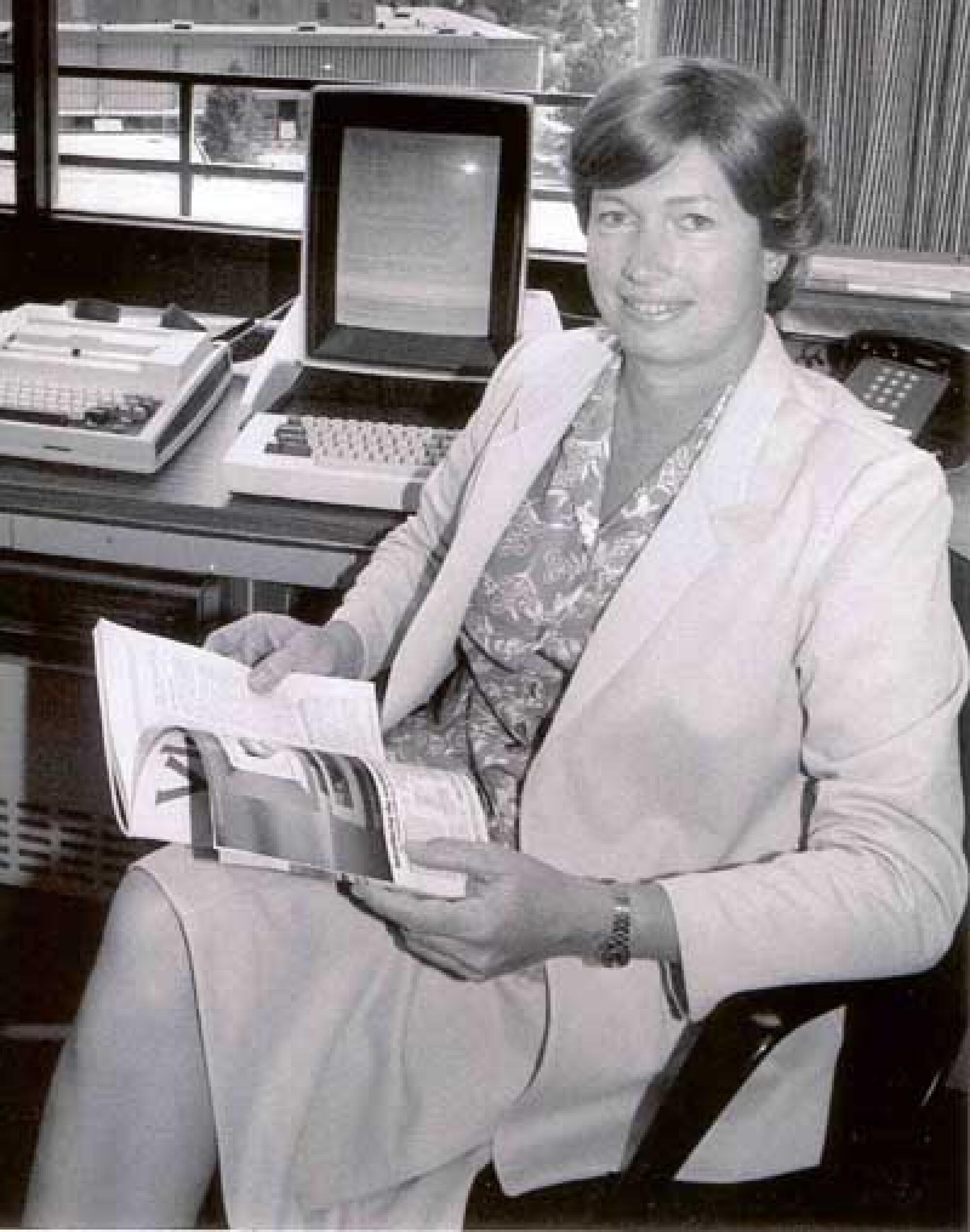
Conway was born in 1938 in White Plains, New York, growing up in a white middle-class world that she described as “haunted” by the violence and repression that lurked underneath its “appearance of normalcy”.
After graduating from Columbia University in the early 60s, she moved to Silicon Valley to work on a secretive IBM supercomputer project.
She thrived on the work, but her personal life was falling apart under the pressure of her suppressed identity, and she finally resolved to undergo medical transitions.

Then IBM fired her after learning of her plans to transition, forcing her to restart her career almost from scratch in a new identity. It was, she recalled, very much like being a Cold War spy.
“You have to operate at a high level pretty quickly, or else you’ll get exposed, and then you’re a traitor to your whole institution,” she told The Independent. “But at the same time you have to be kind of affable, and not attract attention … can’t ever get angry, or show fear.”
Conway secured a job at Xerox’s PARC research lab, now famous for innovations such as the computer mouse and the digital desktop interface, where she began collaborating with California Institute of Technology professor Carver Mead to solve a thorny industry problem.
At the time, the number of components that could be squeezed into each microchip was increasing exponentially every year. But the resulting complexity was difficult to manage using traditional, bespoke methods of chip design, creating a bottleneck on actually exploiting this new power.
Conway and Mead’s innovation – known as “Very Large Scale Integration”, or VLSI – was to develop a set of rules for clustering components together in standardised blocks, like neighbourhoods in a city, simple enough for even a novice engineer to follow.
That work led to a post for Conway at the military research agency DARPA, and then a professorship at the University of Michigan.

She retired from active teaching in 1998, but in the years that followed, Conway came to feel that she had been unfairly left out of the computer industry’s popular history of her invention, and pushed aside in favour of her male collaborator.
“Mead probably thinks it was 80/20 him; most people, I think, in the long term, will find it was really 80/20 me,” she said.
But in recent years her contributions have increasingly been recognised, thanks in part to her own documentation and campaigning.
In 2009, she received an award from the engineering trade group, the Institute of Electrical and Electronics Engineers.
In 2020, IBM finally apologised for firing her 52 years earlier. In October 2023 she was inducted into the National Inventors’ Hall of Fame as the co-creator of VLSI, 14 years after Mead received the same honour.
In a more personal way, Conway also touched the lives of many trans people. For years, her personal website was one of the few places where you could find clear, detailed, unprejudiced information about the experience of being trans and the process of transition – as well as a striking example of how trans people could find lasting happiness and success.
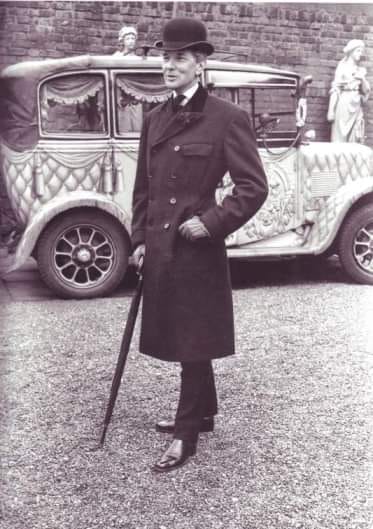
Neil Munro “Bunny” Roger (9/6/1911 – 27/4/97)
“Now I’ve shot so many Nazis, Daddy will have to buy me a sable coat.”
There have always been queens, but few compared to the glib, quick-witted Bunny Roger. He was a war hero, yet his most notable contribution was his 1949 invention – Capri pants! He lived his life courageously and consistently; a man who knew who, what, and why he existed. Born in London, he was the most eccentric of three life-long “bachelor” brothers.
Here’s an anecdote: Roger got out of a taxi and powdered his nose, when his driver said: “You’ve dropped your diamond necklace!” Roger replied: “Diamonds? With tweed? Never!”
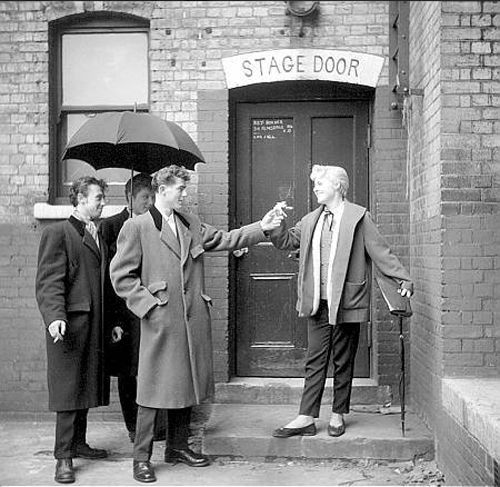
He influenced how men of his era dressed. As a main character in the neo-Edwardian movement in the 1950s, he brought back the precise tailoring of the turn of the century, influencing the Teddy Boys.
Once, when Cecil Beaton was photographing him, he asked Roger to step off the sidewalk into the gutter and Roger’s retort was: “Not on your life! We’ve spent two generations getting out of the gutter!”
I don’t understand how he had the time to be a hero in World War II, when he was busy as a full-time fop on the verge of becoming an important fashion designer. He died a few days before his 86th birthday, partying until right before entering the hospital for cancer treatment. He bragged at the time that he and Princess Diana had the same waist measurement.
The son of a self-made tycoon, as a youth, he taunted his conservative father by bleaching his hair and wearing a bit of rouge. He was expelled from Oxford for his indiscrete queerness. Undaunted, he started his own fashion house at 26 years old, and his first client was Vivien Leigh.
Five years later, Roger was fighting Nazis in Italy and North Africa. He was noted for his courage under fire while still wearing chiffon scarves. He saved a wounded fellow officer from a building that had been bombed. Roger claimed to have gone into a battle brandishing a rolled-up copy of Vogue and commanding: “When in doubt, powder heavily!” Perhaps meaning gun powder, or maybe not.
After the war, he was hired to take over the couture department at an upscale London department store. He also invested in fashion house of Bunny’s buddy, Hardy Amies (1909 – 2003), a discreetly gay fashionista who designed for the Queen. Roger’s money revived the House of Hardy Amies, and when it was sold, it gave him enough funds to retire in comfort and pursue his favourite activities: socialising and buying clothes.
He spent tens of thousands of pounds every year on his wardrobe. His signature look was bowler hat paired with extraordinary shoes that he polished himself using a concoction of beeswax and natural dyes, which he customised by adding red laces to compliment his ruby cufflinks. For each of his suits he had four pairs of shoes or boots made to maximise the number of looks. He owned over 150 Savile Row suits (each suit was said to have cost around £2,000), so it was not a small shoe collection, made larger because he had several pairs of the same shoe made when he found a favourite style.
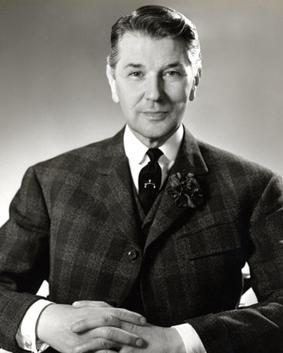
Roger hosted outrageous themed soirées. There were Diamond, Amethyst, and Flame Balls held to celebrate his 60th, 70th, and 80th birthdays. He wore an exotic mauve catsuit with a feather headdress at his Amethyst 70th birthday ball in 1981. At his 80th, he wore a catsuit made of scarlet sequins with a cape of orange organza, casually greeting his 400 guests from behind a wall of fire to the applause of all. His parties were covered by spreads in the newspapers, including a New Year’s Eve Fetish Ball where half the guests were of the stiff upper-class, while the other half wore rubber S/M gear and high heels while being led by women tethered in chains. This outraged his father who seemed to have had no sense of humour, although when Roger was a teenager, he had asked for a doll’s house as a reward for being selected for a sports team, and his father gave it to him.
When he was six years old his mother gave him a fairy costume with diaphanous skirts and butterfly wings. When he got a little older, Roger plucked his eyebrows to look like Marlene Dietrich, whom he adored. When he visited Hollywood, he was disappointed that he was compared to actor George Arliss and not Dietrich. In his later years his face was what he described as “much-lifted”.
He lived with his gay brothers at their estate in Scotland, which Roger furnished with elaborate Gothic furniture, carved with bull and goat motifs, symbols of male sexuality.
There is that old-time euphemism for his type of queer: “… a little light in the loafers”. Well, Roger loved to dance and by all accounts he was a little light in his perfect size-seven loafers. From his London Times obituary: “Beneath his mauve mannerisms, Bunny was stalwart, frank, dependable and undeceived; to onlookers a passing peacock, to intimates, a life enhancer and exemplary friend.”
 Out in the City