

Richmond Tea Rooms
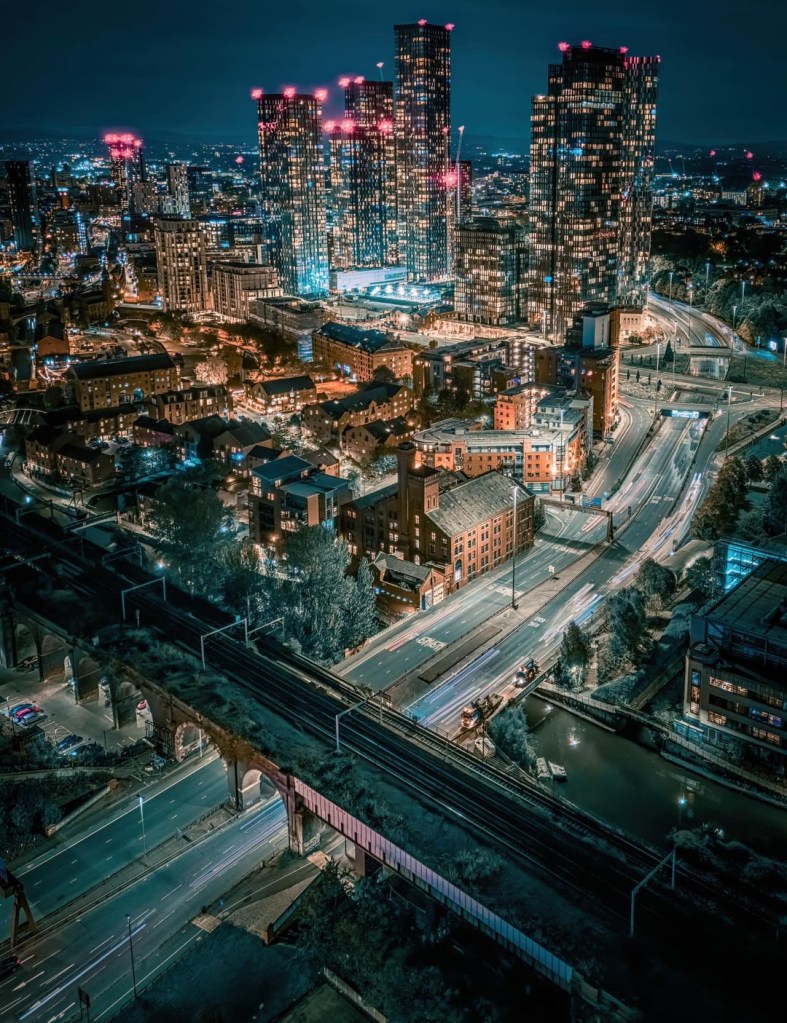
The Richmond Tea Rooms is an “Alice in Wonderland” themed restaurant in the heart of Manchester’s Gay Village.
It’s a unique and wonderful experience and members of Out In The City dined in the enchanted forest area. The food and service were of the highest quality, but in my view, it was a little pricy.
Photos can be seen here.

Celebrating Carolyn Weathers
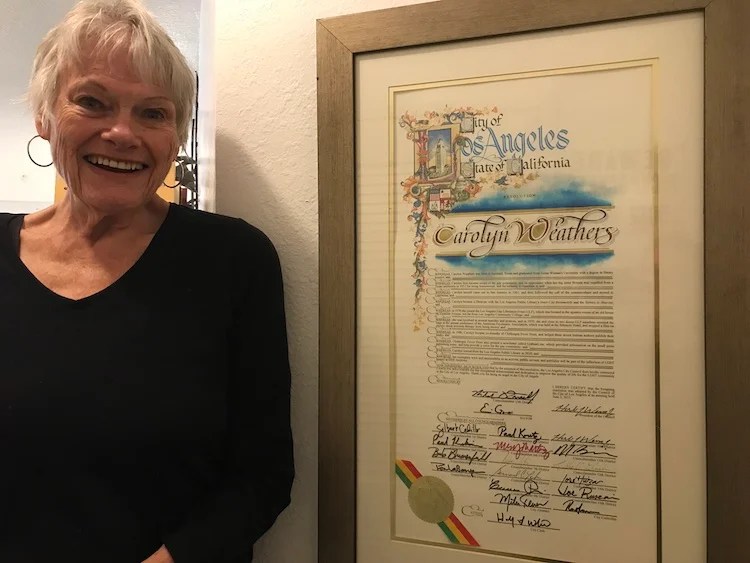
Carolyn Weathers was born 19 February 1940, in Eastland Texas, daughter of a Baptist minister, but not the type that comes to mind today. He wrote papers on the importance of the separation of church and state. He and her mother accepted their two lesbian daughters, and their home was always open to their daughters’s LGBT+ friends. Carolyn had the fortune to always feel right about herself and to know she was not the only one.
As a librarian with the Los Angeles Public Library, she organised the first reading by LGBT+ writers at the Los Angeles Public Library’s Central Library. In 2015, she received a Heritage Award from the City of Los Angeles for her work to improve the lives of the LGBT+ community. That same year, Carolyn, who was retired, was named the “Grand Lesbrarian” of the LA Pride Parade.
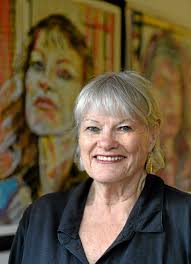
In her own words:
“I’m proud of the people who paved the way. I’m proud of my big sister Brenda, who was expelled from college for “moral turpitude” homosexuality in 1957 when she was 20.
Brenda was handcuffed in a Denton, Texas jail and told she could return to college if she renounced her homosexuality. She refused to do that. After being expelled, Brenda moved to Los Angeles and became a leading LGBTQ activist in the 1970s. Her story is representative of the stories of countless others.
Coming out in 1961
When I came out in 1961, there was no Pride. We in the community had camaraderie, but only in each other’s homes or in the gay bars, which were subject to police raids.
We had no public display of Pride except during San Antonio’s annual Fiesta San Antonio, a twin to New Orleans’s Mardi Gras, and to Rio de Janeiro’s Carnavale, where people are allowed, even expected, to act outside the norms.
One of the celebrations is in La Villita, a historic Mexican village in the heart of downtown San Antonio. We had a place we called the “Gay Curb” where we met and acted just gay enough for people to assume we were gay. The light kiss on the cheek, the holding of hands. That was OK. It was Carnavale after all.
Moving to LA in 1968
Things were different in Los Angeles, where I moved in 1968, drawn there by the burgeoning counterculture and hippies.
Gay, feminists, lesbian-feminists, cross-dressing friends, and I performed impromptu guerrilla theatre on Hollywood Boulevard, usually in front of the tour buses, and we got away with it, but not without angry shouts from some of the passers-by. Things might have been better in Los Angeles, but they had a long way to go.
I’m proud to have been part of the early movement that brought about change.
Protesting in LA in the 1970s
In 1970, the Los Angeles Gay Liberation Front, of which I was a member, held the first Pride Parade in Los Angeles, in Hollywood. It was called the Christopher Street West Parade, named after the location of the Stonewall Inn in New York City.
I can’t describe the thrill of stepping out into the middle of Hollywood Boulevard and marching.
In 1971, the Los Angeles Gay Liberation Front had a “Gay-In” at the merry-go-round in Griffith Park. Over 100 members of the community showed up. We sang, we danced, revelling in ourselves and who we were. “Free to Be, You and Me,” we shouted.”
Disrupting the American Psychiatric Association
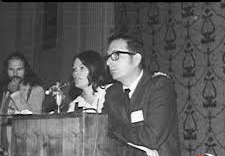
On 17 October 1970, the Biltmore Hotel in Los Angeles hosted the Second Annual Behavioural Modification Conference. The audience was watching a film by Dr M Phillip Feldman, which was making the case for electroshock therapy as the “cure” for homosexuality. Carolyn Weathers, centre, stands at the podium inside the Biltmore. Weathers and approximately 35 men and women from the Los Angeles Gay Liberation Front stormed the stage and cancelled the screening in what became known as the Biltmore Invasion. That demonstration effectively forced one of the first dialogues between mental health professionals and the gay community. Within two years of that incident, “homosexuality” was removed as a mental disorder after decades of stigma and official misclassification.
Today, Pride enables LGBT people who are out in the world to thrive in their authentic selves. Pride offers stepping stones to those who want to come out, but are hesitant for whatever reason. Just knowing that there is such a thing as Pride can offer some comfort to those who, for whatever reason, never come out.
Gay Holocaust Survivor on TikTok
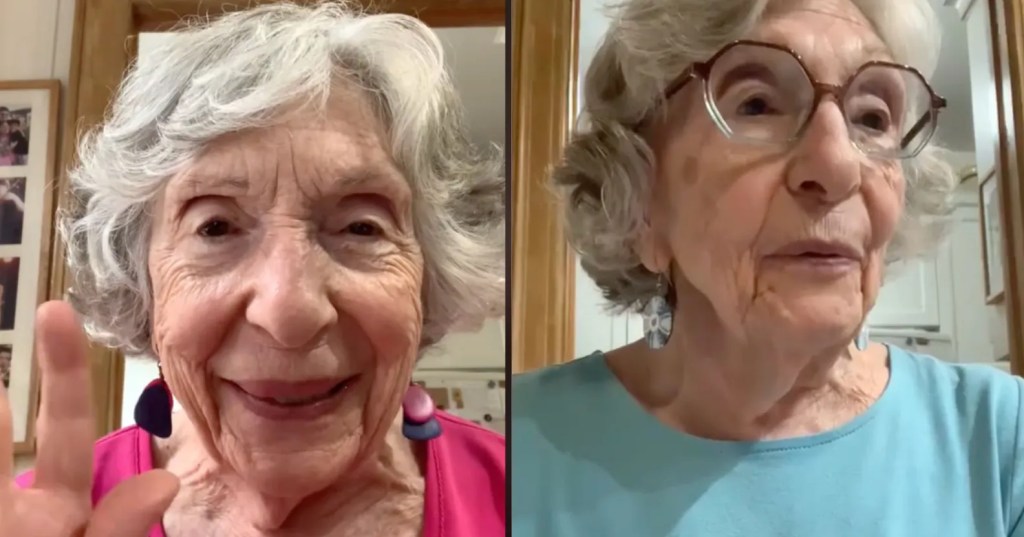
A gay Holocaust survivor has taken to TikTok with the help of her grandchildren to slam “wannabe dictator” Donald Trump.
88-year-old Grandma Elli began posting on TikTok (@grandmaelli) this month, urging her followers not to vote for Republican hopeful Donald Trump in November’s presidential election, while sharing her artwork and collages.
Her TikTok has already had more than 10,000 followers!
 Out in the City