Campaigning for LGBT equality
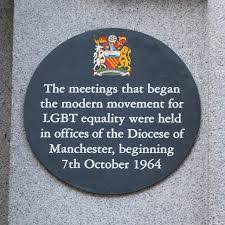
The meetings that began the modern movement for LGBT equality were held in offices of the Diocese of Manchester, beginning 7 October 1964.
Sixty years later, on 7 October 2024, members of Out In The City will be commemorating this meeting outside Church House, 90 Deansgate, Manchester M3 2ER.
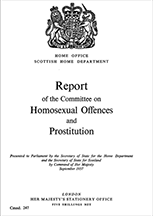
The Wolfenden Report led to the 1967 Sexual Offences Act and the partial decriminalisation of male homosexuality © The National Archives
Wolfenden and After
From 1954 to 1957, the Wolfenden Committee considered the laws on homosexuality and prostitution. Its 1957 report recommended partially decriminalising male homosexual acts. But it would take ten more years of lobbying and activism before the Sexual Offences Act (1967) achieved this.
The Homosexual Law Reform Society
In 1958 the Homosexual Law Reform Society (HLRS) was formed in response to inactivity from the government on the Wolfenden proposals.
The HLRS’s first public event at Caxton Hall, Westminster drew over 1,000 people. Bernard Dobson recalled the experience:
“I went with a friend of mine … and we went early, feeling very self conscious. It was packed out. By going to a place like that, you were proclaiming in a blaze of lights that you were one of these hundreds of homosexual men … they were mostly men – meeting, not in the usual situation, cruising the place, but going there to talk about law reform … On the platform was a man called Antony Grey… I was very excited by the meeting, so I went up to him and told him that he had given a marvellous speech and I was very interested … He gave me his address and I joined the society …”
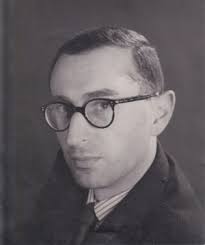
From its offices at 32 Shaftesbury Avenue (now demolished), London, Secretary Antony Grey and many others lobbied Parliament for decriminalisation over the next decade.
Partial decriminalisation in 1967 did not bring freedom for gay men. Prosecutions for ‘gross indecency’ actually went up after 1967 and many more men continued to be convicted until the offence was removed in 2003.
The Campaign for Homosexual Equality
The Campaign for Homosexual Equality (CHE) originally started as the North-Western Committee for Homosexual Law Reform (NWCHLR). The group was founded in Atherton, near Manchester, in Allan Horsfall’s miner’s cottage at 3 Robert Street.
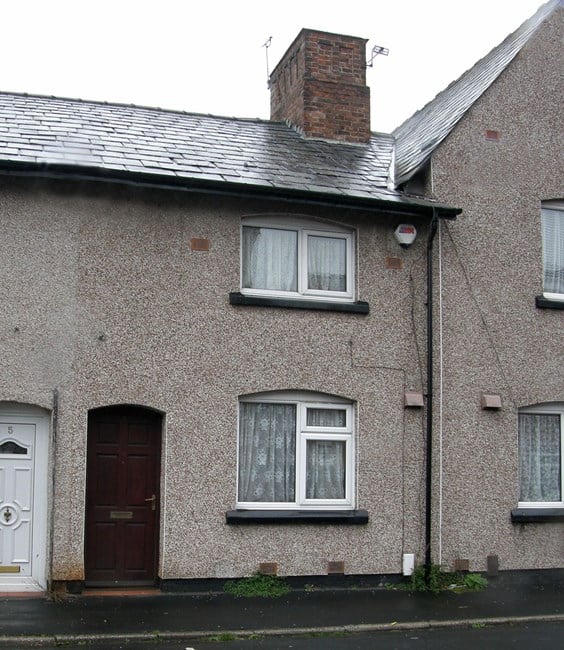
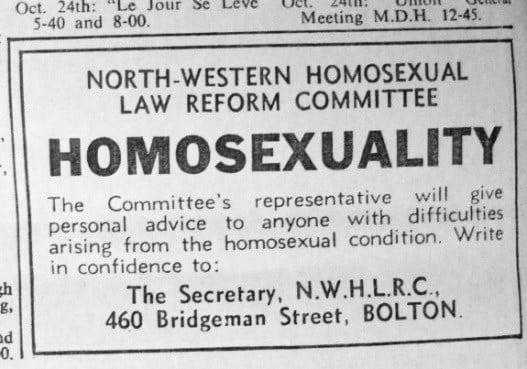
It was organised as a political body aligned with the London-based HLRS, but also sought to offer social opportunities to gay men and lesbians in the northwest of England. It soon expanded, and at its peak in the mid-1970s included 130 branches across England and Wales and more than 5,000 gay and lesbian members.
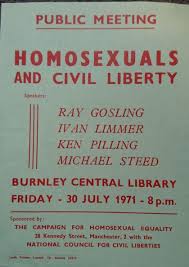
At a 1971 public meeting in Burnley, CHE members confronted opponents to the opening of a local club. At the packed Burnley Public Library meeting, Horsfall invited the homosexuals in the room to stand. Over a hundred did so.
The event has been described as ‘one of the first mass coming-out demonstrations in the UK, certainly the first outside London.’ CHE members recall it as a coming-of-age moment for the gay movement in England.
Arena Three: A Lesbian Community
Well before the women’s and the gay liberation movements, lesbians were organising as a network and community. The cautiously-named Minorities Research Group (MRG) was set up in 1963. Its aims were to put lesbians in touch with one another through its magazine Arena Three, to affirm community and to challenge the negative social stereotypes of lesbianism.
In response to a demand for social meetings, the group held talks and social gatherings at the Shakespeare’s Head pub in Carnaby Street, London from 1964. Other local groups around England followed suit.
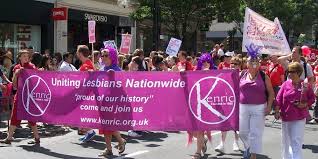
In 1966 a breakaway group was formed, primarily to act as a social club. Kenric was named after its founder members’ neighbourhoods, Kensington and Richmond in west London.
From 1971, the MRG and Arena Three morphed into a new organisation and publication, Sappho. The group and magazine were organised by Jackie Forster and her partner Babs Todd, from their home in Connaught Square, near Marble Arch. Sappho social meetings were held at the Euston Tavern, 73-75 Euston Road and later at the Chepstow pub in Notting Hill.
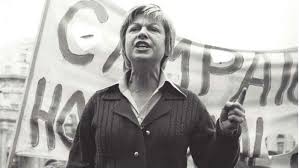
The photo on the right is Jackie Forster at Speakers’ Corner © Campaign for Homosexual Equality
Paul Fairweather will be attending the Out In The City meeting at Cross Street Chapel on Thursday, 10 October at 2.00pm to speak about LGBT history in Manchester.

Royal Northern College of Music
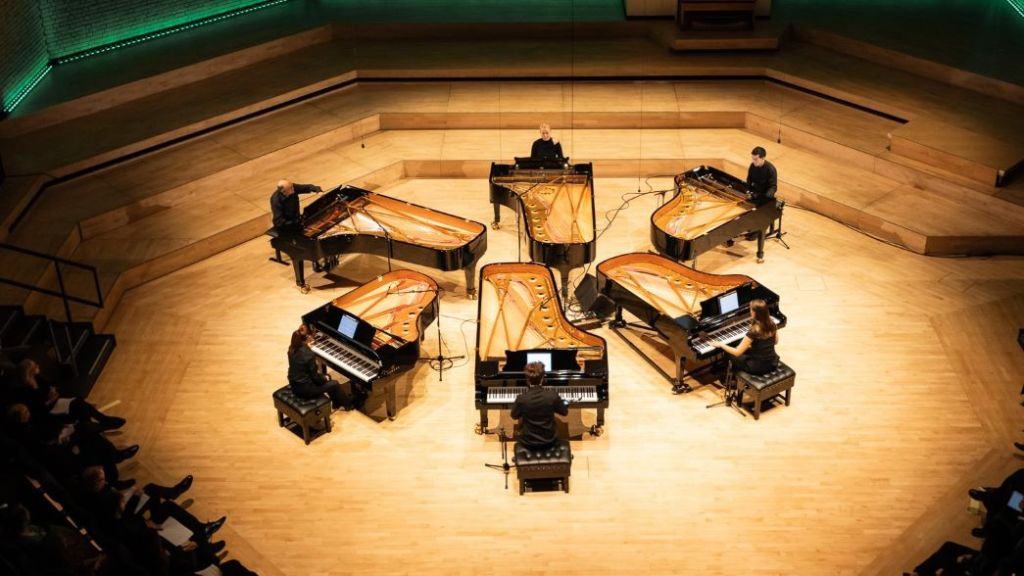
The Royal Northern College of Music (RNCM) is a conservatoire located in Manchester, and is one of the UK’s busiest and most diverse public performance venues.
Out In The City members attended a Thursday lunch time concert where six pianos were played simultaneously by teachers and students.
The three pieces of music were “Totti” by Graham Fitkin, “Six as 1” by Nikki Yeoh and “Six Pianos” by Steve Reich.
The skills of the pianists had to be admired, but views ranged from “excellent” to “the worst concert ever”.
A lesson learnt – you can’t please all of the people all of the time!
Rainbow Lottery Super Draw!
Please support Out In The City by buying a Rainbow Lottery ticket or two (or more!)
With each Rainbow Lottery ticket, you are not just entering to win exciting prizes, you are also supporting our mission to support older LGBT+ people.
It’s a vital part of our fundraising as we receive 50p for every £1 spent and you have the chance to win cash prizes each week from £25 for three numbers up to a jackpot of £25,000 for six numbers – while helping us to achieve more for the LGBT+ communities over 50 years.
Buy tickets here.

This month we have a terrific tech prize for you. On Saturday 26 October, one lucky person will win the just-released iPhone 16 Pro!
This top-of-the-line phone is built for Apple Intelligence, for a whole new smartphone experience. It comes in Grade 5 Titanium with a Super Retina XDR display with a state-of-the-art GPU for gaming, and the most advanced iPhone camera system yet, for professional photos and the highest quality video in a smartphone!
Your regular weekly tickets already enter you into the draw to win this fantastic prize – but did you know you can now top-up your tickets, just for the Super Draw weeks!? And just imagine what you could do with this huge prize …
 Out in the City