
Age Without Limits Campaign
The Centre for Ageing Better has organised an action day on 20 March 2024 with the theme “See and Be Seen”.
This is all about challenging the often narrow, negative and stereotypical way that older people and ageing is portrayed in our society. They have a fantastic image library which showcases the huge diversity that exists in ageing.
After all, you cannot be what you cannot see. You can use this as inspiration, share these images or create your own. The possibilities are without limits.
On 20 March an exhibition will be held in London at Pop 1, The Now Building on Tottenham Court Road and a short film will be launched.
More than a quarter of people hold stereotypical views and may even discriminate on the basis of age without even realising it, according to new data from the Age Without Limits anti-ageism campaign.
Out of almost 5,500 people who completed the campaign’s Are You Ageist? multiple-choice quiz within days of its launch, 28% of respondents submitted answers which indicated “accidentally ageist” views including outdated ideas and misconceptions about ageing.
Accidentally ageist behaviour can include using phrases such as “you can’t teach an old dog new tricks” or “you look good, for your age” which more than half of people (55%) admitted to doing sometimes.
In contrast, two in five people (38%) demonstrate an ageing without limits mentality with a mostly positive attitude towards ageing by saying they would never use such phrases.
The Centre for Ageing Better believes the way we talk about age influences the way we feel about the ageing process and the way we act towards people in different age groups. Ageist language can underpin age discrimination and prejudice as well as cause the recipient of such language to think and talk about their own ageing in a negative and limiting way.
One in five people (22%) who took the quiz demonstrated ageist views overall showing that they hold a bleak perspective on ageing and what it means to get older.
Examples of ageist views include that older workers should retire to make way for younger people, or that they tend to be less able to learn new skills and are less productive – views that are held by almost one in ten people (8%) who took the quiz
The quiz, which forms part of the first-ever national anti-ageism campaign launched by the Centre for Ageing Better this year, has been designed to get people to reflect and consider if they might inadvertently hold negative views to age and ageing.
Evidence shows that a significant proportion of the population unwittingly holds ageist views shaped by the ageist attitudes embedded in our society. The Age Without Limits campaign is looking to challenge harmful ageism for the benefit of all in society as we age.
The campaign’s first-ever annual Action Day will take place on Wednesday 20 March with scores of events organised by community groups taking place the length and breadth of the country.
As part of this Action Day, the Centre for Ageing Better, supported by Age UK, is hosting a free four-day photography exhibition in London, which will challenge people’s perceptions of what ageing looks like and showcase the myriad ways we are ageing.
In 2021, the Centre for Ageing Better launched the country’s first free image library showcasing the wide range of experiences of people over 50 in a bid to challenge negative and stereotypical views of older age. Images from the library will be included in the Challenging Ageism: See and Be Seen exhibition, where attendees will also get the opportunity to take the Are You Ageist? quiz for themselves.
According to the charity, negative societal portrayals of ageing contribute to how people feel about getting older. Older people with more negative self-perceptions of their own ageing are more likely to have depression and to have worse quality of life than those with more positive outlooks.
One in seven people (14%) taking the Are You Ageist? quiz said they feel really down about getting older and dread their milestone birthdays. A further one in five (20%) will try to keep an upcoming milestone birthday quiet, only mentioning it to a few friends on the condition their age is not discussed.
While nearly half of those (49%) who took the quiz are ageing without limits, the results suggest more needs to be done to challenge ageism for the benefit of us all as we grow older.


Best countries for LGBT+ weddings

Wedding experts have discovered the best countries for LGBT+ couples to get married; unsurprisingly, the UK hasn’t even made the top 10 on the list.
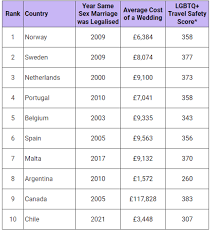
Wedding experts at Hitched looked at the best LGBT+-friendly countries for LGBT+ couples to tie the knot, taking into account how long same-sex marriage has been legal, the average cost to get married there, and how safe the country is for those in the LGBT+ community.
After Greece became the first Christian Orthodox country to legalise same-sex marriage, experts analysed where different countries stand in terms of legal LGBT+ marriages. And in a less than surprising turn, it’s not great news for the UK.
Norway takes the top spot as the best place for LGBT+ couples to say “I do”, being one of the first five European countries to legalise gay marriage, as well as being one of the cheaper options with a high travel safety score, as per Asher Ferguson.
Same-sex marriage was legalised in the country in 2009, nine years after the Netherlands became the first country in the world to pass the legislation. The average cost of a wedding in Norway comes in at just over £6,300 – over three times cheaper than the average wedding in the UK, which the brand revealed to be £20,700.
The second spot goes to Sweden, where same-sex marriage was also legalised in 2009. The average cost of a wedding is slightly dearer at just over £8,000. Meanwhile Canada, often hailed as safe haven for travellers and residents, comes in at ninth place for LGBT+ couples to get married due to its high wedding cost average, sitting at over £110,000.
The UK, however, has only landed at number 20 in the new index due to the late adoption of legal same-sex marriages.
“We have always been quite far behind the rest of Europe when it comes to acceptance of many things that are quite honestly, basic human rights,” said editor Zoe Burke. “To be at number 20 is devastating – we can and should do better.
While we continue to see great strides being made within the wedding industry here in the UK, there is obviously still a very long way to go to ensure that LGBTQI+ people are given the same opportunities, the same respect, and the same basic rights as cis-het couples.
Love is love, after all. It’s quite possibly the one thing that everyone on the planet should agree on.”
Same-sex marriage is legal in 36 countries across the globe, including Greece’s new addition, out of a total of 195 counties. Only 18.4 per cent of countries currently have marriage equality.


Armistead Maupin on trans rights and growing up gay in a homophobic household
Author Armistead Maupin is a pioneer – writing about AIDS and HIV for a mass audience and daring to include gay, lesbian, trans and queer lives when few others were.
His “Tales of the City” series, which started as a newspaper column in 1974, became worldwide best-selling novels and a Netflix series. It chronicles the lives of LGBT+ people in San Francisco and pokes fun at morality and social norms, touching millions of readers and viewers over 50 years. The beloved saga is now back for its 10th and final instalment, “Mona of the Manor”.
Now in his late 70s and living in London, the American writer opens up to Krishnan Guru-Murthy about growing up in the South in a “sexist, homophobic” conservative family, how he came to embrace the LGBT+ community, what life was like at the peak of the AIDS epidemic in the 80s.

 Out in the City