LGBT+ History Month
LGBT+ History Month is an annual celebration of the lives of LGBT+ people of the past. It is marked every February in the UK, with each year’s celebration having its own unique theme. To celebrate we are featuring another article from Arthur Martland.
Towards a Queer History of Wigan
Gross Indecency and Gross Injustice – Billy Winstanley and Thomas Bunney
William (Billy) Winstanley was born in Platt Bridge in 1884, but, by a grim quirk of fate, after less than a year, Parliament had enacted legislation that was to threaten to destroy his life some 44 years later.
The Criminal Law Amendment Act of 1885 had started out as a bill with the worthy aims of protecting women and girls from sexual exploitation and of raising the age of consent from 13 years to 16 years. During the later passage of the bill however, Henry Labouchere, then the Liberal MP for Northampton, introduced an amendment which declared all sexual acts between men to be acts of ‘gross indecency’ and illegal. The proposed amendment was accepted. The Act provided no specific definition of what actually constituted an act of ‘gross indecency’, (other than the involvement of two men), which meant that prosecuting authorities and the courts could interpret the ‘offence’ with a wide degree of latitude, and, not infrequently, in accordance with their own personal prejudices.
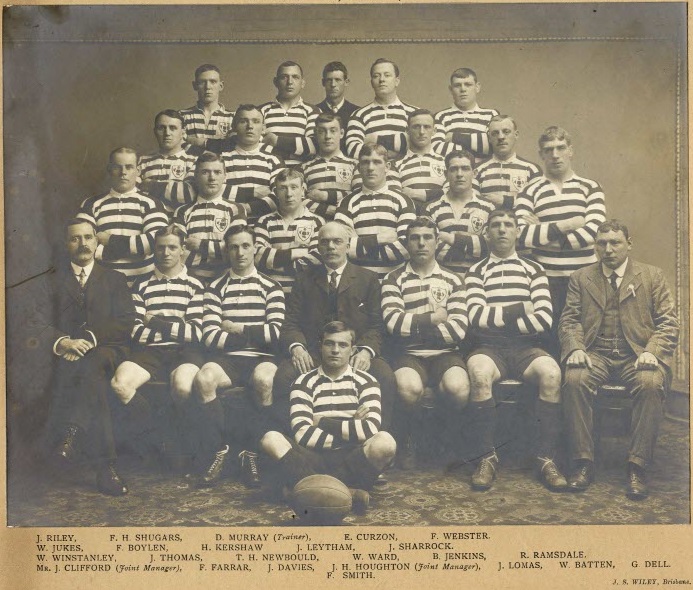
Many thousands of men were prosecuted under this Act, notably Oscar Wilde and Alan Turing, but, in 1929, Billy Winstanley, the celebrated Leigh, Wigan and International rugby player fell foul of the legislation too.
Billy’s success at sport blossomed when he began to play rugby as a forward for the Northern Union Football team at Leigh in December 1904. His skill contributed to the success of the Leigh team when, in 1906, the Leigh club became Northern Union Champions, earning Billy himself a championship winner’s medal. His athletic prowess led naturally to his being chosen as a team player for the first tour by the Northern Union of Australia and New Zealand in 1910, where he scored 5 tries in 14 appearances. After making a total of 171 appearances for Leigh, scoring 19 tries overall, he was transferred to play for Wigan in March 1911 at, what was then, a very large fee of £150. He last played for Wigan in 1919.
Billy’s trial was reported nationally in the press, including locally in the Leigh Journal of 22 February 1929. Billy and his co-accused, Thomas Bunney, appeared before Mr Justice Finlay at the Manchester Assizes, charged with committing an act of gross indecency at Hindley. Thomas, the newspaper reports, was from Platt Bridge, but the headline of the article ‘EX-LEIGH PLAYER SENTENCED’ made it clear that Billy’s fall from grace was the main angle of the reporting. By this time he had long ceased to play rugby for a major team and was working as a labourer for Hindley Urban District Council – a job he soon lost following his arrest.

Finding the men before him to be guilty, the judge commented on their ‘grave offence’ and ‘disgusting crime’ before sentencing Billy to 8 months’ imprisonment and Thomas to 5 months’ imprisonment. Neither of the men had a criminal history, and, though the Act did not insist upon it, the judge himself decided that their prison sentences should be served with hard labour.
As prisoners from the Wigan area, their imprisonment was most likely served at Walton Prison in Liverpool. By 1929, ‘hard labour’ had ceased to mean stone-breaking work, the treadmill and the crank and effectively meant work in the ordinary prison workshops. What survived from the Victorian era, was that ‘hard labour’ prisoners were required to sleep on a plank bed without a mattress for their first two weeks in custody (Cross 1971 10).
The Governor at Walton Prison in 1929 was Lt. Col. C E F Rich DSO, who in his memoirs, ‘Recollections of a Prison Governor’, recorded his time at Walton and his trenchant views on men who have sex with other men.
In a rant against the male prostitute ‘type’, (the ‘filthiest brute on the market’), Rich expounds upon his final solution to what he regards as the problem of same-sex activity:-
‘Why any country should be so weak as to tolerate these creatures running the chance of their bringing into the world others like themselves – since presumably some of them are capable of normal cohabitation with a woman – is more than I can fathom, when there is a remedy to hand. If you have an animal from which you do not desire to breed, you jolly well see to it that the beast becomes incapable of breeding. These people are lower than animals. Why not make sure of their not breeding, then? You would not destroy their souls – presuming them to possess any’. (Rich 1932 138).
Reading Rich’s views, we can readily surmise that Billy and Thomas would have endured a brutalising and demeaning regime whilst at Walton, certainly not one troubled by thoughts of rehabilitation. From Police, to judge, to prison, the whole system was one in which performative cruelty and abuse of an ‘offender’ was to be seen as an end in itself.
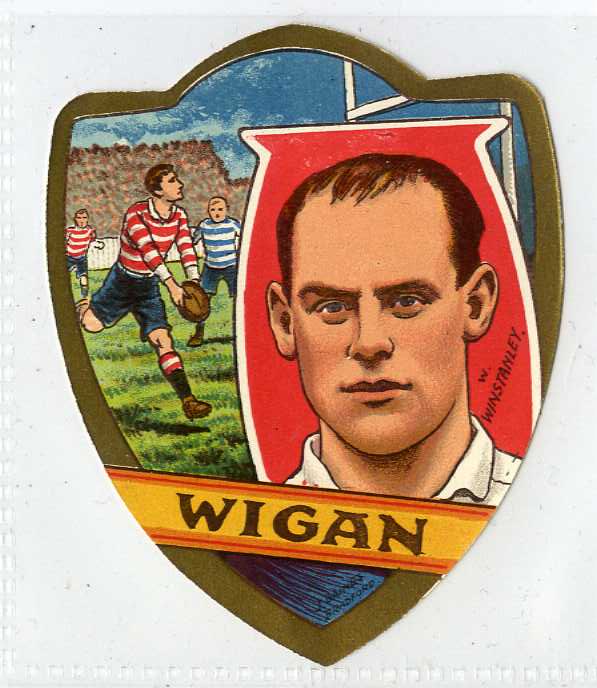
Billy was remembered by his teammate, Johnnie Blackburn, as ‘a quiet and aloof man’ and he was easily picked out in team photographs due to his receding hairline. [*] Whether his ‘quiet and aloof’ manner was a manifestation of his consciousness of being different from others, is hard to say. His ‘offence’ says nothing definitive about his, nor Thomas’s sexuality. We can infer however, how a ‘quiet and aloof’ man would suffer greatly from the targeted violence he suffered from the criminal justice system at every stage and the salacious press reporting he was forced to endure. The record of his non-sporting life is, so far, elusive. I can find no record of him after his court case, nor anything to indicate where he went to after prison. Court records are usually embargoed for 100 years, so hopefully more information about him and Thomas should become available in 2029.
Reference List
Cross, R. (1971) Punishment, Prison and the Public. London: Stevens & Sons.
Rich, CEF, Lt Col. DSO. (1932) Recollections of a Prison Governor. London: Hurst and Blackett.
[*] I am indebted to Mr Mike Latham, Chairman of Leigh Leopards, for generously providing me with this and other information about Billy, together with his encouragement of my research, which is ongoing.
© Arthur Martland
Thanks to Arthur Martland for researching and writing this article.

 Out in the City