Centre for Ageing Better Report
A longer life is an expectation for many, but there is a growing divide in our experiences of ageing.
In this video, we hear from older people from across the country. They were asked how they feel about different issues facing our ageing population.
This video accompanies the State of Ageing 2023 Report. This discusses the data on our older population, highlights stark inequalities and the urgent need for action.

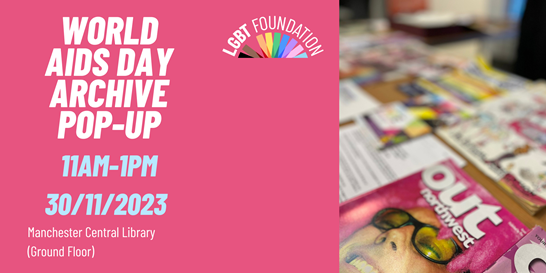
World AIDS Day Archive Pop-Up – 30 November, 11.00am – 1.00pm at Manchester Central Library
Follow this link for more information. Please share with anyone you know who may be interested in attending.
Historians are learning more about how the Nazis targeted trans people
Thanks to Laurie Marhoefer, Professor of History, University of Washington for this article.
In the fall of 2022, a German court heard an unusual case.
It was a civil lawsuit that grew out of a feud on Twitter about whether transgender people were victims of the Holocaust. Though there is no longer much debate about whether gay men and lesbians were persecuted, there’s been very little scholarship on trans people during this period.
The court took expert statements from historians before issuing an opinion that essentially acknowledges that trans people were victimised by the Nazi regime.
This is an important case. It was the first time a court acknowledged the possibility that trans people were persecuted in Nazi Germany. It was followed a few months later by the Bundestag, Germany’s parliament, formally releasing a statement recognising trans and cisgender queer people as victims of fascism.
Up until the past few years, there had been little research on trans people under the Nazi regime. Historians like myself are now uncovering more cases, like that of Toni Simon.
Being trans during the Weimar Republic
In 1933, the year that Hitler took power, the police in Essen, Germany, revoked Toni Simon’s permit to dress as a woman in public. Simon, who was in her mid-40s, had been living as a woman for many years.
The Weimar Republic, the more tolerant democratic government that existed before Hitler, recognised the rights of trans people, though in a begrudging, limited way. Under the republic, police granted trans people permits like the one Simon had.
In the 1930s, transgender people were called “transvestites,” which is rarely a preferred term for trans people today, but at the time approximated what’s now meant by “transgender.” The police permits were called “transvestite certificates,” and they exempted a person from the laws against cross-dressing. Under the Republic, trans people could also change their names legally, though they had to pick from a short, preapproved list.
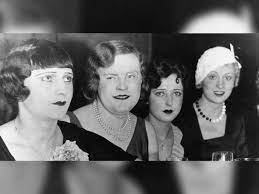
In Berlin, transgender people published several magazines and had a political club. Some glamorous trans women worked at the internationally famous Eldorado cabaret. The sexologist Magnus Hirschfeld, who ran Berlin’s Institute for Sexual Science, advocated for the rights of transgender people.
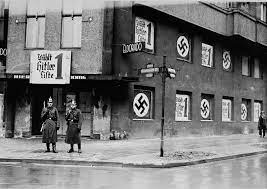
The rise of Nazi Germany destroyed this relatively open environment. The Nazis shut down the magazines, the Eldorado and Hirschfeld’s institute. Most people who held “transvestite certificates,” as Toni Simon did, had them revoked or watched helplessly as police refused to honour them.
That was just the beginning of the trouble.
‘Draconian measures’ against trans people
In Nazi Germany, transgender people were not used as a political wedge issue in the way they are today. There was little public discussion of trans people.
What the Nazis did say about them, however, was chilling.
The author of a 1938 book on “the problem of transvestitism” wrote that before Hitler was in power, there was not much that could be done about transgender people, but that now, in Nazi Germany, they could be put in concentration camps or subjected to forced castration. That was good, he believed, because the “asocial mindset” of trans people and their supposedly frequent “criminal activity … justifies draconian measures by the state.”
Toni Simon was a brave person. I first came across her police file when I was researching trans people at the United States Holocaust Memorial Museum. The Essen police knew Simon as the sassy proprietor of an underground club where LGBTQ people gathered. In the mid 1930s, she was hauled into court for criticising the Nazi regime. By then, the Gestapo had had enough of her. Simon was a danger to youth, a Gestapo officer wrote. A concentration camp was “absolutely necessary.”
I am not certain what happened to Simon. Her file ends abruptly, with the Gestapo planning her arrest. But there are no actual arrest papers. Hopefully, she evaded the police.
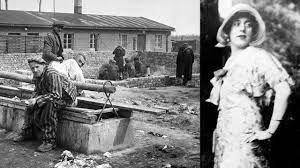
Other trans women did not escape. At the Hamburg State Archive, I read about H Bode, who often went out in public dressed as a woman and dated men. Under the Weimar Republic, she held a transvestite certificate. Nazi police went after her for “cross-dressing” and for having sex with men. They considered her male, so her relationships were homosexual and illegal. They sent her to the concentration camp Buchenwald, where she was murdered.
Liddy Bacroff of Hamburg also had a transvestite pass under the Republic. She made her living selling sex to male clients. After 1933, the police went after her. They wrote that she was “fundamentally a transvestite” and a “morals criminal of the worst sort.” She too was sent to a camp, Mauthausen, and murdered.
Trans Germans previously misgendered
For a long time, the public didn’t know the stories of trans people in Nazi Germany.
Earlier histories tended to misgender trans women, which was odd: When you read the records of their police interrogations, they are often remarkably clear about their gender identity, even though they were not helping their cases at all by doing so.
Bacroff, for example, told the police, “My sense of my sex is fully and completely that of a woman.”
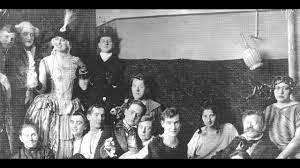
There was also confusion caused by a few cases that, by chance, came to light first. In these cases, police acted less violently. For example, there is a well-known case from Berlin where police renewed a trans man’s “transvestite certificate” after he spent some months in a concentration camp. Historians initially took this case to be representative. Now that we have a lot more cases, we can see that it is an outlier. Police normally revoked the certificates.
A through line to today
Today, right-wing attacks against trans people in the US are intensifying.
Though the American Academy of Pediatrics and every major medical association approves gender-affirming health care for trans kids, Republican politicians have banned it in 19 states, with even more moving to prohibit it.
Gender-affirming medicine is now over 100 years old – and it has roots in Weimar Germany. It had never before been legally restricted in the US Yet Missouri has essentially banned it for adults, and other states are trying to restrict adult care. A host of other anti-trans bills are moving through state legislatures.
I find it fitting, then, that “A Transparent Musical” recently premiered in Los Angeles. In it, fabulously dressed trans Berliners sing and dance in defiance of Nazi thugs.
It’s a reminder that attacks on trans people are nothing new – and that many of them are straight out of the Nazi playbook.
“The Log Books” makes LGBTQ+ history
The Log Books is an extraordinary, award-winning podcast documentary series telling untold stories from Britain’s queer marginalised voices and stories that are not usually featured in the media, or even in LGBTQI+ histories. Over three seasons the podcast has featured around 100 voices from across the UK.
Season 3 features eleven episodes and features stories including:
● Lesbians such as Sali Walker starting queer families in the 90s with sperm donors;
● Kinky club nights such as Sadie Masie, which mixed genders and sexualities;
● Hugo Greenhalgh and Euan Sutherland talking about their groundbreaking legal fight to equalise the age of sexual consent for gay men;
● Transgender teenagers such as Finn, who reached out for help from Switchboard;
● TV viewers’ memories of the lesbian kiss on Brookside and Queer As Folk; and
● The nail bomb at the Admiral Duncan gay pub in 1999.
The Log Books, produced by Adam Zmith, Shivani Dave and Tash Walker, has been collecting and sharing crucial heritage with a diverse cast of contributors and extensive research.
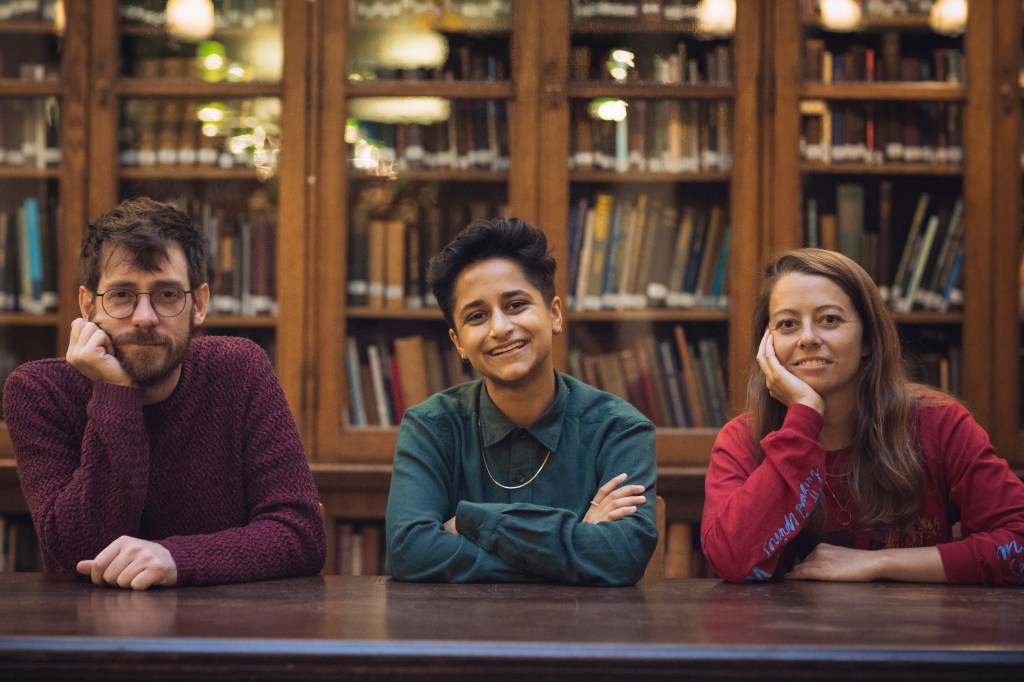
The Log Books has closed in its current form, as its producers move forward to create new podcasts under their new production company Aunt Nell.
Stories + Strategies: diversifying our national LGBTQ+ heritage
Aunt Nell have engaged a freelance Project Manager for a year long project to gather diverse new queer oral histories from across the UK.
The UK’s queer history is endangered. Unheard stories are held by diverse LGBTQ+ people who often feel excluded from museums and society.
The production company Aunt Nell partnering with the museum Queer Britain will aim to increase recognition of oral histories as valuable and impactful research practice and resources – focussing on LGBTQ+ histories – and reduce barriers against full inclusion of queer heritage in the galleries, libraries, archives and museums sector.
Through active participation of underrepresented groups, they will disrupt traditional ideas of knowledge and heritage, empower people to see their stories as an essential part of history, and produce a high-profile podcast series that will democratise and diversify history.
They are currently looking for community groups interested in partnering with heritage institutions. Please get in touch if you’re interested in finding out more.
Cruella Suella

Suella Braverman had no evidence for her claim that “many” people pretend to be gay in order to “game” the UK asylum system, the Home Office has been forced to admit.
The sacked former home secretary made the allegation in September as she sought to shore up support for her flagship policy of deporting asylum seekers to Rwanda. The plan was deemed unlawful in the Supreme Court in a rare reprieve for hundreds of people who had been threatened with offshoring before their claims were decided.
Braverman, a former attorney general, told ITV on 27 September: “People do game the system. They come to the UK. They purport to be homosexual in the effort to game our system – in the effort to get special treatment – and it’s not fair and it’s not right … I’m afraid we do see many instances where people purport to be gay when they’re not actually gay.”
Her former department admitted it could not find any relevant information. Braverman’s homophobic falsehoods look like an attempt to mask her own cruelty and incompetence. Good riddance!
 Out in the City
I knew a trans woman in London who refused to transition fully, because of the experiments carried out in the concentration camps
LikeLike