The colonial legacy of anti-LGBT+ laws in Africa
Namibia’s High Court will rule next May in a case that could see the southern African country overturn a colonial-era ban on same-sex relations.
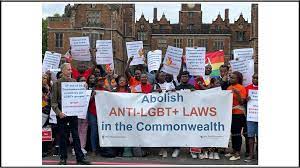
Friedel Dausab, who is gay, is challenging the compatibility of the common law offence of sodomy and related offences with his rights under the constitution. Sexual contact between men is a criminal offence in Namibia but the law is seldom enforced.
Like many anti-LGBT+ statutes across Africa, the Namibian law dates back to colonisation and was retained on the books after independence in 1990.
In October, Mauritius moved to decriminalise same-sex relations when the Supreme Court in the Indian Ocean island nation struck out a law dating back to British colonial rule in 1898, saying it was unconstitutional.
Globally, 65 jurisdictions still criminalise same-sex relations, according to rights group Human Dignity Trust (HDT), and 31 of these are in Africa.
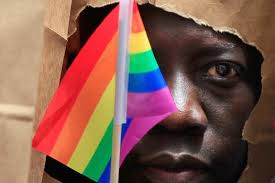
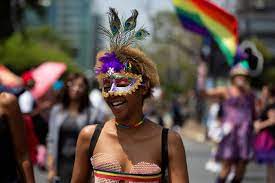
Here’s what you need to know about this colonial legacy in Africa.
Where is the colonial legacy still being felt most keenly?
Rights activists say abuses experienced by LGBT+ people today can often be traced back globally to a colonial legacy of discrimination, even though colonial powers like Britain, France and Portugal long ago decriminalised same-sex relations.
Given the size of its empire at the height of its power, British law still casts a long shadow in its former colonies.
According to HDT research, 13 former British colonies in Africa have laws that prohibit same-sex relations.
“The basis of many of the world’s anti-LGBT criminal laws is British colonialism,” said Téa Braun, chief executive of HDT.
This idea is also espoused by activists who challenge the notion — often voiced by lawmakers pushing for anti-LGBT+ legislation — that same-sex relations are un-African.
They point to historical examples of more fluid sexual behaviour across the continent.
“The British exported their legal systems … imposing them on societies where often consensual same-sex activity did not carry the same social and religious taboos,” said Braun.
By the time Britain legalised same-sex acts in 1967, many former colonies had gained independence and did not inherit the legal change, including Kenya and Uganda.
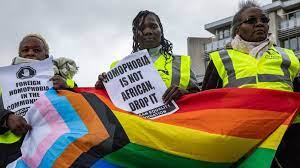
What about other colonies?
While Britain’s colonial legacy weighs heavy on LGBT+ communities in some African countries, it is not the case in every former colony.
Portugal was one of the main colonial powers in Africa and today, all five of its former colonies have decriminalised gay sex.
Guinea-Bissau was the first to do so in 1993 – becoming the first African country to legalise LGBT+ activity while Angola and Mozambique dropped the colonial-era “vices against nature” from their criminal codes in 2019 and 2015, respectively.
Gustavo Gomes da Costa Santos, a sociologist at the Federal University of Pernambuco-Brazil, said one possible reason Portuguese legislation did not have the lasting effect of British law was that it was only applied to colonies in 1954.
“We’re talking about the very late phase of the Portuguese colonial reign in Africa,” he said.
Former French colonies fell under the jurisdiction of the French Penal Code of 1791, which was centuries ahead of other European laws in decriminalising consensual same-sex activity.
But several former French colonies passed anti-homosexuality laws after gaining independence, including Algeria, Cameroon, Mauritania and Chad.
Away from colonial influences, some rights activists say foreign anti-LGBT+ religious groups drive the agenda in some countries while sharia is also used – for example in Somalia and some Nigerian states – to outlaw LGBT+ activity.
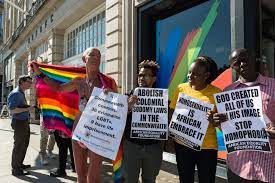
What is behind the current pushback on LGBT+ rights?
A recent wave of conservatism has swept across Africa with activists decrying an assault on LGBT+ rights, notably in east Africa.
In May, Uganda’s President Yoweri Museveni signed one of the world’s harshest anti-LGBT+ laws, including the death penalty for “aggravated homosexuality”, in defiance of Western condemnations and potential sanctions from aid donors.
Next-door, Kenyan authorities are considering similar measures to further penalise gay sex, as are lawmakers in Tanzania and South Sudan.
Some regional lawmakers frame the issue as an existential battle to defend what they see as African values, which they say have been battered by Western pressure to support gay rights. “In the case of Uganda or Nigeria and other cases, the current political elites are now (casting) homosexuality as something ‘un-African’ to enforce their power,” said Gomes da Costa Santos.

Harvey Milk and Sylvester
Harvey Bernard Milk (22 May 1930 – 27 November 1978) was an American politician and the first openly gay man to be elected to public office in California, as a member of the San Francisco Board of Supervisors.
Milk was born and raised in New York where he acknowledged his homosexuality as an adolescent, but chose to pursue sexual relationships with secrecy and discretion well into his adult years. His experience in the counterculture of the 1960s caused him to shed many of his conservative views about individual freedom and the expression of sexuality.
Milk moved to San Francisco in 1972 and opened a camera store. Although he had been restless, holding an assortment of jobs and changing addresses frequently, he settled in the Castro, a neighbourhood that at the time was experiencing a mass immigration of gay men and lesbians. He was compelled to run for city supervisor in 1973, though he encountered resistance from the existing gay political establishment.
His campaign was compared to theatre; he was brash, outspoken, animated, and outrageous, earning media attention and votes, although not enough to be elected. He campaigned again in the next two supervisor elections, dubbing himself the “Mayor of Castro Street”.
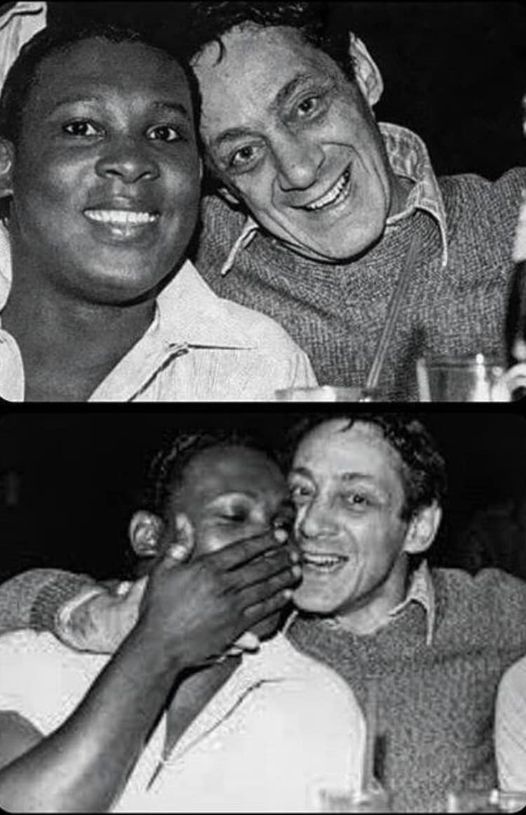
Sylvester James Jr (6 September 1947 – 16 December 1988), known as Sylvester and also the “Queen of Disco”, was an American singer-songwriter. Primarily active in the genres of disco, rhythm and blues, and soul, he was known for his flamboyant and androgynous appearance, falsetto singing voice, and hit disco singles in the late 1970s and 1980s. Here they are together at Harvey Milk’s birthday in 1978.
Over 50’s Digital Café
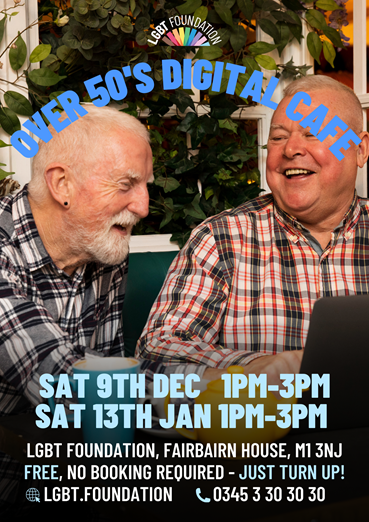
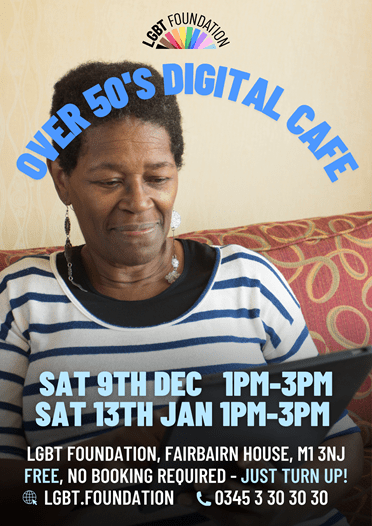
Over 50’s Digital Café on Saturday 9 December and Saturday 13 January, from 1.00 – 3.00pm at LGBT Foundation’s Community Hub at Fairbairn House, 72 Sackville Street, Manchester M1 3NJ
Visit Pride in Ageing’s Over 50’s Digital Café for coffee and a chat about the benefits of getting online. There will also be an opportunity to swap tips and tricks on using smartphones, tablets, laptops and other digital devices, how to save money and how to stay safe.
This monthly social space run by the Pride in Ageing programme is centred around LGBTQ+ people aged over 50, however any adult is welcome to attend. Whether you are a technology beginner or a tech expert all are welcome to the relaxed and LGBTQ+ friendly space. Free Wi-Fi is also provided throughout the session.
Please note: Unfortunately they cannot offer one-on-one troubleshooting or tech support as part of this session, but they can provide signposting to other relevant services who can help you. No booking required, just drop-in on the day.

For those who know me well!
 Out in the City