Statement from LGBT Consortium
We have come together with LGBTQI+ organisations and allies across the country to say enough! Trans people are people too.
We cannot allow our communities, particularly our Trans and Intersex communities, to be attacked in such inhumane and degrading ways as we have seen during the Conservative Party Conference in early October.
Rather than focusing on pressing issues affecting everyone, such as the cost of living, the climate crisis or getting timely healthcare, senior Government ministers, including the Prime Minister, sought to denigrate Trans and Intersex people, and increase the barriers they already face to accessing essential services and support. We are deeply concerned at the nature and tone of these remarks and policies.
Everyone has a right to live with dignity, free from discrimination and abuse, and to play an integral part in their local communities. That is the principle behind the Equality Act, which up until now has been supported by all parties. Government’s responsibility is to all its citizens and it should be working to proactively tackle life-limiting inequalities so that Trans people are safe to live their lives, respected and valued in society, and supported to thrive in what they do.
However, Trans and Intersex people and communities are being let down by a Government that wants to deny their existence and their safety.
For far too long now, we have seen Trans people and communities used in a culture war, mocked by those who are in positions of power, and inaccurately portrayed as a threat to others. People who support Trans people as friends, colleagues and family members are called ‘bullies’, and those questioning the Government’s new narrative in this area are removed from conversations. Announcements like the exclusion of Trans men and women from single-sex wards are made despite the NHS reporting no evidence of abuse by Trans people, and quite possibly with no consultation with those involved in providing or receiving those services. This suggests to the wider public that it is legitimate and appropriate to undertake harassment of Trans people and communities.

We call upon LGBT+ people, friends, allies, family members, businesses and voluntary sector organisations to stand up and say enough. Enough of erasing and attacking some of the most marginalised people and communities in our society, and putting the health, safety and lives of Trans people at risk. Trans people, and all LGBT+ people, are an asset to our country. Reducing inequalities should be our collective goal. If the Government can target one group of innocent people, and block them from necessary services, then it can do the same to anyone else.
LGBTQ+ History Month’s Founder Urges Unity Over Division

Rodney Wilson, the educator who envisioned LGBTQ+ History Month, delves into evolving inclusivity, tackling exclusionary trends, and the dire need for continuous education amid a changing political landscape.
In the US October is LGBTQ+ History Month, a time of reflection and celebration of the community’s past, underlined by a pressing discourse on the contemporary educational and political landscape surrounding LGBTQ+ rights. At the heart of this dialogue is Rodney Wilson, the pioneering educator behind the inception of LGBTQ+ History Month back in 1994.
Wilson’s journey began in a suburban St Louis high school classroom, where he envisioned a dedicated month to commemorate LGBTQ+ history, akin to the observances for African American and women’s history.
October was earmarked, aligning with significant LGBTQ+ milestones and the academic calendar. Over the years, the initiative garnered endorsements from various states and prominent LGBTQ+ organisations, evolving to embrace the diverse identities within the community.
Rodney Wilson addressed the ongoing contentious movement of “LGB without the TQ+,” which is made of gay, lesbian, and bisexual people who believe that transgender people and other identities should not be lumped in with the former.
“It’s hard to get my mind around it, honestly,” he said. “I don’t understand how anyone would want to quite literally cut a group out of a community. … But to take a knife and cut off a letter that symbolises an identity that we all need to be educated about, we all need to learn about, is so frustrating and sad to me.”
Wilson reminisced about the initial naming of the observance as Lesbian and Gay History Month in 1994 and reflected on the community’s growth.
“It did not cross my mind in 1994 to call it Lesbian, Gay, Bisexual, and Transgender History Month. It just didn’t cross my mind. But we are supposed to learn and evolve and grow and continue to open ourselves up to new individuals, new understanding, new information, new identities,” he said.
Wilson envisioned continuous education and open dialogue to foster understanding and inclusivity.
“Adding a colour to the Gilbert Baker flag or adding a letter to our initialism does not detract from the worth or value of the colours and letters already present,” he added. “There’s strength in numbers, there’s strength in cohesion, there’s strength in community. There’s strength in having a wide variety of people with different experiences and the insight that comes from having different experiences,” Wilson said.

Out in the World
Just a small selection of stories from around the world:
Hungary
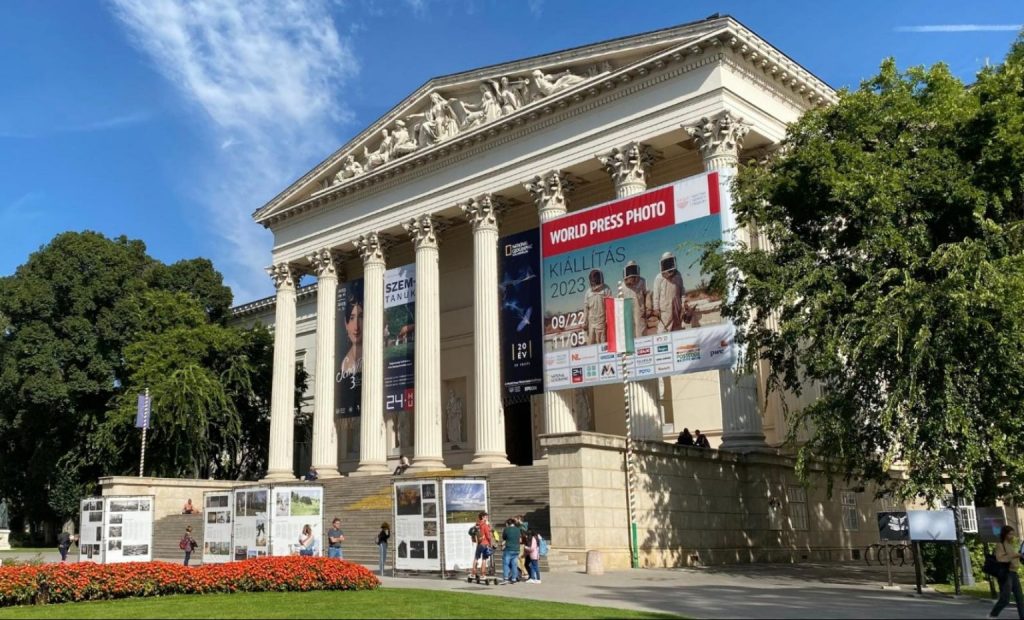
The far-right anti-LGBT+ government of Hungarian Prime Minister Viktor Orbán has banned children under the age of 18 from visiting the World Press Photo exhibition at the Hungarian National Museum in Budapest, citing LGBT+ content in some of the photos.
Since taking power, Orbán and his ruling party have waged an unceasing campaign to restrict the rights of LGBT+ Hungarians. In July 2021, the government passed a law that bans the promotion of homosexuality and sex-reassignment surgery to minors in the country.
This past summer Hungary’s second-largest bookstore chain was fined for violating the 2021 law that limits the access of minors to books, media content and advertisements that “promotes or portrays” the so-called “divergence from self-identity corresponding to sex at birth, sex change or homosexuality.”
The chain was fined for selling copies of British author Alice Oseman’s LGBT+ graphic novel series “Heartstopper,” a global phenomena due to the runaway hit Netflix show based on her books in the series.
Reuters reported that the museum stopped selling tickets for the photo exhibition for youngsters after the far-right Our Homeland party had initiated a government inquiry.
Japan
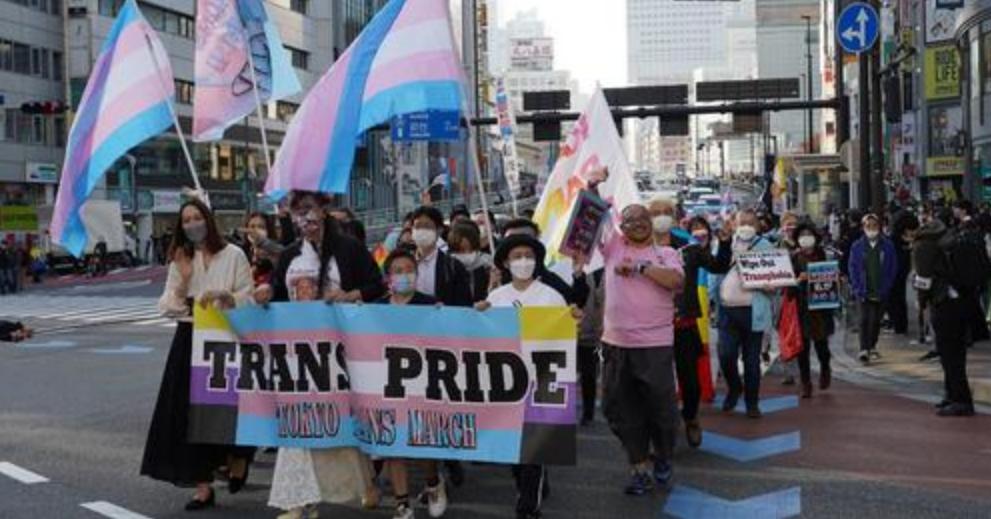
On 25 October 2023, Japan’s highest court ruled in a unanimous decision that the country’s law mandating sterilisation surgery for transgender people as a requirement for legal gender recognition was unconstitutional.
In the ruling, the 15 justices wrote: “Being forced to undergo sterilisation surgery … constitutes a significant constraint on freedom from invasive procedures” in violation of the Japanese Constitution.
Human Rights Watch Japanese Director Kanae Doi noted that since 2004, trans people in Japan who want to legally change their gender must appeal to a family court. Under the Gender Identity Disorder Special Cases Act, applicants must undergo a psychiatric evaluation, be surgically sterilised, and “have a physical form that is endowed with genitalia that closely resemble the physical form of an alternative gender.” They also must be single and without children who are younger than 18.
In May 2023, the Supreme Court ruled in favour of the right of a trans woman government employee to use the restrooms in accordance with her gender identity. In November 2022, the government in Japan’s Kanagawa prefecture awarded another trans woman workplace compensation after recognising her depression was the result of harassment she faced from her supervisor.
Earlier this month, a local family court ruled in favour of a trans man, Gen Suzuki, who requested to have his gender legally changed without undergoing the surgery.
The family court judge, Takehiro Sekiguchi, said the current law violated Article 13 of the constitution that stipulates all people shall be respected as individuals.
According to the Japanese government’s statistics, sexual minorities (LGBT+) make up for 3 to 8 percent of the population and that at most, the statistics estimate that around 0.7 percent of the population is trans.
They are an overwhelming minority. The overwhelming majority of people do not know about trans people and various prejudices are widespread.
The “LGBT Understanding Promotion Act,” which was passed by the Japanese Parliament in June 2023, includes the sentence “we will take care to ensure that all citizens can live their lives with peace of mind,” but according to Japanese trans activist Aya Nishida, the background to this is “If you say you are a woman at heart, you are a man. This is because some people have discriminatory views such as, “If transgender people’s human rights are recognised, women’s human rights will be threatened.”
Nishida provides training on the human rights of trans people to local governments, about issues surrounding trans people.
While the Supreme Court has ruled against the sterilisation requirement, it has asked a lower court to review the requirement to have “genitalia that closely resemble the physical form of an alternative gender.”
As of 1 October 2023, 26 local governments have enacted ordinances that codifies the prohibition of “outing,” which is the act of disclosing a person’s sexual orientation or gender identity without their consent.
According to human rights groups and LGBT+ advocacy organisations, outing constitutes a serious human rights violation and it was defined as a form of abuse of power in the guidelines for legislation.
The harmful consequences of outing hit the national consciousness in 2015, when a graduate student of Hitotsubashi University in Tokyo died after plunging from a school building in an apparent suicide after being outed as gay.
Nigeria

Human rights activists are condemning Nigerian police after observing a recent rise in mass arrests targeting LGBT+ people.
Authorities have been accused of abusing Nigeria’s Same-Sex Marriage Prohibition Act to arrest suspected members of the LGBT+ community “based on assumptions” rather than solid evidence or investigation.
Nigeria is one of over 30 African countries that heavily enforces a number of anti-LGBT+ laws. Among those is the criminalisation of homosexuality, which is punishable with up to 14 years in prison or, under Sharia law, death. Gay marriage, same-sex relationships and gay rights groups are also illegal.
At the same time, Nigeria’s constitution promises its citizens freedom from discrimination and the right to private and family life.
Arrests under Nigeria’s Same-Sex Marriage Prohibition Act, which has been criticised worldwide ever since it was introduced, have always been common. But in recent weeks, there has been a notable spike in mass arrests with little to no evidence, with many suspects claiming to be falsely accused.
Okechukwu Nwanguma, who leads the Rule of Law and Accountability Advocacy Centre, which advocates for police reforms in Nigeria, said that that Nigeria’s anti-gay law is currently being “exploited” by authorities without due process.
“They [law enforcement authorities] are exploiting the law to target people whether or not they are queer … There is a tendency to target them based on assumptions or allegations, not based on any investigation,” said Nwanguma

Just last week, Nigeria’s paramilitary arrested 76 people, claiming that they had been holding “homosexual birthdays” and intended to perform a “same-sex marriage” at the party. One of the prime suspects arrested, identified as Bashir Sani, has said that there were no such plans.
“There was no wedding, only birthday,” Sani told local media after the arrest.
Similarly, in August, more than 200 people were arrested in Nigeria’s southern Delta State over allegations that a gay wedding was due to take place.
These blanket arrests and media events pose a serious risk of further endangering people for their perceived sexual or gender orientation Nigeria’s Amnesty International Isa Sanusi warned.
“Since the signing of the Same Sex Prohibition Act into law in 2014 attacks, harassment, blackmail, and extortion of the LGBTQ+ community is rising, at disturbing speed. The Nigeria Police should be prioritising keeping everyone safe, not stoking more discrimination,” he said.
On the other side of the law, human rights groups have expressed concern that Nigerian law enforcement is ignoring reports of abuse against the LGBT+ community.
Chizelu Emejulu, an activist and lawyer who covers many cases involving LGBT+ people, claimed: “When we get the perpetrators arrested, the consistent thing we have noticed is that people always claim their victims are queer, and once they say that, the police begin to withdraw from these cases.
What the LGBTQ community in Nigeria is asking for is to be left alone to live their lives.”
South Korea

On 27 October 2023, the second highest court in South Korea upheld an earlier ruling for the fourth time, the Military Criminal Act, that criminalises same-sex relations in the military.
The Constitutional Court of South Korea, in a 5-4 vote, ruled that article 92-6 of the Military Criminal Act was constitutional. Justices in their ruling stated that same-sex activities might undermine discipline and harm the combat capabilities of the military. Same-sex activities between civilians however, is not a crime.
Human rights activists have noted that the South Korean military has invoked Article 92-6 to punish sexual acts between male servicemen with sentences of up to two years in prison — regardless of whether the acts were consensual or whether they happened within or outside of military facilities.
Several of South Korea’s allies including the US and the UK have repealed similar provisions in order to align with international obligations to protect against the discrimination of LGBT+ people.
The executive director of the Centre for Military Human Rights Korea, which provides legal assistance to soldiers including those accused of breaking the anti-sodomy law, Lim Tae-Hoon said the decision was “absurd, illogical, regressive and driven by prejudice.
While the world has been making progress in abolishing discrimination against minorities over the past 20 years, the minds of the judges have not advanced even a single step,” he added.
Uganda
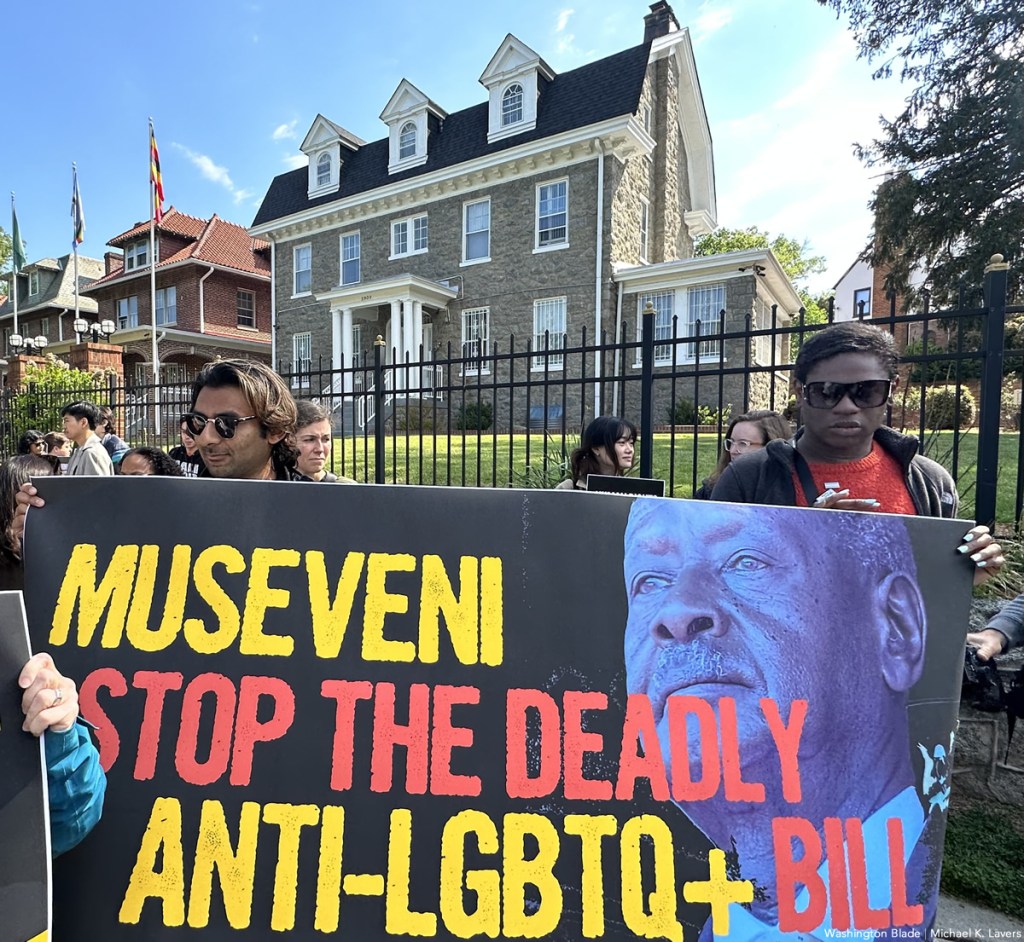
The Biden-Harris administration has announced it plans to remove Uganda from a programme that allows sub-Saharan African countries to trade duty-free with the US.
Then-President Bill Clinton in 2000 signed the African Growth and Opportunity Act, which allows sub-Saharan African countries to access US markets.
President Joe Biden, in a letter, notes the Ugandan government “has engaged in gross violations of internationally recognised human rights.”
Ugandan President Yoweri Museveni on 29 May signed the Anti-Homosexuality Act, which contains a death penalty provision for “aggravated homosexuality.” The Biden-Harris administration last week issued a business advisory for the country in response to the law. The White House will remove Gabon, Niger and the Central African Republic from the African Growth and Opportunity Act with effect from 1 January 2024.
 Out in the City