Shakespeare Garden
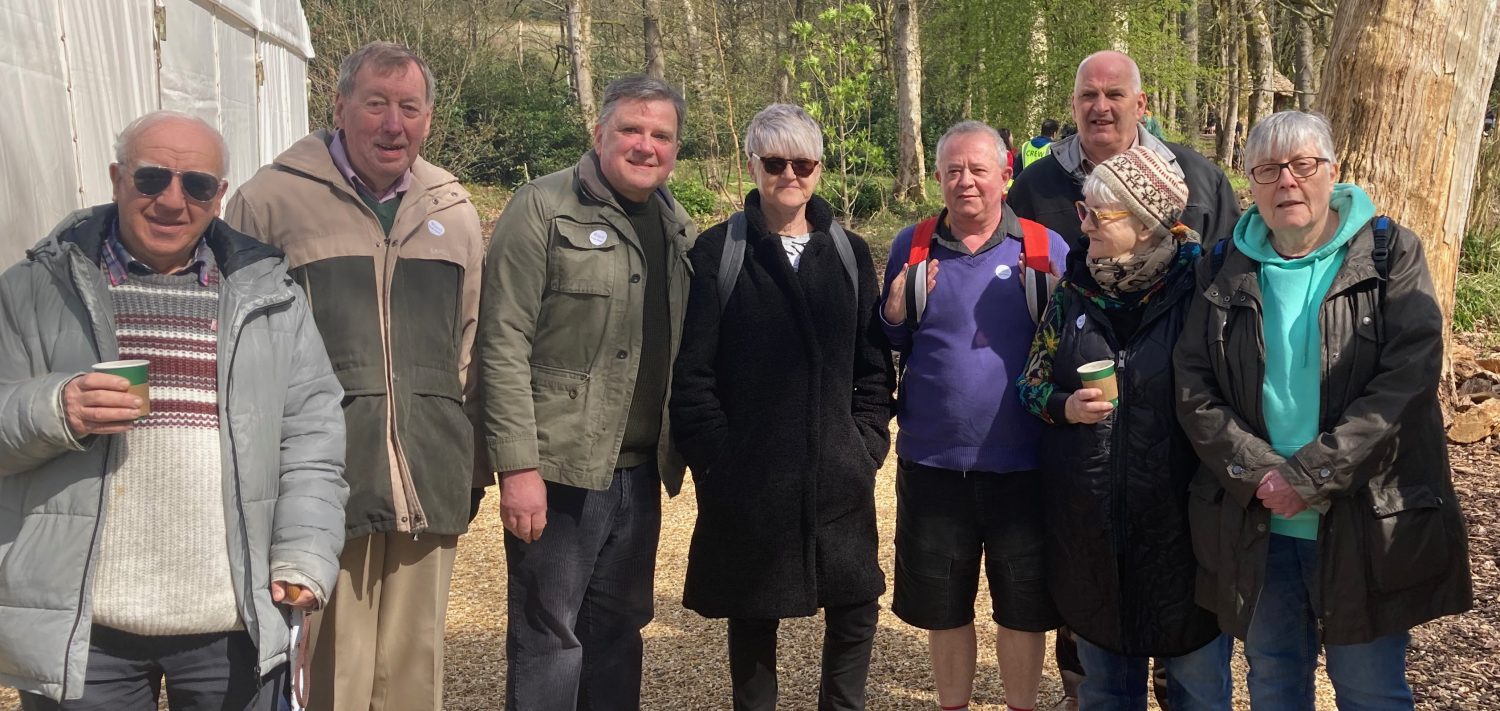
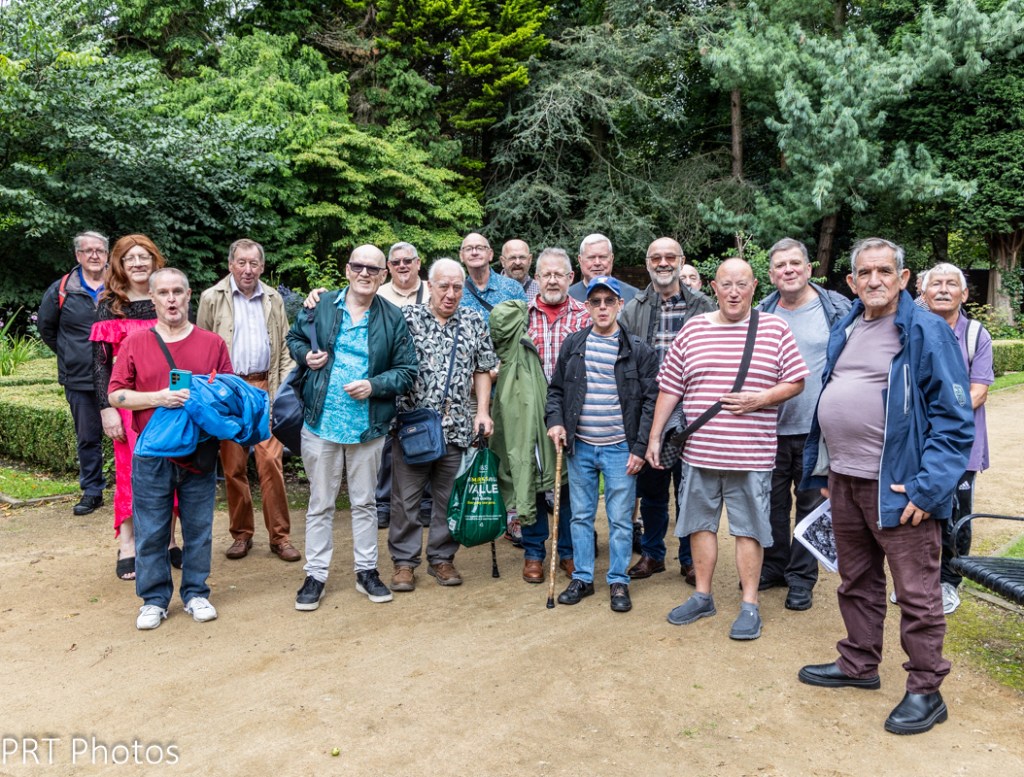
After meeting at Piccadilly Gardens Bus station we travelled to the Great Central pub in Fallowfield.
Many thanks go out to Bruce who lead us on a guided walk around the area passing through the Shakespeare Garden and ending in a walk through Platt Fields Park. His talk was very informative and interesting.
Some great photos can be seen here.

Terrence Higgins honoured with Memorial Quilt
Terry Higgins, the UK’s first named person to die from AIDS-related illnesses, has been honoured with a memorial quilt four decades on from his death.
He passed away at the age of 37 on 4 July 1982, sparking the creation of Terrence Higgins Trust, which is now the country’s leading sexual health and HIV charity.
On 3 August 2023, a memorial quilt paying tribute to him was revealed for the first time at The Festival of Quilts in Birmingham’s NEC.
Making quilts to honour those lost to the AIDS epidemic first became popular in the 1980s and ‘90s to help people grieve those they lost and ensure they are never forgotten.
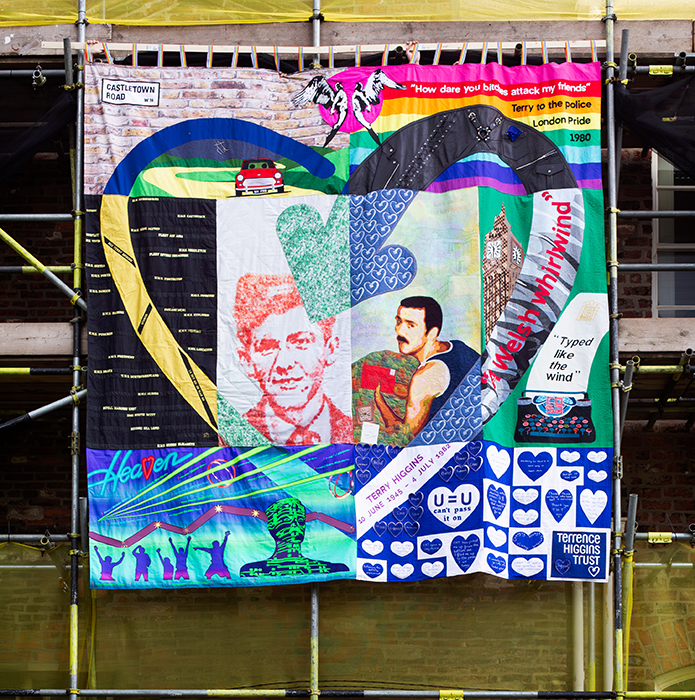
Terrence Higgins Trust worked with The Quilters’ Guild to create the new eight-panel memorial quilt, a project that was overseen by the charity’s co-founders Rupert Whitaker (Terry’s partner) and Martyn Butler, as well as Terry’s close friends Linda Payan and Maxine Saunders.
“It contains a sad, but beautiful, set of memories”
Discussing the significance of the quilt, Whitaker said: “This panel contains images of some of the most meaningful things connected with Terry: my favourite photo of him, his letters to me at uni, some song titles we used to dance to in Heaven, the clock he gave me for Christmas and the note he put in the back of it (which always makes me smile), my grandmother’s cottage in Boscastle where we stayed in the autumn and made crumble from freshly picked blackberries, and where, the following summer, I scattered his ashes in the Valency river nearby.
It contains a sad, but beautiful, set of memories that bring him right back to me. I’m so grateful for the kindness and artistry of Paula, the quilter.”
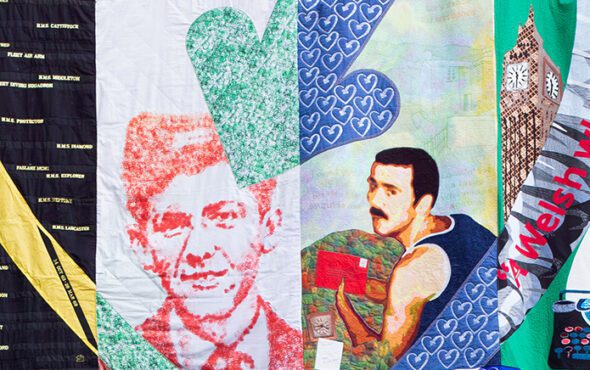
Each panel honours an aspect of Terry’s character, including as a Welshman, gay man and his time in the Royal Navy.
Two of them also explore his working life as a Hansard reporter in Parliament by day and his evenings spent as a barman and DJ in London’s Heaven nightclub.
Service users, volunteers and staff from Terrence Higgins Trust worked together on the final panel, which celebrates the progress made in the fight against HIV and the stigma surrounding it over the last 40 years.
Each panel contains part of the heart motif which is part of the charity’s logo.
“The Terry Higgins Memorial Quilt has surpassed all of our expectations. It is a fittingly stunning tribute to Terry as a friend, lover, Welshman, gay man, activist and to his incredible legacy through our charity Terrence Higgins Trust,” Richard Angell, Chief Executive of Terrence Higgins Trust, said.
“As well as celebrating Terry and the past 40 years, the quilt also celebrates how much progress has been made because of those who acted, including our co-founders Rupert Whitaker and Martyn Butler.
“We stand on their shoulders and today we’re fighting hard to ensure that the UK becomes the first country in the world to end new HIV cases – and, as always, doing so in Terry’s name.”
Lilli Vincenz, early activist in gay rights movement, dies at 85
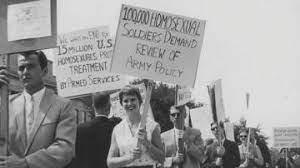
After being outed and discharged from the Women’s Army Corps, she became a central — if long unsung — figure in the struggle for gay equality in the early years of the gay rights movement.
She died 27 June 2023 at a care facility in Oakton, Virginia. She was 85.
Dr Vincenz devoted more than half a century to the cause of gay equality, beginning with her first courageous pickets in Washington in the 1960s and continuing into her later years, when she acted as a keeper of the history that she and other activists had lived.
She knew first hand the slights, injustices and humiliations facing gay and lesbian people. In 1963, while serving in the Women’s Army Corps, she was outed by a roommate and discharged.
The incident spurred her to activism. “Sometime you are the only person who can do something at a certain time,” she told an interviewer. “It’s the old question, ‘If not I, who?’”
In 1963, Dr Vincenz joined the Mattachine Society of Washington, a gay rights organisation co-founded by Frank Kameny, a Harvard-trained astronomer who had been fired from the Army Map Service because of his sexuality.
In 1965, at a time when living openly as a lesbian meant risking discrimination and ostracism, Dr Vincenz marched in what the Library of Congress describes as the first organised picket for gay rights outside the White House. She was the only lesbian among ten demonstrators.
“She was certainly a pioneer in that way,” Lillian Faderman, the author of the book “The Gay Revolution: The Story of the Struggle,” said in an interview. “They couldn’t get another lesbian to show her face.”
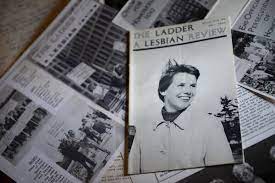
Dr Vincenz became “the first out lesbian ever to appear on a magazine cover that was displayed on newsstands around the country,” according to Faderman, when her radiant smile was showcased on a 1966 cover of the Ladder, a periodical published by the lesbian organisation the Daughters of Bilitis.
Three years later, Dr Vincenz co-founded the gay newspaper that became the Washington Blade. And throughout the 1970s, she hosted regular gatherings at her home in Arlington, Virginia, making it a focus of lesbian life. One regular attendee composed a song:
Come all you women in the DC vicinity
If loving women is your proclivity
Rev up your engine, roll up your bike
And point your wheels to Columbia Pike
Carlyn Springs to 8th Place; turn to the right
For Lilli’s open house on Wednesday night.
Dr Vincenz later became a psychotherapist, with a particular focus in her practice on empowering gay and lesbian people through counselling.
In 2013, the Library of Congress acquired Dr Vincenz’s papers in what to her admirers was a long-awaited recognition of her importance in the gay rights movement.
The collection included, among other artefacts, two 16mm films that she had recorded at early gay rights protests. The first, from 1968, documents one of the “annual reminders” convened in Philadelphia every Independence Day from 1965 to 1969.
Dr Vincenz titled her documentary “The Second Largest Minority” and, in seven minutes of film, recorded demonstrators dressed in business suits and dresses — their attire purposefully coordinated to make the group appear unthreatening — marching in an orderly circle.
The second film, “Gay and Proud”, runs 12 minutes and documents the first gay pride march in New York City, the Christopher Street Liberation Day March of 1970. Galvanised by the Stonewall uprising the previous year, the protesters in New York adopted a markedly more defiant tone.
“The operative word now is ‘pride,’” Mike Mashon, head of the moving image department at the library, wrote in an analysis of the two films, both of which can be viewed on the library’s website.
“It’s one thing to read about how the gay rights movement was catalysed by the Stonewall Inn riots of June 1969, but quite another to see that tonal shift illustrated so vividly in these bookend films,” Mashon continued. “Powerful movements can begin and be sustained in unlikely places, and how fortunate we are that Lilli Vincenz was there to record this one.”
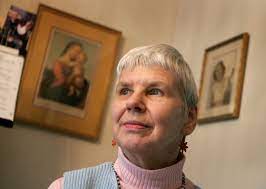
Lilli Marie Vincenz, one of two daughters, was born in Hamburg on 26 September 1937. After her father’s death when she was 2, her mother married an American, and the family immigrated to the United States in 1949. Reflecting on her early life, Dr Vincenz told an interviewer that it “became painful after a while to realise that I was gay and I didn’t know anyone else who was gay. I was extremely lonely.”
With an affinity for literature, Dr Vincenz received a bachelor’s degree in French and German from Douglass College, part of Rutgers University in New Jersey, in 1959. She received a master’s degree in English and comparative literature from Columbia University the following year.
During that period in her life, she began exploring her sexuality and visited a lesbian bar in Provincetown, Massachusetts.
“At first I thought of all the consequences that could follow me from my being seen there,” she wrote in her journal. “But then I thought of all I’d gone through in these past years, and I knew I had to go — no matter what the consequences — for the sake of the past, of the pain, but also for the wishes I’d had, time and time again proclaimed to be willing, if only I had the chance. Now, I can fulfil everything. Well, that’s saying too much — I can fulfil something.”
She worked briefly as an editor at the Prentice Hall publishing house before joining the Women’s Army Corps in 1962. She was working at Walter Reed, the military hospital near Washington, when she was discharged the following year.
Dr Vincenz was one of the first lesbian members of the Mattachine Society of Washington. She joined its executive board and was the editor of its publication the Homosexual Citizen. In addition to the picket at the White House, the group mounted demonstrations outside the Pentagon, the State Department and the US Civil Service Commission.
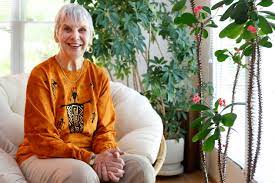
“It was so important that we become visible,” Dr Vincenz said, “because we weren’t really visible before.”
As she moved toward her career as therapist, Dr Vincenz received a master’s degree in psychology from George Mason University in 1976. She received a PhD in human development education from the University of Maryland in 1990.
Of her gay clients, she observed that “many of their wounds have been sustained in the pursuit of and validation of who they are and of not wanting to hide their identity or settle for less. I am grateful to be able to help and to witness their empowerment and healing.”
Dr Vincenz’s partner of 32 years, Nancy Ruth Davis, died in 2019. She had no immediate survivors.
“What did I want to accomplish?” Dr Vincenz told the publication Gay Today, reflecting on her life’s work. “Be with gay people, help the movement, help unmask the lies being told about us, correct the notion of homosexuality as a sickness and present it as it is, a beautiful way to love.”

There are four Prides in the Greater Manchester area on 12 August: Levenshulme, Prestwich, Wigan and the first ever Trans Pride:
Levenshulme Pride
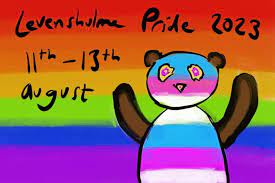
Levenshulme Pride is back on 11 – 13 August for another amazing weekend of FREE events and activities.
Levenshulme Pride started in 2017. They have established themselves as the largest free local Pride in Manchester outside the city centre. Open, inclusive, free and fabulous!
Origin story
Levenshulme Pride was started because a couple walking down the A6 holding hands were called “faggots”. In an instant a pleasant walk in the sunshine became a homophobic hate crime. Just like that. Very casual. No big deal. Except we think it is a big deal!
There was a discussion online where people were both appalled and supportive. What could be done? Well, Levenshulme Pride is what could be done. Levenshulme is a diverse, supportive, energetic and wonderful place to live but it faces challenges.
What better way to counteract hatred than to show the pride we have in our community, the pride we have as LGBT+ people, the pride we have as we come together as a community to celebrate the variety of people living here and the strength that comes from that?
The response to the suggestion of having Levenshulme Pride was amazing and immediate. The enthusiasm has been infectious and empowering. We started from nothing but we made something wonderful happen.
Who is Levenshulme Pride for?
Everybody. Levenshulme Pride will be an opportunity for LGBT people in Levenshulme and beyond to come together and celebrate being part of the great community of Levenshulme. It is a truly open and inclusive event. We welcome any and all people, community groups and businesses to show support for and become part of Levenshulme Pride. We are a People’s Pride.
Levenshulme Pride: No Barriers
Prestwich Pride
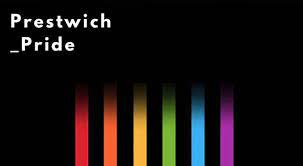
Prestwich will be holding its second Pride event over the weekend of 12 – 14 August.
The events are across a number of sites including bars Wine & Wallop, Cuckoo and The Goods In.
The line up includes a family event “Born To Be Wild Child” as well as performances from drag queens such as Miss Blair and Val the Brown Queen and DJ performances from Manchester’s revered LGBT+ scene, including Jase Jeffrey, Mix Stress and Antoin. Panama Hatty’s is hosting their much-loved drag brunch on Sunday 13 August.

Wigan Pride
Wigan Pride promotes and celebrates equality and diversity by bringing together arts, music, a street parade and positive messages at a big annual event in Wigan. Wigan Pride takes place on Saturday 12 August 2023.
Retrieve your rainbows, raid your closet for something pink, white or blue, and get ready to have your say in style: Wigan Pride is back for 2023.
The Wigan Council backed summer event will return with a celebration of Northern music to the town centre.
Organisers also plan to acknowledge the role both Pride events and people from the region have played as pioneers of social change with a street parade, guest speakers and a competition designed to get young people thinking about their rights and responsibilities.
For the last few years, each Wigan Pride event has celebrated a different colour from the Pride flag, which each has its own meaning. In 2023, guests will be invited to dress in shades of pink and blue, inspired by the transgender flag, alongside the usual splash of rainbows.
As well as offering a fantastic day of entertainment for the whole family, Wigan Pride also helps remind our local community that equal rights are often hard won and should not be taken for granted. Celebrating equality helps us to value the importance of it and make sure that it continues.
Wigan Pride includes people of every race and faith, whether disabled or able-bodied, and all sexualities and genders including lesbian, gay, bisexual, asexual, queer, questioning, intersex, trans, genderqueer, gender variant or non-binary as well as straight and cis allies.
Trans Pride
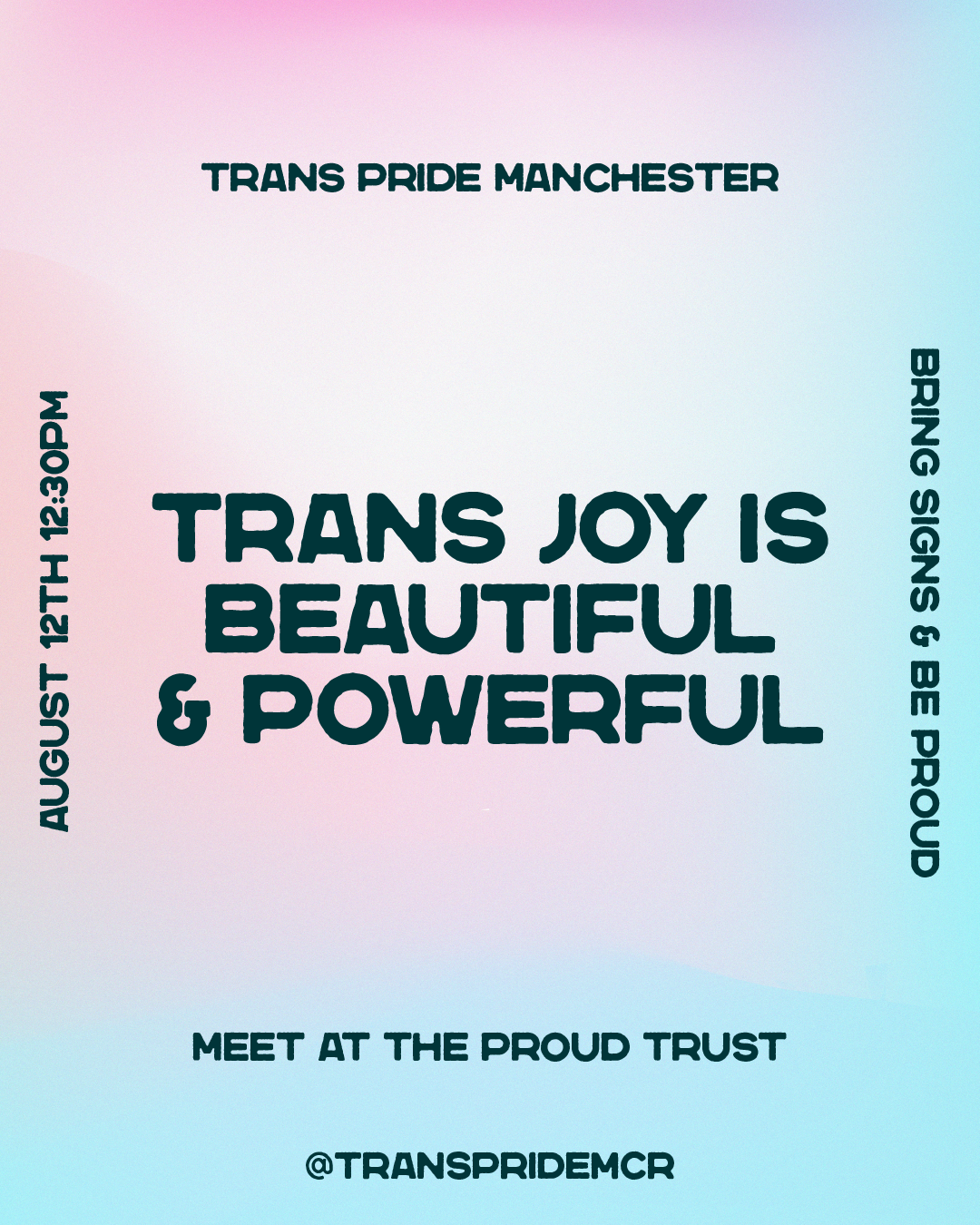
Join us for the first ever Trans Pride event in Manchester on the 12 August 2023.
Trans Pride Manchester is dedicated to supporting, advocating for and celebrating the transgender and non-binary community in the Greater Manchester area.
We aim to create safe spaces, empower individuals and promote education and awareness about the diverse experiences of gender identity.
What’s happening?
The programme for the day is:
12:00pm | Meet at The Proud Place
Meet at The Proud Place (49-51 Sidney Street, Manchester M1 7HB) for a 1:00pm start of the Protest March through the city centre.
13:00-14:00pm | Protest March
We will set off at 1:00pm. Bring signs, be proud and celebrate.
15:00-16:15 | Panel Event at Feel Good Club
A panel event of wonderfully queer and trans humans discussing their journey, things they wish someone told them and also discussing all things gender euphoria and dysphoria. This is being held at Feel Good Club (26-28 Hilton Street, Manchester M1 2EH).
16:30-18:00 | Open Mic at Feel Good Club
Celebrate and amplify the vibrant voices of the trans community at Feel Good Club’s open mic event for Trans Pride! Performances will include singing, spoken word, poetry, comedy etc.
15:00-18:00 | Workshops at The Proud Place
There will be a series of workshops from self care, to binder measuring, changing your name and many more things!
 Out in the City