
Bury
We met up at Bury Tram Interchange and headed to Tina’s Tea Rooms located in Bury Art Museum. This is one of my favourite places – the staff are friendly, the food is gorgeous and it’s a lovely unusual setting.


We crossed over the road to the Fusilier’s Museum where in Olive’s Kitchen Café Bar upstairs there was a small exhibition of photos by Ian Hargreaves.
On display were a number of portraits and a few scenic photographs, but they were difficult to view due to the customers in the cafe. A number of us then visited the famous Bury Market where you can buy anything from ice cube trays to black puddings.

Sexual Offences Act 1967
The Sexual Offences Act 1967 is an Act of Parliament which legalised homosexual acts in England and Wales, on the condition that they were consensual, in private and between two men who had attained the age of 21. It became law 56 years ago.
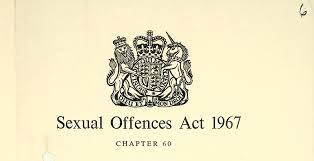
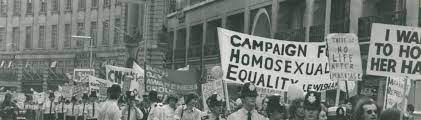
Homosexual activity between men had been illegal for centuries. There was never an explicit ban on homosexual activity between women. In the 1950s, there was an increase of prosecutions against homosexual men and several well-known figures had been convicted. The government set up a committee led by John Wolfenden to consider the laws on homosexuality.
In 1957, the committee published the Wolfenden report, which recommended the decriminalisation of homosexual activity between men above the age of 21. The position was summarised by the committee as follows: “unless a deliberate attempt be made by society through the agency of the law to equate the sphere of crime with that of sin, there must remain a realm of private that is in brief, not the law’s business”. However, the government of Harold Macmillan did not act upon its recommendations, due to fears of public backlash.
In 1965, several politicians sponsored a Sexual Offences Bill, a private member’s bill which drew heavily upon the findings of the Wolfenden report. The key sponsors were Humphry Berkeley, a Conservative MP, Leo Abse, a Labour MP, and Lord Arran, a Conservative peer. By that year, public opinion had shifted in favour. A 1965 opinion poll commissioned by the Daily Mail found that 63% of respondents did not believe that homosexuality should be a crime while only 36% agreed it should, even though 93% agreed that homosexual men were “in need of medical or psychiatric treatment”.
The Sexual Offences (No 2) Bill received royal assent on 27 July 1967, becoming the Sexual Offences Act 1967.
Voice Study: Bisexual Men Sound The Most Masculine

Research published in the Journal of Sex Research aimed to determine whether listeners could detect if a man is bisexual from his voice alone. The findings indicate that people are not able to determine if a man identifies as bisexual based on his voice alone. Additionally, when people listened to the voices of gay, straight, and bisexual men, they perceived the bisexual men as the most masculine among all the speakers they heard.
Previous research has identified specific voice characteristics that are often associated with gay men. These characteristics include higher pitch, wider pitch range, longer vowels, expanded vowel space, and more precise pronunciation. The study’s results suggest that the perceptual voice and speech features that allow listeners to identify gay men’s voices may not be present in bisexual men’s voices.
Good news for people living with HIV & their sexual partners
A host of health organisations acknowledge that undetectable means untransmittable (U=U). This means if someone has HIV but is on treatment and undetectable, there is zero risk of them passing it on.
The World Health Organisation just reaffirmed this message … but goes even further.
WHO released a policy brief to coincide with the International AIDS Society Conference on HIV Science in Brisbane, Australia. The brief not only states there is zero risk of transmission if someone has an undetectable viral load. It goes on to say that people with a suppressed but detectable viral load “have almost zero or negligible risk” of sexual transmission.
What does “suppressed but detectable” mean?
The WHO policy brief states, “There are three key categories for HIV viral load measurements:
unsuppressed (more than 1,000 copies/mL);
suppressed (detected but less than 1,000 copies/mL); and
undetectable (viral load not detected by the test used).”
We know that those with an undetectable viral load cannot pass on the virus. The Lancet posted a systematic review about the risk of transmission in those with “low-level” viral loads. That’s a viral load under 1,000.
The studies analysed included 7,762 sero-discordant couples across 25 countries. They identified two cases of HIV transmission when the HIV-positive partner had a viral load between 200-1,000. Most cases of transmission occurred when the HIV-positive person had a viral load above 10,000.
In those two cases identified, 50 days or more had elapsed between the viral load test and the transmission. Therefore, their viral load may have been different at the time of transmission.
The authors concluded, “There is almost zero risk of sexual transmission of HIV with viral loads of less than 1,000 copies per mL. These data provide a powerful opportunity to destigmatise HIV and promote adherence to antiretroviral therapy.”
The World Health Organisation supports this message. It states, “People living with HIV who have an undetectable viral load … have zero risk of transmitting HIV to their sexual partner(s).” It continues, “People living with HIV who have a suppressed but detectable viral load and are taking medication as prescribed have almost zero or negligible risk of transmitting HIV to their sexual partner(s).”
That will be reassuring to many sero-discordant couples who might worry about small rises in viral load. Even if you’re not undetectable but have less than 1,000 viral copies per milliliter, the chance of transmission is “zero or negligible”.
HIV treatment is recognised as one of the main reasons why HIV transmission rates are falling around the world. UNAIDS is encouraging all countries to reduce HIV transmission by 90% by 2030 (compared to 2010 figures). Some countries in Western Europe, including the UK, are on course to hit this target.
 Out in the City