LGB Alliance Decision
With trans youth charity Mermaids – supported by several other LGBT+ organisations – questioning the Charity Commission’s decision to register LGB Alliance as a charity, the group for the first time had to legally defend the work it does, or doesn’t do, to actually improve the equality and human rights of LGB people.
After a hearing lasting five days in September 2022 and two further days in November 2022, the long awaited judgement was received on 6 July 2023.
The judgement of Mermaids v Charity Commission & LGB Alliance ruled that the case had been dismissed on the grounds that Mermaids did not have the legal right to challenge LGBA‘s charity status.
The LGB Alliance are now claiming to have won the case! They tweeted: “We are delighted that the tribunal found in our favour …”. The truth is the judges did not find in favour of the LGB Alliance. They only kept their charity status on a technicality that Mermaids couldn’t bring their case. Not a win at all.
The judges also castigated the Alliance for its abusive behaviour online.
Statement from LGBT Consortium:
Consortium are disappointed to learn that the appeal was dismissed on the grounds of legal standing. Although the judges were invited to indicate what their decision would have been on broader issues, they have chosen not to do so.
We are proud to have supported Mermaids and the Good Law Project throughout this appeal and firmly believe that charitable status should be reserved for those organisations that work towards a more inclusive society.
Paul Roberts, Consortium’s Chief Executive said, “We maintain that the LGB Alliance’s practice are fundamentally incompatible with the Charity Commission’s guidelines on how charities should provide a public benefit. We will continue to support our members across the LGBT+ sector to work for a more inclusive society, and not one that seeks to divide and spread misinformation.”
Consortium is committed to fighting for equity, inclusivity and defending the rights of all LGBT+ organisations through our work, especially those who face the greatest marginalisation and hostility.
LGBT+ communities across the UK face an onslaught of misinformation and attacks in the mainstream press, in politics and on social media. Trans (including nonbinary and gender diverse) people are entitled, like everyone else, to support and understanding. Our LGBT+ communities will not be divided. We oppose transphobia in all its forms. We stand together.
Statement from Mermaids
Statement from Good Law Project
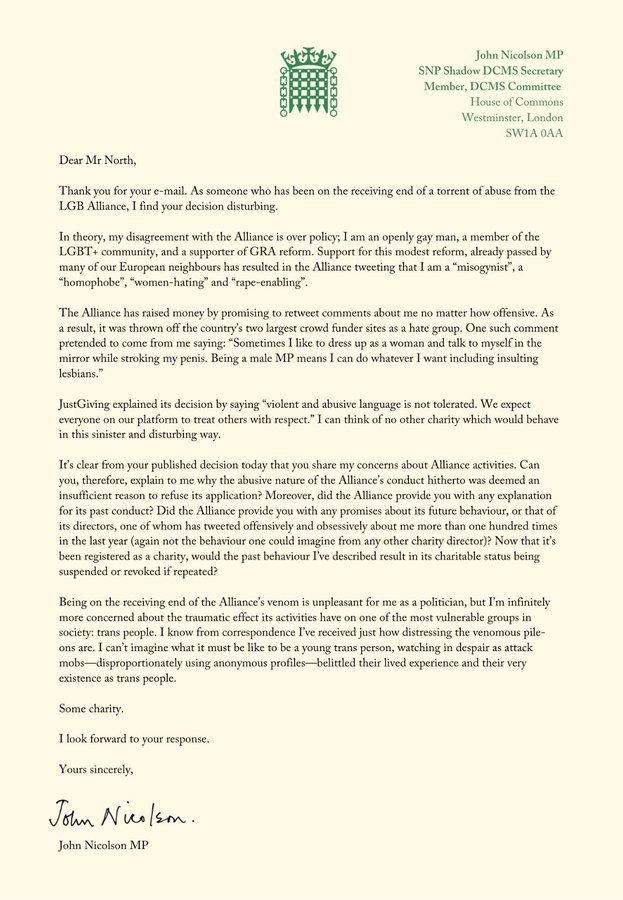
Letter from John Nicolson MP:
The judgement of Mermaids v Charity Commission & LGB Alliance dated 6 July 2023

Charity Commission’s Response
I was going to include the LGB Alliance statement but it is misleading and untrue.
Trans people’s lives are not up for debate. But debates on trans rights do happen and too often they are dominated by people who aren’t trans themselves, giving credence to perspectives that are not informed by personal experience, expertise or knowledge.
So instead of listening to those that seem determined to taint their legacy by opposing progress, we should be elevating the voices of those that don’t get heard, and those that are truly being silenced.

Gay love letters from the 1920s kept in the UK National Archives
In November 1920 the youthful Ernest (Ernie) Smyth was arrested. At 22 years old he worked as a clerk in Belfast, describing himself as 5’5” in height, of medium build, about 26” waist, with dark hair and blue eyes. He had an interest in art and literature, he loved the Pre-Raphaelites and Oscar Wilde, but ‘abhorred ragtime jazz’.
Why was this young railway clerk arrested?
Found in his possession were hundreds of letters. Problematically for him these letters were between himself and many other men – ‘sodomites’, as the police file termed them. These letters provided criminal evidence of Ernie’s relationships with other men in a time when the law essentially criminalised their love.
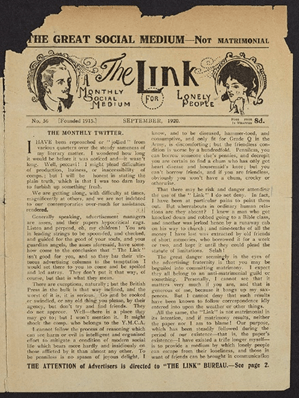
These men from all over the country had supposedly got in contact with Ernie through their classified adverts in The Link, a lonely hearts-style publication from the 1920s. In October 1920 Ernie had placed a personal advertisement in The Link, containing just the following words:
‘Youth (Ireland) 18 fond of music etc, literature well educated, refined, desires sincere friend, own sex. Any age to 35, all letters answered. Box No’
In his allocated 25 words Ernie had dropped in certain words, phrases and hints: ‘music’, ‘literature’, ‘sincere friend’ and most significantly, ‘own sex’. These words would serve both as a signal of his desire to meet other men, but also ultimately to incriminate him.
Through The Link Ernie had been able to meet many men. Indeed, the 200 letters found on him signal a substantial network, which seemed surprising for 1920s Britain.
‘What you desire in the way of a chum is also my own desire’
We can follow his relationship with one of these individuals pretty closely: Geoffrey (Geof) Smith, an ex-serviceman from Enfield. Because of Geof’s proximity to London, the Metropolitan Police requested that the Belfast Police send Ernie’s and Geof’s correspondence to the Met, which leads to these letters’ survival in the UK National Archives collections.

They appear to have initiated contact on 12 September 1920 when Geof wrote to Ernie, saying, ‘I feel sure we would be able to become excellent friends’.
The letters sent between them over a number of months provide a picture of their friendship and relationship. The Link and subsequent letters gave them a chance to correspond, despite the distance between Enfield and Belfast.
Through their vivid and open correspondence we can see that Ernie and Geof pursued a relationship, although whether they were ever able to actually meet is unclear. The intention, however, is clear. Geof writes longingly: ‘May the time (soon) come, Ernie, when we can meet and allow our sensuality to have full swing with each other’. On 2 October 1920 the correspondence continued: ‘I am longing to revel in the joys of your naked body.’
They talk about their fondness for each other and their mutual attraction. However, the letters also recount their sexual dalliances with other men, in what appears to be a competitive attempt to make each other jealous.
‘I cannot understand…’
In a particularly telling line Geof talks openly about his frustrations of the law:
‘I cannot understand why it should be considered a criminal offence for two people of the same sex, who are fond of each other & mutually agreed, to commit sodomy.’

It would take a further 40 years for the State to partially decriminalise homosexual acts. Essentially 22-year-old Ernie would have lived the majority of his life having to hide his sexuality from the law and wider society.
These letters now provide a remarkable and rare insight into LGBT+ lives in the 1920s; they tell a story of love, but also of criminalisation.
The consequences
Ultimately Ernie and Geof were arrested, as well as the self-styled bohemian Walter Birks, who had also met men through The Link. In a particularly incriminating letter he had written, ‘All my love is for my own sex and I am very affectionate’. All three men were arrested under the charge of conspiring to commit ‘gross indecency’.
One further individual was arrested – Walter Barrett, the proprietor of The Link himself, on the charge of aiding and abetting his advertisers, conspiring to enable the commission of such unnatural acts. All were tried at the Central Criminal Court, the Old Bailey.
At the trial Barrett himself claimed The Link was intended for decent people, and was used by decent people: ‘The other sort is not desired’. He admitted he had been careless – not realised people’s ‘true character’. Clearly the police saw differently.
Each was charged and received two years’ imprisonment with hard labour at Wormwood Scrubs.
Despite a successful life as an author and publisher, this proved to be Barrett’s downfall. The Link ceased to exist.
There is no clear evidence that Ernie and Geof ever met again.
One hundred years on, people still instinctively crave ways to meet other people, whether it is through online dating apps or classified advertisements. The stories of people in The Link reflect themes that are still current and topical among the LGBT+ community: the need for LGBT+ spaces (physical and written), the loneliness and isolation that comes from a lack of social acceptance, and the instinctive desire to love and be loved.
In one particular letter Geof comments that ‘I think the “Link” and the UCC (thought to refer to the Universal Correspondence Club) are about the only ways I know about to become acquainted with people like ourselves’. What an extraordinary publication The Link was, enabling people to meet and love despite the law.
Forthcoming Pride Events
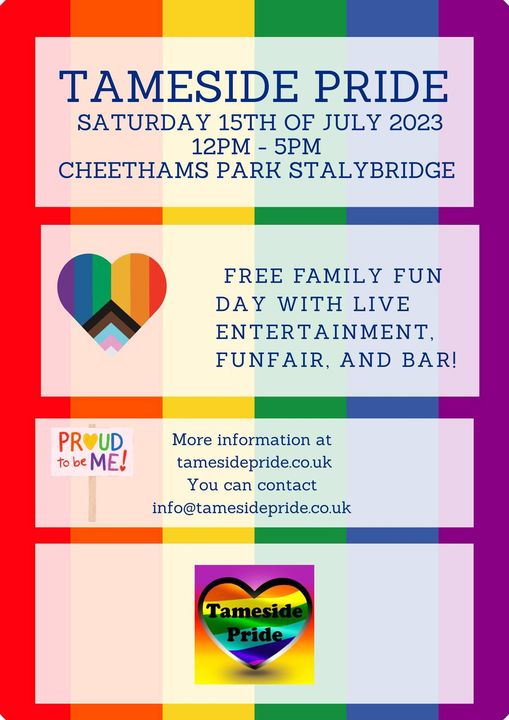
Welcome to Tameside Pride
The day-time free-to-all event will be held in Cheetham’s Park, Stalybridge from 12.00 noon to 5.00pm on Saturday 15 July. There will be a market with stalls from a range of LGBT+ supportive organisations, a big stage with acts throughout the afternoon, a kids playground, and a food / refreshment area.
Rochdale in Rainbows
Back again this year, Rochdale in Rainbows is excited to present the second Pride in the Park! The free event will be held in Broadfield Park from 12.00 noon to 5.00pm on Sunday 16 July.
Join in an afternoon filled with queer joy, family fun, performances and creative and wellbeing activities for LGBTQIA+ communities and allies. There will also be stalls from local organisations, groups and charities in Rochdale Borough.
 Out in the City